
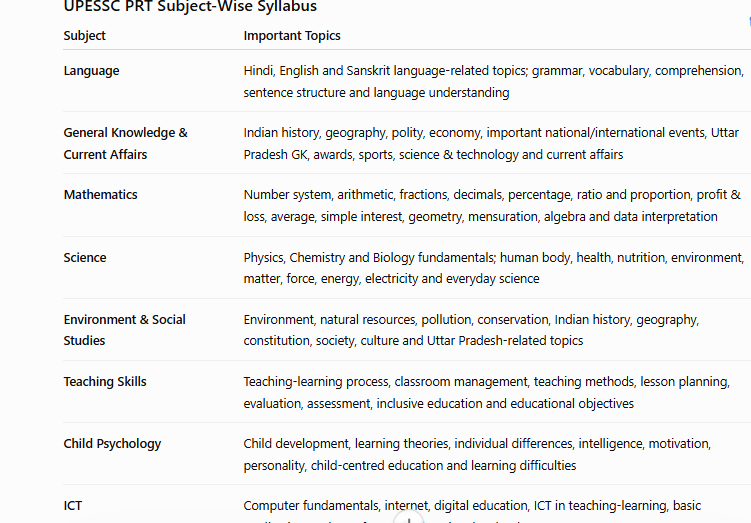
The Uttar Pradesh Education Service Selection Commission (UPESSC) has released the UPESSC PRT Assistant Teacher Syllabus 2026 for candidates preparing for the Primary Assistant Teacher recruitment examination. The syllabus is particularly important this year because the examination pattern has been updated, and candidates preparing with an older Super TET pattern may end up following the wrong question distribution.
The UPESSC Primary Assistant Teacher examination is meant for teaching at the primary level, Classes 1 to 5. The updated written examination consists of 120 objective-type questions, with each question carrying 3 marks. Candidates will get 120 minutes to complete the paper, while 1 mark is deducted for every incorrect answer.
In this article, candidates can check the complete UPESSC PRT syllabus, subject-wise topics, exam pattern, marking scheme and a practical preparation strategy.
UPESSC PRT Assistant Teacher Syllabus 2026: Overview
| Particulars | Details |
|---|---|
| Exam Conducting Body | Uttar Pradesh Education Service Selection Commission (UPESSC) |
| Post | Primary Assistant Teacher (PRT) |
| Teaching Level | Classes 1 to 5 |
| Exam Year | 2026 |
| Question Type | Multiple Choice Questions |
| Total Questions | 120 |
| Total Marks | 360 |
| Duration | 120 Minutes |
| Marks for Correct Answer | +3 |
| Negative Marking | 1 mark for each wrong answer |
| Exam Mode | Objective/OMR-based examination |
| Official Website | upessc.up.gov.in |
The revised pattern reported for the 2026 primary teacher recruitment contains 120 questions carrying 360 marks in total.
UPESSC PRT Exam Pattern 2026
Understanding the exam pattern should be the first step before opening the books. It tells candidates how much time they can spend on each question and which areas need more attention.
The UPESSC PRT Assistant Teacher written examination 2026 will contain 120 multiple-choice questions. Each question will carry three marks.
UPESSC PRT Exam Pattern
| Exam Feature | Details |
|---|---|
| Total Questions | 120 |
| Maximum Marks | 360 |
| Exam Duration | 2 Hours |
| Question Type | MCQ |
| Marks per Question | 3 |
| Negative Marking | 1 mark |
| Level | Primary Teacher |
| Classes Covered | 1 to 5 |
The 1-mark negative marking makes accuracy important. A candidate who attempts too many questions without checking the options carefully can lose marks even after making a reasonable number of attempts.
UPESSC PRT Assistant Teacher Syllabus 2026
The primary teacher syllabus covers a fairly broad range of areas. It is not limited to Mathematics, Hindi and English. Candidates also need to prepare topics related to teaching skills, child psychology, science, environmental studies, reasoning, information technology and general knowledge.
The major areas reported under the primary syllabus include:
- General Knowledge
- Reasoning
- Languages
- Science
- Mathematics
- Environmental Studies and Social Studies
- Teaching Skills
- Child Psychology
- Information Technology
- Life Skills, Management and Attitude
These areas are important because the PRT examination is designed to assess both general knowledge and the academic and teaching abilities required at the primary-school level.
General Knowledge
The General Knowledge section tests a candidate’s awareness of important events and basic facts related to India and Uttar Pradesh.
Candidates should cover topics such as:
- Current affairs
- Important national and international events
- Indian history
- Indian geography
- Indian polity
- Indian economy
- Uttar Pradesh GK
- Important personalities
- Awards and honours
- Sports
- Books and authors
- Important days
- Government schemes
- National symbols
- Basic science and technology
- Important institutions
- Culture and heritage
Uttar Pradesh GK
Since the recruitment is conducted for teaching posts in Uttar Pradesh, candidates should not ignore state-specific knowledge.
Prepare:
- History of Uttar Pradesh
- Geography of Uttar Pradesh
- Rivers and irrigation projects
- Important cities and districts
- Agriculture
- Industries
- Folk dances and festivals
- Important historical places
- State government schemes
- Important personalities from Uttar Pradesh
- Education-related developments in the state
Reasoning Ability
The reasoning section checks basic logical and analytical ability.
Important topics include:
- Analogy
- Classification
- Number series
- Alphabet series
- Coding-decoding
- Blood relations
- Direction sense
- Ranking and order
- Venn diagrams
- Syllogism
- Mathematical reasoning
- Missing numbers
- Statement-based questions
- Non-verbal reasoning
- Odd one out
- Puzzle-based questions
The difficulty is generally expected to remain around the level suitable for a teacher recruitment examination. Candidates should focus more on accuracy and speed than on solving extremely complicated reasoning questions.
Language
Language preparation is an important part of the PRT syllabus because a primary teacher needs strong communication skills.
Candidates should prepare the prescribed language areas carefully.
Hindi
Important Hindi topics may include:
- वर्णमाला
- संधि
- समास
- उपसर्ग एवं प्रत्यय
- पर्यायवाची शब्द
- विलोम शब्द
- अनेक शब्दों के लिए एक शब्द
- मुहावरे और लोकोक्तियां
- वाक्य शुद्धि
- शब्द शुद्धि
- लिंग
- वचन
- काल
- कारक
- रस
- अलंकार
- गद्य एवं पद्य comprehension
- भाषा शिक्षण से जुड़े सामान्य प्रश्न
English
Candidates preparing the English portion should revise:
- Parts of speech
- Noun
- Pronoun
- Verb
- Adjective
- Adverb
- Preposition
- Conjunction
- Articles
- Tenses
- Active and passive voice
- Direct and indirect speech
- Synonyms
- Antonyms
- One-word substitution
- Vocabulary
- Sentence correction
- Fill in the blanks
- Reading comprehension
Mathematics
Mathematics is one of the core areas for a primary teacher. Questions can test both mathematical concepts and the ability to understand elementary mathematics.
Important topics include:
- Number system
- Whole numbers
- Integers
- Fractions
- Decimals
- LCM and HCF
- Simplification
- Percentage
- Ratio and proportion
- Average
- Profit and loss
- Simple interest
- Time and work
- Time, speed and distance
- Basic geometry
- Mensuration
- Data handling
- Measurement
- Basic algebra
- Patterns
- Mathematical reasoning
Candidates should also revise basic concepts taught at the primary-school level instead of preparing only from competitive-exam books.
Science
The Science portion focuses mainly on basic concepts that a primary teacher should understand.
Important areas include:
- Living and non-living things
- Plants
- Animals
- Human body
- Food and nutrition
- Diseases and prevention
- Health and hygiene
- Water
- Air
- Environment
- Matter
- Force and motion
- Energy
- Light
- Sound
- Electricity
- Natural resources
- Pollution
- Everyday science
While studying science, candidates should connect concepts with daily-life examples. This makes it easier to solve conceptual questions.
Environmental Studies and Social Studies
Environmental Studies is particularly relevant at the primary level because children learn about their surroundings through EVS.
Environmental Studies
Prepare topics such as:
- Family and relationships
- Food
- Water
- Shelter
- Travel
- Plants
- Animals
- Human body
- Health and hygiene
- Environment
- Natural resources
- Pollution
- Community
- Occupations
- Local surroundings
- Conservation
Social Studies
Candidates should revise:
- Indian history
- Indian geography
- Indian Constitution
- Government
- Local administration
- Panchayati Raj
- Rights and duties
- Democracy
- Diversity
- Society and culture
- Uttar Pradesh-related social and geographical topics
Teaching Skills
This is one of the sections that candidates should take seriously because the examination is for a teaching post.
Important areas include:
- Teaching-learning process
- Classroom management
- Teaching methods
- Lesson planning
- Learning objectives
- Assessment and evaluation
- Teaching aids
- Individual differences
- Inclusive education
- Learning difficulties
- Remedial teaching
- Child-centred education
- Activity-based learning
- Role of teacher
- Classroom communication
- Motivation
- Continuous assessment
A candidate should understand not only what a teaching method is but also when and why it should be used in a classroom.
Child Psychology
Child Psychology is another important area for PRT candidates.
Questions may be related to:
- Child development
- Physical development
- Cognitive development
- Emotional development
- Social development
- Individual differences
- Intelligence
- Learning
- Motivation
- Personality
- Behaviour
- Learning difficulties
- Child-centred education
- Inclusive education
- Children with special needs
- Classroom behaviour
- Role of family and environment
Candidates should pay attention to the relationship between child development and learning.
For example, a child who learns at a different pace should not automatically be considered weak. A teacher needs to identify the learning gap and select an appropriate teaching approach.
Information Technology
Basic Information Technology knowledge is also included in the primary teacher syllabus.
Candidates should revise:
- Computer fundamentals
- Hardware and software
- Operating systems
- Internet
- Networking basics
- Digital learning
- Online education
- Cyber safety
- Digital resources
- Educational technology
- Basic MS Office concepts
- ICT in education
The focus should be on practical knowledge rather than advanced computer programming.
Life Skills, Management, and Attitude
This part of the syllabus is related to behavioural and professional qualities that are useful for teachers.
Important topics include:
- Communication skills
- Leadership
- Teamwork
- Decision-making
- Problem-solving
- Time management
- Stress management
- Emotional intelligence
- Professional ethics
- Positive attitude
- Classroom discipline
- Responsibility
- Social awareness
- Adaptability
- Conflict management
A teacher deals with children, parents, colleagues and school authorities, so these areas have practical importance beyond the examination itself.
UPESSC PRT Syllabus 2026: How to Prepare
The syllabus may look lengthy at first, but it becomes manageable when divided into small sections.
Step 1: Understand the complete syllabus
Do not start preparation randomly. Make a list of all the subjects and topics and tick them off as you complete them.
Step 2: Start with your strong areas
Begin with subjects where you already have a good foundation. This helps build confidence and allows you to reserve more time for difficult areas.
Step 3: Give special attention to Child Psychology and Teaching
Many candidates spend most of their preparation time on Mathematics and General Knowledge. For a teaching examination, however, pedagogy, child psychology and teaching-related concepts deserve dedicated study time.
Step 4: Revise basic concepts
For PRT preparation, basic concepts are extremely important. NCERT-level material can be useful for understanding elementary Mathematics, EVS and Science concepts.
Step 5: Practise MCQs regularly
After completing a topic, solve questions immediately. This helps identify whether you actually understand the concept or have simply memorised it.
Step 6: Take full-length mock tests
Once you have covered most of the syllabus, start taking complete mock tests within the actual time limit of 120 minutes.
Because the exam includes negative marking, analyse incorrect answers after every mock test.
UPESSC PRT Preparation Strategy
A simple daily routine can make preparation more consistent.
| Study Area | Suggested Daily Time |
|---|---|
| Mathematics | 60 minutes |
| Language | 45 minutes |
| Child Psychology/Pedagogy | 60 minutes |
| EVS/Science | 45 minutes |
| GK & Current Affairs | 30 minutes |
| Reasoning | 30 minutes |
| Mock/Practice Questions | 45 minutes |
| Revision | 30 minutes |
The exact schedule can be changed according to your strengths and weaknesses. The important thing is to maintain regular revision.
How to Attempt the UPESSC PRT Paper
The revised examination has negative marking, so candidates should avoid blind guessing.
A practical approach is:
First round: Attempt questions that are immediately clear.
Second round: Return to questions requiring some calculation or thinking.
Third round: Attempt doubtful questions only when you can eliminate one or more options with reasonable confidence.
Do not spend several minutes on one question. With 120 questions to be completed in 120 minutes, candidates have an average of roughly one minute per question.
UPESSC PRT Important Books
Candidates do not necessarily need a huge collection of books. A small number of reliable resources, combined with regular practice, is generally more useful.
Some useful categories of study material are:
- NCERT books for Classes 1 to 5
- Hindi grammar book
- English grammar book
- General Knowledge book
- Uttar Pradesh GK book
- Child Development and Pedagogy book
- Reasoning practice book
- Previous-year teacher recruitment papers
- Current affairs notes
- UPESSC syllabus and official notices
Before buying a book, candidates should check whether it follows the 2026 syllabus.
UPESSC PRT Assistant Teacher Syllabus 2026: Previous Papers
Previous papers are useful because they show the style and level of questions asked in competitive examinations.
While solving previous papers, do not simply check the score. Maintain a small error notebook containing:
- Questions answered incorrectly
- Questions left unanswered
- Concepts that caused confusion
- Questions taking too much time
- Frequently repeated topics
Revising this notebook before the examination can be surprisingly effective.
UPESSC PRT Assistant Teacher Exam Key Points to Remember
Candidates preparing for the examination should remember the following:
- The PRT examination is meant for the primary level.
- The updated written examination has 120 questions.
- The paper carries 360 marks.
- Each correct answer carries 3 marks.
- There is 1-mark negative marking for an incorrect response.
- The examination duration is 120 minutes.
- The syllabus covers academic subjects as well as teaching-related areas.
- Child Psychology and Teaching Skills should not be ignored.
- Mathematics, Language, Science and EVS require regular practice.
- Current affairs and Uttar Pradesh GK should be revised regularly.
- Candidates should use the latest UPESSC syllabus rather than relying on an older Super TET pattern.
The updated structure has been reported by multiple education sources following the syllabus release by UPESSC.
UP PRT Assistant Teacher Syllabus 2026 in Hindi
1. सामान्य ज्ञान एवं करंट अफेयर्स
इस भाग में राष्ट्रीय और उत्तर प्रदेश से संबंधित सामान्य ज्ञान के साथ समसामयिक घटनाओं पर प्रश्न पूछे जा सकते हैं।
मुख्य टॉपिक्स:
- भारत का इतिहास
- भारतीय भूगोल
- भारतीय संविधान
- भारतीय राजव्यवस्था
- भारतीय अर्थव्यवस्था
- उत्तर प्रदेश का सामान्य ज्ञान
- उत्तर प्रदेश का इतिहास एवं संस्कृति
- महत्वपूर्ण दिवस
- राष्ट्रीय एवं अंतरराष्ट्रीय घटनाएं
- पुरस्कार एवं सम्मान
- खेलकूद
- महत्वपूर्ण व्यक्ति
- विज्ञान एवं तकनीक
- सरकारी योजनाएं
- शिक्षा से संबंधित समसामयिक घटनाएं
- करेंट अफेयर्स
2. भाषा
भाषा खंड में हिंदी तथा अन्य निर्धारित भाषा-संबंधी ज्ञान का परीक्षण किया जाएगा।
हिंदी के महत्वपूर्ण टॉपिक्स:
- वर्ण एवं शब्द
- संधि
- समास
- उपसर्ग एवं प्रत्यय
- पर्यायवाची शब्द
- विलोम शब्द
- अनेकार्थी शब्द
- तत्सम एवं तद्भव
- मुहावरे एवं लोकोक्तियां
- वाक्य शुद्धि
- शब्द शुद्धि
- रस
- छंद
- अलंकार
- गद्य एवं पद्य
- अपठित गद्यांश
- व्याकरण
- भाषा शिक्षण
भाषा की तैयारी करते समय केवल व्याकरण याद करने के बजाय गद्यांश, भाषा प्रयोग और प्राथमिक स्तर की भाषा शिक्षण पद्धति पर भी ध्यान देना उपयोगी रहेगा।
3. गणित
गणित से कुल 16 प्रश्न निर्धारित हैं।
महत्वपूर्ण अध्याय:
- संख्या पद्धति
- पूर्ण संख्या
- भिन्न
- दशमलव
- LCM एवं HCF
- अनुपात एवं समानुपात
- प्रतिशत
- लाभ एवं हानि
- औसत
- समय एवं कार्य
- समय, दूरी एवं चाल
- साधारण ब्याज
- ज्यामिति
- क्षेत्रफल एवं परिमाप
- आयतन
- मापन
- आंकड़ों का प्रबंधन
- तालिका एवं ग्राफ
- प्राथमिक स्तर की गणितीय अवधारणाएं
- गणित शिक्षण की समस्याएं
4. विज्ञान
विज्ञान से 8 प्रश्न पूछे जाने की जानकारी उपलब्ध है।
इसमें मुख्य रूप से निम्न विषयों को तैयार किया जा सकता है:
- भौतिक विज्ञान की मूल अवधारणाएं
- बल एवं गति
- कार्य एवं ऊर्जा
- प्रकाश
- ध्वनि
- विद्युत
- पदार्थ एवं उसके गुण
- रासायनिक परिवर्तन
- अम्ल, क्षार एवं लवण
- जीव-जंतु
- मानव शरीर
- पौधे
- पोषण
- स्वास्थ्य एवं रोग
- पर्यावरण
- दैनिक जीवन में विज्ञान
5. पर्यावरण एवं सामाजिक अध्ययन
इस भाग में पर्यावरण के साथ सामाजिक जीवन और समाज से जुड़े विषयों पर ध्यान देना चाहिए।
मुख्य टॉपिक्स:
- परिवार एवं समुदाय
- भोजन
- पानी
- आवास
- यात्रा एवं परिवहन
- प्राकृतिक संसाधन
- पर्यावरण संरक्षण
- प्रदूषण
- वन एवं वन्यजीव
- भारत का इतिहास
- भारतीय भूगोल
- नागरिक शास्त्र
- स्थानीय प्रशासन
- भारतीय समाज
- संस्कृति एवं विरासत
- उत्तर प्रदेश से संबंधित सामाजिक एवं भौगोलिक जानकारी
6. शिक्षण कौशल
शिक्षण कौशल PRT परीक्षा का महत्वपूर्ण हिस्सा है।
इसमें निम्न विषयों की तैयारी करें:
- शिक्षण-अधिगम प्रक्रिया
- प्रभावी शिक्षण की विशेषताएं
- कक्षा प्रबंधन
- शिक्षण विधियां
- बाल-केंद्रित शिक्षा
- गतिविधि आधारित शिक्षण
- सीखने की कठिनाइयां
- मूल्यांकन
- सतत एवं व्यापक मूल्यांकन की अवधारणा
- उपचारात्मक शिक्षण
- व्यक्तिगत भिन्नताएं
- समावेशी शिक्षा
- शिक्षक की भूमिका
- शिक्षण सामग्री
- सीखने के परिणाम
7. बाल मनोविज्ञान
बाल मनोविज्ञान से संबंधित प्रश्नों में बच्चे के विकास और सीखने की प्रक्रिया को समझना जरूरी है।
महत्वपूर्ण टॉपिक्स:
- बाल विकास
- शारीरिक विकास
- मानसिक विकास
- सामाजिक एवं भावनात्मक विकास
- भाषा विकास
- बुद्धि
- व्यक्तित्व
- अभिप्रेरणा
- सीखना और स्मृति
- व्यक्तिगत भिन्नताएं
- प्रतिभाशाली बच्चे
- विशेष आवश्यकता वाले बच्चे
- सीखने की कठिनाइयां
- बाल-केंद्रित शिक्षा
- बाल व्यवहार
- किशोरावस्था की सामान्य विशेषताएं
8. ICT / सूचना प्रौद्योगिकी
ICT से 4 प्रश्न निर्धारित हैं।
तैयारी के विषय:
- कंप्यूटर की मूल जानकारी
- Hardware और Software
- Operating System
- Internet
- डिजिटल शिक्षा
- ऑनलाइन शिक्षण
- डिजिटल कंटेंट
- साइबर सुरक्षा की मूल जानकारी
- शिक्षा में ICT का उपयोग
- ऑनलाइन कक्षा
- डिजिटल लर्निंग प्लेटफॉर्म
9. जीवन कौशल, प्रबंधन एवं अभिवृत्ति
इस भाग में शिक्षक के व्यवहार, नेतृत्व और व्यावहारिक जीवन से संबंधित क्षमताओं को महत्व दिया जा सकता है।
मुख्य टॉपिक्स:
- जीवन कौशल
- संचार कौशल
- निर्णय लेने की क्षमता
- समस्या समाधान
- नेतृत्व
- टीमवर्क
- समय प्रबंधन
- तनाव प्रबंधन
- सकारात्मक दृष्टिकोण
- भावनात्मक समझ
- शिक्षक का व्यवहार
- कार्यस्थल संबंध
- जिम्मेदारी एवं नैतिकता
- विद्यालय प्रबंधन
10. रीजनिंग
रीजनिंग से 5 प्रश्न निर्धारित हैं।
महत्वपूर्ण टॉपिक्स:
- Number Series
- Alphabet Series
- Analogy
- Classification
- Coding-Decoding
- Blood Relation
- Direction Test
- Ranking
- Odd One Out
- Venn Diagram
- Puzzle
- Logical Reasoning
- Statement एवं Conclusion
- क्रम एवं व्यवस्था
FAQs on UPESSC PRT Assistant Teacher Syllabus 2026
What is the UPESSC PRT exam pattern 2026?
The updated PRT examination consists of 120 objective-type questions carrying a total of 360 marks. Each question carries three marks, and one mark is deducted for an incorrect answer. The examination duration is 120 minutes.
How many questions are asked in the UPESSC PRT exam?
A total of 120 questions are asked in the UPESSC Primary Assistant Teacher examination.
What is the total marks of the UPESSC PRT examination?
The written examination carries 360 marks.
Is there negative marking in UPESSC PRT 2026?
Yes. The updated pattern includes 1 mark negative marking for an incorrect answer.
How much time is given for the UPESSC PRT paper?
Candidates get 120 minutes, or two hours, to complete the examination.
Which subjects are included in the UPESSC PRT syllabus?
The syllabus includes General Knowledge, Reasoning, Languages, Science, Mathematics, Environmental Studies/Social Studies, Teaching Skills, Child Psychology, Information Technology and Life Skills/Management/Attitude.
Is Child Psychology important for UPESSC PRT?
Yes. Child Psychology is one of the major areas of the primary teacher syllabus and should be included in regular preparation.
Where can I check the official UPESSC PRT syllabus?
Candidates should check the official UPESSC website, upessc.up.gov.in, for the latest syllabus, notification, examination schedule and other official updates.
About The Author
