
India’s aviation network has changed dramatically over the last few years. New greenfield airports are coming up, existing airports are expanding, and several major cities are developing large aviation hubs to meet the growing demand for domestic and international travel.
When people ask about the biggest airport in India, they often mean passenger traffic. However, airport size can also be measured by total land area. On that basis, the ranking looks quite different.
For 2026, Rajiv Gandhi International Airport in Hyderabad remains one of the largest operational airports in India by land area, while Noida International Airport has emerged as an important new airport with a large long-term masterplan. Noida International Airport began commercial operations on June 15, 2026, with Phase 1 designed for 12 million passengers annually and a masterplan for expansion beyond 70 million passengers.
This article provides a detailed look at the Top 10 biggest airports in India by area in 2026, along with their location, airport codes, approximate land area and important features.
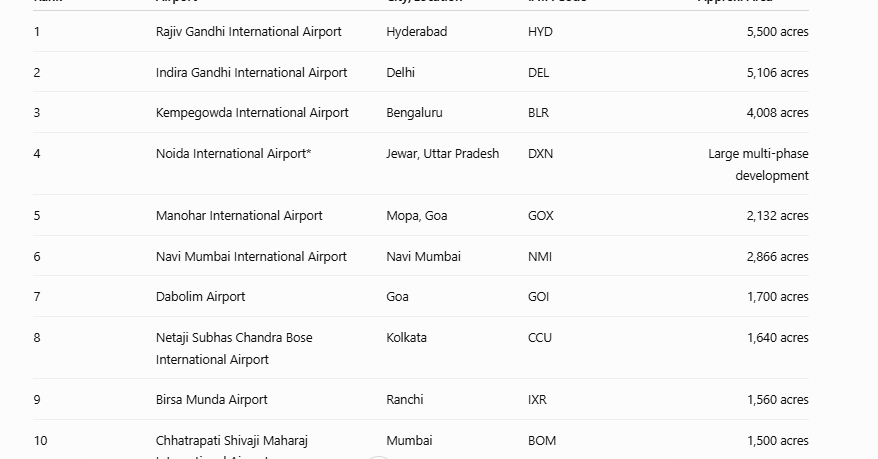
Top 10 Biggest Airports in India 2026
| Rank | Airport | City/Location | IATA Code | Approx. Area |
|---|---|---|---|---|
| 1 | Rajiv Gandhi International Airport | Hyderabad | HYD | 5,500 acres |
| 2 | Indira Gandhi International Airport | Delhi | DEL | 5,106 acres |
| 3 | Kempegowda International Airport | Bengaluru | BLR | 4,008 acres |
| 4 | Noida International Airport* | Jewar, Uttar Pradesh | DXN | Large multi-phase development |
| 5 | Manohar International Airport | Mopa, Goa | GOX | 2,132 acres |
| 6 | Navi Mumbai International Airport | Navi Mumbai | NMI | 2,866 acres |
| 7 | Dabolim Airport | Goa | GOI | 1,700 acres |
| 8 | Netaji Subhas Chandra Bose International Airport | Kolkata | CCU | 1,640 acres |
| 9 | Birsa Munda Airport | Ranchi | IXR | 1,560 acres |
| 10 | Chhatrapati Shivaji Maharaj International Airport | Mumbai | BOM | 1,500 acres |
Note: Rankings can vary depending on whether the calculation uses currently developed airport land, the airport’s total land parcel, or its long-term masterplan. Therefore, Noida International Airport is discussed separately as a major new airport whose full planned development is still being built out. Published 2026 lists also differ on some airport-area figures.
1. Rajiv Gandhi International Airport, Hyderabad – 5,500 Acres
Rajiv Gandhi International Airport (HYD) is generally listed as the largest operational airport in India by land area, occupying approximately 5,500 acres.
Located at Shamshabad, on the outskirts of Hyderabad, the airport was developed as a greenfield airport and replaced the city’s old Begumpet airport for commercial operations.
Key details
| Particular | Details |
|---|---|
| Airport | Rajiv Gandhi International Airport |
| City | Hyderabad, Telangana |
| IATA Code | HYD |
| Approx. area | 5,500 acres |
| Type | International |
| Location | Shamshabad |
Its large land parcel gives the airport considerable scope for terminal, runway, cargo and commercial expansion. It is also an important aviation gateway for Telangana and the wider south-central Indian region.
The airport’s position outside the dense urban core is one reason it was able to be developed on such a large footprint.
2. Indira Gandhi International Airport, Delhi – 5,106 Acres
Indira Gandhi International Airport (DEL) is India’s principal international aviation gateway and is spread across approximately 5,106 acres.
Although it ranks behind Hyderabad in land area in commonly cited rankings, Delhi airport is arguably more prominent when passenger traffic is considered. Recent 2026 data places it far ahead of most Indian airports in passenger numbers.
The airport has multiple passenger terminals and several runways and serves as a major hub for international and domestic flights.
Key details
| Particular | Details |
|---|---|
| Airport | Indira Gandhi International Airport |
| City | New Delhi |
| IATA Code | DEL |
| Area | Approx. 5,106 acres |
| Terminals | Multiple |
| Importance | Major international hub |
Delhi’s airport infrastructure is particularly important because it serves the National Capital Region and connects India with destinations across Asia, Europe, the Middle East and North America.
3. Kempegowda International Airport, Bengaluru – About 4,008 Acres
Kempegowda International Airport (BLR) is another enormous airport campus, covering approximately 4,008 acres.
Located in Devanahalli, north of Bengaluru, the airport was developed to accommodate the city’s rapidly increasing aviation demand.
Key details
| Particular | Details |
|---|---|
| Airport | Kempegowda International Airport |
| City | Bengaluru, Karnataka |
| IATA Code | BLR |
| Area | Approx. 4,008 acres |
| Type | International |
| Major role | Bengaluru’s primary aviation gateway |
Bengaluru’s importance as India’s technology and business centre has helped make BLR one of the country’s busiest airports.
The airport’s large land area also provides room for long-term infrastructure development.
4. Noida International Airport, Jewar – Major New Aviation Hub
Noida International Airport (DXN) is one of the most significant additions to India’s aviation infrastructure in 2026.
The airport is located at Jewar in Uttar Pradesh and is designed as a multi-phase greenfield airport serving Delhi NCR, western Uttar Pradesh and surrounding regions.
The airport officially began commercial operations on June 15, 2026, with IndiGo operating the first commercial flight. Phase 1 has a passenger capacity of 12 million annually, while the masterplan provides for expansion to more than 70 million passengers per year.
Key details
| Particular | Details |
|---|---|
| Airport | Noida International Airport |
| Location | Jewar, Uttar Pradesh |
| IATA Code | DXN |
| Type | Greenfield international airport |
| Phase 1 capacity | 12 million passengers/year |
| Long-term capacity | 70+ million passengers/year |
| Operations began | June 15, 2026 |
What makes Jewar particularly interesting is that its importance cannot be judged only by the infrastructure available on day one. The airport has been planned as a large-scale aviation ecosystem with room for future passenger, cargo and related development.
It is expected to improve air connectivity for Noida, Greater Noida, western Uttar Pradesh and parts of the wider Delhi NCR.
5. Manohar International Airport, Mopa – 2,132 Acres
Manohar International Airport (GOX) is located at Mopa in North Goa. It covers approximately 2,132 acres.
The airport was developed to increase Goa’s aviation capacity and complement the older Dabolim Airport.
Key details
| Particular | Details |
|---|---|
| Airport | Manohar International Airport |
| Location | Mopa, Goa |
| IATA Code | GOX |
| Area | Approx. 2,132 acres |
| Type | International |
| Main purpose | Passenger and tourism connectivity |
Goa is one of India’s biggest tourism destinations, so having modern airport infrastructure is particularly important for both domestic and international visitors.
6. Navi Mumbai International Airport – 2,866 Acres
Navi Mumbai International Airport (NMI) is another major greenfield airport that has changed India’s aviation landscape.
The airport spans more than 1,160 hectares, equivalent to about 2,866 acres, and is planned for a long-term capacity of up to 90 million passengers per year. Its initial phase has capacity for about 20 million passengers annually.
Commercial operations began in December 2025, making it operational by 2026.
Key details
| Particular | Details |
|---|---|
| Airport | Navi Mumbai International Airport |
| Location | Navi Mumbai, Maharashtra |
| IATA Code | NMI |
| Area | 2,866 acres |
| Initial capacity | 20 million passengers/year |
| Ultimate planned capacity | 90 million passengers/year |
| Type | Greenfield international airport |
The airport is expected to reduce pressure on Mumbai’s existing airport while creating a major aviation and economic hub for the Mumbai Metropolitan Region.
7. Dabolim Airport, Goa – About 1,700 Acres
Dabolim Airport (GOI) is Goa’s older major airport and occupies approximately 1,700 acres according to commonly cited 2026 rankings.
The airport is located near Vasco da Gama and has traditionally served as the principal aviation gateway to Goa.
Key details
| Particular | Details |
|---|---|
| Airport | Dabolim Airport |
| Location | Goa |
| IATA Code | GOI |
| Approx. area | 1,700 acres |
| Type | International airport |
| Major role | Goa tourism and passenger connectivity |
The opening of Mopa’s Manohar International Airport has given Goa a two-airport aviation system, allowing the state to handle growing tourism and passenger demand.
8. Netaji Subhas Chandra Bose International Airport, Kolkata – About 1,640 Acres
Netaji Subhas Chandra Bose International Airport (CCU) is one of eastern India’s most important aviation hubs.
The airport occupies approximately 1,640 acres and serves Kolkata as well as a large part of eastern and northeastern India.
Key details
| Particular | Details |
|---|---|
| Airport | Netaji Subhas Chandra Bose International Airport |
| City | Kolkata, West Bengal |
| IATA Code | CCU |
| Area | Approx. 1,640 acres |
| Type | International |
| Region served | Eastern India |
Kolkata’s geographical position makes its airport particularly important for connections between mainland India and the Northeast, as well as international destinations in Southeast and East Asia.
9. Birsa Munda Airport, Ranchi – About 1,560 Acres
Birsa Munda Airport (IXR) is located in Ranchi, Jharkhand. It covers approximately 1,560 acres in commonly reported airport-area rankings.
Key details
| Particular | Details |
|---|---|
| Airport | Birsa Munda Airport |
| City | Ranchi |
| IATA Code | IXR |
| Area | Approx. 1,560 acres |
| State | Jharkhand |
| Type | Domestic/international connectivity |
The airport is an important transportation link for Jharkhand and supports business, tourism, education and industrial travel.
10. Chhatrapati Shivaji Maharaj International Airport, Mumbai – About 1,500 Acres
Chhatrapati Shivaji Maharaj International Airport (BOM) is one of India’s busiest airports despite having a considerably smaller land footprint than Hyderabad, Delhi and Bengaluru.
It covers approximately 1,500 acres in commonly reported rankings.
Key details
| Particular | Details |
|---|---|
| Airport | Chhatrapati Shivaji Maharaj International Airport |
| City | Mumbai, Maharashtra |
| IATA Code | BOM |
| Area | Approx. 1,500 acres |
| Type | International |
| Importance | Major financial and aviation hub |
Mumbai airport is a good example of why airport area and airport traffic are two different measurements. The airport is constrained by the densely developed city around it, yet it handles enormous passenger volumes.
Biggest Airports in India by Area: Quick Comparison
| Airport | Approx. Area | Location |
|---|---|---|
| Rajiv Gandhi International Airport | 5,500 acres | Hyderabad |
| Indira Gandhi International Airport | 5,106 acres | Delhi |
| Kempegowda International Airport | 4,008 acres | Bengaluru |
| Navi Mumbai International Airport | 2,866 acres | Navi Mumbai |
| Manohar International Airport | 2,132 acres | Goa |
| Dabolim Airport | 1,700 acres | Goa |
| Netaji Subhas Chandra Bose International Airport | 1,640 acres | Kolkata |
| Birsa Munda Airport | ~1,560 acres | Ranchi |
| Chhatrapati Shivaji Maharaj International Airport | ~1,500 acres | Mumbai |
The figures are approximate because airport-area statistics are not always reported using an identical methodology. Some sources count the total airport land parcel, while others refer to developed operational land or particular phases of a project.
Which Is the Biggest Airport in India in 2026?
If we consider currently established operational airport land area, Rajiv Gandhi International Airport, Hyderabad, is generally cited as the biggest, with a footprint of around 5,500 acres.
However, Noida International Airport deserves special mention because it is a new multi-phase airport whose masterplan extends well beyond its Phase 1 infrastructure. It started commercial operations in June 2026 and is planned to expand substantially over time.
Meanwhile, Navi Mumbai International Airport has a 2,866-acre footprint and is designed to eventually handle up to 90 million passengers annually.
Biggest Airport vs Busiest Airport in India
It is important not to confuse largest by land area with busiest by passenger traffic.
For example, Mumbai’s Chhatrapati Shivaji Maharaj International Airport occupies roughly 1,500 acres but handles far more passengers than several airports that have larger land areas. Similarly, Delhi’s IGI Airport is both very large and one of India’s busiest aviation hubs. Recent 2026 reporting lists Delhi’s annual passenger traffic at more than 79 million.
So, there are actually two different questions:
- Biggest by land area: Rajiv Gandhi International Airport, Hyderabad, among operational airports.
- Busiest by passenger traffic: Indira Gandhi International Airport, Delhi, according to recent traffic figures.
Why Are Indian Airports Becoming Bigger?
India’s growing aviation market is the biggest reason behind the development of large airport campuses.
1. Rising air travel
More Indians are choosing air travel for business, tourism, education and family trips. This has created demand for larger terminals and additional runways.
2. Expansion of cargo
Airports are no longer designed only for passengers. Cargo terminals, logistics parks and aircraft maintenance facilities are becoming increasingly important.
3. Future expansion
A large airport site gives developers room to add terminals, runways, parking areas and support infrastructure without acquiring large amounts of additional land later.
4. Airport-led economic development
Modern airports are increasingly being developed as commercial ecosystems containing hotels, offices, retail areas, logistics facilities and other businesses.
The trend is visible in current airport development plans. For example, Adani Airports announced an integrated airport-city development programme across several airports in 2026, involving hospitality, retail, business and entertainment infrastructure.
Future of Large Airports in India
India’s airport infrastructure is likely to become even more impressive over the next decade. New greenfield airports and expansion projects are being developed in different parts of the country.
Noida International Airport is a particularly important example. Its first phase has begun operations, while subsequent phases are expected to increase passenger capacity significantly.
Navi Mumbai is another major example, with a long-term design capacity of 90 million passengers annually.
These airports are not simply transportation facilities. They are expected to become major centres for trade, tourism, logistics, employment and regional economic development.
FAQs
Which is the biggest airport in India in 2026 by area?
Rajiv Gandhi International Airport in Hyderabad is commonly listed as the biggest operational airport in India by land area, at approximately 5,500 acres.
Which is the second-largest airport in India by area?
Indira Gandhi International Airport in Delhi is generally ranked second, with approximately 5,106 acres.
Which is the largest airport in India by passenger traffic?
Indira Gandhi International Airport in Delhi is India’s leading airport by passenger traffic. Recent 2025–26 figures reported for the airport are above 79 million passengers.
How big is Noida International Airport?
Noida International Airport is being developed as a large multi-phase aviation hub. Phase 1 began commercial operations in June 2026 with a capacity of 12 million passengers annually, while its masterplan provides for capacity exceeding 70 million passengers annually.
Which is the biggest airport in South India by area?
Rajiv Gandhi International Airport in Hyderabad, at around 5,500 acres, is generally regarded as the largest airport in South India by land area.
Which Indian airport has the largest future passenger capacity?
Navi Mumbai International Airport is designed to scale to approximately 90 million passengers per year on completion.
Final Takeaway
The biggest airports in India in 2026 show how quickly the country’s aviation infrastructure is evolving. Hyderabad, Delhi and Bengaluru continue to dominate the list of large established airports, while new facilities such as Noida International Airport and Navi Mumbai International Airport are changing the country’s aviation map.
For area alone, Rajiv Gandhi International Airport, Hyderabad, stands out at around 5,500 acres. But when passenger traffic, future capacity and economic importance are considered, Delhi, Mumbai, Bengaluru, Navi Mumbai and Noida all play exceptionally important roles.
About The Author
