
UP Pollution Control Board Monitoring Assistant Syllabus 2026: The UP Pollution Control Board (UPPCB) Monitoring Assistant Exam 2026 is one of the most important opportunities for science graduates aiming for a stable government job in the environmental sector. Conducted by the Uttar Pradesh Subordinate Services Selection Commission (UPSSSC), this exam tests both technical knowledge and general awareness.
If you are preparing for this exam, understanding the syllabus thoroughly is the first and most crucial step toward success.
Overview of UPPCB Monitoring Assistant Exam 2026
| Feature | Details |
|---|---|
| Exam Name | UPPCB Monitoring Assistant Exam 2026 |
| Conducting Body | UPSSSC |
| Selection Process | PET 2025 Score + Written Exam |
| Mode of Exam | Offline (OMR-Based) |
| Total Questions | 100–120 MCQs |
| Duration | 2 Hours |
| Negative Marking | 0.25 Marks |
| Medium | Hindi & English |
The exam generally includes 60–70% technical questions and 30–40% general studies questions.
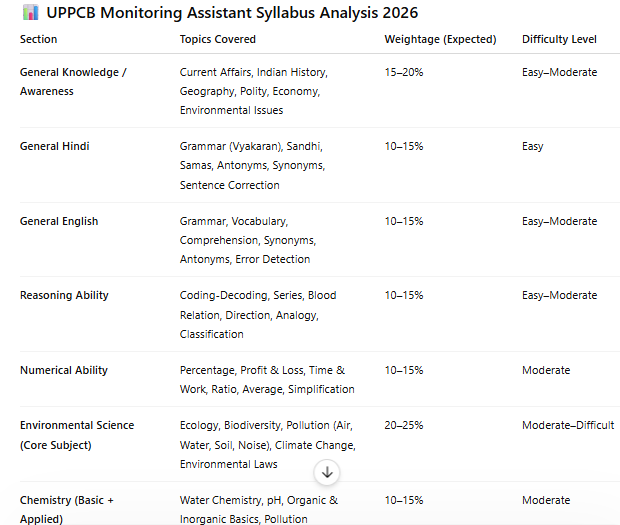
UPPCB Monitoring Assistant Syllabus Analysis 2026
| Section | Topics Covered | Weightage (Expected) | Difficulty Level | Preparation Tips |
|---|---|---|---|---|
| General Knowledge / Awareness | Current Affairs, Indian History, Geography, Polity, Economy, Environmental Issues | 15–20% | Easy–Moderate | Focus on last 6–12 months current affairs and static GK |
| General Hindi | Grammar (Vyakaran), Sandhi, Samas, Antonyms, Synonyms, Sentence Correction | 10–15% | Easy | Practice basic Hindi grammar rules and previous papers |
| General English | Grammar, Vocabulary, Comprehension, Synonyms, Antonyms, Error Detection | 10–15% | Easy–Moderate | Improve reading skills and practice error detection questions |
| Reasoning Ability | Coding-Decoding, Series, Blood Relation, Direction, Analogy, Classification | 10–15% | Easy–Moderate | Practice daily reasoning sets and focus on accuracy |
| Numerical Ability | Percentage, Profit & Loss, Time & Work, Ratio, Average, Simplification | 10–15% | Moderate | Learn shortcuts and practice speed-based questions |
| Environmental Science (Core Subject) | Ecology, Biodiversity, Pollution (Air, Water, Soil, Noise), Climate Change, Environmental Laws | 20–25% | Moderate–Difficult | Focus on NCERT + basic environmental concepts |
| Chemistry (Basic + Applied) | Water Chemistry, pH, Organic & Inorganic Basics, Pollution Chemistry, Industrial Waste | 10–15% | Moderate | Revise basic chemistry concepts and applications |
| Computer Knowledge | MS Office, Internet, Basics of Computer, Cyber Awareness | 5–10% | Easy | Learn basic computer operations and shortcuts |
UPPCB Monitoring Assistant Syllabus 2026
The syllabus is divided into two major sections:
1. Technical Subjects (Core Section)
This is the most important part of the exam and carries maximum weightage.
A. Environmental Monitoring & Sampling
- Air quality monitoring (PM2.5, PM10, SO₂, NOx)
- Ambient air monitoring techniques
- Stack monitoring methods
- Water sampling & effluent sampling
- Noise pollution monitoring
These topics are directly related to fieldwork duties of a Monitoring Assistant.
B. Laboratory Techniques & Analysis
- BOD (Biochemical Oxygen Demand) testing
- COD (Chemical Oxygen Demand)
- pH measurement
- Dissolved Oxygen (DO)
- Turbidity analysis
- Spectrophotometry basics
- Chromatography basics
Questions are often practical-based, so conceptual clarity is essential.
C. Environmental Laws & Regulations
- Water (Prevention and Control of Pollution) Act, 1974
- Air (Prevention and Control of Pollution) Act, 1981
- Environment Protection Act, 1986
- Solid Waste Management Rules
- Role of Pollution Control Boards
Direct factual questions are frequently asked from these laws.
D. Environmental Science & Ecology
- Ecosystem & biodiversity
- Climate change
- Environmental pollution (air, water, soil)
- Environmental impact assessment (EIA)
- Wildlife conservation
This section overlaps with general science and environmental awareness.
E. Basic Science (Chemistry & Biology)
- Chemical reactions and compounds
- Water chemistry basics
- Biological processes in pollution
- Microorganisms in wastewater treatment
2. General Studies Section
This section ensures overall aptitude and awareness.
A. General Knowledge & Current Affairs
- National & International current events
- Government schemes (especially UP-based)
- Environmental issues in India
- Important organizations (CPCB, NGT)
B. Uttar Pradesh Special GK
- Geography, history, and culture of UP
- Industrial development and pollution issues
- State government initiatives
UP-specific questions carry high weightage in recent exams.
C. General Hindi
- Sandhi, Samas
- Synonyms & antonyms
- Idioms & phrases
- Comprehension
D. Reasoning Ability
- Coding-decoding
- Series & analogy
- Blood relations
- Syllogism
E. Computer Knowledge
- Basic computer fundamentals
- MS Office
- Internet & digital literacy
Exam Pattern (Expected)
| Section | Subjects | Questions | Marks |
|---|---|---|---|
| Part A | Hindi, GK, Reasoning, Computer | 30–40 | 30–40 |
| Part B | Technical Subjects | 60–70 | 60–70 |
| Total | All Subjects | 100–120 | 100–120 |
Important Topics to Focus (High Scoring Areas)
- BOD, COD, DO values
- Environmental laws (Acts & Rules)
- Air & water quality standards
- Sampling techniques
- UP Special GK
- Current environmental issues
These topics are frequently repeated in exams.
Preparation Strategy for UPPCB Monitoring Assistant 2026
1. Build Strong Basics
- Start with NCERT Science (Class 6–10)
- Focus on environmental concepts and chemistry basics
2. Focus on Technical Section First
- It carries maximum weightage
- Practice lab-based and practical questions
3. Prepare Environmental Laws Thoroughly
- Learn important sections and provisions
- Focus on Acts & years (very important for MCQs)
4. Practice Previous Year Papers
- Understand exam pattern
- Improve speed and accuracy
5. Attempt Mock Tests Regularly
- Analyze mistakes
- Improve time management
Best Books for Preparation
- Environmental Engineering – S.K. Garg
- Lucent General Knowledge
- NCERT Science (Class 6–10)
- UP Special GK Books
Final Tips for Success
- Give priority to technical subjects
- Revise formulas, standards, and values regularly
- Stay updated with environmental current affairs
- Focus on accuracy (negative marking applies)
Conclusion
The UP Pollution Control Board Monitoring Assistant Syllabus 2026 is a balanced mix of technical knowledge, environmental science, and general studies. Candidates who focus on core environmental concepts, lab techniques, and UP-specific GK have a strong chance of cracking the exam.
Consistent preparation, smart revision, and practice are the keys to success.
FAQs
1. What subjects are included in the Monitoring Assistant syllabus 2026?
The syllabus mainly includes:
- Environmental Monitoring
- Laboratory Techniques
- Environmental Laws
- General Science (Chemistry & Biology basics)
- General Studies (GK, Current Affairs, Computer)
2. What is the most important subject for this exam?
The Environmental Monitoring & Laboratory Techniques section is the most important because it is directly related to field and lab work and carries significant weightage.
3. What topics are covered under Environmental Monitoring?
Key topics include:
- Air quality monitoring
- Water and effluent sampling
- Stack monitoring
- Field data collection techniques
4. What laboratory techniques should candidates prepare?
Important lab topics are:
- BOD, COD testing
- pH measurement
- Dissolved Oxygen (DO) analysis
- Spectrophotometry & chromatography basics
5. Are environmental laws part of the syllabus?
Yes, major environmental laws include:
- Water Act 1974
- Air Act 1981
- Environment Protection Act 1986
6. Is General Science important for this exam?
Yes, candidates should prepare:
- Basic Chemistry (pollutants, reactions)
- Basic Biology (ecosystem, environment)
These are directly linked to pollution monitoring concepts.
7. What is included in General Studies?
General Studies covers:
- Current affairs
- UP-specific knowledge
- Computer basics
- Environmental awareness
8. Is knowledge of Pollution Control Boards required?
Yes, questions may be asked on:
- Functions and powers of State & Central Pollution Control Boards
- Environmental policies and regulations
9. What type of questions are asked in the exam?
- Objective type (MCQs)
- Concept-based and practical application questions
- Some factual questions from laws and current affairs
10. What is the exam pattern for a Monitoring Assistant?
Generally:
- Total Questions: 100
- Total Marks: 100
- Duration: 2 hours
- Sections: General + Technical
11. Is there any negative marking?
It depends on the official notification, but many state PCB exams may include negative marking (≈0.25 marks).
12. What is the difficulty level of the syllabus?
- Moderate level
- Technical part: Moderate to Difficult
- General section: Easy to Moderate
13. How to prepare for the Monitoring Assistant syllabus effectively?
- Focus on Environmental Science basics
- Practice lab-based questions
- Revise environmental laws regularly
- Solve previous year papers
14. Is current affairs important for this exam?
Yes, especially:
- Environmental issues
- Government schemes (e.g., pollution control initiatives)
- Recent policies related to environment
15. Can non-science students apply for Monitoring Assistant?
Generally, science background (especially Chemistry/Environmental Science) is preferred or required.
About The Author
