
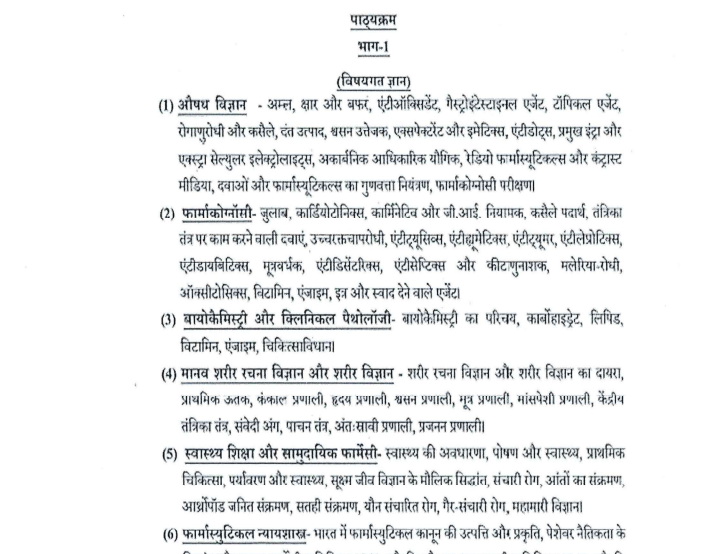
The Uttar Pradesh Subordinate Services Selection Commission (UPSSSC) has released the Pharmacist Syllabus 2026 along with the latest exam pattern in its official notification. Candidates preparing for the UPSSSC Pharmacist exam must understand the syllabus thoroughly to score well in the exam. The syllabus mainly focuses on pharmacy subjects, computer knowledge, and Uttar Pradesh General Knowledge.
This article provides a complete breakdown of the UPSSSC Pharmacist Syllabus 2026, exam pattern, subject-wise topics, and preparation tips.
UPSSSC Pharmacist Exam Pattern 2026
Before starting preparation, candidates must understand the exam pattern:
| Particulars | Details |
|---|---|
| Exam Mode | Offline/OMR Based |
| Question Type | Multiple Choice Questions (MCQs) |
| Total Questions | 100 |
| Total Marks | 100 |
| Duration | 2 Hours (120 Minutes) |
| Negative Marking | 0.25 marks deducted |
Section-wise Distribution
| Section | Subject | Questions | Marks |
|---|---|---|---|
| Part 1 | Subject Related Knowledge (Pharmacy) | 65 | 65 |
| Part 2 | Computer & IT Knowledge | 15 | 15 |
| Part 3 | Uttar Pradesh General Knowledge | 20 | 20 |
| Total | — | 100 | 100 |
The pharmacy section carries the highest weightage, so candidates must focus more on core subjects.
UPSSSC Pharmacist Selection Process 2026
The selection process generally includes:
- UPSSSC PET (Preliminary Eligibility Test)
- Main Written Examination
- Document Verification
Only PET-qualified candidates are eligible for the mains exam.
UPSSSC Pharmacist Syllabus 2026: Part 1 – Subject Related Knowledge (Pharmacy)
This section carries 65 questions and is based on the Diploma in Pharmacy level syllabus. It includes the following subjects:
The level of these questions will be based on the Diploma in Pharmacy.
Pharmaceutics
- Acids, Bases, and Buffers
- Antioxidants
- Gastrointestinal agents
- Topical agents
- Antimicrobials and Astringents
- Dental products
- Respiratory stimulants
- Expectorants and Emetics
- Antidotes
- Major intra and extracellular electrolytes
- Inorganic official compounds
- Radiopharmaceuticals and contrast media
- Quality control of drugs and pharmaceuticals
- Pharmacognosy tests
Pharmacognosy
- Laxatives
- Cardiotonics
- Carminatives and GI regulators
- Astringents
- Drugs acting on the nervous system
- Antihypertensive drugs
- Antitussives
- Antirheumatics
- Antitumor drugs
- Antileprotics
- Antidiabetics
- Diuretics
- Antidysenterics
- Antiseptics and disinfectants
- Antimalarials
- Oxytocics
- Vitamins and enzymes
- Perfumes and flavoring agents
Biochemistry & Clinical Pathology
- Introduction to biochemistry
- Carbohydrates and lipids
- Vitamins and enzymes
- Therapeutics
Human Anatomy and Physiology
- Scope of anatomy and physiology
- Elementary tissues
- Skeletal system
- Cardiovascular system
- Respiratory system
- Urinary system
- Muscular system
- Central nervous system
- Sensory organs
- Digestive system
- Endocrine system
- Reproductive system
Health Education & Community Pharmacy
- Concept of health
- Nutrition and health
- First aid
- Environment and health
- Fundamental principles of microbiology
- Communicable diseases
- Intestinal infections
- Arthropod-borne infections
- Surface infections
- Sexually transmitted diseases
- Non-communicable diseases
- Epidemiology
Pharmaceutical Jurisprudence
- Origin and nature of pharmaceutical legislation in India
- Principles and significance of professional ethics
- Pharmacy Act, 1948
- Drugs and Cosmetics Act, 1940
- Drugs and Magic Remedies Act, 1954
- Narcotic Drugs and Psychotropic Substances Act, 1985
- Drugs (Price Control) Order
- Poisons Act, 1919
- Medicinal and Toilet Preparations Act, 1955
- Medical Termination of Pregnancy Act, 1971
Pharmacology & Toxicology
- Routes of drug administration
- General mechanism of drug action
- Drugs affecting the central nervous system
- Drugs acting on the respiratory and digestive systems
- Autacoids
- Cardiovascular drugs
- Drugs affecting renal function
- Hormones and hormone antagonists
- Chemotherapy of microbial diseases
- Disinfectants and antiseptics
Drug Store and Business Management
- Introduction to drug store management
- Drug house management
- Sales management
- Recruitment and training
- Banking and finance
Hospital & Clinical Pharmacy
- Hospital pharmacy
- Drug distribution systems in hospitals
- Manufacturing (sterile and non-sterile)
- Pharmacy Therapeutic Committee (PTC)
- Hospital formulary system
- Drug information service
- Surgical dressings
UPSSSC Pharmacist Syllabus 2026: Part 2 – Computer & Information Technology
This section contains 15 questions that test candidates’ basic knowledge of computers and digital technologies.
- History, Introduction, and Application of Computers, IT, Internet, and WWW.
- Hardware and Software; Input and Output devices.
- Internet Protocol/IP Address; IT gadgets and their applications.
- Creation and use of e-mail IDs.
- Operation of Printer, Tablet, and Mobile.
- Elements of Word Processing (MS-Word) and Excel (MS-Excel).
- Operating System, Social Networking, and E-Governance.Digital Financial Tools and Applications.Future Skills and Cyber Security.
- Technological developments like Artificial Intelligence, Big Data Processing, Deep Learning, Machine Learning, and IoT, including India’s achievements in these fields.
UPSSSC Pharmacist Syllabus 2026: Part 3 – General Information of Uttar Pradesh
This section includes 20 questions based on the history, culture, geography, and general awareness of the state of Uttar Pradesh.
- History, Culture, Art, and Architecture of UP.
- Festivals, Folk Dances, Literature, Regional Languages, and Heritage.
- Social Customs, Tourism, and Geographical Landscape.
- Environment, Natural Resources, Climate, Soil, Forests, and Wildlife.
- Mines, Minerals, Economy, Agriculture, Industry, Business, and Employment.
- Polity, Administration, Current Events, and achievements of UP state in various fields.
UPSSSC Pharmacist Syllabus 2026 (Subject-wise Topics)
The syllabus is divided into three main sections:
1. Subject Related Knowledge (Pharmacy)
This is the most important section with 65% weightage. Questions are based on Diploma in Pharmacy level.
Important Topics:
Pharmaceutics
- Acids, bases, buffers
- Antioxidants
- Gastrointestinal agents
- Antimicrobials, topical agents
- Dental products
- Electrolytes
- Drug quality control
Pharmacognosy
- Laxatives, cardiotonics
- Antidiabetics, antimalarials
- Vitamins, enzymes
- Antiseptics & disinfectants
Human Anatomy & Physiology
- Digestive system
- Nervous system
- Cardiovascular system
- Respiratory system
- Endocrine system
Biochemistry & Clinical Pathology
- Carbohydrates, proteins, lipids
- Vitamins & enzymes
- Metabolism
Pharmacology & Toxicology
- Drug action mechanisms
- CNS drugs
- Cardiovascular drugs
- Chemotherapy
- Hormones
Pharmaceutical Jurisprudence
- Pharmacy Act 1948
- Drugs & Cosmetics Act 1940
- NDPS Act 1985
- Drug Price Control Order
Hospital & Clinical Pharmacy
- Drug distribution systems
- Sterile manufacturing
- Hospital formulary
- Drug information service
Drug Store Management
- Sales & marketing
- Financial management
- Inventory control
This section tests core pharmacy knowledge and practical application.
2. Computer Knowledge & Information Technology
This section checks basic digital awareness.
Important Topics:
- Basics of computers
- Hardware & software
- Internet & WWW
- MS Word, MS Excel
- Email usage
- Cyber security
- Artificial Intelligence & Machine Learning
- Digital financial tools
- E-governance
Questions are generally basic to moderate level.
3. General Knowledge of Uttar Pradesh
This section evaluates candidates’ knowledge about the state.
Important Topics:
- History of Uttar Pradesh
- Culture, art, festivals
- Geography & environment
- Rivers, climate, soil
- Economy & agriculture
- Polity & administration
- Current affairs of UP
Regular reading of UP GK and current affairs is essential.
UPSSSC Pharmacist Syllabus 2026 PDF Download
UPSSSC Pharmacist Syllabus 2026 PDF includes three major sections: Subject-related Pharmacy knowledge, Computer & IT, and General Knowledge of Uttar Pradesh. The exam consists of 100 MCQs (100 marks) with a duration of 2 hours and 0.25 negative marking. Pharmacy section (65 marks) covers topics like Pharmaceutics, Pharmacology, Toxicology, Hospital Pharmacy, and Drug Management. Computer section (15 marks) includes basics of IT, internet, MS Office, and cyber security. UP GK (20 marks) includes history, culture, geography, economy, and current affairs of Uttar Pradesh. Candidates can download the official syllabus PDF from here: upsssc pharmacist syllabus pdf
UPSSSC Pharmacist Preparation Tips 2026
Here are some expert tips to crack the exam:
- Focus on pharmacy subjects (65 marks weightage)
- Make short notes for revision
- Practice previous year papers
- Strengthen basic computer knowledge
- Read UP current affairs daily
- Attempt mock tests for time management
Best Strategy to Crack UPSSSC Pharmacist 2026
- Start with core pharmacy subjects
- Cover D.Pharm syllabus thoroughly
- Allocate time:
- 60% → Pharmacy
- 20% → UP GK
- 20% → Computer
- Revise weekly and attempt mock tests
FAQs on UPSSSC Pharmacist Syllabus 2026
Q1. How many questions are asked in UPSSSC Pharmacist exam?
A total of 100 questions are asked.
Q2. Is there negative marking?
Yes, 0.25 marks are deducted for each wrong answer.
Q3. Which section has highest weightage?
Pharmacy section (65 marks) has the highest weightage.
Q4. What is the exam duration?
The exam duration is 2 hours.
Q5. What is the level of syllabus?
The syllabus is based on Diploma in Pharmacy (D.Pharm) level.
Conclusion
The UPSSSC Pharmacist Syllabus 2026 is designed to test candidates’ professional pharmacy knowledge, computer awareness, and UP-specific general knowledge. Since the pharmacy section dominates the paper, candidates must prioritize it while maintaining a balanced preparation strategy for other sections.
A well-planned study schedule, regular revision, and consistent practice can help you secure success in this competitive exam.
About The Author
