
The Uttar Pradesh Common Nursing Entrance Test (UP CNET) 2026 is conducted by Atal Bihari Vajpayee Medical University (ABVMU) for admission to B.Sc Nursing and other nursing courses. To crack this exam, candidates must clearly understand the latest syllabus, exam pattern, and subject-wise weightage.
UP CNET Syllabus 2026
The UP CNET Syllabus 2026 is essential for candidates preparing for the Uttar Pradesh Common Nursing Entrance Test. It provides a clear outline of subjects, topics, and exam pattern required to secure admission into B.Sc Nursing courses across the state. The syllabus mainly covers subjects like Physics, Chemistry, Biology, and General Knowledge based on the 10+2 level. Understanding the detailed syllabus helps candidates plan their preparation effectively, focus on important topics, and improve their chances of success. Aspirants should thoroughly review the syllabus and align their study strategy accordingly to perform well in the examination.
The syllabus is mainly based on Class 11 & 12 NCERT concepts along with English and Nursing Aptitude.
UP CNET 2026 Exam Pattern
Before starting preparation, check the exam structure:
| Particulars | Details |
|---|---|
| Mode of Exam | Offline (OMR Based) |
| Total Questions | 120 |
| Total Marks | 120 |
| Duration | 140 Minutes |
| Type of Questions | Multiple Choice Questions |
| Marking Scheme | +1 for correct answer |
| Negative Marking | No |
Each question carries 1 mark and there is no negative marking, so attempt all questions.
Subject-wise Marks Distribution
The UP CNET exam has equal weightage for all subjects:
| Subject | Questions | Marks | Weightage |
|---|---|---|---|
| Physics | 24 | 24 | 20% |
| Chemistry | 24 | 24 | 20% |
| Biology | 24 | 24 | 20% |
| English | 24 | 24 | 20% |
| Nursing Aptitude | 24 | 24 | 20% |
Total = 120 Questions / 120 Marks
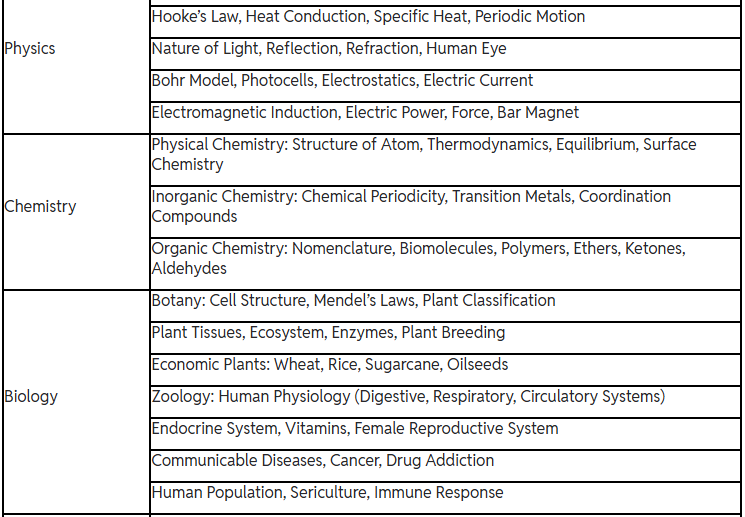
UP CNET BSc Nursing Syllabus 2026 Detailed
The UP CNET Syllabus 2026 provides a detailed breakdown of subjects including Physics, Chemistry, Biology, Nursing Aptitude, and English, helping candidates prepare thoroughly for the BSc Nursing entrance exam. This comprehensive syllabus covers essential topics such as human physiology, plant classification, logical reasoning, and English grammar to equip aspiring nursing professionals with the necessary knowledge.
|
Subject |
Topics |
|
Physics |
Units and Dimensions, Work, Power and Energy, Acceleration |
|
Hooke’s Law, Heat Conduction, Specific Heat, Periodic Motion |
|
|
Nature of Light, Reflection, Refraction, Human Eye |
|
|
Bohr Model, Photocells, Electrostatics, Electric Current |
|
|
Electromagnetic Induction, Electric Power, Force, Bar Magnet |
|
|
Chemistry |
Physical Chemistry: Structure of Atom, Thermodynamics, Equilibrium, Surface Chemistry |
|
Inorganic Chemistry: Chemical Periodicity, Transition Metals, Coordination Compounds |
|
|
Organic Chemistry: Nomenclature, Biomolecules, Polymers, Ethers, Ketones, Aldehydes |
|
|
Biology |
Botany: Cell Structure, Mendel’s Laws, Plant Classification |
|
Plant Tissues, Ecosystem, Enzymes, Plant Breeding |
|
|
Economic Plants: Wheat, Rice, Sugarcane, Oilseeds |
|
|
Zoology: Human Physiology (Digestive, Respiratory, Circulatory Systems) |
|
|
Endocrine System, Vitamins, Female Reproductive System |
|
|
Communicable Diseases, Cancer, Drug Addiction |
|
|
Human Population, Sericulture, Immune Response |
|
|
Nursing Aptitude |
Current Affairs, Basics of Indian Polity |
|
Logical Reasoning: Series, Relationships, Space Visualization |
|
|
Problem Solving, Decision Making, Observation |
|
|
Analytical Ability, Judgment, Non-Verbal Reasoning |
|
|
English |
Grammar: Spotting Errors, Fill in the Blanks |
|
Vocabulary: Synonyms, Antonyms, One Word Substitution |
|
|
Reading Skills: Comprehension, Cloze Test |
|
|
Sentence Arrangement, Misspelt Words, Idioms and Phrases |
UP CNET 2026 Syllabus: Important Topics
1. Physics Syllabus
Physics questions are based on conceptual understanding from the NCERT:
- Units & Measurements
- Laws of Motion
- Work, Energy & Power
- Thermodynamics
- Oscillations & Waves
- Electrostatics & Current Electricity
- Magnetic Effects of Current
- Optics
- Modern Physics
Focus on numerical + conceptual clarity.
2. Chemistry Syllabus
Divided into Physical, Organic & Inorganic Chemistry:
Physical Chemistry
- Atomic Structure
- Thermodynamics
- Chemical Equilibrium
- Electrochemistry
- Chemical Kinetics
Organic Chemistry
- Hydrocarbons
- Alcohols, Aldehydes, Ketones
- Biomolecules
- Polymers
Inorganic Chemistry
- Periodic Table
- Chemical Bonding
- Coordination Compounds
- p-Block Elements
Important topics include bonding, organic reactions & equilibrium.
3. Biology Syllabus
Biology carries high-scoring potential:
Botany
- Cell Structure
- Plant Physiology
- Genetics
- Ecology
- Plant Reproduction
Zoology
- Human Physiology
- Reproductive System
- Evolution
- Diseases & Immunity
- Biotechnology
Topics like Human Physiology & Genetics are highly important.
4. English Syllabus
- Reading Comprehension
- Vocabulary
- Synonyms & Antonyms
- Grammar (Tenses, Articles, Prepositions)
- Sentence Correction
Practice daily for accuracy and speed.
5. Nursing Aptitude Syllabus
This section tests your suitability for nursing:
- Basic First Aid
- Health & Hygiene
- Nutrition
- Maternal & Child Health
- Logical Reasoning
- General Awareness (Health-related)
Focus on practical knowledge + reasoning-based questions.
UP CNET 2026 Marking Scheme
| Response Type | Marks |
|---|---|
| Correct Answer | +1 |
| Incorrect Answer | 0 |
| Unattempted | 0 |
No negative marking → Attempt maximum questions.
Important Highlights
- Syllabus based on NCERT Class 11–12
- Equal weightage to all subjects
- Biology & Nursing Aptitude are scoring
- No negative marking gives an advantage
Preparation Tips for UP CNET 2026
- Study NCERT books thoroughly
- Practice previous year papers
- Take mock tests regularly
- Focus more on Biology & Nursing Aptitude
- Revise formulas and concepts daily
Conclusion
The UP CNET Syllabus 2026 is well-balanced across science subjects, English, and nursing aptitude. Since each section carries equal weightage, candidates must prepare all subjects strategically. With proper planning, NCERT-based preparation, and consistent practice, cracking UP CNET becomes achievable.
About The Author
