
The Kerala PSC Degree Level Preliminary Exam 2026 is a common screening test conducted by the Kerala Public Service Commission to recruit candidates for various graduate-level government posts. This exam tests candidates on General Knowledge, Aptitude, Language, and Current Affairs.
A clear understanding of the syllabus is essential for structured preparation and scoring high marks.
Kerala PSC Degree Prelims Syllabus 2026
KPSC Degree Prelims Syllabus 2026 includes two objective papers. Paper 1 covers General Studies such as current affairs (national & international), Indian history, geography, polity, economy, and social issues. Paper 2 focuses on aptitude and Karnataka-specific topics, including state current affairs, government schemes, science & technology, environment, logical reasoning, data interpretation, comprehension, and decision-making. The exam aims to test candidates’ general awareness, analytical ability, and understanding of Kerala and India. It is a screening stage for the Mains exam, so broad conceptual clarity and regular revision are essential for success.
Kerala PSC Degree Prelims 2026: Overview
| Particular | Details |
|---|---|
| Exam Name | Kerala PSC Degree Prelims 2026 |
| Conducting Body | Kerala PSC |
| Exam Mode | OMR (Objective Type) |
| Total Marks | 100 |
| Duration | 1 hour 15 minutes |
| Level | Graduate |
| Selection Process | Prelims → Mains |
The exam is conducted as a common preliminary test for multiple posts, and qualifying candidates move to the Mains stage.
Kerala PSC Degree Prelims Exam Pattern 2026
The question paper is divided into four parts:
| Part | Subject | Marks |
|---|---|---|
| Part I | General Knowledge & Current Affairs | 50 |
| Part II | Arithmetic, Mental Ability & Reasoning | 20 |
| Part III | General English | 20 |
| Part IV | Regional Language (Malayalam/Tamil/Kannada) | 10 |
Total: 100 Marks
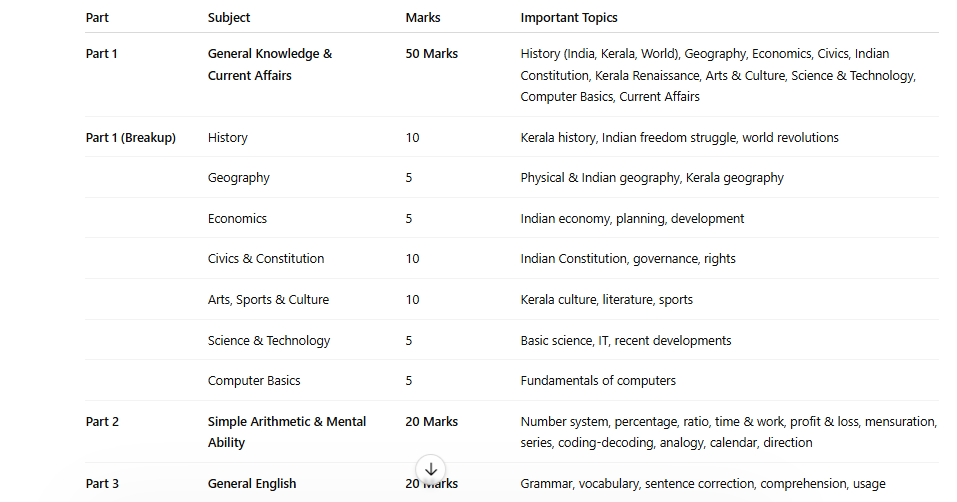
Kerala PSC Degree Prelims Syllabus 2026
| Part | Subject | Marks | Important Topics |
|---|---|---|---|
| Part 1 | General Knowledge & Current Affairs | 50 Marks | History (India, Kerala, World), Geography, Economics, Civics, Indian Constitution, Kerala Renaissance, Arts & Culture, Science & Technology, Computer Basics, Current Affairs |
| Part 1 (Breakup) | History | 10 | Kerala history, Indian freedom struggle, world revolutions |
| Geography | 5 | Physical & Indian geography, Kerala geography | |
| Economics | 5 | Indian economy, planning, development | |
| Civics & Constitution | 10 | Indian Constitution, governance, rights | |
| Arts, Sports & Culture | 10 | Kerala culture, literature, sports | |
| Science & Technology | 5 | Basic science, IT, recent developments | |
| Computer Basics | 5 | Fundamentals of computers | |
| Part 2 | Simple Arithmetic & Mental Ability | 20 Marks | Number system, percentage, ratio, time & work, profit & loss, mensuration, series, coding-decoding, analogy, calendar, direction |
| Part 3 | General English | 20 Marks | Grammar, vocabulary, sentence correction, comprehension, usage |
| Part 4 | Regional Language (Malayalam/Kannada/Tamil) | 10 Marks | Grammar, vocabulary, translation, comprehension |
1. General Knowledge & Current Affairs (50 Marks)
This is the most important section, covering multiple subjects:History (India, Kerala & World)
- Kerala History:
- Arrival of Europeans
- Travancore history (Marthanda Varma era)
- Social reform movements
- Formation of Kerala state (1956)
- Indian History:
- Freedom struggle
- British rule & reforms
- Post-independence developments
- World History:
- French Revolution
- Russian Revolution
- World Wars
- UN and global organizations
Geography
- Physical Geography (India & World)
- Climate, Soil, Rivers
- Kerala Geography (Western Ghats, biodiversity)
- Environmental issues
Economics
- Indian Economy basics
- Planning and development
- Banking and financial system
- Inflation, poverty, and unemployment
Civics & Indian Constitution
- Fundamental Rights & Duties
- Directive Principles
- Parliament & Judiciary
- Governance and public administration
Science & Technology
- Basic Physics, Chemistry, Biology
- Space, IT, Biotechnology
- Recent scientific developments
Environment & Ecology
- Climate change
- Biodiversity conservation
- Pollution and global warming
- Environmental laws in India
Arts, Sports & Culture
- Indian and Kerala culture
- Literature, festivals
- Awards and sports events
Current Affairs
- National and international events
- Kerala-specific current affairs
- Government schemes and policies
2. Simple Arithmetic (10 Marks)
Topics include:
- Numbers & basic operations
- Percentage, Ratio & Proportion
- Profit & Loss
- Time & Work, Time & Distance
- Simple & Compound Interest
- Average
- Mensuration
- Progressions
3. Mental Ability & Reasoning (10 Marks)
- Number & Alphabet Series
- Coding-Decoding
- Analogy
- Direction sense
- Calendar & Clock
- Odd one out
- Logical reasoning
- Family relations
4. General English (20 Marks)
- Vocabulary (Synonyms, Antonyms)
- Grammar (Tense, Articles, Prepositions)
- Sentence correction
- Comprehension
- Idioms and phrases
5. Regional Language (10 Marks)
Candidates can choose:
- Malayalam / Tamil / Kannada
Topics:
- Grammar
- Vocabulary
- Translation
- Comprehension
Important Features of Kerala PSC Degree Prelims Syllabus
- Covers multi-disciplinary subjects
- Focus on Kerala-specific topics
- Includes current affairs integration
- Balanced weightage across sections
- Objective-type questions only
The syllabus is designed to test general awareness and analytical ability rather than deep specialization.
Preparation Tips for Kerala PSC Degree Prelims 2026
1. Focus on Kerala GK
- Kerala history, geography, and current affairs are highly important
2. Strengthen Basics
- NCERT-level understanding is sufficient for most topics
3. Practice Arithmetic & Reasoning Daily
- Improves speed and accuracy
4. Revise Current Affairs Regularly
- Cover last 6–12 months
5. Solve Previous Year Papers
- Helps understand exam pattern and difficulty level
Conclusion
The Kerala PSC Degree Prelims Syllabus 2026 is comprehensive but manageable with the right strategy. By focusing on General Knowledge, Kerala-specific topics, aptitude, and language skills, candidates can clear the prelims and move toward the Mains stage.
A structured study plan, regular revision, and mock tests are key to success in this highly competitive exam.
About The Author
