
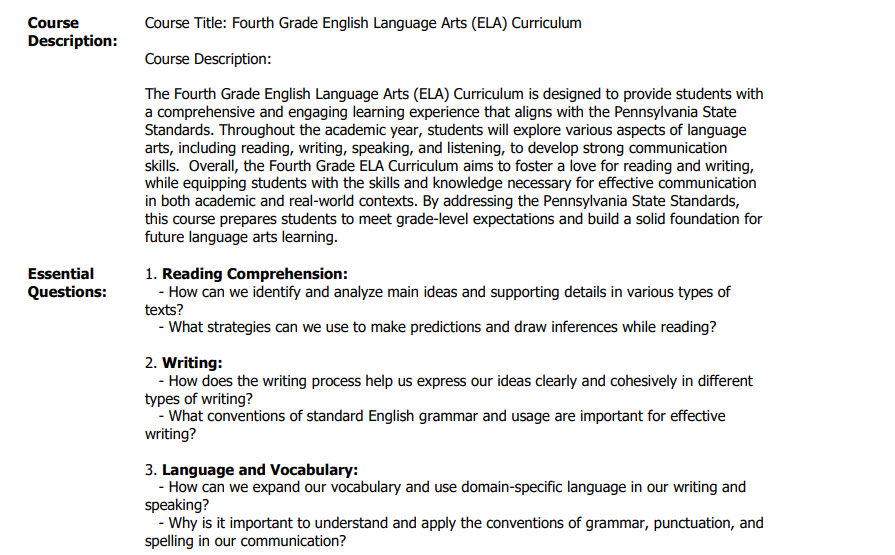
The US Grade 4 English Language Arts (ELA) Curriculum 2026 represents a pivotal moment in a child’s literacy journey. As students transition from “learning to read” to “reading to learn,” the curriculum emphasizes deeper text analysis, structured writing, and the cultivation of critical thinking skills. For the 2026 school year, many districts are implementing updated curricula grounded in the latest educational research, including the Science of Reading and a focus on morphological awareness. This guide explores the key components of what fourth graders will learn.
US Grade 4 English Language Arts (ELA) Curriculum: The “Big Picture” Shifts in 2026
While curricula vary by state and district, several overarching themes define Grade 4 ELA for 2026:
-
Deepening Comprehension: Students move beyond basic recall to making inferences, citing evidence, and understanding the author’s purpose.
-
Structured Writing: The focus is on formal writing processes—planning, drafting, revising, and editing across opinion/argument, informative/explanatory, and narrative genres.
-
Expanding Vocabulary: There is a significant push to learn Greek and Latin roots, prefixes, and suffixes (morphology) to decode unfamiliar multisyllabic words.
-
Knowledge Building: Curricula are increasingly using content-rich texts to build students’ background knowledge in history, science, and the arts.
USA Grade 4 ELA Curriculum 2026
| Strand | Key Topics / Skills | Learning Outcomes |
|---|---|---|
| Reading – Literature (RL) | • Story elements (theme, character, setting) • Poetry, drama, fiction • Text structure & point of view |
• Identify theme and summarize texts • Describe characters and events using evidence • Compare stories and understand narrator’s perspective |
| Reading – Informational Text (RI) | • Main idea & supporting details • Text features (headings, charts) • Cause-effect, problem-solution |
• Explain main idea with evidence • Interpret facts, events, and concepts • Compare information across texts |
| Reading – Foundational Skills (RF) | • Phonics & word analysis • Fluency & pronunciation • Vocabulary development |
• Decode multisyllabic words • Read grade-level text fluently • Use context to understand meaning |
| Writing (W) | • Opinion writing • Informative/explanatory writing • Narrative writing • Research projects |
• Write structured essays with evidence • Develop clear introductions & conclusions • Conduct short research and present findings |
| Speaking & Listening (SL) | • Group discussions • Presentations • Listening comprehension |
• Participate in collaborative discussions • Present ideas clearly with facts and details • Respond to questions and build on others’ ideas |
| Language (L) | • Grammar & sentence structure • Vocabulary usage • Punctuation & spelling |
• Use correct grammar and conventions • Apply vocabulary in context • Understand word relationships and meanings |
Key Focus Areas in Grade 4 ELA
- Strong emphasis on reading comprehension and analysis
- Development of structured writing skills (paragraph → essay)
- Building academic vocabulary and grammar accuracy
- Encouraging discussion, reasoning, and presentation skills
- Integration of reading + writing + speaking across subjects
Skills Students Develop
- Critical thinking and inference
- Evidence-based answers
- Organized writing (introduction–body–conclusion)
- Independent reading fluency
- Communication and collaboration
About The Author
