
Robotics and Automation Engineering is an interdisciplinary field that integrates mechanical, electrical, electronics, and computer engineering to design intelligent machines and automated systems. The syllabus for 2026 is structured to provide both theoretical foundations and practical exposure to modern technologies like AI, IoT, and Industry 4.0. It aims to prepare students for industries such as manufacturing, healthcare, defense, and space technology. The curriculum emphasizes innovation, problem-solving, and real-world application of robotics systems.
Robotics and Automation Engineering Syllabus 2026
Robotics and Automation Engineering Syllabus 2026 is presented in an easy format (semester-wise) based on the latest university curricula and industry trends.
Year 1: Foundation Subjects
| Semester | Subjects |
|---|---|
| Semester 1 | Engineering Mathematics-I, Engineering Physics, Programming for Engineers (C/Python), Engineering Graphics & CAD, Workshop Practice, Communication Skills, Environmental Studies |
| Semester 2 | Engineering Mathematics-II, Basic Electrical & Electronics Engineering, Engineering Mechanics, Chemistry, Microcontrollers Basics, Mechatronics Fundamentals, Soft Skills |
Focus: Strong base in maths, physics, programming, and engineering fundamentals
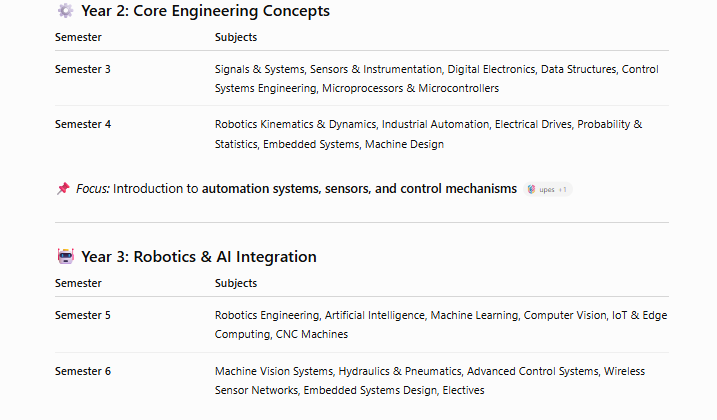
Year 2: Core Engineering Concepts
| Semester | Subjects |
|---|---|
| Semester 3 | Signals & Systems, Sensors & Instrumentation, Digital Electronics, Data Structures, Control Systems Engineering, Microprocessors & Microcontrollers |
| Semester 4 | Robotics Kinematics & Dynamics, Industrial Automation, Electrical Drives, Probability & Statistics, Embedded Systems, Machine Design |
Focus: Introduction to automation systems, sensors, and control mechanisms
Year 3: Robotics & AI Integration
| Semester | Subjects |
|---|---|
| Semester 5 | Robotics Engineering, Artificial Intelligence, Machine Learning, Computer Vision, IoT & Edge Computing, CNC Machines |
| Semester 6 | Machine Vision Systems, Hydraulics & Pneumatics, Advanced Control Systems, Wireless Sensor Networks, Embedded Systems Design, Electives |
Focus: Integration of AI, robotics programming, and automation technologies
Year 4: Advanced Topics & Specialization
| Semester | Subjects |
|---|---|
| Semester 7 | Industrial Robotics, Field Robotics, Human-Robot Interaction, ROS (Robot Operating System), Electives (AI Robotics, DSP, IoT), Internship |
| Semester 8 | Capstone Project, Simulation & Modelling, Medical Robotics / Micro Robotics, Entrepreneurship Development, Industrial Training |
Focus: Real-world applications, research, and industry exposure
Key Subjects Covered Across All Years
| Category | Topics |
|---|---|
| Mathematics | Linear Algebra, Calculus, Probability, Numerical Methods |
| Electronics | Digital Circuits, Sensors, Actuators |
| Mechanical | Kinematics, Dynamics, Machine Design |
| Computer Science | Programming, Data Structures, AI, Machine Learning |
| Robotics Core | Robot Design, Control Systems, Computer Vision |
| Automation | PLC, Industrial Automation, IoT |
Robotics combines Mechanical + Electrical + Computer Science engineering disciplines
Practical Components
- Robotics Lab & Simulation
- Embedded Systems Projects
- AI & Machine Learning Projects
- Industrial Internship
- Final Year Capstone Project
Core Subjects Overview
The Robotics and Automation Engineering syllabus is divided into foundational, core, and advanced subjects across semesters. Students begin with basic engineering principles and gradually move toward specialized topics such as robot kinematics, control systems, and artificial intelligence. Practical labs and project-based learning are integrated into each stage to enhance understanding. The curriculum is regularly updated to align with global technological advancements and industry requirements.
Mathematics for Robotics
Mathematics forms the backbone of robotics engineering, enabling precise modeling and control of robotic systems. Topics include linear algebra, calculus, differential equations, and probability theory. These concepts are essential for understanding robot motion, trajectory planning, and system optimization. Students also learn numerical methods and computational techniques to solve complex engineering problems efficiently.
Engineering Mechanics
Engineering Mechanics introduces students to the principles of forces, motion, and energy. It covers statics and dynamics, helping learners understand how robotic components behave under different conditions. This subject is crucial for designing stable and efficient robotic structures. Practical applications include analyzing robotic arms, mobile robots, and automated machinery systems.
Basics of Electrical and Electronics Engineering
This subject provides knowledge of electrical circuits, electronic components, and signal processing. Students learn about resistors, capacitors, transistors, and integrated circuits used in robotic systems. Understanding these fundamentals helps in designing control circuits and embedded systems. It also lays the groundwork for advanced topics like robotics sensors and automation controllers.
Programming and Data Structures
Programming is a core skill in robotics, enabling control and automation of machines. Students learn languages like C, C++, Python, and MATLAB for algorithm development. Data structures such as arrays, stacks, queues, and trees are taught to optimize performance. The course also introduces problem-solving techniques and coding practices essential for robotics software development.
Sensors and Actuators
Sensors and actuators are key components of any robotic system. Sensors collect data from the environment, such as temperature, distance, and motion, while actuators convert signals into physical movement. The syllabus covers different types of sensors like ultrasonic, infrared, and vision systems. Students also learn about motors, servo systems, and hydraulic actuators used in automation.
Robot Kinematics and Dynamics
This subject focuses on the motion of robots without and with forces. Kinematics deals with position, velocity, and acceleration, while dynamics studies forces and torques affecting motion. Students learn forward and inverse kinematics to control robotic arms. This knowledge is essential for designing robots that perform precise and efficient movements.
Control Systems Engineering
Control systems are used to manage and regulate robotic operations. This subject covers feedback systems, stability analysis, and controller design. Students learn about PID controllers, transfer functions, and system modeling. The course helps in developing automated systems that can operate accurately with minimal human intervention.
Artificial Intelligence in Robotics
Artificial Intelligence (AI) enables robots to perform intelligent tasks such as decision-making and learning. The syllabus includes machine learning, neural networks, and computer vision. Students explore how AI is used in autonomous vehicles, industrial robots, and service robots. Practical applications involve building smart systems that can adapt to changing environments.
Industrial Automation
Industrial Automation focuses on automating manufacturing and production processes. Topics include PLC (Programmable Logic Controllers), SCADA systems, and industrial robotics. Students learn how automated systems improve efficiency, reduce errors, and increase productivity. The course also covers real-world case studies from industries like automotive and electronics.
Embedded Systems and IoT
Embedded systems are specialized computing systems used in robotics. This subject covers microcontrollers, real-time systems, and hardware-software integration. IoT (Internet of Things) enables robots to communicate and share data over networks. Students learn to design smart robotic systems connected to cloud platforms and remote monitoring tools.
Machine Vision and Image Processing
Machine vision allows robots to interpret visual data from cameras and sensors. This subject includes image processing techniques, pattern recognition, and object detection. Students learn how robots identify objects, navigate environments, and perform quality inspection. Applications include autonomous driving, surveillance, and medical imaging.
Human-Robot Interaction
Human-Robot Interaction (HRI) focuses on communication between humans and robots. It includes user interface design, safety protocols, and collaborative robotics. Students study how robots can work alongside humans in industries and healthcare. The course emphasizes designing user-friendly and safe robotic systems.
Robotics Lab and Practical Training
Practical training is an essential part of the syllabus, allowing students to apply theoretical knowledge. Robotics labs include building and programming robots, working with sensors, and testing automation systems. Students gain hands-on experience with tools like Arduino, Raspberry Pi, and robotic simulation software. Industry internships are also encouraged to provide real-world exposure.
Final Year Projects and Research
In the final year, students undertake major projects that involve designing and developing robotic systems. These projects encourage innovation and problem-solving skills. Students may work on areas like autonomous robots, smart automation systems, or AI-based robotics. Research opportunities help in advancing knowledge and preparing for higher studies or industry roles.
Career Opportunities after Robotics Engineering
Graduates of Robotics and Automation Engineering have diverse career options in industries such as manufacturing, aerospace, healthcare, and IT. Job roles include Robotics Engineer, Automation Engineer, AI Specialist, and Control Systems Engineer. The demand for skilled professionals is increasing due to rapid technological advancements. Students can also pursue higher education or start their own tech-based ventures.
Conclusion
The Robotics and Automation Engineering Syllabus 2026 is designed to meet the demands of modern industries and technological innovation. It combines strong theoretical knowledge with practical skills to prepare students for future challenges. With the integration of AI, IoT, and automation, this field offers immense career growth and opportunities. Students completing this course are well-equipped to contribute to the development of intelligent systems and smart technologies.
About The Author
