
India Post Gramin Dak Sevak (GDS) is one of the popular government-sector opportunities for candidates who have completed Class 10 and are looking for a job in the postal department. One of the biggest reasons candidates consider GDS recruitment is the comparatively simple eligibility criteria, rural posting opportunities, and a structured remuneration system.
However, there is an important point that candidates should understand before comparing GDS salary with regular central government jobs. GDS employees are paid Time-Related Continuity Allowance (TRCA), along with applicable Dearness Allowance and other benefits, rather than the regular pay matrix salary applicable to departmental employees. The Department of Posts also states that GDS are holders of civil posts but are outside the regular civil services of the Union of India.
For 2026, the GDS remuneration structure continues to distinguish mainly between Branch Postmaster (BPM) and Assistant Branch Postmaster (ABPM)/Dak Sevak posts. The January 2026 GDS notification lists the basic TRCA slabs as ₹12,000–₹29,380 for BPM and ₹10,000–₹24,470 for ABPM/Dak Sevak.
India Post GDS Salary 2026: Overview
Candidates can check the major details of the GDS salary structure below.
| Particulars | Details |
|---|---|
| Organisation | India Post, Department of Posts |
| Post | Gramin Dak Sevak (GDS) |
| Major Posts | BPM, ABPM/Dak Sevak |
| Salary Component | Time Related Continuity Allowance (TRCA) |
| BPM TRCA | ₹12,000 to ₹29,380 per month |
| ABPM/Dak Sevak TRCA | ₹10,000 to ₹24,470 per month |
| Additional Component | Dearness Allowance and applicable allowances |
| Increment | Applicable as per GDS rules |
| Service Benefits | GDS Gratuity and Service Discharge Benefit Scheme, subject to rules |
| Employment Status | Civil post, outside regular Central Civil Services |
The above TRCA slabs are the basic salary ranges specified in the GDS recruitment framework. Actual monthly earnings can vary depending on the post, applicable allowances, working conditions, and other rules in force at the time.
India Post GDS Pay Scale 2026
The GDS pay structure is comparatively straightforward. Instead of using the central government’s regular pay matrix, India Post uses the Time-Related Continuity Allowance (TRCA) system.
BPM Salary
The Branch Postmaster is placed in the TRCA slab of:
₹12,000 – ₹29,380 per month
The starting TRCA is ₹12,000. With progression under the applicable rules, the TRCA can rise within the prescribed slab.
ABPM/Dak Sevak Salary
The TRCA slab for an assistant branch postmaster/Dak Sevak is
₹10,000 – ₹24,470 per month
Thus, ABPM/Dak Sevak candidates start at a lower TRCA than BPMs, although both positions have defined opportunities for progression under the GDS rules.
India Post GDS Salary Structure 2026
The monthly remuneration of a GDS should not be viewed as the TRCA figure alone. The Department’s notifications specify that GDS emoluments include TRCA plus Dearness Allowance, along with applicable benefits and allowances.
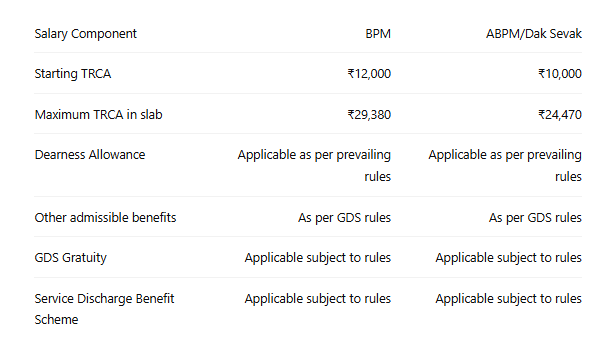
The salary structure can therefore be understood as follows:
| Salary Component | BPM | ABPM/Dak Sevak |
|---|---|---|
| Starting TRCA | ₹12,000 | ₹10,000 |
| Maximum TRCA in slab | ₹29,380 | ₹24,470 |
| Dearness Allowance | Applicable as per prevailing rules | Applicable as per prevailing rules |
| Other admissible benefits | As per GDS rules | As per GDS rules |
| GDS Gratuity | Applicable subject to rules | Applicable subject to rules |
| Service Discharge Benefit Scheme | Applicable subject to rules | Applicable subject to rules |
Note: The amount credited to an individual employee should not be calculated simply by adding a fixed percentage to the starting TRCA because applicable allowances and rates can change. Candidates should check the latest Department of Posts orders for the prevailing DA rate and other benefits.
India Post GDS In-Hand Salary 2026
Many candidates search specifically for “GDS salary in hand.” The in-hand amount is essentially the remuneration payable after applicable deductions and adjustments.
For a newly engaged candidate, the starting TRCA is:
- BPM: ₹12,000 per month
- ABPM/Dak Sevak: ₹10,000 per month
In addition, applicable Dearness Allowance and other admissible components can increase the gross monthly remuneration. The actual amount received in the bank account may differ because deductions, recoveries or other applicable adjustments can affect the final payment.
Therefore, candidates should be cautious about websites that quote one fixed “GDS in-hand salary” for every employee. The actual monthly amount can vary.
Salary Structure & In-Hand Earnings
Your actual monthly pay = TRCA + Dearness Allowance (DA) + other small allowances – deductions.
- Dearness Allowance: Linked to the rates applicable to central government employees and revised periodically. Recent updates have put it in the 58–60% range of basic TRCA (it moves with inflation and central DA announcements). This significantly boosts the take-home amount.
- Other common allowances (vary by post and duties):
- Office Maintenance Allowance (mainly for BPMs who provide the space)
- Cycle Maintenance Allowance (for those using their own cycle for delivery)
- Stationery / Fixed Stationery Charge
- Cash Conveyance Allowance
- Boat Allowance (in specific areas)
- Risk/hardship or delivery-related compensation in some cases
Rough in-hand picture for a new joiner (approximate, depending on exact DA rate, location, and allowances at the time):
- Fresh BPM (Level 1): Often lands in the ₹18,000–₹20,000+ range after DA and small allowances, minus modest deductions.
- Fresh ABPM/Dak Sevak: Typically ₹15,000–₹17,000+ range.
Deductions are generally light and may include:
- GDS Group Insurance Scheme (GIS) contribution
- Service Discharge Benefit Scheme (SDBS) contribution
- Professional tax (state-dependent)
Longer-serving GDS staff see steady growth. After several years of 3% increments + rising DA, many move well above the starting figures. There is also a financial upgradation scheme that adds fixed amounts after 12, 24, and 36 years of continuous engagement.
Note: GDS are not regular central government employees. Their service is governed by the Gramin Dak Sevaks (Conduct and Engagement) Rules. They do not get the full suite of regular employee benefits (like standard NPS/OPS pension in the same way), but they do receive GDS Gratuity and benefits under the Service Discharge Benefit Scheme on exit.
Job Profile – What You Actually Do
GDS Salary After 5 Years
The GDS remuneration does not remain permanently at the starting figure. Employees can move through the applicable TRCA slab subject to the prescribed conditions and rules.
For example:
| Post | Starting TRCA | Maximum TRCA in prescribed slab |
|---|---|---|
| BPM | ₹12,000 | ₹29,380 |
| ABPM/Dak Sevak | ₹10,000 | ₹24,470 |
The maximum figure should not be interpreted as the amount every employee will automatically receive after a fixed number of years. Progression depends on the applicable GDS rules and conditions.
GDS Annual Increment 2026
GDS remuneration also provides for progression within the applicable TRCA slab. The commonly cited structure provides for an annual increase subject to the conditions prescribed by the Department.
Candidates should remember that an annual increment is not the same thing as an automatic promotion. The employee’s TRCA may increase while the employee continues in the same post.
The applicable GDS rules and departmental orders should always be checked for the exact conditions governing increment.
India Post GDS Allowances 2026
Apart from TRCA, GDS employees are entitled to applicable allowances and social-security-related benefits.
Dearness Allowance
Dearness Allowance, or DA, is payable along with TRCA according to the applicable government orders. Since DA rates can be revised periodically, candidates should not assume that the same percentage will remain applicable throughout 2026.
GDS Gratuity
GDS employees are also covered by the GDS Gratuity provisions, subject to the applicable rules and qualifying conditions.
Service Discharge Benefit Scheme
The GDS framework also provides for a Service Discharge Benefit Scheme. The January 2026 notification specifically mentions this benefit along with GDS gratuity.
Other Applicable Benefits
Depending on the applicable rules, GDS employees may receive other benefits connected with service, leave and welfare provisions. These should be considered separately from the basic TRCA.
India Post GDS Job Profile 2026
The job profile is different for BPM and ABPM/Dak Sevak. The nature of work also depends on the particular Branch Post Office and duties assigned by the Department.
Branch Postmaster (BPM) Job Profile
The BPM is responsible for the overall functioning of the Branch Post Office. Major responsibilities include:
- Managing the day-to-day operations of the Branch Post Office.
- Handling postal transactions and services.
- Performing duties connected with India Post Payments Bank (IPPB).
- Promoting postal products and services.
- Operating customer-service-related activities.
- Supervising the functioning of the Branch Post Office.
- Handling mail conveyance and delivery responsibilities in a single-handed Branch Office.
- Performing ABPM duties when required or when an ABPM is unavailable.
- Carrying out other duties assigned by the competent postal authorities.
The official job description states that BPMs are responsible for the smooth and timely functioning of the Branch Post Office, including mail conveyance and delivery in single-handed offices.
ABPM/Dak Sevak Job Profile
The ABPM/Dak Sevak assists with postal operations and performs several customer-facing and delivery-related duties.
Major responsibilities may include:
- Assisting the BPM in Branch Post Office operations.
- Delivery and conveyance of mail.
- Handling postal transactions as assigned.
- Assisting customers with postal services.
- Supporting IPPB-related work.
- Marketing and promoting postal products.
- Performing duties assigned by the BPM or competent postal authorities.
- Working with digital devices and systems used by India Post.
The exact duties depend on the Branch Office and the instructions issued by the Department.
GDS Working Hours
GDS posts are generally associated with a limited-hours engagement structure rather than the standard full-day schedule followed by many regular departmental employees.
The basic GDS notification refers to 4-hour/Level 1 TRCA slabs for the minimum TRCA. However, the actual duties and working hours can vary according to the nature of the post and operational requirements.
Candidates should therefore not assume that every GDS employee works exactly four hours every day simply because the starting TRCA is linked to the four-hour level.
Is GDS a permanent government job?
This is one of the most common questions asked by candidates.
GDS employees are holders of civil posts under the Department of Posts, but they are not regular Central Government employees in the regular Civil Services of the Union of India. They are governed by the GDS (Conduct and Engagement) Rules, 2020, as amended from time to time.
Therefore, GDS should not be directly compared with regular posts such as Postal Assistant, Sorting Assistant, or other departmental positions that operate under the regular Central Government service framework.
GDS BPM vs ABPM Salary
The key difference between the two posts can be understood easily from the table below.
| Feature | BPM | ABPM/Dak Sevak |
|---|---|---|
| Full Form | Branch Postmaster | Assistant Branch Postmaster/Dak Sevak |
| Starting TRCA | ₹12,000 | ₹10,000 |
| Maximum TRCA in slab | ₹29,380 | ₹24,470 |
| Main Responsibility | Overall Branch Office operations | Assistance, delivery and postal operations |
| Customer Service | Yes | Yes |
| Mail-related Duties | Yes | Yes |
| IPPB-related Work | Yes | Yes |
| Marketing of Postal Services | Yes | Yes |
| Additional Duties | As assigned | As assigned |
The BPM has the higher TRCA slab because the post carries broader responsibility for the functioning of the Branch Post Office.
GDS Job Profile: What Does a Typical Day Look Like?
A typical GDS working day can be quite different from that of an office-based government employee.
A BPM may begin by checking the day’s postal transactions, managing the branch office, handling customer requirements, and coordinating mail-related activities. In a single-handed branch office, the BPM may have to manage several responsibilities personally.
An ABPM/Dak Sevak may spend a significant part of the day assisting with office work, handling postal services, sorting or delivering mail, helping customers, and carrying out field duties.
The role therefore combines office work, customer service, and field responsibilities.
GDS Residence and Accommodation Rules
Candidates applying for BPM positions should pay particular attention to the accommodation requirement.
The GDS notification states that a selected BPM has to provide accommodation for the branch post office before engagement and is required to reside in the post village where the branch office is functioning. The accommodation has to meet the standards prescribed by the Department.
This is an important practical aspect of the job that candidates sometimes overlook while focusing only on salary.
GDS Salary and Benefits: Important Points
Before accepting a GDS post, candidates should understand the following:
- GDS remuneration is based on TRCA rather than the regular central government pay matrix.
- BPM has a higher starting TRCA than ABPM/Dak Sevak.
- A dearness allowance is payable as applicable.
- The GDS gratuity and service discharge benefit scheme are available subject to the relevant rules.
- GDS employees are governed by separate engagement rules.
- The job can involve both office and field duties.
- BPMs have wider responsibility for branch office operations.
- Selected BPMs have specific residence/accommodation requirements.
- The actual monthly amount received can differ from the starting TRCA because of applicable allowances and deductions.
- Candidates should verify the latest official notification and departmental orders before relying on any salary figure.
Is India Post GDS Salary Good for 10th Pass Candidates?
For a candidate looking for an entry-level postal opportunity after Class 10, GDS can be an attractive option. The recruitment framework requires a 10th-standard qualification, and the position offers a defined TRCA structure along with applicable benefits.
At the same time, candidates should have realistic expectations. GDS is not the same as a regular central government employee post, and its remuneration and service conditions are governed separately.
The job can be particularly suitable for candidates who prefer working in or around their local area and are comfortable with postal, customer service, and field-related responsibilities.
Frequently Asked Questions (FAQs)
What is the India Post GDS salary in 2026?
The starting TRCA is ₹12,000 per month for BPM and ₹10,000 per month for ABPM/Dak Sevak. The prescribed TRCA slabs extend up to ₹29,380 for BPM and ₹24,470 for ABPM/Dak Sevak. Dearness allowance and other applicable benefits are additional as per rules.
What is the maximum salary of GDS BPM?
The prescribed BPM TRCA slab is ₹12,000 to ₹29,380 per month. The actual remuneration can also include applicable DA and other admissible benefits.
What is the salary of GDS ABPM in 2026?
The ABPM/Dak Sevak TRCA slab is ₹10,000 to ₹24,470 per month, with applicable DA and other benefits as per the rules.
Does GDS get a dearness allowance?
Yes. India Post’s GDS notifications specify payment of TRCA along with Dearness Allowance, subject to the applicable rules and rates.
Is GDS a central government employee?
GDS employees hold civil posts under the Department of Posts, but they are outside the regular Civil Services of the Union of India and are governed by the GDS (Conduct and Engagement) Rules.
What is the main work of a GDS BPM?
A BPM manages the day-to-day operations of the Branch Post Office, handles postal and customer-service activities, supports IPPB services, promotes postal products, and may be responsible for mail conveyance and delivery.
Is GDS salary paid monthly?
Yes. GDS remuneration is paid through the TRCA-based system, along with applicable allowances and benefits.
Can GDS salary increase with service?
Yes. GDS employees can progress within the prescribed TRCA slab subject to the applicable rules and conditions. The maximum slab should not be treated as an automatic salary figure after a fixed number of years.
Conclusion
The India Post GDS Salary 2026 structure provides a starting TRCA of ₹12,000 for BPM and ₹10,000 for ABPM/Dak Sevak, with prescribed slabs extending to ₹29,380 and ₹24,470, respectively. In addition to TRCA, eligible GDS employees receive applicable Dearness Allowance and other benefits under the GDS framework.
For candidates with a Class 10 qualification, GDS can be a useful opportunity, particularly for those interested in postal work and comfortable with a combination of customer-service, office and field duties. However, it is important to remember that GDS service conditions are different from those of regular Central Government employees.
Candidates should always check the latest notification and official Department of Posts orders for the exact remuneration, allowances and service conditions applicable at the time of engagement. The official GDS portal is the most reliable source for recruitment-related updates.
About The Author
