
Students planning their B.Tech studies at Gokaraju Rangaraju Institute of Engineering and Technology (GRIET) can use the GRIET Syllabus 2026 to understand the subjects they will study across four years. The institute follows the GR25 curriculum for students admitted from the 2025-26 academic year. The B.Tech programme is spread across 8 semesters, and students need a minimum of 160 credits out of 164 credits for successful completion of the degree.
For 2026, the official GRIET syllabus portal lists GR25 curricula for Civil Engineering, CSE, EEE, Mechanical Engineering, ECE, CSE (AI & ML), CSE (Data Science) and CSE & Business Systems. This article focuses on the four branches requested here: CSE, EEE, Mechanical Engineering and Civil Engineering.
GRIET Syllabus 2026 Highlights
| Particular | Details |
|---|---|
| Institute | Gokaraju Rangaraju Institute of Engineering and Technology |
| Location | Hyderabad, Telangana |
| Degree | B.Tech |
| Curriculum | GR25 |
| Applicable to | Batches admitted from 2025-26 |
| Duration | 4 years |
| Number of Semesters | 8 |
| Minimum Credits Required | 160 out of 164 |
| Evaluation | CIE + Semester End Examination |
| Medium of Instruction | English |
| Main branches covered here | CSE, EEE, Mechanical, Civil |
The official GR25 regulations state that the B.Tech programme consists of four academic years and two semesters in each year. The curriculum follows a credit-based system with Continuous Internal Evaluation (CIE) and Semester End Examination (SEE).
GRIET CSE Syllabus 2026
The B.Tech Computer Science and Engineering (CSE) curriculum combines mathematics and engineering fundamentals in the first year with programming, databases, operating systems, networks, web development, AI/ML, DevOps, cybersecurity and other advanced computing areas in later semesters.
The official GR25 CSE structure contains subjects such as Programming for Problem Solving, Data Structures, Java Programming, DBMS, Computer Networks, Full Stack Web Development, Software Engineering, Machine Learning and Cyber Security.
CSE 1st Year – 1st Semester
| Subject | Type |
|---|---|
| Linear Algebra and Function Approximation | Mathematics |
| Advanced Engineering Physics | Basic Science |
| Semiconductor Devices and Circuits | Engineering Science |
| English for Skill Enhancement | Humanities |
| Programming for Problem Solving | Engineering Science |
| Basics of Computer Science and Engineering | Engineering Science |
| Graphics for Engineers | Engineering Science |
| Advanced Engineering Physics Lab | Laboratory |
| Programming for Problem Solving Lab | Laboratory |
| English Language and Communication Skills Lab | Laboratory |
CSE 1st Year – 2nd Semester
| Subject | Type |
|---|---|
| Differential Equations and Vector Calculus | Mathematics |
| Engineering Chemistry | Basic Science |
| Fundamentals of Electrical Engineering | Engineering Science |
| Data Structures | Engineering Science |
| Python Programming | Engineering Science |
| Innovation and Design Thinking | Humanities/Management |
| Engineering Workshop | Practical |
| Engineering Chemistry Lab | Laboratory |
| Fundamentals of Electrical Engineering Lab | Laboratory |
| Data Structures Lab | Laboratory |
These first-year subjects are designed to give students a broad engineering foundation before they move into specialized computer science courses.
CSE 2nd Year – 3rd Semester
| Subject | Type |
|---|---|
| Discrete Mathematics | Core |
| Digital Logic Design | Core |
| Java Programming | Core |
| Computer Oriented Statistical Methods | Mathematics |
| Database Management Systems | Core |
| Environmental Science | Value Added |
| Java Programming Lab | Laboratory |
| Scripting Languages Lab | Skill Development |
| Database Management Systems Lab | Laboratory |
CSE 2nd Year – 4th Semester
| Subject | Type |
|---|---|
| Computer Organization | Core |
| Operating Systems | Core |
| Computer Networks | Core |
| Full Stack Web Development | Core |
| Design and Analysis of Algorithms | Core |
| Full Stack Web Development Lab | Laboratory |
| Operating Systems and Computer Networks Lab | Laboratory |
| Data Visualization Lab | Skill Development |
The third and fourth semesters are particularly important for CSE students because the curriculum moves into databases, algorithms, operating systems, networking and web development.
CSE 3rd Year – 5th Semester
| Subject | Type |
|---|---|
| Software Engineering | Core |
| Machine Learning | Core |
| Foundations of DevOps | Core |
| Professional Elective-I | Elective |
| Open Elective-I | Elective |
| Machine Learning Lab | Laboratory |
| Foundations of DevOps Lab | Laboratory |
| Field-Based Research Project | Project |
| Indian Knowledge System | Value Added |
Professional Elective-I options include: Artificial Intelligence, Image Processing, Cloud Computing and Distributed Systems.
Open Elective-I: Data Science for Engineers.
CSE 3rd Year – 6th Semester
| Subject | Type |
|---|---|
| Automata and Compiler Design | Core |
| Deep Learning | Core |
| Economics and Accounting for Engineers | Management |
| Professional Elective-II | Elective |
| Open Elective-II | Elective |
| Deep Learning Lab | Laboratory |
| Advanced English Communication Skills Lab | Laboratory |
| Internet of Things Lab | Laboratory |
| Value Ethics and Gender Culture | Value Added |
Professional Elective-II options: Blockchain Technology, Software Testing Methodologies, Quantum Computing and Computer Vision.
Open Elective-II: Data Analytics.
CSE 4th Year – 7th Semester
| Subject | Type |
|---|---|
| Big Data Analytics | Core |
| Cyber Security | Core |
| Professional Elective-III | Elective |
| Professional Elective-IV | Elective |
| Open Elective-III | Elective |
| Big Data Analytics Lab | Laboratory |
| Cyber Security Lab | Laboratory |
| Industry-Oriented Mini Project/Internship | Project |
Professional Elective-III options: Generative AI, Agile Methodologies, Data Stream Mining and Information Retrieval Systems.
Professional Elective-IV options: Parallel Programming, Natural Language Processing, Software Project Management and Robotic Process Automation.
CSE 4th Year – 8th Semester
| Subject | Type |
|---|---|
| Fundamentals of Management and Entrepreneurship | Management |
| Professional Elective-V | Elective |
| Professional Elective-VI | Elective |
| Project Work | Major Project |
Professional Elective-V includes Social Media Mining, Prompt Engineering, Game Theory and Mobile Application Development.
Professional Elective-VI includes Human Computer Interaction, Edge Computing, Graph Theory and Adhoc and Sensor Networks.
GRIET EEE Syllabus 2026
The Electrical and Electronics Engineering (EEE) curriculum starts with electrical fundamentals and gradually progresses towards machines, power systems, electronics, control systems, power electronics, electric vehicles and advanced power-system technologies.
EEE 1st Year – 1st Semester
| Subject | Type |
|---|---|
| Linear Algebra and Function Approximation | Mathematics |
| Engineering Chemistry | Basic Science |
| Fundamentals of Electrical and Electronics Engineering | Core |
| Programming for Problem Solving | Engineering Science |
| Innovation and Design Thinking | Management |
| Engineering Workshop | Practical |
| Graphics for Engineers | Practical |
| Elements of Electrical and Electronics Engineering Lab | Laboratory |
| Engineering Chemistry Lab | Laboratory |
| Programming for Problem Solving Lab | Laboratory |
EEE 1st Year – 2nd Semester
| Subject | Type |
|---|---|
| Differential Equations and Vector Calculus | Mathematics |
| Advanced Engineering Physics | Basic Science |
| English for Skill Enhancement | Humanities |
| Data Structures | Engineering Science |
| Electrical Circuit Analysis | Core |
| Advanced Engineering Physics Lab | Laboratory |
| Data Structures Lab | Laboratory |
| English Language and Communication Skills Lab | Laboratory |
| Electrical Circuit Analysis Lab | Laboratory |
The official EEE GR25 structure confirms these first-year subjects and their laboratory components.
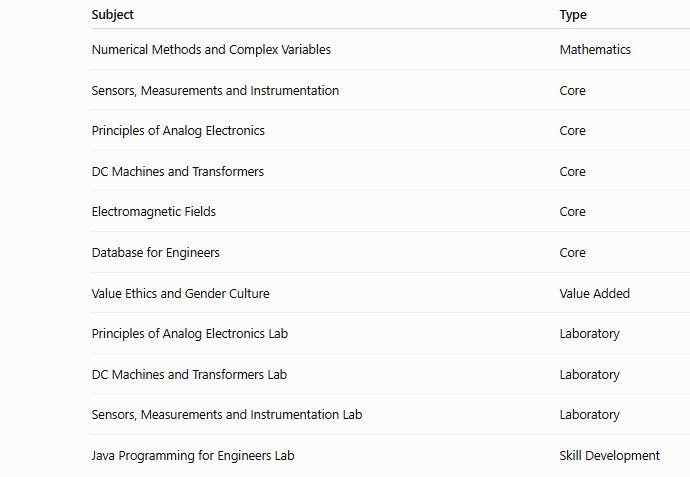
EEE 2nd Year – 3rd Semester
| Subject | Type |
|---|---|
| Numerical Methods and Complex Variables | Mathematics |
| Sensors, Measurements and Instrumentation | Core |
| Principles of Analog Electronics | Core |
| DC Machines and Transformers | Core |
| Electromagnetic Fields | Core |
| Database for Engineers | Core |
| Value Ethics and Gender Culture | Value Added |
| Principles of Analog Electronics Lab | Laboratory |
| DC Machines and Transformers Lab | Laboratory |
| Sensors, Measurements and Instrumentation Lab | Laboratory |
| Java Programming for Engineers Lab | Skill Development |
EEE 2nd Year – 4th Semester
| Subject | Type |
|---|---|
| Power Generation and Distribution | Core |
| AC Machines | Core |
| Control Systems | Core |
| Principles of Digital Electronics | Core |
| Microprocessors and Microcontrollers | Core |
| Environmental Science | Value Added |
| Principles of Digital Electronics Lab | Laboratory |
| AC Machines Lab | Laboratory |
| Control Systems Lab | Laboratory |
| PCB Design Lab | Skill Development |
These semesters establish the core EEE foundation in electrical machines, instrumentation, electronics and control systems.
EEE 3rd Year – 5th Semester
| Subject | Type |
|---|---|
| Power Transmission Systems | Core |
| Power Electronics | Core |
| Power System Protection | Core |
| Professional Elective-I | Elective |
| Open Elective-I | Elective |
| Effective Technical Communication | Humanities |
| Indian Knowledge System | Value Added |
| Power System Protection Lab | Laboratory |
| Power Electronics Lab | Laboratory |
| Microprocessors and Microcontrollers Lab | Laboratory |
| Field-Based Project/Internship | Project |
Professional Elective-I includes Wide Band Gap Power Devices, Solar and Wind Energy Systems, Electrical Machine Design and Operations Research.
EEE 3rd Year – 6th Semester
| Subject | Type |
|---|---|
| DSP-Based Electromechanical Systems | Core |
| Power System Analysis | Core |
| Economics and Accounting for Engineers | Management |
| Professional Elective-II | Elective |
| Open Elective-II | Elective |
| Power System Analysis Lab | Laboratory |
| DSP-Based Electrical Lab | Laboratory |
Professional Elective-II options include Modelling and Simulation of Power Electronic Converters, HVDC Transmission Systems, Advanced Control Systems and Operating Systems.
EEE 4th Year – 7th Semester
| Subject | Type |
|---|---|
| Power Semiconductor Drives | Core |
| Electric and Hybrid Vehicles | Core |
| Professional Elective-III | Elective |
| Professional Elective-IV | Elective |
| Fundamentals of Management and Entrepreneurship | Management |
| Open Elective-III | Elective |
| Power Semiconductor Drives Lab | Laboratory |
| Industry-Oriented Mini Project/Summer Internship | Project |
Professional Elective-III: Modern Power Electronics, High Voltage Engineering, Digital Control Systems, Industrial Automation.
Professional Elective-IV: Power Quality and FACTS, Utilization of Electrical Energy, Special Electrical Machines, VLSI Design.
EEE 4th Year – 8th Semester
| Subject | Type |
|---|---|
| Power System Monitoring and Control | Core |
| Professional Elective-V | Elective |
| Professional Elective-VI | Elective |
| Project Work | Major Project |
GRIET Mechanical Engineering Syllabus 2026
The Mechanical Engineering curriculum focuses on mechanics, thermodynamics, manufacturing, machine design, fluid mechanics, heat transfer, CAD/CAM, additive manufacturing and modern manufacturing technologies.
Mechanical 1st Year – 1st Semester
| Subject | Type |
|---|---|
| Linear Algebra and Function Approximation | Mathematics |
| Engineering Chemistry | Basic Science |
| Programming for Problem Solving | Engineering Science |
| Engineering Mechanics | Core/Engineering Science |
| Graphics for Engineers | Engineering Science |
| Engineering Chemistry Lab | Laboratory |
| Programming for Problem Solving Lab | Laboratory |
| Engineering Workshop | Practical |
| Innovation and Design Thinking | Management |
Mechanical 1st Year – 2nd Semester
| Subject | Type |
|---|---|
| Differential Equations and Vector Calculus | Mathematics |
| Advanced Engineering Physics | Basic Science |
| Thermodynamics | Core |
| English for Skill Enhancement | Humanities |
| Data Structures | Engineering Science |
| Python Programming | Engineering Science |
| Advanced Engineering Physics Lab | Laboratory |
| English Language and Communication Skills Lab | Laboratory |
| Data Structures Lab | Laboratory |
Mechanical 2nd Year – 3rd Semester
| Subject | Type |
|---|---|
| Kinematics of Machinery | Core |
| Metallurgy and Material Science | Core |
| Strength of Materials | Core |
| Basic Electrical and Electronics Engineering | Core |
| Manufacturing Engineering | Core |
| Metallurgy and Material Science Lab | Laboratory |
| Strength of Materials Lab | Laboratory |
| Manufacturing Engineering Lab | Laboratory |
| Data Analytics with R Programming for Engineers Lab | Skill Development |
| Value Ethics and Gender Culture | Value Added |
Mechanical 2nd Year – 4th Semester
| Subject | Type |
|---|---|
| Thermal Engineering | Core |
| Fluid Mechanics and Fluid Machines | Core |
| Dynamics of Machinery | Core |
| Probability, Statistics and Complex Variables | Mathematics |
| Manufacturing Technology and Metrology | Core |
| Thermal Engineering Lab | Laboratory |
| Fluid Mechanics and Fluid Machines Lab | Laboratory |
| Manufacturing Technology and Metrology Lab | Laboratory |
| Part Modelling and Assembly Development | Skill Development |
| Environmental Science | Value Added |
Mechanical 3rd Year – 5th Semester
| Subject | Type |
|---|---|
| Basic Machine Design | Core |
| Economics and Accounting for Engineers | Management |
| CAD/CAM | Core |
| Applied Thermodynamics | Core |
| Professional Elective-I | Elective |
| Open Elective-I | Elective |
| Computer Aided Modeling and Analysis Lab | Laboratory |
| Internet of Things Lab | Laboratory |
| Field-Based Project | Project |
| Indian Knowledge Systems | Value Added |
Professional Elective-I options include Robotics, Advanced Strength of Materials, Mechanical Vibrations and Industrial Internet of Things.
Mechanical 3rd Year – 6th Semester
| Subject | Type |
|---|---|
| Advanced Machine Design | Core |
| Heat Transfer | Core |
| Additive Manufacturing | Core |
| Professional Elective-II | Elective |
| Open Elective-II | Elective |
| Computer Aided Manufacturing | Laboratory |
| Heat Transfer Lab | Laboratory |
| Effective Technical Communication | Humanities |
| Additive Manufacturing Skill Course | Skill Development |
Professional Elective-II includes Mechanical Measurements, Material Characterization and Testing, Un-Conventional Machining Processes and Intelligent Manufacturing Systems.
Mechanical 4th Year – 7th Semester
| Subject | Type |
|---|---|
| Finite Element Analysis | Core |
| Instrumentation and Control Systems | Core |
| Professional Elective-III | Elective |
| Professional Elective-IV | Elective |
| Open Elective-III | Elective |
| Instrumentation and Control Systems Lab | Laboratory |
| CFD Lab | Laboratory |
| Mini Project with Internship | Project |
Professional Elective-III includes Renewable Energy Resources, Turbomachinery, Computational Fluid Dynamics and Electrical & Hybrid Vehicles.
Professional Elective-IV includes Tribology, Design for Manufacturing Assembly, Soft Computing Techniques in Mechanical Engineering and Artificial Intelligence in Mechanical Engineering.
Mechanical 4th Year – 8th Semester
| Subject | Type |
|---|---|
| Financial Management and Accounting | Core |
| Professional Elective-V | Elective |
| Professional Elective-VI | Elective |
| Project Work | Major Project |
Professional Elective-V includes Refrigeration and Air Conditioning, Power Plant Engineering, Automobile Engineering and Energy Conservation and Management.
Professional Elective-VI includes Production Planning and Control, Mechatronics, Microprocessors Applications in Manufacturing and Micro and Nano Manufacturing.
GRIET Civil Engineering Syllabus 2026
Civil Engineering students at GRIET study a mixture of structural engineering, surveying, construction, fluid mechanics, geotechnical engineering, environmental engineering, transportation and water resources.
Civil 1st Year – 1st Semester
| Subject | Type |
|---|---|
| Linear Algebra and Function Approximation | Mathematics |
| Engineering Chemistry | Basic Science |
| Programming for Problem Solving | Engineering Science |
| Engineering Workshop | Practical |
| Graphics for Engineers | Engineering Science |
| Elements of Civil Engineering Lab | Laboratory |
| Engineering Chemistry Lab | Laboratory |
| Programming for Problem Solving Lab | Laboratory |
| Design Thinking and Tinkering Lab | Skill Development |
Civil 1st Year – 2nd Semester
| Subject | Type |
|---|---|
| Differential Equations and Vector Calculus | Mathematics |
| Advanced Engineering Physics | Basic Science |
| English for Skill Enhancement | Humanities |
| Data Structures | Engineering Science |
| Engineering Mechanics | Engineering Science |
| Python Programming | Engineering Science |
| Data Structures Lab | Laboratory |
| English Language and Communication Skills Lab | Laboratory |
| Advanced Engineering Physics Lab | Laboratory |
Civil 2nd Year – 3rd Semester
| Subject | Type |
|---|---|
| Building Materials and Construction Planning | Core |
| Surveying and Geomatics | Core |
| Solid Mechanics-I | Core |
| Probability and Statistics | Mathematics |
| Fluid Mechanics | Core |
| Basic Electrical and Electronics Engineering | Core |
| Value Ethics and Gender Culture | Value Added |
| Surveying Lab | Laboratory |
| Solid Mechanics Lab | Laboratory |
Civil 2nd Year – 4th Semester
| Subject | Type |
|---|---|
| Solid Mechanics-II | Core |
| Engineering Geology | Core |
| Structural Analysis-I | Core |
| Economics and Accounting for Engineers | Management |
| Hydraulic Engineering | Core |
| Environmental Science | Value Added |
| Engineering Geology Lab | Laboratory |
| Computer Aided Design Lab | Laboratory |
| Fluid Mechanics and Hydraulic Machinery Lab | Laboratory |
| Digital Surveying Lab | Skill Development |
Civil 3rd Year – 5th Semester
| Subject | Type |
|---|---|
| Geotechnical Engineering | Core |
| Concrete Technology | Core |
| Hydrology and Water Resources Engineering | Core |
| Design of Reinforced Concrete Structures | Core |
| Professional Elective-I | Elective |
| Open Elective-I | Elective |
| Effective Technical Communication | Humanities |
| Geotechnical Engineering Lab | Laboratory |
| Concrete Technology Lab | Laboratory |
| Building Information Modelling Lab | Skill Development |
| Field-Based Project/Internship | Project |
Professional Elective-I includes Structural Analysis-II, Traffic Engineering and Management, Surface Hydrology and Pavement Materials.
Civil 3rd Year – 6th Semester
| Subject | Type |
|---|---|
| Design of Steel Structures | Core |
| Foundation Engineering | Core |
| Environmental Engineering | Core |
| Entrepreneurship and Project Management | Humanities |
| Professional Elective-II | Elective |
| Open Elective-II | Elective |
| Indian Knowledge Systems | Value Added |
| Environmental Engineering Lab | Laboratory |
| GIS Lab | Laboratory |
| Structural Detailing Lab | Skill Development |
Professional Elective-II includes Masonry Structures, Rock Mechanics, Open Channel Flow and Green Building Technology.
Civil 4th Year – 7th Semester
| Subject | Type |
|---|---|
| Estimation and Costing | Core |
| Transportation Engineering | Core |
| Professional Elective-III | Elective |
| Professional Elective-IV | Elective |
| Open Elective-III | Elective |
| Transportation Engineering Lab | Laboratory |
| Computer Applications in Structural Engineering Lab | Laboratory |
| Industry-Oriented Mini Project/Summer Internship | Project |
Professional Elective-III: Bridge Engineering, Ground Improvement Techniques, Groundwater and Tall Buildings.
Professional Elective-IV: Finite Element Methods, Port and Harbour Engineering, Physico-Chemical Processes for Water and Wastewater Treatment, Rehabilitation and Retrofitting of Structures.
Open Elective-III: Plumbing (Water and Sanitation).
Civil 4th Year – 8th Semester
| Subject | Type |
|---|---|
| Professional Elective-V | Elective |
| Professional Elective-VI | Elective |
| Project Work | Major Project |
Professional Elective-V: Design of Prestressed Concrete Structures, Urban Transportation and Planning, Design of Hydraulic Structures, Construction Project Planning and Systems.
Professional Elective-VI: Earthquake Engineering, Pavement Design, along with other prescribed departmental elective options.
GRIET Syllabus 2026: Subject-Wise Comparison
| Semester | CSE | EEE | Mechanical | Civil |
|---|---|---|---|---|
| 1 | Maths, Physics, Programming, CSE basics | Maths, Chemistry, Electrical fundamentals | Maths, Chemistry, Mechanics | Maths, Chemistry, Programming |
| 2 | Data Structures, Python, Electrical basics | Circuit Analysis, Data Structures | Thermodynamics, Data Structures | Mechanics, Data Structures, Python |
| 3 | Discrete Maths, Java, DBMS, Digital Logic | Machines, Analog Electronics, EM Fields | Kinematics, Strength, Manufacturing | Surveying, Fluid Mechanics, Solid Mechanics |
| 4 | OS, Networks, Algorithms, Full Stack | Power Systems, Control, Digital Electronics | Thermal, Fluid Mechanics, Manufacturing | Structural Analysis, Geology, Hydraulics |
| 5 | Software Engineering, ML, DevOps | Power Transmission, Power Electronics | Machine Design, CAD/CAM | Geotechnical, Concrete, Hydrology |
| 6 | Compiler Design, Deep Learning, IoT | Power System Analysis, DSP | Heat Transfer, Additive Manufacturing | Steel Structures, Foundation, Environmental Engineering |
| 7 | Big Data, Cyber Security, Electives | Drives, EVs, Advanced EEE Electives | FEA, Instrumentation, CFD | Estimation, Transportation, Structural Applications |
| 8 | Management, Electives, Project | Power System Monitoring, Electives, Project | Financial Management, Electives, Project | Electives and Major Project |
GRIET Syllabus 2026 PDF Download
Students should preferably download the official GR25 syllabus PDF rather than relying on third-party syllabus copies because GRIET maintains separate curriculum documents for different branches and regulations.
The institute’s official syllabus directory currently lists the GR25 PDFs for CSE, EEE, Civil Engineering and Mechanical Engineering, along with ECE, CSE-AIML, CSE-Data Science and CSBS.
Official GRIET syllabus portal: GRIET Syllabus – GR25 Official PDFs
Direct branch-wise PDFs
- GR25 CSE Syllabus PDF
- GR25 EEE Syllabus PDF
- GR25 Civil Engineering Syllabus PDF
- GR25 Mechanical Engineering Syllabus PDF
How to Prepare According to the GRIET Syllabus
A common mistake students make is waiting for examinations before opening the syllabus. The better approach is to use the semester-wise curriculum as a study roadmap.
For CSE: Give extra attention to programming, Data Structures, DBMS, Algorithms, OS, Networks, Full Stack Development, ML and Cyber Security.
For EEE: Build a strong foundation in circuit analysis, machines, electronics, control systems and power systems before moving to power electronics and advanced electrical applications.
For Mechanical: Do not study theory alone. Machine design, manufacturing, CAD/CAM, thermal engineering and laboratory work become much easier when concepts are connected with practical applications.
For Civil: Surveying, structural analysis, fluid mechanics, geotechnical engineering, concrete technology and environmental engineering require both conceptual understanding and numerical practice.
The GR25 curriculum also includes laboratories, projects, internships and skill-development courses, so students should not treat practical components as secondary subjects.
GRIET GR25 Exam and Evaluation Pattern
Under the GR25 regulations, courses are generally evaluated through 40 marks of Continuous Internal Evaluation and 60 marks of Semester End Examination. For theory courses, the semester-end examination is conducted for 60 marks. Practical courses also have CIE and semester-end evaluation components.
Students normally need at least 35% in the 60-mark semester-end examination and 40% overall in CIE + SEE to earn credits in a course.
The institute also requires students to maintain the prescribed attendance. The GR25 regulations specify 75% aggregate attendance, with limited condonation provisions for eligible cases.
Frequently Asked Questions on GRIET Syllabus 2026
Is GRIET Syllabus 2026 available for CSE?
Yes. GRIET has released the GR25 CSE curriculum applicable to batches admitted from 2025-26. It covers all eight semesters, including programming, DBMS, OS, networks, web development, ML, cybersecurity, electives and project work.
How many semesters are there in B.Tech at GRIET?
The B.Tech programme is of four years divided into eight semesters.
What is the minimum credit requirement?
Students need to earn at least 160 credits out of 164 credits to successfully complete the B.Tech programme under GR25.
Does GRIET provide separate syllabi for different branches?
Yes. The official GR25 directory provides separate PDFs for CSE, EEE, Civil, Mechanical and other B.Tech programmes.
Does the GRIET syllabus include practical subjects?
Yes. All four branches include laboratory courses, and senior semesters also include projects, internships or industry-oriented work.
Which GRIET CSE subjects are most important for placements?
Programming, Data Structures, DBMS, Operating Systems, Computer Networks, Algorithms, Full Stack Development and newer areas such as Machine Learning, Cloud Computing, Cyber Security and Generative AI are particularly useful for building placement-oriented skills.
Is the GR25 syllabus applicable to older batches?
No. The official documents specifically state that GR25 is applicable to batches admitted from 2025-26. Students from earlier admission years should check their applicable regulation, such as GR24 or GR22, rather than automatically following GR25.
About The Author
