
The IMD Scientific Assistant Syllabus 2026 is especially important for candidates preparing for the Staff Selection Commission (SSC) examination for the Scientific Assistant in India Meteorological Department (IMD). The 2026 recruitment has brought an important change compared with the older pattern: the examination is now conducted through two Computer-Based Examination papers, with Paper-I being qualifying in nature and Paper-II carrying the marks used for final merit.
Candidates applying for Scientific Assistant in IMD have to select one technical subject from Computer Science & Information Technology, Electronics & Telecommunication Engineering, or Physics, according to their educational qualification. The subject selected in the application form cannot subsequently be changed.
The following article explains the latest IMD Scientific Assistant Syllabus 2026, exam pattern, subject-wise syllabus, marking scheme and preparation strategy.
IMD Scientific Assistant Syllabus 2026: Overview
The Scientific Assistant post is included in the SSC 2026 examination, and the post belongs to Group B, Level-6 of the Pay Matrix, with the pay scale mentioned in the official notice as ₹35,400–₹1,12,400. Candidates need to have the prescribed science/technical qualification for the post.
| Particular | Details |
|---|---|
| Exam Conducting Body | Staff Selection Commission (SSC) |
| Department | India Meteorological Department (IMD) |
| Post | Scientific Assistant |
| Post Level | Group B, Level-6 |
| Exam Mode | Computer-Based Examination |
| Number of Papers | 2 |
| Paper-I | General Intelligence & Reasoning, General Awareness + Technical Subject |
| Paper-II | Technical Subject |
| Technical Subjects | CS & IT / Electronics & Telecommunication Engineering / Physics |
| Paper-I Marks | 200 |
| Paper-II Marks | 300 |
| Paper-I Duration | 2 Hours |
| Paper-II Duration | 2 Hours |
| Paper-I Status | Qualifying |
| Final Merit | Based on normalized Paper-II marks |
The official SSC notice states that Paper-I and Paper-II are objective-type multiple-choice examinations.
IMD Scientific Assistant Exam Pattern 2026
The IMD Scientific Assistant Exam Pattern 2026 consists of two papers. Unlike the older pattern often seen in previous recruitment cycles, candidates should prepare according to the 2026 SSC notice.
Paper-I Exam Pattern
Paper-I contains three components:
- General Intelligence & Reasoning
- General Awareness
- One technical subject selected by the candidate
For Scientific Assistant candidates, the technical subject is one of the following:
- Part-D: Computer Science & Information Technology
- Part-E: Electronics & Telecommunication Engineering
- Part-F: Physics
| Paper | Section | Questions | Marks | Duration |
|---|---|---|---|---|
| Paper-I | General Intelligence & Reasoning | 50 | 50 | 2 Hours |
| Paper-I | General Awareness | 50 | 50 | 2 Hours* |
| Paper-I | Technical Subject | 100 | 100 | 2 Hours* |
| Total | — | 200 | 200 | 2 Hours |
*The three components are part of the same Paper-I examination duration. Candidates eligible for compensatory time under the prescribed rules get additional time.
Paper-II Exam Pattern
Paper-II is completely based on the technical subject chosen by the candidate.
| Paper | Subject | Questions | Maximum Marks | Duration |
|---|---|---|---|---|
| Paper-II | CS & IT / Electronics & Telecommunication / Physics | 100 | 300 | 2 Hours |
Thus, each question in Paper-II effectively carries 3 marks.
The official notification specifies that Paper-I is qualifying in nature, while the normalized marks of Paper-II are used for determining final merit.
IMD Scientific Assistant Marking Scheme 2026
Candidates should pay close attention to negative marking because careless guessing can reduce the overall score.
| Paper | Correct Answer | Wrong Answer |
|---|---|---|
| Paper-I | +1 mark | -0.25 mark |
| Paper-II | +3 marks | -1 mark |
The SSC notification specifically prescribes 0.25 marks negative marking in Paper-I and 1 mark negative marking in Paper-II.
Important points
- Both papers contain objective-type MCQs.
- Questions are provided in Hindi and English.
- Paper-I is qualifying.
- Candidates are shortlisted for Paper-II on the basis of normalized Paper-I performance and the applicable qualifying criteria.
- Only normalized Paper-II marks are used for final merit.
- If an examination is conducted in multiple shifts, SSC will normalize the marks.
IMD Scientific Assistant Syllabus 2026: Subject-Wise
The syllabus is divided into the general sections and the technical subject selected by the candidate.
IMD Scientific Assistant General Intelligence & Reasoning Syllabus
The reasoning section checks how effectively a candidate can identify patterns, understand relationships and solve logical problems.
Important topics include:
- Analogy
- Similarities and differences
- Space visualization
- Problem solving
- Analysis
- Judgment
- Decision making
- Visual memory
- Discrimination
- Observation
- Relationship concepts
- Arithmetical reasoning
- Verbal classification
- Figure classification
- Number series
- Abstract ideas and symbols
- Symbolic relationships
- Arithmetical computation
- Analytical functions
SSC’s indicative syllabus specifically mentions both verbal and non-verbal reasoning areas.
Preparation tip
Do not spend too much time on a single reasoning question. Regular practice of previous-year questions and timed mock tests can make this section considerably easier.
IMD Scientific Assistant General Awareness Syllabus
General Awareness is designed to test the candidate’s awareness of India, the surrounding environment and important developments.
Major areas include:
- Current affairs
- Indian history
- Indian culture
- Geography
- Economic developments
- Indian polity
- Scientific research
- General scientific awareness
- India and neighbouring countries
- Everyday scientific observations
- Environmental awareness
The official syllabus says that questions are intended to test general awareness and knowledge of current events, along with India’s history, culture, geography, economic scene, general polity and scientific research.
How to prepare General Awareness
A practical approach is to divide preparation into three parts:
Static GK: History, Geography, Polity and basic science.
Current Affairs: Recent national and international developments, government initiatives, science and technology and important events.
Scientific Awareness: Basic concepts and developments related to science and technology.
Computer Science & Information Technology Syllabus
Candidates selecting Part-D: Computer Science & Information Technology should prepare the subject at approximately the graduation level. The official notification specifically places Computer Science & IT among the subjects whose questions are approximately at graduation level.
Important topics
| Unit | Major Topics |
|---|---|
| Engineering Mathematics | Discrete Mathematics, Linear Algebra, Calculus, Probability & Statistics |
| Digital Logic | Boolean Algebra, Combinational & Sequential Circuits, Number Representation |
| Computer Organization | ALU, Control Unit, Memory Hierarchy, I/O, Pipelining |
| Programming | C Programming, Recursion, Arrays, Linked Lists, Trees, Graphs |
| Data Structures | Stacks, Queues, Trees, Heaps, Graphs |
| Algorithms | Searching, Sorting, Hashing, Complexity, Greedy, Dynamic Programming |
| Theory of Computation | Automata, Regular Languages, CFG, PDA, Turing Machines |
| Compiler Design | Lexical Analysis, Parsing, Intermediate Code, Optimization |
| Operating Systems | Processes, Threads, Synchronization, Deadlock, Scheduling, Memory Management |
| Databases | ER Model, Relational Model, SQL, Normalization, Transactions |
| Computer Networks | OSI/TCP-IP, Ethernet, Routing, IP, TCP, UDP, DNS, HTTP, FTP |
These topics are directly reflected in the detailed syllabus issued by SSC.
Electronics & Telecommunication Engineering Syllabus
Candidates opting for Part-E: Electronics and Telecommunication Engineering have to prepare both electronics and telecommunications.
Electronics
Important areas include:
- Electronic materials and components
- Conductors and semiconductors
- Resistors, capacitors and inductors
- PN junction diode
- Zener diode
- Rectifiers
- Clippers and clampers
- BJT
- FET and MOSFET
- Transistor biasing
- Amplifiers
- Oscillators
- Voltage regulation
- Kirchhoff’s laws
- Thevenin’s theorem
- Norton’s theorem
- Maximum power transfer theorem
- AC circuits
- Three-phase circuits
- Resonance
- Digital electronics
- Logic gates
- Flip-flops
- Counters
- Shift registers
- ADC and DAC
Telecommunication
Important topics include:
- Antennas
- Directivity
- Radiation pattern
- Radio wave propagation
- Electromagnetic spectrum
- Amplitude Modulation
- Modulation index
- SSB
- Frequency Modulation
- Pulse Modulation
- Sampling theorem
- PAM, PWM and PPM
- PCM
- Multiplexing
- FDM and TDM
- Digital communication
- ASK, PSK and FSK
- Fibre optics
- RF communication
- Wireless telecommunications
- Satellite communication
The official syllabus covers these areas under Part-E.
Physics Syllabus
Physics is another technical option available to Scientific Assistant candidates. This section is broad, so students should avoid limiting preparation to only basic formulas.
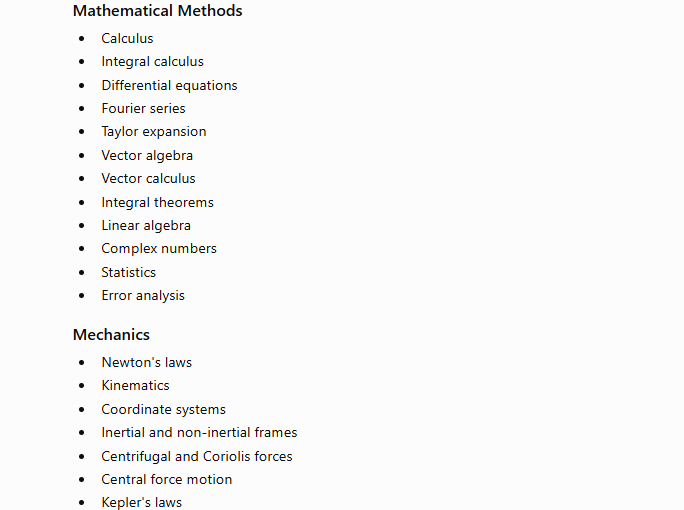
The syllabus includes the following major units:
Mathematical Methods
- Calculus
- Integral calculus
- Differential equations
- Fourier series
- Taylor expansion
- Vector algebra
- Vector calculus
- Integral theorems
- Linear algebra
- Complex numbers
- Statistics
- Error analysis
Mechanics
- Newton’s laws
- Kinematics
- Coordinate systems
- Inertial and non-inertial frames
- Centrifugal and Coriolis forces
- Central force motion
- Kepler’s laws
- Gravitation
- Conservation laws
- Collision
- Moment of inertia
- Rigid body dynamics
Properties of Matter
- Elasticity
- Surface tension
- Viscosity
- Fluid dynamics
- Equation of continuity
- Euler’s equation
- Bernoulli’s theorem
Oscillations and Waves
- Simple harmonic motion
- Damped oscillations
- Forced oscillations
- Resonance
- Quality factor
- Wave equation
- Travelling and standing waves
- Phase and group velocity
- Sound waves
- Doppler effect
Optics
- Reflection
- Refraction
- Mirrors and lenses
- Interference
- Diffraction
- Rayleigh criterion
- Resolving power
- Diffraction grating
- Polarization
Electricity and Magnetism
- Coulomb’s law
- Electric field
- Electric potential
- Gauss’s law
- Capacitors
- DC circuits
- AC circuits
- Magnetic field
- Ampere’s law
- Lorentz force
- Electromagnetic induction
- Faraday’s law
- Maxwell’s equations
- Electromagnetic waves
Thermodynamics
- Laws of thermodynamics
- Isothermal and adiabatic processes
- Entropy
- Carnot cycle
- Heat engines
- Maxwell’s relations
- Phase transitions
- Statistical distributions
Modern Physics
- Special relativity
- Black-body radiation
- Photoelectric effect
- Compton effect
- de Broglie waves
- Uncertainty principle
- X-rays
- Schrödinger equation
- Bohr atom
- Atomic spectra
- Nuclear physics
- Radioactivity
Solid State and Electronics
- Crystal structures
- Bravais lattices
- Miller indices
- X-ray diffraction
- Band theory
- Conductors
- Semiconductors
- Insulators
- PN junction
- Zener diode
- BJT
- Analog electronics
- Digital electronics
- Operational amplifiers
- Logic gates
The official SSC syllabus covers these Physics areas under Part-F.
Paper-I vs Paper-II: What Candidates Should Understand
One of the most important things to understand is the difference between the two papers.
Paper-I is essentially the screening stage. It contains General Intelligence & Reasoning, General Awareness and the selected technical subject. Its normalized marks are used to shortlist candidates for Paper-II.
Paper-II is the deciding technical paper. It consists of 100 questions carrying 300 marks, and its normalized score is used for final merit.
Therefore, candidates should not treat Paper-I as unimportant simply because it is qualifying. A weak Paper-I score can prevent a candidate from reaching Paper-II.
How to Prepare for IMD Scientific Assistant Syllabus 2026?
A good preparation strategy should balance the general and technical sections.
Step 1: Select your technical subject carefully
Scientific Assistant candidates have to choose one of Part-D, Part-E or Part-F based on their eligible educational stream. SSC clearly states that the subject selected during application cannot be changed later.
So, candidates should select the subject in which they have the strongest academic foundation.
Step 2: Complete the technical syllabus first
Technical subjects carry substantial weight in the examination. Start with the fundamental concepts and gradually move towards numerical and application-based questions.
For example:
- Physics students should revise undergraduate Physics systematically.
- CS students should give special attention to data structures, algorithms, OS, DBMS and networks.
- Electronics students should focus on electronic devices, circuits, digital electronics, communication and related fundamentals.
Step 3: Practice MCQs every day
Reading theory alone is not enough. After completing each topic, solve objective questions.
A useful daily routine could be:
| Activity | Suggested Time |
|---|---|
| Technical theory | 3 hours |
| Technical MCQs | 1.5 hours |
| Reasoning | 45 minutes |
| General Awareness | 45 minutes |
| Revision | 1 hour |
| Mock/PYQ practice | 1 hour |
The exact schedule can be adjusted according to your background.
Step 4: Make short revision notes
For technical subjects, prepare short notes containing:
- Important formulas
- Definitions
- Important concepts
- Common mistakes
- Short tricks
- Frequently asked facts
These notes become particularly useful during the final revision.
Step 5: Take full-length mock tests
Once a reasonable portion of the syllabus is complete, start taking timed tests. The purpose is not just to check your score but also to identify:
- Topics where accuracy is low
- Questions taking too much time
- Frequently forgotten formulas
- Weak technical units
- Guessing habits
IMD Scientific Assistant Preparation: Which Topics Should You Prioritise?
Since the technical syllabus is extensive, studying everything with equal intensity from day one may not be the most efficient approach.
For Physics
Give special attention to:
- Mechanics
- Electricity and Magnetism
- Thermodynamics
- Waves and Oscillations
- Optics
- Modern Physics
- Semiconductor Devices
- Mathematical Methods
For Computer Science & IT
Prioritise:
- Data Structures
- Algorithms
- DBMS
- Operating Systems
- Computer Networks
- Digital Logic
- Computer Organization
- Programming
- Theory of Computation
- Engineering Mathematics
For Electronics & Telecommunication
Prioritise:
- Electronic Devices
- Analog Circuits
- Digital Electronics
- Network Theory
- Communication Systems
- Antennas
- Electromagnetic Waves
- Signals and related fundamentals
- Semiconductor devices
- Telecommunication
These priorities should be used as a preparation strategy rather than treated as an official SSC topic-wise weightage, because the notification does not provide a fixed chapter-wise question distribution.
IMD Scientific Assistant Syllabus 2026 PDF
Candidates should always prefer the official SSC notification/syllabus when downloading or verifying the syllabus. The 2026 official notice contains the examination scheme and detailed indicative syllabus for the technical parts.
The official 2026 notice confirms that the Scientific Assistant examination has Paper-I and Paper-II, with separate technical options for Computer Science & IT, Electronics & Telecommunication Engineering and Physics.
IMD Scientific Assistant Exam 2026: Important Points
Before beginning preparation, candidates should remember these points:
- The examination is conducted by SSC.
- Scientific Assistant in IMD is a Group B, Level-6 post.
- The examination has two CBT papers.
- Paper-I carries 200 marks.
- Paper-II carries 300 marks.
- Paper-I is qualifying in nature.
- Paper-II marks determine final merit.
- Paper-I has 0.25-mark negative marking.
- Paper-II has 1-mark negative marking.
- Candidates must choose one technical subject.
- Technical options are CS & IT, Electronics & Telecommunication Engineering and Physics.
- The selected technical subject cannot be changed later.
- Paper-II questions are at approximately graduation level for these IMD technical subjects.
FAQs on IMD Scientific Assistant Syllabus 2026
What is the IMD Scientific Assistant syllabus for 2026?
The syllabus consists of General Intelligence & Reasoning, General Awareness and a technical subject in Paper-I, followed by a technical Paper-II. The technical subject can be Computer Science & IT, Electronics & Telecommunication Engineering or Physics.
How many questions are asked in IMD Scientific Assistant Paper-I?
Paper-I contains 200 questions: 50 General Intelligence & Reasoning, 50 General Awareness and 100 questions from the selected technical subject.
How many marks is Paper-II?
Paper-II consists of 100 questions for 300 marks and is based entirely on the technical subject selected by the candidate.
Is there negative marking in the IMD Scientific Assistant exam?
Yes. There is a negative marking of 0.25 marks for each wrong answer in Paper-I and 1 mark for each wrong answer in Paper-II.
Is Paper-I qualifying in nature?
Yes. SSC states that Paper-I is qualifying in nature and candidates are shortlisted for Paper-II based on their normalized Paper-I performance and applicable qualifying requirements.
Which subjects can be selected for Scientific Assistant IMD?
Candidates applying for Scientific Assistant in IMD can choose one of three subjects: Computer Science & Information Technology, Electronics & Telecommunication Engineering, or Physics, subject to their prescribed educational qualification.
What is the level of the technical syllabus?
For Computer Science & IT, Electronics & Telecommunication Engineering and Physics, SSC specifies that the questions are approximately at the graduation level.
Final Takeaway
The IMD Scientific Assistant Syllabus 2026 is broader and more technical than a typical SSC general recruitment examination. Candidates need to prepare both the common sections and their chosen technical discipline. The biggest change to keep in mind is the two-paper structure, where Paper-I acts as the qualifying/shortlisting stage and Paper-II, carrying 300 marks, plays the decisive role in final merit.
For serious preparation, candidates should therefore spend most of their study time building strong command over their selected technical subject while maintaining consistent practice in Reasoning and General Awareness. Most importantly, prepare from the latest SSC notice rather than relying blindly on older IMD Scientific Assistant exam patterns circulating online.
About The Author
