
The PSSSB Group D Syllabus 2026 is an important resource for candidates preparing for Punjab Subordinate Services Selection Board Group D recruitment. The examination tests candidates mainly on Punjabi language, General Knowledge and Current Affairs, Punjab history and culture, logical reasoning and mental ability, English, and Information communication technology (ICT).
PSSSB Group D Syllabus 2026: Highlights
| Particular | Details |
|---|---|
| Exam Conducting Body | Punjab Subordinate Services Selection Board (PSSSB) |
| Exam | PSSSB Group D |
| Advertisement | No. 08 of 2025 |
| Exam Cycle | 2026 |
| Exam Mode | Offline/OMR-based |
| Question Type | Objective-type MCQs |
| Total Questions | 150 |
| Total Marks | 150 |
| Part A | Punjabi Language, Qualifying |
| Part B | GK, Punjab History, Reasoning, Punjabi, English & ICT |
| Part A Duration | 30 minutes |
| Part B Duration | 2 hours |
| Negative Marking | 0.25 mark for each wrong answer in Part B |
| Part A Qualifying Marks | 25 out of 50 |
| Merit | Based on Part B marks |
The 2026 paper analysis confirms that Part A contained 50 Punjabi questions, while Part B contained 100 questions. Candidates had to secure at least 50% marks in Part A for their Part B responses to be evaluated.
PSSSB Group D Exam Pattern 2026
Understanding the exam pattern before starting preparation can save a lot of time. The paper is essentially divided into two stages within the written examination.
Part A – Punjabi Language
Part A consists of 50 questions for 50 marks. It is qualifying in nature, meaning these marks do not determine the final merit position. Candidates need to score at least 25 marks to qualify.
There is no negative marking in Part A.
Part B – Main Merit-Based Paper
Part B carries 100 questions for 100 marks. It includes six subjects and carries negative marking of 0.25 mark for every incorrect answer. The merit list is prepared using marks obtained in this section after qualifying Part A.
PSSSB Group D Exam Pattern
| Part | Subject | Questions | Marks | Duration |
|---|---|---|---|---|
| Part A | Punjabi Language | 50 | 50 | 30 minutes |
| Part B | General Knowledge & Current Affairs | 25 | 25 | 2 hours |
| Part B | Punjab History & Culture | 17 | 17 | 2 hours |
| Part B | Logical Reasoning & Mental Ability | 25 | 25 | 2 hours |
| Part B | Punjabi Language | 13 | 13 | 2 hours |
| Part B | English Language | 12 | 12 | 2 hours |
| Part B | ICT | 8 | 8 | 2 hours |
| Total | — | 150 | 150 | 2 hours 30 minutes |
The section-wise distribution above matches the structure reported for the April 5, 2026 Group D paper.
PSSSB Group D Syllabus 2026: Subject-Wise Topics
1. Punjabi Language – Part A
This is the qualifying section, but candidates should not take it lightly. Missing the minimum qualifying score means Part B will not be considered.
Important topics include:
- Punjabi grammar
- Punjabi vocabulary
- Synonyms and antonyms
- Word formation
- Prefixes and suffixes
- Singular and plural
- Masculine and feminine
- Nouns
- Pronouns
- Verbs
- Conjunctions
- Idioms
- Punctuation
- Punjabi numbers
- Punjabi months
- Punjabi dialects
- Punjabi traditions
- Important Sikh Gurus and their writings
- Basic Punjab history and culture
The April 2026 paper included questions on Punjabi months, dialects, punctuation, word formation, idioms, grammatical categories, prefixes/suffixes, gender and number, among other areas.
How to prepare Part A
The best approach is regular revision rather than trying to learn everything in the final few days. Candidates should practise Punjabi grammar questions daily and revise commonly used idioms, synonyms, antonyms and grammatical rules.
2. General Knowledge & Current Affairs
This section carries 25 questions, making it one of the highest-weightage sections in Part B.
Important topics
- Current affairs
- National events
- International events
- Indian polity
- Indian Constitution
- Modern Indian history
- Geography
- General science
- Environment
- Important organisations
- Government schemes
- Awards and honours
- Sports
- Books and authors
- Important days
- National and international institutions
- Punjab-related current affairs
The April 2026 paper included questions from current affairs, modern history, science, Constitution, geography, international organisations and Indian institutions.
Preparation tip
Instead of reading several newspapers from cover to cover, candidates can maintain a monthly current-affairs notebook. Give extra attention to Punjab-specific news and government schemes, as these are particularly relevant to a Punjab state-level examination.
3. Punjab History and Culture
Punjab History and Culture carries 17 questions in Part B.
This is an area where focused preparation can make a noticeable difference.
Important topics
- Ancient Punjab
- Medieval Punjab
- Modern Punjab
- Punjab’s geographical features
- Important rivers
- Sikh Gurus
- Sikh history
- Punjab’s religious and cultural heritage
- Important historical places
- Shrines and monuments
- Mughal period
- Punjab’s role in the freedom movement
- Important personalities
- Punjabi literature
- Authors and literary works
- Bhakti and Sufi traditions
- Folk traditions and culture
The actual 2026 paper included questions related to ancient history, Punjab history, Gurus, rivers, shrines, Mughal history and the freedom struggle.
Tip: Make separate short notes for important dates, personalities, movements, historical places and events. These facts are easier to revise repeatedly.
4. Logical Reasoning and Mental Ability
Reasoning is another major section, with 25 questions.
Important topics
- Analogy
- Classification
- Number series
- Alphabet series
- Coding-decoding
- Direction sense
- Ranking
- Syllogism
- Statement-based questions
- Seating arrangement
- Simple puzzles
- Data interpretation
- Basic numerical reasoning
- Percentage
- HCF and LCM
- Calculations
- Logical relationships
The April 2026 paper had considerable emphasis on seating arrangement, along with analogy, data interpretation, series, coding-decoding, direction, syllogism and basic numerical questions.
How to score well
Reasoning improves mainly through practice. Rather than spending hours reading theory, solve questions with a timer. Start with analogy, classification, series and coding-decoding before moving to seating arrangements and puzzles.
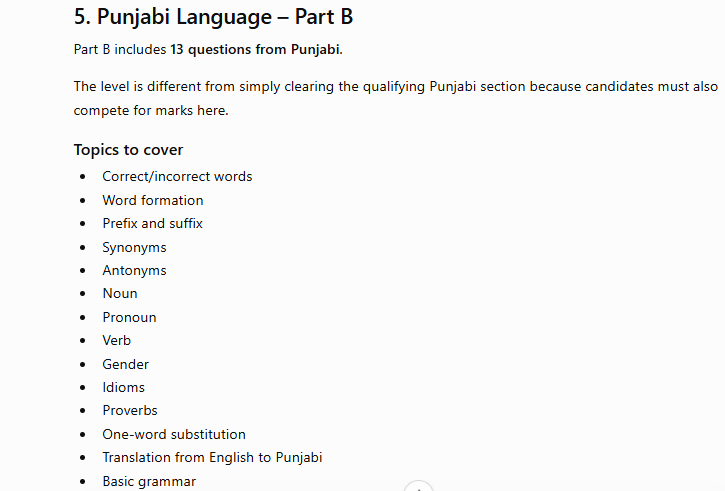
5. Punjabi Language – Part B
Part B includes 13 questions from Punjabi.
The level is different from simply clearing the qualifying Punjabi section because candidates must also compete for marks here.
Topics to cover
- Correct/incorrect words
- Word formation
- Prefix and suffix
- Synonyms
- Antonyms
- Noun
- Pronoun
- Verb
- Gender
- Idioms
- Proverbs
- One-word substitution
- Translation from English to Punjabi
- Basic grammar
The 2026 paper included questions involving gender, idioms, proverbs, spelling, one-word substitution, prefixes/suffixes, synonyms, antonyms and grammatical categories.
6. English Language
The English section carries 12 questions.
Important topics
- Basic grammar
- Subject-verb agreement
- Nouns
- Pronouns
- Verbs
- Adjectives
- Adverbs
- Articles
- Prepositions
- Synonyms
- Antonyms
- One-word substitution
- Idioms and phrases
- Spellings
- Sentence correction
- Active and passive voice
- Direct and indirect speech
- Fill in the blanks
The 2026 paper included questions from idioms, one-word substitution, spelling errors, verbs, prepositions, synonyms and antonyms.
For candidates who are not comfortable with English, starting with grammar rules and vocabulary is usually more productive than immediately attempting difficult comprehension exercises.
7. Information & Communication Technology (ICT)
ICT carries 8 questions, so it is a relatively small section but can be useful for scoring easy marks.
PSSSB Group D ICT syllabus
- Basics of computers
- Computer hardware
- Input and output devices
- Computer memory
- Operating systems
- MS Word
- MS Excel
- MS PowerPoint
- Internet
- Internet protocols
- Computer networks
- Network topology
- Basic digital technology
Questions in the April 2026 paper covered areas such as PowerPoint, Excel functions, computer memory, Internet protocols, input-output devices, MS Word and network topology.
Preparation tip: Do not devote an excessive amount of time to advanced computer science. Focus on basic computer awareness and commonly used office applications.
PSSSB Group D Syllabus: Most Important Sections
If you are trying to prioritise your preparation, look at the Part B distribution first.
| Subject | Marks | Priority |
|---|---|---|
| General Knowledge & Current Affairs | 25 | Very High |
| Logical Reasoning & Mental Ability | 25 | Very High |
| Punjab History & Culture | 17 | High |
| Punjabi | 13 | Moderate |
| English | 12 | Moderate |
| ICT | 8 | Moderate |
| Total | 100 | — |
GK/Current Affairs and Reasoning together account for 50 marks, so these two sections deserve consistent preparation. At the same time, Punjab History and Culture should not be ignored because it contributes another 17 marks.
How to Prepare for PSSSB Group D Exam 2026?
A simple and realistic preparation plan is better than collecting dozens of books and study materials.
Step 1: Finish the basic syllabus
First, divide the syllabus into small topics. For example, complete percentage, ratio and basic calculations before moving to more complicated reasoning or numerical questions.
Step 2: Give Punjabi daily practice
Since Part A is compulsory, spend some time every day on Punjabi grammar and vocabulary. Your first target should be comfortably crossing the 25-mark qualifying requirement, rather than merely aiming for 25.
Step 3: Build Punjab GK notes
Prepare short notes on:
- Punjab history
- Important personalities
- Gurus
- Rivers
- Districts
- Important places
- Culture
- Literature
- Freedom movement
Revise these notes repeatedly.
Step 4: Practise reasoning with a timer
Reasoning questions can consume considerable time, particularly puzzles and seating arrangements. Practising under timed conditions helps you identify which questions should be attempted first.
Step 5: Revise current affairs
Cover important national, international and Punjab current affairs. Monthly revision is more effective than trying to memorise an entire year’s news in one sitting.
Step 6: Attempt mock tests
Once you have completed most of the syllabus, start taking full-length mock tests. After each test, spend time analysing wrong answers.
Ask yourself:
- Was the question unfamiliar?
- Did I make a calculation mistake?
- Did I misunderstand the question?
- Did I spend too much time on it?
- Was the answer a careless error?
This analysis is often more valuable than simply taking another mock test.
PSSSB Group D Preparation Strategy: A Simple Daily Timetable
Candidates preparing from scratch can follow a timetable such as this:
| Study Area | Suggested Time |
|---|---|
| Punjabi | 45 minutes |
| GK & Current Affairs | 60 minutes |
| Punjab History & Culture | 45 minutes |
| Reasoning | 60 minutes |
| English | 30 minutes |
| ICT | 20 minutes |
| Previous Questions/Mock Test | 40 minutes |
The exact schedule can obviously be adjusted according to your strengths and weaknesses.
PSSSB Group D Selection Process
For the Group D recruitment cycle associated with Advertisement No. 08 of 2025, the selection process centred on the written examination followed by document verification. The written paper was conducted in the offline format.
A candidate should therefore focus on two things:
- Qualify Part A in Punjabi.
- Maximise the Part B score, since Part B determines merit after Part A qualification.
PSSSB Group D Syllabus 2026: Key Points to Remember
Before starting your preparation, keep these points in mind:
- The written examination has 150 questions.
- There are 150 marks in total.
- Part A contains 50 Punjabi questions.
- Part A is qualifying in nature.
- Candidates need at least 25 marks in Part A.
- There is no negative marking in Part A.
- Part B contains 100 questions.
- Part B carries 0.25 negative marking for each wrong answer.
- GK and Reasoning carry 25 marks each.
- Punjab History and Culture carries 17 marks.
- Punjabi, English and ICT carry 13, 12 and 8 marks, respectively.
- Merit is prepared using Part B marks after qualifying Part A.
Final Takeaway
The PSSSB Group D Syllabus 2026 is not excessively difficult, but the competition makes smart preparation important. Candidates should not make the mistake of preparing only General Knowledge. Punjabi is essential for clearing Part A, while GK, Current Affairs, Reasoning and Punjab History & Culture are particularly important for building a strong Part B score.
The best strategy is straightforward: understand the syllabus, prepare Punjab-specific topics thoroughly, practise reasoning regularly, revise current affairs and take mock tests under exam-like conditions. Also remember that the April 2026 Group D examination provides useful insight into the actual distribution of questions, but candidates preparing for a subsequent recruitment should follow the latest PSSSB notification if the Board changes the pattern.
FAQs
Q1. How many questions are there in the PSSSB Group D exam?
The 2026 Group D paper had 150 questions: 50 in Part A and 100 in Part B.
Q2. What is the qualifying mark for PSSSB Group D Part A?
Candidates need to score at least 25 marks out of 50, or 50%, in Part A.
Q3. Is there negative marking in PSSSB Group D?
Yes. In the 2026 examination structure, 0.25 marks were deducted for each incorrect answer in Part B. Part A had no negative marking.
Q4. Which subjects are included in Part B?
Part B includes General Knowledge & Current Affairs, Punjab History and Culture, Logical Reasoning & Mental Ability, Punjabi, English and ICT.
Q5. Which subjects carry the highest weightage?
General Knowledge & Current Affairs and Logical Reasoning & Mental Ability carry the highest weightage, with 25 marks each.
About The Author

Brajesh
Brajesh (MCA, M.Tech (IT)) is a passionate education and career content creator with a strong academic background in Computer Applications (MCA) and Technology (M.Tech). With years of hands-on experience in exam preparation strategies, syllabus analysis, and government job updates, he helps students and aspirants navigate their academic and professional journeys with clarity and confidence.