
Choosing the best bank in India in 2026 is not as simple as looking at the highest interest rate or the largest number of branches. For most customers, things like digital banking, branch availability, loan options, customer service, deposit safety, fees, technology and the bank’s overall financial strength matter much more.
India’s banking sector has also changed considerably in recent years. Public-sector banks have improved their asset quality and profitability, while large private banks continue to compete aggressively on technology, retail banking and digital services. According to SBI’s FY2026 annual report, the banking system recorded healthy growth, while public-sector banks reported improving capital adequacy and low net NPAs.
Based on a combination of size, financial strength, customer reach, digital services, product range, reputation and overall usefulness, here is a practical list of the top 10 banks in India in 2026.
Note: This is an editorial ranking, not an official ranking issued by the RBI. The “best” bank can differ depending on whether you need a savings account, home loan, business account, salary account, FD or digital banking.
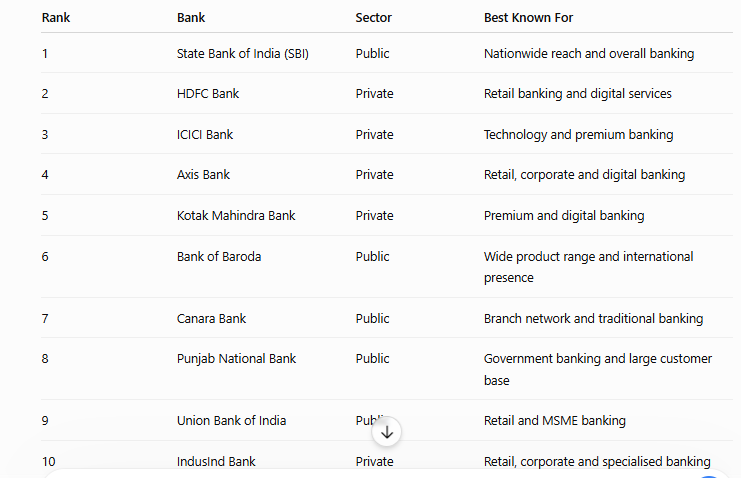
Top 10 Best Banks in India 2026
| Rank | Bank | Sector | Best Known For |
|---|---|---|---|
| 1 | State Bank of India (SBI) | Public | Nationwide reach and overall banking |
| 2 | HDFC Bank | Private | Retail banking and digital services |
| 3 | ICICI Bank | Private | Technology and premium banking |
| 4 | Axis Bank | Private | Retail, corporate and digital banking |
| 5 | Kotak Mahindra Bank | Private | Premium and digital banking |
| 6 | Bank of Baroda | Public | Wide product range and international presence |
| 7 | Canara Bank | Public | Branch network and traditional banking |
| 8 | Punjab National Bank | Public | Government banking and large customer base |
| 9 | Union Bank of India | Public | Retail and MSME banking |
| 10 | IndusInd Bank | Private | Retail, corporate and specialised banking |
1. State Bank of India (SBI)
State Bank of India
When Indians talk about banking, SBI is difficult to ignore. It remains one of the country’s most widely recognised banking institutions, particularly because of its enormous branch and ATM network.
SBI is a strong choice for customers who want a bank with a substantial physical presence. This can be particularly useful for people living in smaller cities and towns where digital-only banking may not be enough.
The bank offers savings accounts, fixed deposits, home loans, personal loans, education loans, business banking, insurance and investment-related products.
SBI’s FY2026 annual report noted that the overall banking sector remained healthy, with public-sector banks reporting improved capital adequacy and relatively low net NPA levels.
Why SBI is among the best
- Very large branch network
- Strong presence across India
- Wide range of banking products
- Strong government and institutional banking presence
- Useful for customers who prefer branch banking
- Extensive ATM and digital banking infrastructure
Best suited for: General banking, senior citizens, rural customers, salaried employees, students and customers who value branch accessibility.
2. HDFC Bank
HDFC Bank has traditionally been one of India’s most important private-sector banks, particularly in retail banking.
The bank has built a large customer base through savings accounts, credit cards, personal loans, home loans, vehicle finance and business banking.
However, 2026 has been an unusual year for HDFC Bank. The bank has faced leadership and governance-related scrutiny following the resignation of CEO Sashidhar Jagdishan and earlier changes at the board level.
That doesn’t automatically make the bank a poor choice for customers, but it is something readers should be aware of when evaluating the bank in 2026.
Why HDFC Bank remains a top bank
- Large retail customer base
- Strong digital banking ecosystem
- Extensive credit-card portfolio
- Wide range of loans
- Large branch network
- Strong corporate and retail banking operations
Best suited for: Salaried professionals, retail customers, credit-card users, home-loan customers and digital banking users.
3. ICICI Bank
ICICI Bank
ICICI Bank is arguably one of the strongest all-round private banks in India in 2026.
Its biggest strengths are technology, digital banking, retail products and a broad financial-services ecosystem.
The bank reported total deposits of approximately ₹18.34 lakh crore and a loan portfolio of about ₹16.31 lakh crore as of June 30, 2026. Its net NPA ratio was 0.35%, while its total capital adequacy ratio stood at 16.84%.
The bank has also attracted attention for strong operating performance. Recent research highlighted improvements in productivity and employee retention, while ICICI was also one of the biggest beneficiaries of FCNR(B) deposit mobilisation in 2026.
Key strengths
- Excellent mobile and internet banking
- Strong retail banking franchise
- Wide range of financial products
- Strong asset quality
- Good digital customer experience
- Strong corporate and international presence
Best suited for: Digital-first customers, salaried professionals, high-value customers, borrowers and people looking for a broad financial-services ecosystem.
4. Axis Bank
Axis Bank
Axis Bank has grown into one of India’s largest private-sector lenders. It serves retail customers, businesses, large corporations and institutional clients.
The bank’s product portfolio includes savings accounts, salary accounts, credit cards, personal loans, home loans, vehicle loans, business banking and investment services.
Its large physical and digital network makes it a fairly balanced choice for customers who want both online convenience and branch support.
Why Axis Bank makes the list
- Strong private-sector banking franchise
- Good digital banking facilities
- Large credit-card business
- Extensive retail loan portfolio
- Corporate banking capabilities
- Wide branch network
Best suited for: Salaried employees, credit-card users, retail borrowers and business customers.
5. Kotak Mahindra Bank
Kotak Mahindra Bank
Kotak Mahindra Bank has positioned itself differently from some of the larger mass-market banks. It has a particularly strong presence in premium banking, wealth management and corporate financial services.
It is also one of the banks attracting considerable attention from investors and analysts in 2026. Goldman Sachs identified ICICI Bank and Kotak Mahindra Bank as its top banking picks in its coverage of Indian banks.
For customers, however, investment ratings should not be the only consideration. Account charges, services, branch availability and specific product terms should be compared before opening an account.
Key strengths
- Premium banking
- Wealth management
- Strong corporate banking
- Digital banking
- Investment and financial-services ecosystem
- Personalised banking options
Best suited for: Affluent customers, professionals, entrepreneurs and customers interested in premium banking services.
6. Bank of Baroda
Bank of Baroda
Bank of Baroda, commonly known as BoB, is one of India’s major public-sector banks.
Its strength is the combination of a large domestic network and an international presence. It offers retail banking, corporate banking, MSME loans, agricultural banking, home loans, personal loans and other financial services.
For customers who prefer a traditional public-sector bank but still want modern digital services, Bank of Baroda can be an attractive option.
Major advantages
- Large branch network
- Strong government banking presence
- Retail and MSME products
- International operations
- Home and personal loan products
- Digital banking facilities
Best suited for: Families, MSMEs, government employees and customers looking for a public-sector bank.
7. Canara Bank
Canara Bank
Canara Bank is another major public-sector lender with a substantial presence across India.
It is particularly relevant for customers who prefer physical branches and traditional banking services alongside digital facilities.
The bank also continues to adjust its products according to market conditions. For example, Canara Bank revised its savings-account interest rates effective September 5, 2026, with rates varying according to balance slabs.
This is a useful reminder that customers should check the latest applicable rate and charges rather than relying on older comparisons.
Key strengths
- Large branch network
- Public-sector banking
- Retail loans
- Agricultural and MSME banking
- Savings and deposit products
- Digital banking services
Best suited for: Retail customers, pensioners, farmers, MSMEs and customers who value branch banking.
8. Punjab National Bank (PNB)
Punjab National Bank
Punjab National Bank is one of India’s oldest and largest public-sector banks.
PNB has a particularly strong presence in government-linked banking, retail banking, agriculture, MSMEs and corporate banking.
The bank’s size also gives it a broad product portfolio covering deposits, loans, credit cards, business banking and other financial services.
Why PNB remains a leading bank
- Large customer base
- Extensive branch network
- Government banking services
- MSME and agricultural lending
- Retail banking
- Digital banking facilities
Best suited for: Government employees, pensioners, farmers, MSMEs and traditional banking customers.
9. Union Bank of India
Union Bank of India
Union Bank of India has become an important player among India’s public-sector lenders.
The bank offers savings and current accounts, fixed deposits, personal loans, home loans, education loans, MSME finance and corporate banking services.
Its scale and public-sector backing make it an option worth considering, particularly for customers who don’t necessarily need the premium features of a large private bank.
Key strengths
- Public-sector banking
- Wide product portfolio
- Retail and MSME lending
- Agricultural banking
- Corporate banking
- Physical branch network
Best suited for: Retail customers, MSMEs, agricultural customers and people who prefer PSU banks.
10. IndusInd Bank
IndusInd Bank
IndusInd Bank completes our top 10 list.
It has a strong presence in retail and corporate banking and has historically focused on products for individuals, businesses and affluent customers.
It is smaller than giants such as SBI, HDFC Bank and ICICI Bank, but size alone doesn’t determine whether a bank is appropriate for a particular customer.
For someone looking for private-sector services beyond the largest three or four banks, IndusInd can be considered alongside other private lenders.
Key strengths
- Retail banking
- Corporate banking
- Digital banking
- Vehicle and business finance
- Premium banking services
Best suited for: Retail customers, entrepreneurs and corporate customers.
Public Sector vs Private Sector Banks in India
One of the most common questions is whether a public-sector bank or private-sector bank is better.
The answer depends largely on what you expect from your bank.
| Factor | Public Sector Banks | Private Sector Banks |
|---|---|---|
| Branch reach | Usually very strong | Strong, especially in cities |
| Digital experience | Improving rapidly | Generally strong |
| Customer service | Varies by branch | Often more standardised |
| Government-related banking | Strong | Limited |
| Rural presence | Very strong | Moderate to strong |
| Technology | Improving | Usually a major strength |
| Premium services | Available | Generally stronger |
| MSME/agriculture | Strong | Also significant |
| Account charges | Product dependent | Product dependent |
| Best for | Broad accessibility | Digital & premium experience |
It is therefore too simplistic to say that private banks are always better or that public-sector banks are always safer.
Which Is the No. 1 Bank in India in 2026?
If the ranking is based on overall reach, scale, product availability and nationwide accessibility, State Bank of India is the strongest candidate for the No. 1 position.
If the focus is instead on private-sector digital and retail banking, ICICI Bank, HDFC Bank and Axis Bank are among the leading choices.
There is also an important distinction between “best bank for customers” and “best bank for investors.” A bank that is attractive from an investment perspective may not necessarily offer the best savings account or customer service for every individual.
Best Bank in India 2026 for Different Needs
| Requirement | Bank to Consider |
|---|---|
| Overall banking | SBI |
| Private-sector banking | ICICI Bank |
| Digital banking | ICICI Bank / HDFC Bank |
| Large branch network | SBI |
| Premium banking | Kotak Mahindra Bank |
| Credit cards | HDFC Bank / ICICI Bank / Axis Bank |
| Home loan | SBI / HDFC Bank / ICICI Bank |
| MSME banking | SBI / Bank of Baroda / PNB |
| Government-related banking | SBI / PNB / Bank of Baroda |
| Rural banking | SBI / Canara Bank / PNB |
| Corporate banking | SBI / ICICI Bank / HDFC Bank |
| Public-sector banking | SBI / Bank of Baroda |
| Private-sector banking | ICICI / HDFC / Axis |
How to Choose the Best Bank for Yourself
Don’t choose a bank simply because it appears at No. 1 on a list. Your requirements should come first.
1. Check minimum balance requirements
Some savings accounts require customers to maintain a particular average balance. If your balance is usually low, look for a zero-balance or low-minimum-balance account.
2. Compare savings interest rates
Interest rates can change. For example, banks revised certain deposit and savings rates during 2026, so old articles may no longer provide an accurate comparison.
3. Look at digital banking
For younger customers and professionals, a good mobile application can make everyday banking much easier.
Check whether you can conveniently:
- Transfer money
- Pay bills
- Block cards
- Open deposits
- Download statements
- Manage beneficiaries
- Apply for loans
- Contact customer support
4. Consider branch availability
If you live in a smaller town or frequently need branch services, a bank with a large physical network can be much more useful than a bank that primarily focuses on digital services.
5. Compare loan terms
Don’t compare loans only by the advertised interest rate. Look at:
- Processing fees
- Prepayment charges
- Documentation charges
- Tenure
- Floating/fixed rate conditions
- Insurance requirements
- Other applicable fees
6. Check customer service
A good bank should provide multiple ways to resolve issues, including branches, telephone support and digital grievance channels.
Are Public Sector Banks Safe?
Public-sector banks are an important part of India’s financial system, but customers should not assume that government ownership means every product or investment is risk-free.
For ordinary deposits, eligible deposits are covered by the Deposit Insurance and Credit Guarantee Corporation (DICGC) up to the applicable insurance limit, subject to its rules.
Customers should also remember that bank deposits, bank shares, mutual funds and other investments are different products with different risks.
What About Bank Failures and Deposit Insurance?
For eligible deposits, DICGC provides deposit insurance subject to the applicable rules and limits. The commonly referenced insurance cover is up to ₹5 lakh per depositor per bank, including principal and interest, subject to the scheme’s conditions.
This is one reason customers with substantial deposits may choose to distribute money across different banks rather than keeping all their funds in a single account.
Best Banks in India 2026: Final Ranking
The banking sector is too large to reduce to one simple winner, but for a broad consumer-focused ranking, the following list provides a useful starting point:
- State Bank of India – Best overall reach
- HDFC Bank – Leading private-sector retail bank
- ICICI Bank – Strong all-round private bank
- Axis Bank – Strong retail and corporate banking
- Kotak Mahindra Bank – Premium and wealth banking
- Bank of Baroda – Leading PSU alternative
- Canara Bank – Strong traditional banking network
- Punjab National Bank – Major PSU banking franchise
- Union Bank of India – Strong public-sector option
- IndusInd Bank – Established private-sector alternative
Final Verdict
For someone who simply wants a reliable all-purpose bank, SBI remains one of the strongest choices because of its scale and nationwide reach.
For someone who prioritises private-sector digital banking, ICICI Bank, HDFC Bank and Axis Bank deserve serious consideration. Kotak Mahindra Bank can be particularly interesting for premium and wealth-management customers.
About The Author
