
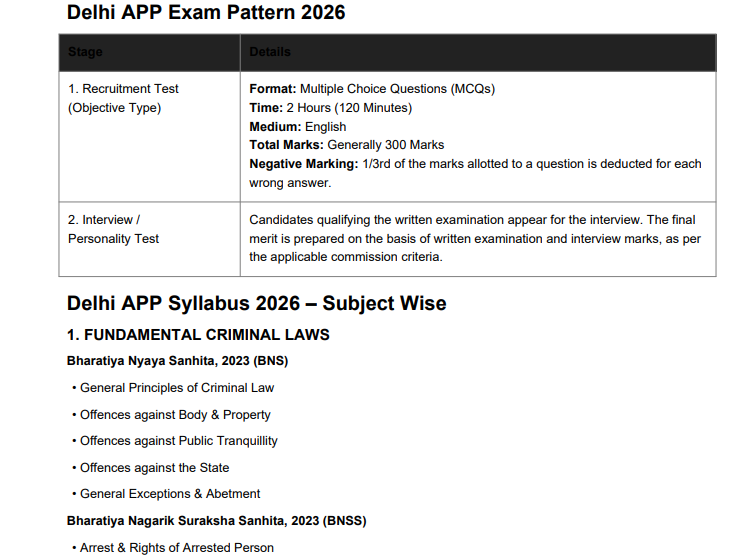
The Delhi Assistant Public Prosecutor (APP) Syllabus 2026 is especially important for law graduates preparing for prosecution services under the Directorate of Prosecution, Government of NCT of Delhi. The recruitment is conducted through the Union Public Service Commission (UPSC), and the examination primarily tests candidates on criminal law, procedural law, evidence law, the Constitution, and important special statutes.
The Directorate of Prosecution’s official website currently lists the Assistant Public Prosecutor Recruitment Rules, while the revised APP recruitment rules were notified in January 2026.
Important: Candidates should distinguish between the Recruitment Rules and the detailed exam syllabus. The official Delhi Prosecution website provides the recruitment rules, but the detailed 2026 examination syllabus should be checked against the latest UPSC recruitment notification when issued. The subject-wise syllabus below is therefore a preparation-oriented compilation based on the current recruitment framework and available 2026 exam information.
Delhi APP Syllabus 2026 – Overview
| Particular | Details |
|---|---|
| Exam Name | Delhi Assistant Public Prosecutor (APP) Exam 2026 |
| Post | Assistant Public Prosecutor |
| Recruiting Authority | UPSC |
| Department | Directorate of Prosecution, GNCT of Delhi |
| Exam Level | Government/Prosecution Service |
| Selection Process | Written Examination + Interview |
| Question Type | Objective-type questions, as applicable under the recruitment test |
| Major Focus | Criminal Law, Criminal Procedure, Evidence, and Special Laws |
| New Criminal Laws | BNS, BNSS, and BSA |
| Official Recruitment Rules | Available on the Delhi Prosecution website |
| Official Syllabus PDF | Check the latest UPSC notification |
The Delhi Directorate of Prosecution’s recruitment rules page specifically lists the Assistant Public Prosecutor rules, and UPSC maintains its recruitment test notices separately.
Delhi APP Syllabus 2026 Subject-Wise
The most important part of preparation is understanding which laws deserve maximum attention. Since India’s new criminal laws have replaced the IPC, CrPC and Indian Evidence Act framework, candidates should prepare BNS, BNSS and BSA thoroughly.
1. Bharatiya Nyaya Sanhita (BNS), 2023
The Bharatiya Nyaya Sanhita is one of the most important subjects for the Delhi APP examination.
Candidates should cover:
- Preliminary provisions and definitions
- General explanations
- General exceptions
- Abetment
- Criminal conspiracy
- Attempt to commit offences
- Offences against women
- Offences relating to children
- Offences affecting the human body
- Culpable homicide
- Murder
- Causing hurt and grievous hurt
- Wrongful restraint and wrongful confinement
- Kidnapping and abduction
- Sexual offences
- Offences against property
- Theft
- Robbery and dacoity
- Criminal breach of trust
- Cheating
- Mischief
- Criminal trespass
- Forgery
- Offences against the State
- Public servant-related offences
- Offences relating to public tranquillity
- Defamation
- Criminal intimidation
- Attempts and abetments
Preparation tip: Do not study BNS only by memorising section numbers. Understand the ingredients of each offence and the distinction between similar offences.
2. Bharatiya Nagarik Suraksha Sanhita (BNSS), 2023
BNSS is equally important because an Assistant Public Prosecutor needs a strong understanding of criminal procedure.
Important topics include:
- Constitution of criminal courts
- Powers of courts
- Arrest of persons
- Rights of arrested persons
- Summons and warrants
- Proclamation and attachment
- Search and seizure
- Information to police
- FIR
- Investigation
- Statements and confessions
- Remand
- Bail
- Anticipatory bail
- Cognizance of offences
- Complaints to Magistrates
- Charge
- Trial before Magistrates
- Sessions trials
- Summary trials
- Plea bargaining
- Evidence during investigation and trial
- Discharge
- Acquittal
- Conviction
- Appeals
- Revision
- Reference
- Transfer of criminal cases
- Limitation
- Maintenance proceedings
- Compounding of offences
For APP preparation, candidates should particularly focus on FIR, investigation, arrest, bail, cognizance, charge, trial and appeals.
3. Bharatiya Sakshya Adhiniyam (BSA), 2023
Evidence law forms another core area of the Delhi APP syllabus.
Important BSA Topics
- Meaning and scope of evidence
- Facts in issue
- Relevant facts
- Admissions
- Confessions
- Statements by persons who cannot be called as witnesses
- Statements made under special circumstances
- Expert evidence
- Character evidence
- Oral evidence
- Documentary evidence
- Primary and secondary evidence
- Electronic and digital records
- Burden of proof
- Presumptions
- Estoppel
- Examination of witnesses
- Cross-examination
- Re-examination
- Leading questions
- Hostile witnesses
- Competency of witnesses
- Privileged communications
With digital evidence becoming increasingly important in criminal trials, candidates should pay special attention to provisions concerning electronic records and digital evidence.
4. Constitution of India
Constitutional law is another important component of APP preparation.
Candidates should revise:
- Preamble
- Fundamental Rights
- Fundamental Duties
- Directive Principles of State Policy
- Right to Equality
- Right to Freedom
- Right to Life and Personal Liberty
- Protection against arrest and detention
- Constitutional remedies
- Writ jurisdiction
- Separation of powers
- Union and State executive
- Parliament and State Legislature
- Supreme Court
- High Courts
- Judicial review
- Emergency provisions
- Constitutional amendments
- Basic Structure Doctrine
- Centre-State relations
- Constitutional bodies
High-Priority Areas
Articles 14, 19, 20, 21, 22, 32 and 226 deserve special attention because they frequently arise in criminal-law and constitutional questions.
5. Prevention of Corruption Act
The Prevention of Corruption Act is an important special legislation for prosecution-oriented examinations.
Study:
- Important definitions
- Public servant
- Criminal misconduct
- Bribery-related offences
- Acceptance of undue advantage
- Giving and taking undue advantage
- Sanction for prosecution
- Investigation
- Presumptions
- Trial of offences
- Special Courts
- Relevant amendments
Candidates should also understand the practical relationship between corruption offenses and criminal procedure.
6. Delhi Special Police Establishment Act
The Delhi Special Police Establishment Act should also be included in the preparation plan.
Important areas include:
- Establishment of the Delhi Special Police Establishment
- Jurisdiction and powers
- Extension of jurisdiction
- Consent of State Government
- Powers of investigation
- Relationship with other investigating agencies
7. Information Technology Act, 2000
The IT Act becomes relevant particularly because criminal prosecution increasingly involves electronic evidence and cyber offences.
Prepare:
- Important definitions
- Digital/electronic records
- Electronic signatures
- Cyber offences
- Computer-related offences
- Identity theft
- Cheating by personation using computer resources
- Privacy-related offences
- Cyber terrorism
- Intermediary-related provisions
- Investigation and adjudication provisions
Candidates should also connect the IT Act with the evidence-law provisions dealing with electronic records.
8. Central Vigilance Commission Act
Candidates should cover the basic statutory framework of the Central Vigilance Commission Act, 2003, including:
- Constitution of the Commission
- Powers and functions
- Jurisdiction
- Vigilance administration
- Investigation-related provisions
- Role of the CVC in corruption-related matters
This is a comparatively smaller subject, so it can be completed after the major criminal laws.
9. Prevention of Money Laundering Act, 2002
The PMLA is another important special law to revise.
Major topics include:
- Money laundering
- Proceeds of crime
- Attachment of property
- Adjudicating Authority
- Offences and penalties
- Search and seizure
- Arrest
- Bail
- Investigation
- Scheduled offences
- Special Courts
- Confiscation of property
- Powers of enforcement authorities
Delhi APP Syllabus 2026 – Quick Revision Table
| Subject | Important Topics |
|---|---|
| BNS 2023 | Offences, general exceptions, abetment, conspiracy, offences against body/property/women/children |
| BNSS 2023 | FIR, arrest, investigation, bail, cognizance, charge, trial, appeal, revision |
| BSA 2023 | Relevancy, admissions, confessions, documentary/electronic evidence, burden of proof, witnesses |
| Constitution | Fundamental Rights, Article 14, 19, 20, 21, 22, writs, judiciary |
| Prevention of Corruption Act | Public servant, undue advantage, criminal misconduct, prosecution sanction |
| DSPE Act | CBI/DSPE jurisdiction, investigation powers and State consent |
| IT Act | Cyber offences, electronic records, digital evidence |
| CVC Act | Commission, powers, vigilance and investigation |
| PMLA | Money laundering, proceeds of crime, attachment, arrest, bail and special courts |
These subjects are also reflected in the preparation material being offered for the 2026 Delhi APP cycle, which focuses on BNS, BNSS, BSA, Constitution and special laws including the Prevention of Corruption Act, DSPE Act, IT Act, CVC Act and PMLA.
Delhi APP Exam Pattern 2026
Candidates should be careful with online sources because different coaching websites currently describe the examination pattern differently. One commonly reported 2026 pattern is a written objective examination followed by an interview, with 100 marks for the written test and 100 marks for the interview.
A preparation-oriented representation is:
| Stage | Type | Marks |
|---|---|---|
| Written Examination | Objective/MCQ | 100 |
| Interview | Personality/Subject Knowledge | 100 |
| Total | — | 200 |
However, candidates should treat this table as provisional until the applicable UPSC notification confirms the final scheme.
Some coaching sources report a 2-hour written test and negative marking of one-third for an incorrect answer.
Delhi APP Selection Process 2026
The expected selection process can be understood in two broad stages:
Stage 1: Written Examination
The written examination tests the candidate’s understanding of criminal law and related statutes. The biggest advantage in this stage goes to candidates who know the bare Acts thoroughly rather than relying entirely on coaching notes.
Stage 2: Interview
Candidates shortlisted from the written examination may be called for an interview. The interview is likely to assess:
- Legal knowledge
- Understanding of criminal procedure
- Knowledge of recent legal developments
- Analytical ability
- Communication skills
- Understanding of prosecutorial responsibilities
- Confidence and professional judgement
How to Prepare for Delhi APP Syllabus 2026
A good strategy is to avoid studying every law with equal intensity. APP preparation should be built around the laws that are most directly connected with criminal prosecution.
Step 1: Finish the New Criminal Laws
Start with:
BNS → BNSS → BSA
Read the bare Acts first. After completing a chapter, solve MCQs based on that chapter.
Step 2: Make a Section-Wise Revision Notebook
Create separate short notes for:
- Important definitions
- Offence ingredients
- Punishments
- Exceptions
- Procedural timelines
- Bail provisions
- Evidentiary principles
- Important presumptions
This makes final revision much faster.
Step 3: Study Special Acts
After completing the three new criminal laws, move to:
- Prevention of Corruption Act
- PMLA
- IT Act
- DSPE Act
- CVC Act
Step 4: Revise the Constitution
Do not try to memorise the entire Constitution at the same level. Focus on Fundamental Rights, judiciary, writs, constitutional remedies and provisions relevant to criminal justice.
Step 5: Solve Previous-Year Questions
Previous APP/APO/ADPO and prosecution-service questions can help identify recurring concepts. While solving them, pay attention to why an option is correct, not just the final answer.
Best Books for Delhi APP Preparation 2026
| Subject | Suggested Study Material |
|---|---|
| BNS | Bare Act + standard criminal law reference book |
| BNSS | Bare Act + standard Criminal Procedure reference |
| BSA | Bare Act + Evidence Law reference |
| Constitution | Indian Polity/standard Constitutional Law book |
| Special Acts | Bare Acts |
| Current Legal Developments | Supreme Court judgments + reliable legal current affairs |
| MCQ Practice | APP/APO/ADPO previous papers and test series |
For APP examinations, bare Acts should be the foundation. Candidates often make the mistake of reading coaching notes without opening the actual statutory text.
Delhi APP Syllabus 2026 Free PDF
Candidates looking for the Delhi App syllabus PDF should download it only from an official source when the detailed syllabus is released.
The Directorate of Prosecution’s official website currently provides the Assistant Public Prosecutor Recruitment Rules on its recruitment-rules page.
Download/Check Delhi APP Recruitment Rules – Official Delhi Prosecution Website
For UPSC recruitment-test notices and examination-related documents, candidates should also monitor the official UPSC recruitment section.
Check UPSC Recruitment Test Notices
Note: Avoid downloading a PDF from an unofficial website and assuming it is the final 2026 syllabus. The detailed examination scheme can change through the official notification.
Delhi APP Syllabus 2026 – Most Important Topics
If you have limited preparation time, prioritize these areas:
Very High Priority
- BNS
- BNSS
- BSA
- Arrest and bail
- FIR and investigation
- Cognizance
- Charge and trial
- Evidence and admissibility
- Confession and admission
- Electronic evidence
- Fundamental Rights
High Priority
- Prevention of Corruption Act
- PMLA
- IT Act
- Constitutional remedies
- DSPE Act
Revision Priority
- CVC Act
- Less frequently used provisions of special laws
- Detailed procedural provisions that have low practical frequency
Delhi APP Preparation Strategy for 60 Days
| Days | Target |
|---|---|
| 1–15 | BNS |
| 16–30 | BNSS |
| 31–40 | BSA |
| 41–47 | Constitution |
| 48–53 | Prevention of Corruption Act + PMLA |
| 54–56 | IT Act + DSPE Act + CVC Act |
| 57–60 | Full revision + mock tests |
Try to reserve the final week primarily for revision and MCQs, rather than starting completely new topics.
FAQs on Delhi APP Syllabus 2026
Is the Delhi APP syllabus released for 2026?
The Directorate of Prosecution has published the APP recruitment rules, but candidates should verify the detailed examination syllabus and scheme from the applicable UPSC recruitment notification.
What are the major subjects in Delhi APP?
The major preparation areas are BNS, BNSS, BSA, Constitution of India and important special laws, including the Prevention of Corruption Act, PMLA, IT Act, DSPE Act and CVC Act.
Are BNS, BNSS and BSA important for Delhi APP?
Yes. Candidates preparing for the 2026 cycle should give these three new criminal laws very high priority.
Is there negative marking in the Delhi APP exam?
Several 2026 preparation sources report negative marking of one-third mark for an incorrect answer, but candidates should confirm the exact marking scheme from the final UPSC notification before relying on it for the examination.
What should I study first for Delhi APP?
Start with the BNS, BNSS and BSA bare Acts, followed by the Constitution and special criminal laws.
Where can I download the Delhi APP syllabus PDF?
The safest sources are the official UPSC website and the Directorate of Prosecution, Delhi. The Delhi Prosecution website currently lists the APP recruitment rules, while UPSC publishes its recruitment-test notices separately.
About The Author
