
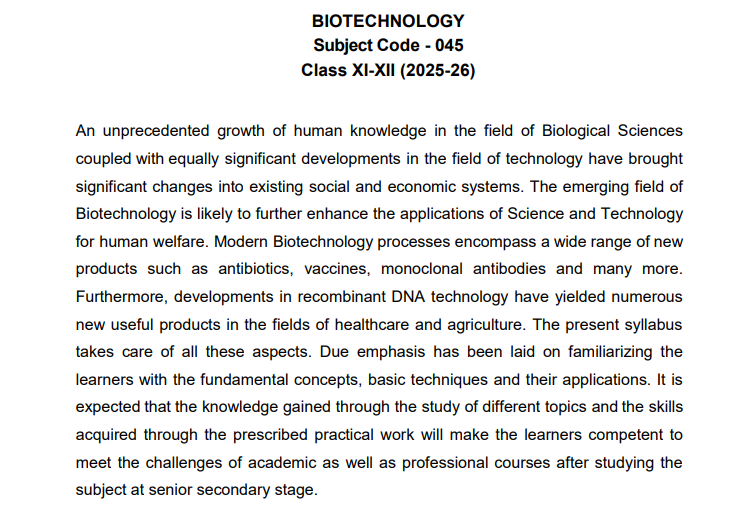
The CBSE Class 12 Biotechnology Syllabus 2025-26 provides a detailed outline for students, covering essential topics like Protein and Gene Manipulation, Cell Culture, and Genetic Manipulation. It helps students understand core biotechnology concepts and prepares them for both theoretical exams and practicals.
CBSE Class 12 Bio Technology Syllabus 2025-26
CBSE has also released the official syllabus PDF for Class 12 Biotechnology for the 2025-26 session. This document includes important information like the exam pattern, marking scheme, and detailed topic breakdown, ensuring students have all the resources they need for effective preparation.
CBSE Class 12 Biotechnology Syllabus: Units and Marks Distribution
| Unit | Marks |
|---|---|
| Unit V: Protein and Gene Manipulation | 40 |
| Unit VI: Cell Culture and Genetic Manipulation | 30 |
| Practicals | 30 |
Unit V: Protein and Gene Manipulation (40 Marks)
Chapter 1: Recombinant DNA Technology
- Introduction to Recombinant DNA Technology.
- Tools of Recombinant DNA Technology.
- Making an rDNA molecule.
- Introduction of recombinant DNA into host cells.
- Identification of recombinants.
- Polymerase Chain Reaction (PCR).
- DNA Sequencing.
Chapter 2: Protein Structure and Engineering
- Introduction to proteins.
- Structure-function relationship in proteins.
- Characterization of proteins.
- Protein-based products.
- Designing proteins (Protein Engineering).
Chapter 3: Genomics, Proteomics, and Bioinformatics
- Gene prediction and counting.
- Genome similarity.
- SNPs (Single Nucleotide Polymorphisms) and Comparative genomics.
- Functional genomics.
- Proteomics.
- Information sources and analysis using bioinformatics tools.
Unit VI: Cell Culture and Genetic Manipulation (30 Marks)
Chapter 1: Microbial Cell Culture and its Applications
- Introduction to microbial culture.
- Microbial nutrition and culture techniques.
- Measurement and kinetics of microbial growth.
- Isolation of microbial products.
- Strain isolation and improvement.
- Applications of microbial culture technology.
Chapter 2: Plant Cell Culture and Applications
- Introduction to cell and tissue culture techniques.
- Applications of cell and tissue culture.
- Transgenic plants with beneficial traits.
- Biosafety of transgenic plants.
Chapter 3: Animal Cell Culture and Applications
- Introduction to animal cell culture techniques.
- Applications of animal cell culture.
- Stem cell technology.
Practicals (30 Marks)
Experiments
- Use of special equipment in biotechnology experiments.
- Isolation of bacterial plasmid DNA.
- Detection of DNA by gel electrophoresis.
- Estimation of DNA by UV spectroscopy.
- Isolation of bacteria from curd & staining of bacteria.
- Cell viability assay using Evan’s blue dye exclusion method.
- Data retrieval and database search using NCBI. Download and analyze a DNA and protein sequence.
- Reading of a DNA sequencing gel.
- Project work.
Scheme of Evaluation (Practical)
| Component | Marks |
|---|---|
| Two experiments (including one computer-based practical) | 6 + 6 |
| Practical record | 4 |
| Viva on practical | 4 |
| Project work write-up | 5 |
| Viva on project | 5 |
| Total | 30 |
Assessment Areas (Theory) 2025-26
| Competencies | Weightage |
|---|---|
| Demonstrate Knowledge and Understanding | 50% |
| Application of Knowledge / Concepts | 30% |
| Analyze, Evaluate, and Create | 20% |
Typology of Questions:
- Very Short Answer (VSA) including MCQs.
- Assertion-Reasoning type questions.
- Short Answer (SA).
- Long Answer I (LA-I).
- Long Answer II (LA-II).
- Source-based, Case-based, Passage-based, Integrated assessment questions.
Note: An internal choice of around 33% will be provided.
Suggestive Verbs for Competencies
- Demonstrate Knowledge and Understanding: State, name, list, identify, define, suggest, describe, outline, summarize.
- Application of Knowledge/Concepts: Calculate, illustrate, show, adapt, explain, distinguish.
- Analyze, Evaluate, and Create: Interpret, analyze, compare, contrast, examine, evaluate, discuss, construct.
CBSE Class 12 Bio-Technology Syllabus 2025-26 PDF Download
For more details and to download the CBSE Class 12 Bio-Technology Syllabus 2025-26 in PDF format, visit the official CBSE website or download it via the link given below. The syllabus outlines the course structure, marking scheme, and preparation guidelines for students pursuing biotechnology in Class 12.
BioTechnology_SrSec_PDF 2025-26
How to Prepare CBSE Class 12 Bio Technology Syllabus Easily?
To prepare for the CBSE Class 12 Biotechnology syllabus rapidly, follow this structured approach:
- Know the Syllabus: Familiarize yourself with the entire syllabus, which typically includes topics like:
- Genetic Manipulation and Its Applications
- Bioinformatics
- Environmental Biotechnology
- Industrial Biotechnology
- Biotechnology and its applications in agriculture and medicine
- Break Down the Topics: Divide the syllabus into manageable sections. Prioritize topics based on weightage and your current understanding.
- Focus on Key Concepts: Biotechnology can be concept-heavy, so understanding the basics of genetic engineering, fermentation processes, gene cloning, and PCR will give you a solid foundation.
- Use NCERT Textbooks and Reference Books: Stick to the NCERT Biotechnology book as it’s aligned with the syllabus. Use reference books like “Biotechnology: Principles and Processes” by B.D. Singh for deeper insights.
- Practice Previous Year Papers: Solving past years’ question papers helps you understand exam patterns and frequently asked questions.
- Make Notes: Condense key topics into concise notes that you can quickly revise before the exam.
- Revision and Mock Tests: Allocate time for revision. Take mock tests to gauge your preparation and improve time management.
- Stay Updated: Since biotechnology is a rapidly evolving field, keep an eye on current developments in biotechnology applications, research, and technologies.
By focusing on understanding core concepts and applying them to practical examples, you’ll be able to prepare more efficiently.
Books to Cover CBSE Class 12 Bio Technology Syllabus
The best books you can use to fully cover the CBSE Class 12 Biotechnology syllabus (Board + Concept + Practice) — including essential textbooks, reference guides, and practice papers:
1. Core Textbooks (Must-Have)
1. NCERT: Biotechnology Textbook (Class 12)
Official CBSE prescribed textbook that explains all Biotechnology concepts in a clear and board-aligned way.
Covers topics such as Recombinant DNA Technology, Protein Engineering, Genomics & Bioinformatics, Microbial, Plant & Animal Cell Culture, and applications — matching the CBSE syllabus.
Why use it:
-
Essential for understanding theory
-
Most board questions are directly from NCERT concepts
-
Good for building fundamentals before moving to reference books
This should be your base book.
2. “A Textbook of Biotechnology – Class 12” by R.C. Dubey (S. Chand)
Specifically written as per CBSE & NCERT guidelines, detailed explanations + diagrams.
Why it’s useful:
-
More detailed than NCERT
-
Helpful if you want deeper insights
-
Good for exam preparation and conceptual clarity
2. Reference & Practice Books
3. CBSE Biotechnology Chapter-Wise Solved Papers / Question Banks
Books like:
-
CBSE Chapterwise Solved Papers Biotechnology Class 12 (Arihant / Akanksha Singhal editions)
Why use them:
-
Helps understand past exam patterns
-
Offers chapter-wise questions & solved answers
-
Great for revision and scoring higher marks
4. NCERT Solutions & Guides (Practice)
NCERT Solutions (available as books & online PDF) provide step-by-step answers to textbook questions and additional practice.
Why use them:
-
Improves accuracy in board-style answers
-
Good practice before exams
Study Strategy (Books Order)
Step 1: Read NCERT Biotechnology chapters thoroughly (main concept building).
Step 2: Refer to R.C. Dubey textbook for extra elaboration and deeper understanding.
Step 3: Solve NCERT Solutions to secure basics and answer patterns.
Step 4: Practice chapter-wise solved papers / question banks for revision and scoring.
Tips for Boards
Make sure you carefully study diagrams and techniques like PCR, gene cloning, and cell culture steps — these are high-yield topics.
Use solved papers to get the feel of maximum-mark questions.
FAQs Based on CBSE Class 12 Biotechnology syllabus
1. What topics are included in the CBSE Class 12 Biotechnology syllabus for 2025-26?
The syllabus includes key concepts such as:
- Genetics and Evolution: The molecular basis of inheritance, genetic disorders, and the concept of evolution.
- Biotechnology and Its Applications: Introduction to biotechnology, the role of microorganisms, genetic engineering, and the applications in agriculture, medicine, and industry.
- Biochemistry and Biotechnology Techniques: Enzymes, bioreactors, PCR, and DNA fingerprinting.
- Human Health and Disease: Diseases caused by microbes, immune system responses, and biotechnology’s role in diagnostics.
- Environmental Biotechnology: Bioremediation, waste management, and environmental monitoring.
2. How is biotechnology applied in agriculture according to the syllabus?
The syllabus highlights biotechnology’s applications in agriculture, including:
- Genetic modification of plants for pest resistance, improved yield, and tolerance to environmental stresses.
- Development of genetically modified crops like Bt cotton and Golden rice.
- Plant tissue culture techniques for crop improvement.
3. What practicals are included in the Class 12 Biotechnology practical exam?
The practicals focus on:
- DNA Extraction from plant and animal tissues.
- Preparation of a bacterial culture and observing microbial growth.
- PCR technique to amplify a segment of DNA.
- Study of mitosis and meiosis in plant/animal cells.
4. Are there any specific biotechnology tools or techniques students need to understand?
Yes, the syllabus emphasizes understanding the following tools and techniques:
- Recombinant DNA technology and its applications in gene therapy.
- Polymerase Chain Reaction (PCR) and Gel Electrophoresis.
- Gene cloning and DNA sequencing techniques.
5. What are the key differences between Class 11 and Class 12 biotechnology topics?
In Class 12, students delve deeper into applications of biotechnology and focus more on advanced topics like genetic engineering, industrial biotechnology, and environmental applications. Class 11 is more foundational, focusing on the basic principles of biology, genetics, and the scientific methods involved in biotechnology.
Related Articles:
About The Author

4 thoughts on “CBSE Class 12 Bio Technology Syllabus 2025-26, Download Official PDF”