
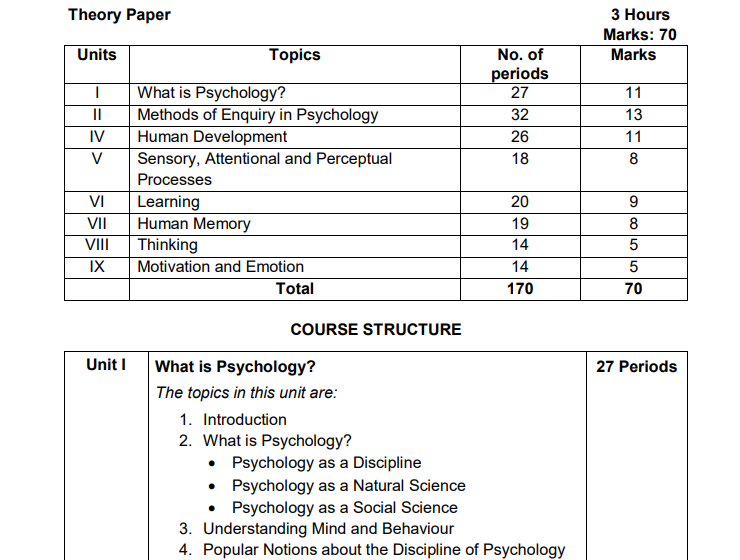
The CBSE Class 12 Psychology Syllabus for the academic year 2026-27 has been officially released and is now available on the CBSE website. This syllabus outlines important topics such as psychological attributes, personality, stress management, psychological disorders, and therapeutic approaches. It provides a clear understanding of human behavior and mental processes, helping students prepare for their board exams with a comprehensive and structured approach. With 170 periods and a maximum of 70 marks for the theory section, the syllabus covers both theoretical knowledge and practical assessments, including psychological tests and case profiles.
CBSE Class 12 Psychology Syllabus 2026-27
For easy access, we have also provided a direct link to download the PDF of the CBSE Class 12 Psychology Syllabus 2026-27. This downloadable syllabus will help students plan their studies effectively, as it includes details of each unit, marks distribution, and the practical requirements. It’s important for students to review the syllabus thoroughly to ensure they are well-prepared for their exams.
Class 12 Psychology Marks Distribution
| Units | Topics | No. of Periods | Marks |
|---|---|---|---|
| I. Variations in Psychological Attributes | Intelligence, Emotional Intelligence, Creativity | 30 | 13 |
| II. Self and Personality | Self, Personality, Major Approaches | 32 | 13 |
| III. Meeting Life Challenges | Stress, Coping, Positive Health | 23 | 9 |
| IV. Psychological Disorders | Major Psychological Disorders | 30 | 12 |
| V. Therapeutic Approaches | Psychotherapy, Types of Therapy | 25 | 9 |
| VI. Attitude and Social Cognition | Attitude Formation, Prejudice | 16 | 8 |
| VII. Social Influence and Group Processes | Group Influence, Social Loafing | 14 | 6 |
| Total | 170 | 70 |
Psychology Class 12 Syllabus 2026 in Detail
Unit I: Variations in Psychological Attributes (30 Periods, 13 Marks)
Topics include:
- Introduction
- Individual Differences in Human Functioning
- Assessment of Psychological Attributes
- Intelligence
- Theories of Intelligence: Psychometric, Information Processing, Triarchic Theory, Multiple Intelligences
- Emotional Intelligence
- Special Abilities: Aptitude and Creativity
Unit II: Self and Personality (32 Periods, 13 Marks)
Topics include:
- Introduction
- Concept of Self: Cognitive and Behavioral Aspects
- Culture and Self
- Personality: Major Approaches (Type, Trait, Psychodynamic, Humanistic, etc.)
- Assessment of Personality: Self-Report Measures, Projective Techniques, Behavioral Analysis
Unit III: Meeting Life Challenges (23 Periods, 9 Marks)
Topics include:
- Nature and Types of Stress
- Effects of Stress on Health (General Adaptation Syndrome, Stress and Immune System)
- Coping with Stress: Techniques
- Promoting Positive Health and Well-being
Unit IV: Psychological Disorders (30 Periods, 12 Marks)
Topics include:
- Concepts of Abnormality and Psychological Disorders
- Classification of Psychological Disorders
- Major Disorders: Anxiety, Obsessive-Compulsive, Depressive, Bipolar, Schizophrenia, Neurodevelopmental, Substance-Related Disorders
Unit V: Therapeutic Approaches (25 Periods, 9 Marks)
Topics include:
- Nature and Process of Psychotherapy
- Types of Therapy: Behavioral, Cognitive, Humanistic-Existential, and Alternative Therapies
- Rehabilitation of the Mentally Ill
Unit VI: Attitude and Social Cognition (16 Periods, 8 Marks)
Topics include:
- Explaining Social Behavior
- Nature and Components of Attitudes
- Attitude Formation and Change
- Prejudice and Discrimination
- Strategies for Handling Prejudice
Unit VII: Social Influence and Group Processes (14 Periods, 6 Marks)
Topics include:
- Nature and Formation of Groups
- Types of Groups
- Influence of Groups on Individual Behavior: Social Loafing, Group Polarization
Psychology Class 12 Syllabus: Practical (30 Marks, 60 Periods)
| Component | Marks |
|---|---|
| Practical File and Case Profile | 10 |
| Viva Voce (Case Profile and Two Practicals) | 5 |
| Two Practicals (Conduct and Reporting) | 15 |
| Total | 30 |
- Development of Case Profile: Using interview, observation, and psychological tests.
- Test Administration: Students must administer and interpret five psychological tests related to intelligence, aptitude, attitude, and personality.
- Practical Examination: Students will conduct and interpret two psychological tests during the exam.
Question Paper Design for Class XII (2026-27)
| Competencies | Marks | Weightage |
|---|---|---|
| 1. Remembering and Understanding: Recall facts, terms, and concepts. Show understanding through organizing, translating, and comparing. | 25 | 35% |
| 2. Applying: Solve problems using knowledge, facts, and techniques in new ways. | 31 | 45% |
| 3. Formulating, Analyzing, Evaluating, and Creating: Examine information, make inferences, and propose solutions. | 14 | 20% |
| Total | 70 | 100% |
CBSE Class 12 Psychology Syllabus 2026-27 PDF Download
You can download the PDF of the CBSE Class 12 Psychology Syllabus from the official CBSE website or click on the link below. This will help you get the latest and most accurate syllabus for your studies.
CBSE class 12 Psychology Syllabus -Click Here To Download PDF
Related Articles:
Psychology Syllabus Class 12 CBSE 2026-27: FAQs
Q1. What are the main units in CBSE Class 12 Psychology syllabus 2026–27?
Answer:
The syllabus consists of 7 units:
- Variations in Psychological Attributes
- Self and Personality
- Meeting Life Challenges
- Psychological Disorders
- Therapeutic Approaches
- Attitude and Social Cognition
- Social Influence and Group Processes
Q2. What is the total marks distribution for Psychology?
Answer:
- Theory: 70 Marks
- Practical/Project Work: 30 Marks
- Total: 100 Marks
Q3. Which unit has the highest weightage?
Answer:
Units like Variations in Psychological Attributes and Self and Personality carry the highest weightage (around 13 marks each).
Q4. Is there any practical work in Class 12 Psychology?
Answer:
Yes, practical work includes:
- Case profile preparation
- Conducting psychological tests
- Viva voce
These together carry 30 marks.
Q5. What topics are covered under Psychological Disorders?
Answer:
It includes:
- Concept of abnormality
- Classification of disorders
- Anxiety, depression, schizophrenia, OCD, etc.
Q6. What is included in Therapeutic Approaches?
Answer:
Topics include:
- Psychotherapy process
- Types of therapies (Behaviour, Cognitive, Humanistic, etc.)
- Rehabilitation and ethics in therapy
Q7. Is the syllabus based on NCERT books?
Answer:
Yes, the syllabus is fully based on the NCERT Psychology Class 12 textbook, which is the most important resource.
Q8. What type of questions are asked in the exam?
Answer:
Questions include:
- MCQs and case-based questions
- Short and long answer questions
- Application and analytical questions
Q9. Is Psychology a scoring subject in Class 12?
Answer:
Yes, Psychology is considered scoring if:
- Concepts are clearly understood
- Answers are well-structured
- Case-based questions are practiced
Q10. How should I prepare for CBSE Class 12 Psychology?
Answer:
- Focus on NCERT line-by-line
- Practice case studies
- Revise important terms and definitions
- Solve previous year papers
Q11. What skills does this syllabus develop?
Answer:
It helps develop:
- Understanding of human behavior
- Analytical thinking
- Emotional intelligence
- Real-life problem-solving skills
Q12. Are case-based questions important?
Answer:
Yes, CBSE focuses on competency-based and case-study questions, so practice is essential.
About The Author
