
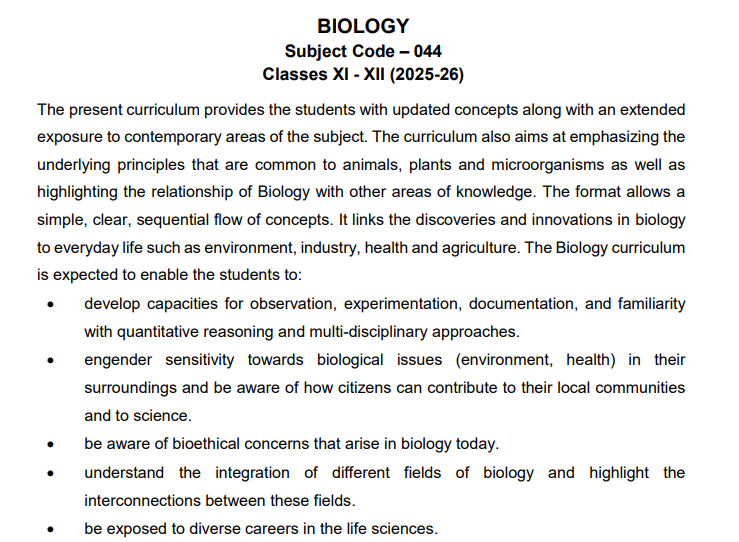
The CBSE Class 12 Biology syllabus for the 2026-27 academic year covers important topics in biological sciences. It is divided into different units that explore key areas like reproduction, genetics, biotechnology, and ecology. Each unit helps students understand essential concepts, such as how plants reproduce and the principles of inheritance, connecting theory to real-life examples in biology.
The Central Board of Secondary Education Class 12 Biology Syllabus 2026–27 is divided into five major units covering core concepts of life sciences. It includes topics like Reproduction, Genetics & Evolution, Human Welfare, Biotechnology, and Ecology. The syllabus comprises 16 chapters, such as Human Reproduction, Molecular Basis of Inheritance, Evolution, Microbes in Human Welfare, and Environmental Issues. The theory paper carries 70 marks, while 30 marks are allotted to practicals, including experiments, viva, and project work. The syllabus emphasizes conceptual understanding, diagrams, and application-based learning, mainly based on NCERT textbooks.
CBSE Class 12 Biology Syllabus 2026-27
In addition to theory, the syllabus emphasizes hands-on learning through practical experiments. Students will engage in lab activities, like studying plant populations and isolating DNA from different materials. This blend of theory and practice helps students gain a deeper understanding of biology and develop important scientific skills. Overall, the syllabus is designed to prepare students for further studies in biology while building a solid foundation in scientific knowledge.
Class 12 Biology Theory Syllabus
| Unit No. | Unit Title | Marks |
|---|---|---|
| VI | Reproduction | 16 |
| VII | Genetics and Evolution | 20 |
| VIII | Biology and Human Welfare | 12 |
| IX | Biotechnology and its Applications | 12 |
| X | Ecology and Environment | 10 |
| Total | 70 |
CBSE Class 12 Biology Syllabus 2026-27 Topic-wise
Unit VI: Reproduction (16 Marks)
- Chapter 2: Sexual Reproduction in Flowering Plants
- Flower structure; development of male and female gametophytes; types of pollination and their agencies; outbreeding devices; pollen-pistil interaction; double fertilization; post-fertilization events (development of endosperm and embryo, seed development, and fruit formation); special modes (apomixis, parthenocarpy, polyembryony); significance of seed dispersal and fruit formation.
- Chapter 3: Human Reproduction
- Male and female reproductive systems; microscopic anatomy of the testis and ovary; gametogenesis (spermatogenesis and oogenesis); menstrual cycle; fertilization; embryo development up to blastocyst formation; implantation; pregnancy and placenta formation (elementary idea); parturition and lactation (elementary idea).
- Chapter 4: Reproductive Health
- Need for reproductive health and prevention of Sexually Transmitted Diseases (STDs); birth control methods; contraception; medical termination of pregnancy (MTP); amniocentesis; infertility and assisted reproductive technologies (IVF, ZIFT, GIFT for general awareness).
Unit VII: Genetics and Evolution (20 Marks)
- Chapter 5: Principles of Inheritance and Variation
- Heredity and variation; Mendelian inheritance; deviations from Mendelism (incomplete dominance, co-dominance, multiple alleles and inheritance of blood groups, pleiotropy); elementary idea of polygenic inheritance; chromosome theory of inheritance; sex determination in humans, birds, and honey bees; linkage and crossing over; sex-linked inheritance (haemophilia, color blindness); Mendelian disorders (thalassemia); chromosomal disorders (Down’s syndrome, Turner’s and Klinefelter’s syndromes).
- Chapter 6: Molecular Basis of Inheritance
- Search for genetic material; DNA as genetic material; structure of DNA and RNA; DNA packaging; DNA replication; Central Dogma; transcription, genetic code, translation; gene expression and regulation (lac operon); genome projects (Human and rice genome); DNA fingerprinting.
- Chapter 7: Evolution
- Origin of life; biological evolution and evidences for biological evolution (paleontology, comparative anatomy, embryology, molecular evidence); Darwin’s contribution; modern synthetic theory of evolution; mechanisms of evolution (variation, natural selection, gene flow, genetic drift); Hardy-Weinberg principle; adaptive radiation; human evolution.
Unit VIII: Biology and Human Welfare (12 Marks)
- Chapter 8: Human Health and Diseases
- Pathogens; parasites causing human diseases (malaria, dengue, chikungunya, filariasis, ascariasis, typhoid, pneumonia, common cold, amoebiasis, ringworm) and their control; basic concepts of immunology; cancer, HIV, and AIDS; adolescence; drug and alcohol abuse.
- Chapter 10: Microbes in Human Welfare
- Role of microbes in food processing, industrial production, sewage treatment, energy generation, bio-control agents, and bio-fertilizers; production and judicious use of antibiotics.
Unit IX: Biotechnology and its Applications (12 Marks)
- Chapter 11: Biotechnology – Principles and Processes
- Genetic Engineering (Recombinant DNA Technology).
- Chapter 12: Biotechnology and its Applications
- Application of biotechnology in health and agriculture; human insulin and vaccine production; stem cell technology; gene therapy; genetically modified organisms (Bt crops); transgenic animals; biosafety issues, biopiracy, and patents.
Unit X: Ecology and Environment (10 Marks)
- Chapter 13: Organisms and Populations
- Population interactions (mutualism, competition, predation, parasitism); population attributes (growth, birth rate, death rate, age distribution).
- Chapter 14: Ecosystem
- Ecosystem components; productivity and decomposition; energy flow; pyramids of number, biomass, and energy.
- Chapter 15: Biodiversity and its Conservation
- Concept, patterns, importance of biodiversity; loss of biodiversity; conservation strategies; biodiversity hotspots; endangered organisms; extinction; Red Data Book; sacred groves; biosphere reserves; national parks; wildlife sanctuaries; Ramsar sites.
Practical Syllabus (30 Marks)
The practical syllabus is designed to provide hands-on experience in biology and includes various experiments and assessments.
Evaluation Scheme for Practical Examination
| S.No. | Title | Marks |
|---|---|---|
| 1 | One Major Experiment | 5 |
| 2 | One Minor Experiment (2 & 3) | 4 |
| 3 | Slide Preparation (1 & 4) | 5 |
| 4 | Spotting | 7 |
| 5 | Practical Record + Viva Voce | 4 |
| 6 | Investigatory Project + Record + Viva | 5 |
| Total | 30 |
List of Experiments
- Prepare a temporary mount to observe pollen germination.
- Study plant population density using the quadrat method.
- Study plant population frequency using the quadrat method.
- Prepare a temporary mount of onion root tip to study mitosis.
- Isolate DNA from available plant material such as spinach, green pea seeds, or papaya.
Spotting Observations
- Flowers adapted to different pollination agencies (wind, insects, birds).
- Pollen germination on stigma through permanent slides or scanning electron micrographs.
- Identification of gamete development stages (T.S. of testis and ovary through permanent slides).
- Meiosis in onion bud cells or grasshopper testis through permanent slides.
- T.S. of blastula through permanent slides (mammalian).
- Mendelian inheritance using seeds of different colors/sizes from any plant.
- Prepared pedigree charts for genetic traits (e.g., rolling of tongue, blood groups).
- Controlled pollination techniques (emasculation, tagging, and bagging).
- Common disease-causing organisms (e.g., Ascaris, Entamoeba, Plasmodium) are viewed through permanent slides, models, or virtual images.
- Specimens showing symbiotic associations (e.g., root nodules of leguminous plants).
- Flashcards/models showing examples of homologous and analogous organs.
CBSE Class 12 Biology Syllabus 2026-27 PDF Download
The official PDF for the CBSE Class 12 Biology syllabus for the academic year 2026-27 has been released by CBSE. Students can download the syllabus from the official CBSE website to ensure they have access to all necessary details for their studies. We have also given the direct link to download the Syllabus PDF for the Class 12 biology subject.
Related Articles:
FAQs on CBSE Class 12 Biology Syllabus
Q1. What is the CBSE Class 12 Biology syllabus?
The Class 12 Biology syllabus is divided into five units:
-
Reproduction
-
Genetics and Evolution
-
Biology and Human Welfare
-
Biotechnology and Its Applications
-
Ecology and Environment
Q2. How many chapters are there in CBSE Class 12 Biology?
There are 16 chapters in total, covering theoretical concepts, diagrams, and application-based topics.
Q3. Is the CBSE Class 12 Biology syllabus the same for NEET?
Yes, the NCERT-based CBSE Biology syllabus forms the core syllabus for NEET, with most questions asked directly from NCERT textbooks.
Q4. Which unit carries the highest weightage in Biology?
Genetics and Evolution usually carries the highest weightage, followed by Ecology and Environment.
Q5. Are diagrams important in the Biology exam?
Yes, labelled diagrams are extremely important and frequently asked in exams. Practising diagrams from NCERT is essential.
Q6. Is NCERT enough to score well in Biology?
Yes, NCERT textbooks are sufficient for board exams. However, for NEET aspirants, additional practice books can be helpful.
Q7. Has the CBSE Biology syllabus been reduced?
CBSE has rationalised the syllabus in recent years. Students should always check the latest syllabus issued by CBSE for the current academic session.
Q8. What type of questions are asked in Class 12 Biology?
The exam includes MCQs, very short answer, short answer, long answer, and case-based questions.
Q9. How many marks is the Biology theory paper?
The Biology theory paper is conducted for 70 marks, with 30 marks allotted to practical exams.
Q10. How can I score 90+ in Class 12 Biology?
-
Read NCERT line by line
-
Practise diagrams and flowcharts
-
Solve previous years’ question papers
-
Focus on high-weightage units
-
Revise regularly
Q11. Is the practical exam important for Biology?
Yes, practicals contribute 30 marks, which can significantly improve the overall score.
Q12. Which chapters are most important for last-minute revision?
-
Principles of Inheritance and Variation
-
Molecular Basis of Inheritance
-
Biotechnology: Principles and Processes
-
Ecosystem
-
Biodiversity and Conservation
About The Author
