
UPTET Syllabus 2026: The UPTET (Uttar Pradesh Teacher Eligibility Test) 2026 is a crucial exam for candidates aspiring to become primary (Class 1–5) and upper primary (Class 6–8) teachers in Uttar Pradesh. Understanding the syllabus and exam pattern thoroughly is the first step toward success.
UPTET 2026: Exam Overview
| Particulars | Details |
|---|---|
| Exam Name | UPTET 2026 |
| Conducting Body | Uttar Pradesh Basic Education Board |
| Papers | Paper 1 & Paper 2 |
| Mode of Exam | Offline (OMR Based) |
| Total Questions | 150 Questions |
| Total Marks | 150 Marks |
| Duration | 2 Hours 30 Minutes |
| Negative Marking | No |
UPTET 2026 Exam Pattern
Paper 1 (Primary Level: Class 1–5)
| Subject | Questions | Marks |
|---|---|---|
| Child Development & Pedagogy | 30 | 30 |
| Language I (Hindi) | 30 | 30 |
| Language II (English/Sanskrit/Urdu) | 30 | 30 |
| Mathematics | 30 | 30 |
| Environmental Studies | 30 | 30 |
| Total | 150 | 150 |
Paper 2 (Upper Primary Level: Class 6–8)
| Subject | Questions | Marks |
|---|---|---|
| Child Development & Pedagogy | 30 | 30 |
| Language I | 30 | 30 |
| Language II | 30 | 30 |
| Mathematics & Science OR Social Studies | 60 | 60 |
| Total | 150 | 150 |
Detailed UPTET Syllabus 2026
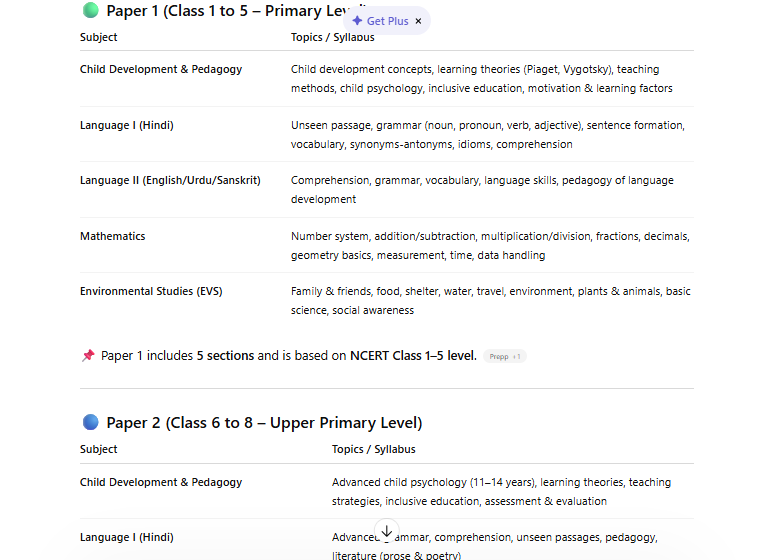
Paper 1 (Primary Level: Class 1–5)
1. Child Development & Pedagogy (30 Marks)
Focus: Teaching methodology + child psychology
Topics include:
- Child Development (0–11 years)
- Learning theories (Piaget, Vygotsky, Kohlberg)
- Concept of Inclusive Education
- Understanding children with special needs
- Teaching-learning process
- Motivation & learning styles
Tip: Concept-based questions, not rote learning
2. Language I – Hindi (30 Marks)
Focus: Language proficiency + teaching ability
Topics:
- Hindi grammar (व्याकरण)
- Vocabulary & sentence formation
- Unseen passage (गद्यांश)
- Teaching methods of Hindi
- Language skills: reading, writing, speaking
3. Language II – English/Sanskrit/Urdu (30 Marks)
Focus: Basic understanding + pedagogy
For English:
- Grammar (tenses, articles, prepositions)
- Vocabulary & comprehension
- Unseen passages
- Teaching methods (pedagogy)
4. Mathematics (30 Marks)
Focus: Basic concepts (Class 1–5 level)
Topics:
- Number system
- Addition, subtraction, multiplication, division
- Fractions & decimals
- Geometry (basic shapes)
- Measurement & time
- Pedagogical issues (how to teach maths)
Questions are conceptual and application-based
5. Environmental Studies (EVS) (30 Marks)
Focus: Daily life + environment awareness
Topics:
- Family & friends
- Food, shelter, water
- Plants & animals
- Transport & communication
- Basic science concepts
- EVS teaching methods
Paper 2 (Upper Primary Level: Class 6–8)
1. Child Development & Pedagogy (30 Marks)
Focus: Child psychology (11–14 years)
Topics:
- Learning theories & development stages
- Individual differences
- Inclusive education
- Teaching strategies & assessment
2. Language I (30 Marks)
- Grammar & comprehension
- Pedagogy of language development
- Teaching methods
3. Language II (30 Marks)
- Basic grammar & vocabulary
- Comprehension passages
- Language teaching pedagogy
4. Mathematics & Science (60 Marks) (for Science/Math teachers)
Mathematics:
- Number system
- Algebra
- Geometry
- Mensuration
- Data handling
- Pedagogy
Science:
- Physics: motion, force, energy
- Chemistry: पदार्थ, chemical changes
- Biology: plants, animals, human body
- Pedagogy of science
OR
4. Social Studies (60 Marks) (for Arts teachers)
Topics:
- History (ancient, medieval, modern India)
- Geography (India & world)
- Civics (constitution, democracy)
- Social & political life
1. Child Development & Pedagogy (Common for Both Papers)
This is the most important and scoring section.
Key Topics:
- Child Development (0–11 years)
- Learning theories (Piaget, Vygotsky, Kohlberg)
- Inclusive education & special needs children
- Teaching-learning processes
- Intelligence & motivation
- Assessment and evaluation
Focus Tip: Conceptual understanding is more important than rote learning.
2. Language I (Hindi)
Topics:
- Grammar (Vyakaran)
- Sentence formation
- Comprehension (गद्यांश)
- Vocabulary & usage
- Teaching methods of language
Focus Tip: Practice comprehension daily and revise grammar rules.
3. Language II (English/Sanskrit/Urdu)
Topics:
- Basic grammar (Tenses, Articles, Prepositions)
- Reading comprehension
- Vocabulary
- Pedagogy of language development
Focus Tip: Focus on basic grammar + pedagogy questions.
4. Mathematics (Paper 1 & Paper 2)
Paper 1 Level:
- Number system
- Simplification
- LCM & HCF
- Geometry basics
- Time, Distance, Profit & Loss
Paper 2 Level:
- Algebra
- Geometry
- Mensuration
- Data handling
- Pedagogical issues in Mathematics
Focus Tip: Practice NCERT (Class 1–8) thoroughly.
5. Environmental Studies (Paper 1)
Topics:
- Family & Friends
- Food, Shelter
- Water & Travel
- Things We Make & Do
- EVS Pedagogy
Focus Tip: Study NCERT EVS books (Class 3–5).
6. Science / Social Studies (Paper 2)
Science Topics:
- Physics basics
- Chemistry basics
- Biology concepts
- Pedagogy of Science
Social Studies Topics:
- History
- Geography
- Civics
- Pedagogy of Social Science
Focus Tip: Focus more on pedagogy + NCERT concepts.
Best Study Plan to Crack UPTET 2026 in First Attempt
Month 1: Foundation Building
- Complete Child Development & Pedagogy
- Start Language I & II basics
- Cover NCERT (Class 1–5) for Maths & EVS
- Daily Study Time: 5–6 hours
Month 2: Advanced Preparation
- Complete Maths & Science/Social Studies
- Start solving previous year papers
- Practice mock tests (2 per week)
- Revise pedagogy topics
Month 3: Revision & Practice
- Full-length mock tests (4–5 per week)
- Revise short notes
- Focus on weak areas
- Practice time management
Daily Study Routine
| Time | Task |
|---|---|
| 2 Hours | Child Development |
| 1 Hour | Language I |
| 1 Hour | Language II |
| 1.5 Hours | Maths/EVS/Science |
| 30 mins | Revision |
Preparation Tips for Success
Focus on NCERT Books (Class 1–8)
Practice Previous Year Papers regularly
Make short notes for revision
Strengthen pedagogy concepts
Attempt mock tests consistently
Avoid guesswork—focus on accuracy
Common Mistakes to Avoid
- Ignoring pedagogy section
- Not solving mock tests
- Skipping NCERT basics
- Poor time management
- Over-reliance on guidebooks
Conclusion
The UPTET Syllabus 2026 is vast but manageable with the right strategy. Focus on concept clarity, regular practice, and consistent revision. If you follow a structured study plan and practice mock tests, clearing UPTET in the first attempt is absolutely achievable.
FAQs
1. What is the syllabus of UPTET 2026?
UPTET syllabus includes two papers:
- Paper 1 (Class 1–5): Child Development & Pedagogy, Language 1, Language 2, Mathematics, Environmental Studies
- Paper 2 (Class 6–8): Child Development & Pedagogy, Language 1, Language 2, Mathematics & Science / Social Studies
2. Is the UPTET syllabus the same for Paper 1 and Paper 2?
No, both papers have different syllabi. Paper 1 focuses on the primary level, while Paper 2 includes subject-specific topics like Science or Social Studies for upper primary classes.
3. What are the main subjects in UPTET Paper 1?
The five main subjects are:
- Child Development & Pedagogy
- Language I (Hindi)
- Language II (English/Urdu/Sanskrit)
- Mathematics
- Environmental Studies
4. What subjects are included in UPTET Paper 2?
Paper 2 includes:
- Child Development & Pedagogy
- Language I
- Language II
- Mathematics & Science (for Science teachers) OR Social Studies (for Arts teachers)
5. Is there any negative marking in UPTET 2026?
No, there is no negative marking, so candidates should attempt all questions.
6. How many questions are asked in UPTET exam?
Each paper consists of 150 multiple-choice questions (MCQs).
7. What is the duration of the UPTET exam?
The exam duration is 2 hours 30 minutes (150 minutes) for each paper.
8. What topics are covered under Child Development & Pedagogy?
Key topics include:
- Child development stages
- Learning theories (Piaget, Vygotsky, etc.)
- Teaching methods
- Inclusive education
9. Is the syllabus based on NCERT?
Yes, most topics (especially Maths, EVS, Science) are based on NCERT syllabus (Class 1–8 level).
10. Can I apply for both Paper 1 and Paper 2?
Yes, candidates can apply for both papers if they meet eligibility criteria.
11. What is the qualifying marks for UPTET?
- General: 60% (90 marks)
- Reserved categories: 55% (82 marks approx.)
12. Which section is most important in UPTET?
Child Development & Pedagogy (CDP) is considered the most important as it appears in both papers and carries significant weight.
13. Does UPTET syllabus change every year?
No, the syllabus usually remains almost the same, with minor updates if any.
14. Which language options are available in UPTET?
Candidates can choose from:
- Hindi (Language I)
- English / Urdu / Sanskrit (Language II)
15. How to cover UPTET syllabus effectively?
- Focus on NCERT books (Class 1–8)
- Practice previous year papers
- Strengthen pedagogy concepts
- Attempt mock tests regularly
About The Author
