
The Haryana Pharmacist Recruitment 2026 is expected to be conducted by the Haryana Staff Selection Commission (HSSC) for Group C posts. Candidates preparing for this exam must understand the latest syllabus, exam pattern, and marking scheme to plan an effective strategy.
Although the official notification for 2026 may follow the previous pattern, the syllabus is generally based on the Diploma/B.Pharmacy level subjects along with Haryana GK and basic aptitude topics.
Haryana Pharmacist 2026: Overview
| Particular | Details |
|---|---|
| Conducting Body | Haryana Staff Selection Commission (HSSC) |
| Post Name | Pharmacist |
| Exam Level | State Level |
| Mode of Exam | Objective (CBT/OMR) |
| Qualification | D.Pharm / B.Pharm |
| Selection Process | CET + Written Exam |
As per HSSC recruitment trends, candidates must first qualify the Common Eligibility Test (CET) before appearing in the main written exam.
Haryana Pharmacist Exam Pattern 2026
The exam pattern is expected to follow a single written test format similar to other pharmacist exams.
Exam Structure
| Section | Questions | Marks |
|---|---|---|
| Pharmacy Subjects | 70–80 | 70–80 |
| Haryana GK & General Awareness | 10–15 | 10–15 |
| Reasoning / Maths / Computer | 5–10 | 5–10 |
| Total | 100 | 100 |
Key Highlights
- Mode: Objective Type (MCQs)
- Duration: 90–120 minutes
- Total Questions: 100
- Negative Marking: 0.25 marks (expected)
- Medium: Hindi & English
Similar pharmacist exams usually contain 100 MCQs with negative marking and 2-hour duration, which is followed by many state recruitment boards.
Haryana Pharmacist Syllabus 2026 (Detailed)
The syllabus mainly focuses on core pharmacy subjects along with basic general awareness and Haryana-specific topics.
1. Pharmaceutics
- Dosage forms (Tablets, Capsules, Syrups, Ointments)
- Pharmaceutical calculations
- Dispensing pharmacy
- Sterilization techniques
- Packaging and storage of drugs
- Prescription handling
2. Pharmacology
- General pharmacology (drug action, pharmacokinetics)
- Drugs acting on:
- Central Nervous System (CNS)
- Cardiovascular system
- Gastrointestinal tract
- Respiratory system
- Hormones and antibiotics
- Chemotherapy & anti-microbial drugs
3. Pharmaceutical Chemistry
- Organic chemistry basics
- Drug classification and structure
- Medicinal chemistry
- Pharmaceutical analysis
- Identification tests of drugs
4. Pharmacognosy
- Crude drugs (plant sources)
- Herbal medicines
- Adulteration of drugs
- Extraction methods
- Natural products
5. Biochemistry & Clinical Pathology
- Carbohydrates, proteins, lipids
- Enzymes and metabolism
- Vitamins and minerals
- Blood and urine analysis
- Disease diagnosis basics
6. Hospital & Clinical Pharmacy
- Drug distribution systems
- Patient counselling
- Drug interactions
- Adverse drug reactions (ADR)
- Clinical trials
- Pharmacy ethics
7. Community Pharmacy & Health Education
- Role of pharmacist in society
- National health programs
- OTC drugs
- Public health awareness
- Medication adherence
- Health screening services
8. Haryana GK & General Awareness
- Haryana history, culture, geography
- Current affairs (state & national)
- Government schemes
- Basic polity and economy
Haryana-specific questions usually carry significant weightage in HSSC exams, so candidates must prepare them thoroughly.
9. Basic Computer & Reasoning
- Computer fundamentals
- MS Office basics
- Logical reasoning
- Data interpretation
- Basic mathematics (10th level)
Haryana Pharmacist Syllabus Analysis 2026
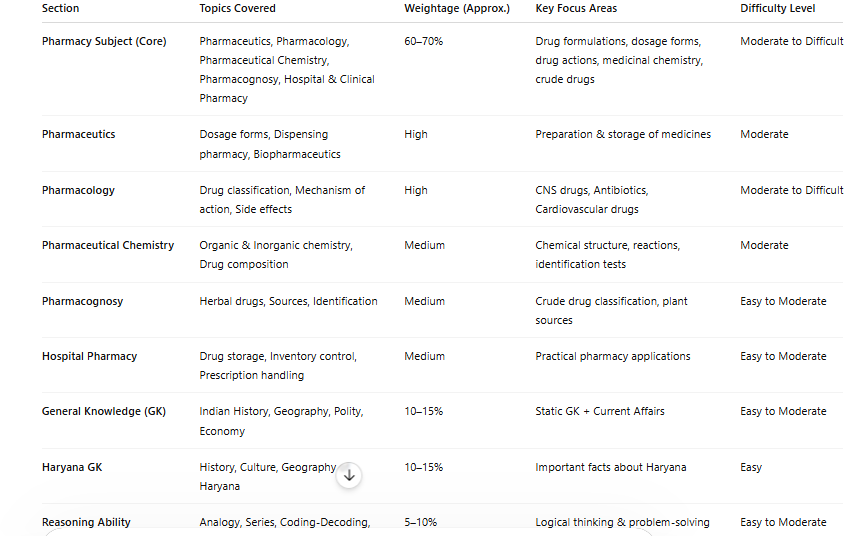
Detailed tabular analysis of the Haryana Pharmacist Syllabus (commonly based on recruitment exams conducted by the Haryana Staff Selection Commission):
Haryana Pharmacist Syllabus Analysis
| Section | Topics Covered | Weightage (Approx.) | Key Focus Areas | Difficulty Level |
|---|---|---|---|---|
| Pharmacy Subject (Core) | Pharmaceutics, Pharmacology, Pharmaceutical Chemistry, Pharmacognosy, Hospital & Clinical Pharmacy | 60–70% | Drug formulations, dosage forms, drug actions, medicinal chemistry, crude drugs | Moderate to Difficult |
| Pharmaceutics | Dosage forms, Dispensing pharmacy, Biopharmaceutics | High | Preparation & storage of medicines | Moderate |
| Pharmacology | Drug classification, Mechanism of action, Side effects | High | CNS drugs, Antibiotics, Cardiovascular drugs | Moderate to Difficult |
| Pharmaceutical Chemistry | Organic & Inorganic chemistry, Drug composition | Medium | Chemical structure, reactions, identification tests | Moderate |
| Pharmacognosy | Herbal drugs, Sources, Identification | Medium | Crude drug classification, plant sources | Easy to Moderate |
| Hospital Pharmacy | Drug storage, Inventory control, Prescription handling | Medium | Practical pharmacy applications | Easy to Moderate |
| General Knowledge (GK) | Indian History, Geography, Polity, Economy | 10–15% | Static GK + Current Affairs | Easy to Moderate |
| Haryana GK | History, Culture, Geography of Haryana | 10–15% | Important facts about Haryana | Easy |
| Reasoning Ability | Analogy, Series, Coding-Decoding, Blood Relations | 5–10% | Logical thinking & problem-solving | Easy to Moderate |
| Mathematics | Arithmetic, Percentage, Ratio, Time & Work | 5–10% | Basic calculations | Easy to Moderate |
| English/Hindi Language | Grammar, Vocabulary, Comprehension | 5–10% | Error detection, synonyms, antonyms | Easy |
Key Insights from the Analysis
- Core Pharmacy subjects dominate the exam (around 60–70%), so strong conceptual clarity is essential.
- Pharmacology & Pharmaceutics are the most important scoring areas.
- Haryana GK is crucial and often decisive in final selection.
- Questions are generally Diploma in Pharmacy (D.Pharm) level.
- Focus more on practical applications rather than just theory.
Haryana Pharmacist Selection Process 2026
The selection process generally includes:
- Common Eligibility Test (CET)
- Main Written Examination
- Document Verification
Only candidates who qualify CET are eligible for the final selection stage.
Preparation Tips for Haryana Pharmacist 2026
1. Focus on Core Pharmacy Subjects
Most questions come from D.Pharm/B.Pharm syllabus, especially Pharmacology and Pharmaceutics.
2. Practice MCQs Daily
Solve previous year papers and mock tests to improve speed and accuracy.
3. Cover Haryana GK Thoroughly
State-specific GK can be a scoring section.
4. Revise Regularly
Prepare short notes for quick revision of drugs and classifications.
5. Attempt Mock Tests
Helps in time management and exam temperament.
Conclusion
The Haryana Pharmacist Syllabus 2026 is primarily based on pharmacy subjects along with Haryana GK and basic aptitude. Candidates should focus more on concept clarity, drug classifications, and practical pharmacy knowledge.
Understanding the exam pattern and syllabus in detail will help you create a targeted study plan and increase your chances of success in this competitive exam.
FAQs
1. What are the main subjects in Haryana Pharmacist Syllabus 2026?
The syllabus generally includes:
- Pharmacy / Professional Knowledge
- General Awareness
- Reasoning Ability
- Quantitative Aptitude
- Basic Computer Knowledge
These sections are common across most pharmacist exams in India.
2. Which section carries the highest weightage?
The Pharmacy (Professional Knowledge) section carries the highest weightage and is the most important for selection, often contributing the majority of marks.
3. What topics are covered under Pharmacy subjects?
Key pharmacy topics include:
- Pharmacology
- Pharmaceutics
- Pharmacognosy
- Pharmaceutical Chemistry
- Human Anatomy & Physiology
- Hospital & Clinical Pharmacy
4. Is General Knowledge important for this exam?
Yes, General Awareness is important and includes:
- Current Affairs
- Indian Polity
- History & Geography
- Haryana GK (state-specific questions may be asked)
5. What is the difficulty level of the exam?
The exam is usually of moderate level, with:
- Pharmacy questions: Moderate to difficult
- Other sections: Easy to moderate
6. Is there negative marking in Haryana Pharmacist Exam?
Yes, most pharmacist exams (including similar state exams) include negative marking (usually 0.25 marks deduction) for wrong answers.
7. What is the exam mode for Haryana Pharmacist?
The exam is generally conducted in:
- Offline (OMR) or
- Online (CBT mode)
depending on the recruitment authority.
8. What is the qualification required to cover the syllabus?
Candidates must have:
- Diploma in Pharmacy (D.Pharm) or
- Bachelor of Pharmacy (B.Pharm)
as the syllabus is based on pharmacy-level knowledge.
9. How much time is required to complete the syllabus?
On average:
- 2–3 months for Pharmacy subjects
- 1 month for General sections
With revision, total preparation takes 3–4 months.
10. Are Haryana-specific questions asked in the exam?
Yes, questions related to:
- Haryana History
- Culture
- Geography
- Government Schemes
are often included.
11. Is Computer Knowledge compulsory?
Yes, basic computer knowledge is part of the syllabus, including:
- MS Office
- Internet basics
- Computer fundamentals
12. What is the best strategy to prepare?
- Focus 70% on Pharmacy subjects
- Practice MCQs daily
- Revise notes regularly
- Solve previous year papers
13. Is the syllabus same as other state pharmacist exams?
Mostly yes. The core Pharmacy syllabus remains similar, but:
- Haryana GK is unique
- Exam pattern may slightly vary
14. Are numerical questions asked in the exam?
Yes, in Quantitative Aptitude:
- Percentage
- Ratio
- Profit & Loss
- Time & Work
15. Can non-pharmacy students apply?
No, only candidates with pharmacy qualifications are eligible.
About The Author
