
WBPSC Miscellaneous Syllabus 2026: The West Bengal Public Service Commission conducts the Miscellaneous Services Examination to recruit candidates for various administrative posts under the Government of West Bengal. The WBPSC Miscellaneous Service Syllabus 2026 is designed to assess a candidate’s overall knowledge, aptitude, and suitability for government service. It covers key subjects such as General Studies, English, Arithmetic, and Reasoning, ensuring a balanced evaluation of both academic understanding and analytical skills.
Candidates preparing for the WBPSC Miscellaneous Exam 2026 must clearly understand the latest syllabus and exam pattern to plan an effective study strategy. A thorough grasp of the syllabus not only helps in prioritizing important topics but also improves time management during preparation. This article provides a detailed overview of the WBPSC Miscellaneous Service Syllabus 2026, along with important topics and preparation insights to help aspirants succeed.
WBPSC Miscellaneous Service Syllabus Analysis 2026
1. Selection Process Overview
| Stage | Exam Type | Nature | Marks |
|---|---|---|---|
| Preliminary | Objective (MCQ) | Qualifying | 200 |
| Mains (Final Exam) | Descriptive | Merit-based | 450 |
| Interview | Personality Test | Final Selection | 100 |
Final merit = Mains + Interview marks
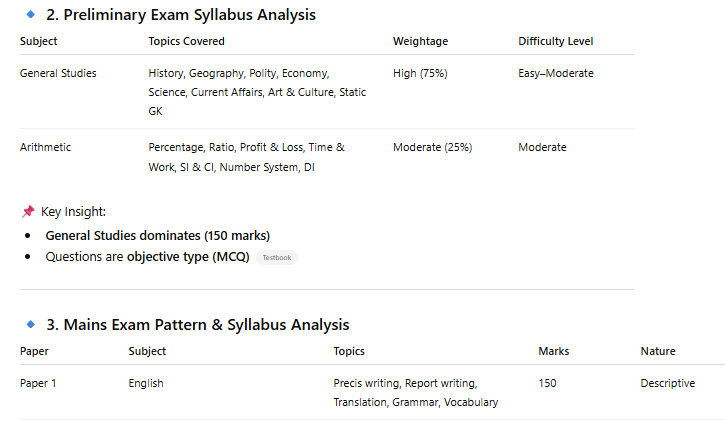
2. Preliminary Exam Syllabus Analysis
| Subject | Topics Covered | Weightage | Difficulty Level |
|---|---|---|---|
| General Studies | History, Geography, Polity, Economy, Science, Current Affairs, Art & Culture, Static GK | High (75%) | Easy–Moderate |
| Arithmetic | Percentage, Ratio, Profit & Loss, Time & Work, SI & CI, Number System, DI | Moderate (25%) | Moderate |
Key Insight:
- General Studies dominates (150 marks)
- Questions are objective type (MCQ)
3. Mains Exam Pattern & Syllabus Analysis
| Paper | Subject | Topics | Marks | Nature |
|---|---|---|---|---|
| Paper 1 | English | Precis writing, Report writing, Translation, Grammar, Vocabulary | 150 | Descriptive |
| Paper 2 | Indian Language (Bengali/Hindi/Urdu/Nepali/Santhali) | Translation, Grammar, Precis, Report writing | 150 | Descriptive |
| Paper 3 | General Studies + Arithmetic | GK topics + Maths (same as Prelims level) | 150 | Descriptive |
Key Insight:
- Standard = 10+2 level (Higher Secondary)
- Focus on writing skills + conceptual clarity
4. Detailed Subject-wise Syllabus Breakdown
General Studies
| Area | Topics |
|---|---|
| History | Ancient, Medieval, Modern India |
| Geography | India & World Geography |
| Polity | Constitution, Governance |
| Economy | Indian Economy, Budget, Banking |
| Science | Physics, Chemistry, Biology basics |
| Current Affairs | National & International |
| Misc | Art & Culture, Sports, Famous Personalities |
Arithmetic
| Topic | Subtopics |
|---|---|
| Basic Maths | Number System, Simplification |
| Percentage & Profit | Profit & Loss, Discount |
| Ratio | Ratio & Proportion |
| Time Topics | Time & Work, Time & Distance |
| Interest | Simple & Compound Interest |
| Data | Data Interpretation |
Language Papers (English + Regional)
| Section | Skills Tested |
|---|---|
| Writing | Report Writing |
| Translation | English ↔ Regional Language |
| Grammar | Sentence Correction, Usage |
| Comprehension | Precis Writing |
5. Interview (Personality Test)
| Aspect | Details |
|---|---|
| Marks | 100 |
| Focus Areas | Communication skills, Personality, General Awareness |
| Language Skill | Bengali language knowledge important |
Conducted after clearing Mains
6. Overall Preparation Analysis
| Section | Importance | Strategy |
|---|---|---|
| Prelims | Qualifying | Focus on GK + Practice MCQs |
| Mains | निर्णायक (Most Important) | Writing practice + Concept clarity |
| Interview | Final stage | Personality + Communication |
WBPSC Miscellaneous Service Selection Process 2026
The West Bengal Public Service Commission (WBPSC) conducts the Miscellaneous Services Examination to recruit candidates for various government posts. Understanding the latest syllabus and exam pattern is essential for effective preparation.
The selection process consists of three stages:
- Preliminary Examination
- Final (Mains) Examination
- Personality Test (Interview)
WBPSC Miscellaneous Exam Pattern 2026
1. Preliminary Exam Pattern
The prelims exam is objective (MCQ-based) and qualifying in nature.
| Subject | No. of Questions | Marks | Duration |
|---|---|---|---|
| General Studies | 75 | 150 | |
| Arithmetic | 25 | 50 | |
| Total | 100 | 200 | 90 Minutes |
- Each question carries 2 marks
- Only qualifying marks are not counted in the final merit
2. Mains Exam Pattern
The main exam is descriptive (conventional type).
| Paper | Subject | Marks | Duration |
|---|---|---|---|
| Paper 1 | English | 150 | 90 min |
| Paper 2 | Bengali/Hindi/Urdu/Nepali/Santali | 150 | 90 min |
| Paper 3 | General Studies + Arithmetic | 150 | 150 min |
| Total | — | 450 | — |
- Papers are of 10+2 level standard
- Marks of mains are counted for final merit
3. Personality Test (Interview)
- Total Marks: 100
- Final merit = Mains + Interview marks
WBPSC Miscellaneous Syllabus 2026
1. General Studies Syllabus
This section is crucial for both Prelims and Mains.
Important Topics:
- Current Affairs (National & International)
- Indian History
- Geography (India & World)
- Indian Polity & Constitution
- Economy & Economic Scene
- General Science & Scientific Research
- Art & Culture
- Sports & Awards
- Famous Personalities
- Countries & Capitals
Preparation Tip: Focus on current affairs + static GK combination.
2. Arithmetic (Quantitative Aptitude)
This section tests numerical ability and problem-solving skills.
Important Topics:
- Number System
- HCF & LCM
- Percentage
- Profit and Loss
- Ratio and Proportion
- Average
- Time and Work
- Time, Speed & Distance
- Simple & Compound Interest
- Mixture & Allegation
- Data Interpretation
- Boats & Streams
- Pipes & Cisterns
- Problems on Ages
Preparation Tip: Practice previous year questions for speed.
3. English (Mains Paper I)
Descriptive paper focusing on writing and grammar.
Important Topics:
- Report Writing
- Precis Writing (Summary)
- Translation (Regional language → English)
- Grammar Usage
- Synonyms & Antonyms
- Sentence Correction
4. Indian Language Paper (Mains Paper II)
Candidates can choose from Bengali, Hindi, Urdu, Nepali, or Santali.
Important Topics:
- Translation (English → Regional Language)
- Report Writing
- Precis Writing
- Grammar
Same pattern as English but in regional language
5. General Studies & Arithmetic (Mains Paper III)
This paper is a mix of GS + Maths.
Important Topics:
- Current Affairs & Static GK
- Indian Polity & Economy
- Science & Technology
- History & Geography
- Quantitative Aptitude (same as prelims but on a deeper level)
Important Topics to Focus (High Weightage)
Most Important Areas for Prelims
- Current Affairs (last 6–12 months)
- Indian Polity (Constitution basics)
- Geography (India + World)
- Arithmetic basics (Percentage, Ratio, Time & Work)
Most Important Areas for Mains
- Report Writing & Precis
- Translation Practice
- Static GK + Current Affairs
- Advanced Arithmetic Questions
Preparation Strategy for WBPSC Miscellaneous 2026
- Cover NCERT basics (History, Geography, Polity)
- Read daily current affairs
- Practice answer writing for mains
- Solve arithmetic questions daily
- Attempt previous year papers & mock tests
Conclusion
The WBPSC Miscellaneous Syllabus 2026 is well-structured, covering General Studies, Arithmetic, and Language papers. Candidates should focus on both objective preparation for prelims and descriptive writing skills for mains. A balanced strategy combining concept clarity, practice, and revision is key to success.
FAQs
1. What is the syllabus of the WBPSC Miscellaneous Services Exam?
The WBPSC Miscellaneous Services syllabus includes General Studies, Arithmetic, English, and Reasoning. It covers topics like history, geography, current affairs, basic maths, grammar, and logical reasoning.
2. How many stages are there in the WBPSC Miscellaneous Exam?
The exam is conducted in three stages:
- Preliminary Exam
- Final (Main) Exam
- Personality Test (Interview)
3. What subjects are included in the Preliminary exam?
The Preliminary exam includes:
- English
- General Studies
- Arithmetic
- Reasoning
4. Is there negative marking in WBPSC Miscellaneous Exam?
Yes, there is negative marking in the Preliminary exam. Candidates should attempt questions carefully to avoid losing marks.
5. What is the level of questions in the WBPSC Miscellaneous syllabus?
The level of questions is generally moderate, based on 10th to graduation level, depending on the subject.
6. What topics are covered under General Studies?
General Studies includes:
- Indian History
- Geography
- Polity
- Economy
- Science
- Current Affairs
7. What type of questions are asked in the English section?
The English section includes:
- Grammar
- Vocabulary
- Synonyms & Antonyms
- Comprehension
- Sentence Correction
8. What topics are included in Arithmetic?
Arithmetic covers:
- Percentage
- Profit & Loss
- Time & Work
- Ratio & Proportion
- Simple & Compound Interest
9. What is included in the Reasoning section?
Reasoning includes:
- Logical Reasoning
- Analogy
- Series
- Coding-Decoding
- Puzzle-based questions
10. What is the syllabus for the Main Exam?
The Main exam includes:
- English Paper
- Bengali/Hindi/Urdu/Nepali/Santali Paper
- General Studies & Arithmetic
11. Is knowledge of Bengali compulsory for WBPSC Miscellaneous Exam?
Yes, candidates must have knowledge of Bengali or any other recognized language of West Bengal.
12. What is the weightage of the Personality Test?
The Personality Test (Interview) carries final qualifying marks, and it assesses communication skills, confidence, and general awareness.
13. How to prepare for the WBPSC Miscellaneous syllabus effectively?
- Understand the syllabus thoroughly
- Make a subject-wise study plan
- Practice previous year papers
- Focus on current affairs regularly
14. Are NCERT books enough for preparation?
NCERT books are helpful for basic concepts, but candidates should also refer to advanced books and mock tests.
15. What is the best strategy to cover the syllabus on time?
- Divide syllabus into small sections
- Allocate daily study hours
- Revise regularly
- Attempt mock tests weekly
About The Author
