
The WB Gram Panchayat Recruitment 2026 exam is conducted for various posts, including Executive Assistant, Sahayak, Gram Panchayat Karmee, and others, under the Government of West Bengal. To crack this exam, candidates must clearly understand the latest WB Gram Panchayat Syllabus 2026 and exam pattern, which focuses on basic academics and rural development knowledge.
WB Gram Panchayat Syllabus 2026
The WB Gram Panchayat Syllabus 2026 is essential for candidates preparing for various village-level administrative posts in West Bengal. It outlines the subjects, topics, and exam pattern required to crack the recruitment process. The syllabus generally includes sections like General Knowledge, English, Mathematics, Reasoning, and Rural Development-related topics. Understanding the detailed syllabus helps candidates plan an effective study strategy and focus on high-weightage areas. Along with the syllabus, candidates should also review the exam pattern to understand marking schemes and question formats. Proper preparation based on the official syllabus can significantly improve the chances of success in the WB Gram Panchayat exam 2026.
WB Gram Panchayat Exam Pattern 2026
As per the latest update, the selection process generally consists of:
- Written Examination (MCQ-based)
- Interview / Personality Test
Overall Exam Structure
| Component | Marks |
|---|---|
| Written Exam (MCQs) | 85 Marks |
| Interview | 15 Marks |
| Total | 100 Marks |
The written exam includes objective-type questions from four major subjects.
Subject-wise Weightage (Typical Pattern)
| Subject | Marks |
|---|---|
| English | 25 |
| Bengali | 25 |
| Arithmetic | 25 |
| General Knowledge (Rural Focus) | 10 |
| Total | 85 Marks |
Some posts, like Gram Panchayat Karmee or Nirman Sahayak, may have slightly different patterns depending on qualification level.
WB Gram Panchayat Syllabus 2026 (Subject-wise)
1. English Syllabus
The English section tests basic language skills.
Important Topics:
- Grammar (Tense, Articles, Prepositions)
- Vocabulary
- Synonyms & Antonyms
- Sentence Correction
- Idioms & Phrases
- One Word Substitution
- Reading Comprehension
2. Bengali Syllabus
This section evaluates understanding of the Bengali language and culture.
Important Topics:
- Bengali Grammar
- Vocabulary
- Comprehension
- Bengali Literature
- Idioms & Proverbs
- Synonyms & Antonyms
- Culture & History of Bengal
3. Arithmetic (Mathematics)
Important Topics:
- Number System
- Percentage
- Ratio & Proportion
- Average
- Profit & Loss
- Time & Work
- Speed, Distance & Time
- Simple & Compound Interest
- HCF & LCM
4. General Knowledge (Rural Development Focus)
This is the most important section for scoring.
Important Topics:
- Current Affairs
- Indian History & Geography
- Indian Polity (Panchayati Raj System)
- Rural Economy & Agriculture
- Government Schemes (Rural Development)
- Environmental Studies
- Rural Sociology & Culture
WB Gram Panchayat Assistant / Sahayak Syllabus 2026
West Bengal Gram Panchayat Assistant / Sahayak Syllabus 2026 in a clear and detailed format based on the latest exam pattern.
The West Bengal Gram Panchayat Sahayak Exam 2026 consists of a Written Test + Interview.
Exam Pattern
- Written Exam: 85 Marks (MCQ)
- Interview: 15 Marks
- Total: 100 Marks
Subjects in Written Exam
- English
- Bengali
- Arithmetic (Maths)
- General Knowledge (Rural Development Focus)
Subject-wise Detailed Syllabus
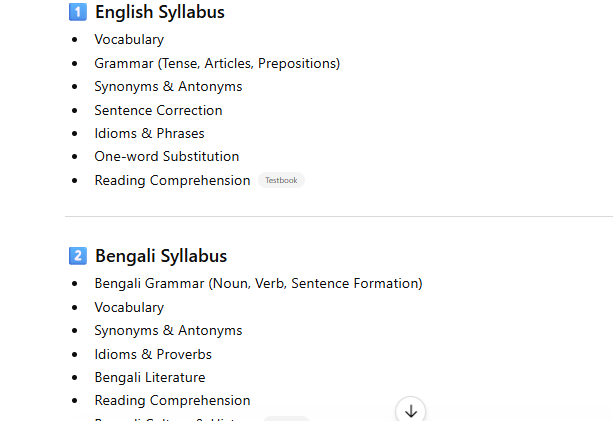
English Syllabus
- Vocabulary
- Grammar (Tense, Articles, Prepositions)
- Synonyms & Antonyms
- Sentence Correction
- Idioms & Phrases
- One-word Substitution
- Reading Comprehension
Bengali Syllabus
- Bengali Grammar (Noun, Verb, Sentence Formation)
- Vocabulary
- Synonyms & Antonyms
- Idioms & Proverbs
- Bengali Literature
- Reading Comprehension
- Bengali Culture & History
Arithmetic (Maths) Syllabus
- Number System
- HCF & LCM
- Simplification
- Percentage
- Ratio & Proportion
- Average
- Profit & Loss
- Time & Work
- Speed, Distance & Time
- Simple & Compound Interest
- Problems on Ages
General Knowledge (Important Section)
Focus is on Rural Life & Development
- Indian History
- Geography (India + Rural Areas)
- Indian Polity (Panchayati Raj System)
- Economy (Agriculture & Rural Economy)
- Environmental Studies
- Current Affairs
- Government Schemes (Rural Development)
- Rural Development Programs & Policies
- Rural Sociology & Culture
Post-wise Exam Pattern (Sahayak)
| Subject | Marks |
|---|---|
| English | 25 |
| Bengali | 25 |
| Arithmetic | 25 |
| GK (Rural Development) | 10 |
| Total | 85 |
Preparation Tips
- Focus more on GK + Rural Development schemes (high scoring)
- Practice basic maths (Class 8–10 level)
- Strengthen Bengali language (important for scoring)
- Solve previous year papers & mock tests regularly
Post-wise Exam Pattern (Variation)
Different posts may have different patterns:
- Executive Assistant / Sahayak → Full 85 marks written exam
- Gram Panchayat Karmee → Lower-level (Class VIII standard questions)
- Nirman Sahayak → Includes Civil Engineering subjects
Always check the official notification for post-specific details.
Key Preparation Tips
- Focus on basic concepts (Class 8–10 level)
- Strengthen Bengali + GK (local topics)
- Study Panchayati Raj & rural schemes carefully
- Practice previous year papers & mock tests
- Stay updated with current affairs of West Bengal
Final Words
The WB Gram Panchayat Syllabus 2026 is simple but scoring if prepared strategically. The exam mainly tests basic academic knowledge + awareness of rural development. Candidates who focus on fundamentals and practice regularly can easily secure good marks.
FAQs
Q1. What subjects are included in WB Gram Panchayat exam?
English, Bengali, Arithmetic, and General Knowledge (Rural Development).
Q2. What is the total marks of the exam?
Total 100 marks (85 written + 15 interview).
Q3. Is there negative marking?
Generally, no official confirmation—check the notification.
Q4. What is the difficulty level?
Mostly Class 8–10 level, making it beginner-friendly.
About The Author
