
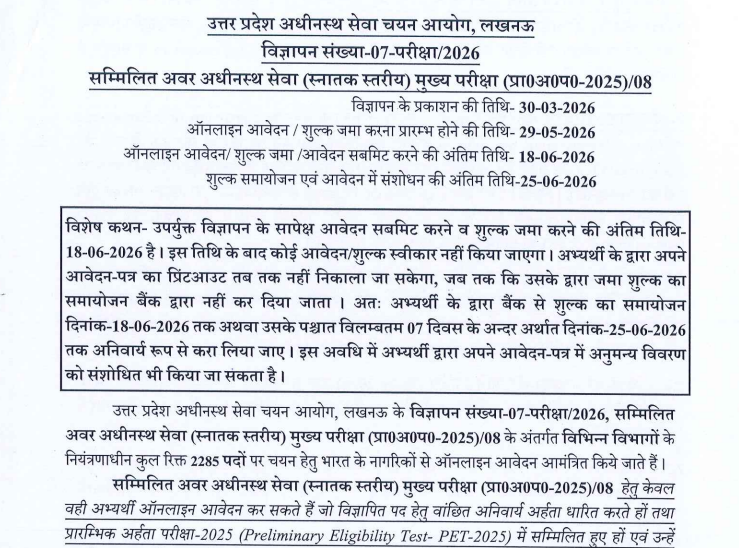
The UPSSSC Lower PCS 2026 (Combined Lower Subordinate Services Exam) is a major state-level recruitment exam conducted by the Uttar Pradesh Subordinate Services Selection Commission (UPSSSC) for various Group C posts. To crack this exam, candidates must clearly understand the latest UPSSSC Lower PCS Syllabus 2026 and exam pattern, as both have been revised recently.
UPSSSC Lower PCS Syllabus 2026
The UPSSSC Lower PCS Syllabus 2026 covers multiple subjects to assess candidates’ general awareness and aptitude. It includes General Studies topics such as Indian History, Polity, Geography, Economy, Environment, and Current Affairs. Candidates must also prepare General Science, Elementary Mathematics, and General Intelligence (Reasoning). Language skills are tested through General Hindi/English. A separate section covers Computer & Information Technology, including basic concepts and applications. Additionally, Uttar Pradesh General Knowledge (history, culture, geography, administration) carries significant weight. The exam is objective with 100 questions for 100 marks and includes negative marking for wrong answers.
UPSSSC Lower PCS 2026: Overview
| Particulars | Details |
|---|---|
| Exam Name | UPSSSC Lower PCS (Combined Lower Subordinate Services) |
| Conducting Body | UPSSSC |
| Level | State Level |
| Mode | Offline (OMR Based) |
| Total Questions | 100 |
| Total Marks | 100 |
| Duration | 2 Hours |
| Negative Marking | 0.25 marks |
| Selection Process | PET → Mains Exam |
Candidates must first qualify PET (Preliminary Eligibility Test) to appear in the Mains exam.
UPSSSC Lower PCS Exam Pattern 2026
The exam consists of a single objective-type paper divided into three parts.
Key Highlights
- Total Questions: 100
- Total Marks: 100
- Duration: 120 minutes
- Negative Marking: 1/4 mark deduction per wrong answer
Section-wise Exam Pattern
| Part | Subject | Questions | Marks |
|---|---|---|---|
| Part-1 | General Studies + Hindi + Data Interpretation | 65 | 65 |
| Part-2 | Computer & IT Knowledge | 15 | 15 |
| Part-3 | Uttar Pradesh General Awareness | 20 | 20 |
| Total | — | 100 | 100 |
The paper tests both general awareness + state-specific knowledge + computer skills.
UPSSSC Lower PCS Syllabus 2026: Important Topics
The syllabus is divided into three major parts:
Part 1: Subject-Related Knowledge
This is the most important section covering General Studies and Hindi.
1. History of India & National Movement
- Ancient, Medieval & Modern History
- Freedom struggle & nationalism
- Independence movement
2. Indian Polity & Constitution
- Constitutional development
- Governance & political system
- Panchayati Raj
- Public policy & administration
3. Geography (India & World)
- Physical & economic geography
- Agriculture, population, urbanization
- Smart cities & rural development
4. Indian Economy & Social Development
- Planning & NITI Aayog
- Budget & financial system
- Liberalization & globalization
- Infrastructure & agriculture
5. Current Affairs
- National & international events
6. Science & Technology
- Everyday applications
- Policies & innovations
7. Environmental Ecology & Disaster Management
- Environment basics
- Climate change & disaster handling
8. Data Interpretation
- Graphs, charts, tables
- Statistical analysis
9. General Hindi
- Grammar (Sandhi, Samas, etc.)
- Vocabulary (Synonyms, Antonyms)
- Sentence correction
- Official letter writing
Note: Recent changes include removal of Maths & Reasoning and addition of Data Interpretation and Science & Tech.
Part 2: Computer & Information Technology
- Basics of computers
- MS Office (Word, Excel, PowerPoint)
- Internet & networking
- Cybersecurity basics
- Latest technological developments
Part 3: Uttar Pradesh General Awareness
- History of Uttar Pradesh
- Geography of UP
- Economy & culture
- Administrative structure
- Government schemes
- Important places & events
This section is crucial as UP-specific questions carry significant weightage.
UPSSSC Lower PCS Syllabus 2026 in Detail
The syllabus is divided into three parts: Part 1 comprises questions on Subject-Related Knowledge, Part 2 consists of questions on Computer and IT, and Part 3 consists of Uttar Pradesh General Awareness questions. The unit-wise syllabus can be checked below.
UPSSSC Lower PCS Syllabus for Subject-Related Knowledge
This section has been recently updated. Topics like General Intelligence and Elementary Mathematics have been removed, and Data Interpretation has been introduced. General Science has been replaced with Science and Technology.
| Subject | Topics & Details |
| Subject Related Knowledge (Part-1) | History of India and Indian National Movement |
| Social, cultural, economic and political aspects of Indian history | |
| Indian National Movement – freedom movement | |
| Rise of nationalism | |
| Attainment of independence | |
| Indian Polity and Indian Constitution | |
| Constitutional development in India | |
| Indian Constitution | |
| Indian political system and governance | |
| Panchayati Raj and local self-governance | |
| Public policy | |
| Official issues | |
| Community development | |
| Geography of India and World | |
| Physical, social and economic geography of the country | |
| Agriculture | |
| Horticulture | |
| Forestry | |
| Animal husbandry | |
| Population and urbanization patterns | |
| Smart cities and smart villages | |
| General information about world geography | |
| Indian Economy and Social Development | |
| Economic planning in India | |
| Objectives and achievements of planning | |
| Role of NITI Aayog | |
| Sustainable Development Goals (SDGs) | |
| Components of government budget and financial system | |
| Development of agriculture, industry and trade commerce in India | |
| Land reforms in India after independence | |
| Effects of globalization and liberalization in India | |
| Changes in industrial policy and their impact on industrial development | |
| Infrastructure: Power, ports, roads, airports and railways etc. | |
| Current Events of National and International Importance | |
| Knowledge of recent events at both national and international level | |
| Science and Technology | |
| Applications of India’s Science and Technology Policy in everyday life | |
| S&T for development and national security | |
| Achievements of Indians in science and technology | |
| Indigenization of technology | |
| Development of new technologies including mutually beneficial and technologically useful technologies | |
| Awareness in the fields of space technology, defense technology, energy sources, nanotechnology, microbiology and biotechnology | |
| Issues related to intellectual property rights and digital rights | |
| Environmental Ecology and Disaster Management | |
| General information on environmental protection and ecosystems | |
| Wildlife conservation | |
| Biodiversity | |
| Environmental pollution and degradation | |
| Environmental impact assessment | |
| Climate change | |
| Disaster mitigation and disaster management in India as a non-traditional security and safety challenge | |
| Disaster Management Act-2005 | |
| National Disaster Management Authority (NDMA) | |
| State Disaster Management Authority (SDMA) | |
| National Disaster Response Force (NDRF) | |
| State Disaster Response Force (SDRF) | |
| Various agencies working in the field of disaster management in India | |
| Efforts and achievements being made in the field of disaster mitigation and disaster management at the global level | |
| Data Interpretation | |
| Interpretation and analysis of data | |
| Statistical Analysis – Graphs and Diagrams to test the candidate’s ability to draw general knowledge conclusions from information presented in statistical and graphical diagrams | |
| General Hindi | |
| Questions related to addressing official, semi-official, personal and professional issues via letters, office orders, notifications and circulars | |
| Varna and Sound: Pronunciation, writing, vowels, consonants, identification and use of Matras, classification of sounds | |
| Word formation: Sandhi and Sandhi-vicched, Samas (Compounds), Prefix (Upasarg), Suffix (Pratyay) | |
| Word types: (a) Tat-sam, Ardha-tat-sam, Tadbhav, Deshaj, Videshi; (b) Noun, Pronoun, Adjective, Verb, Indeclinable (Adverb, Preposition, Conjunction, Interjection, Nipata) | |
| Word Knowledge: Synonyms, Antonyms, meaning of word pairs, one-word substitution, similar sounding different words, appropriate word selection, relationship vocabulary | |
| Word Correction | |
| Grammatical categories: Case markers (Parsarg), Gender, Number, Person, Tense, Mood, Aspect, Voice | |
| Sentence structure: Types (Simple, Compound, Complex) and Sentence correction | |
| Use of punctuation marks | |
| Idioms and Proverbs |
UPSSSC Lower PCS Syllabus for Computer and Information Technology
This section checks basic understanding of computers and modern technology. “Candidates who do not have a technical background can still score well by covering basic concepts and practising commonly asked questions from this section.
| Subject | Topics & Details |
| Part-2 (Computer and Information Technology) | Core Concepts |
| History and Introduction of Computer | |
| Information Technology concepts | |
| Internet and World Wide Web (WWW) | |
| Hardware and Software | |
| Input and Output devices | |
| Internet Protocol/IP Address | |
| IT gadgets and their applications | |
| Creation and operation of e-mail ID | |
| Operation of Printer, Tablet and Mobile | |
| MS-Word and Excel Processing elements | |
| Operating Systems | |
| Social Networking | |
| e-Governance | |
| Digital Financial Tools and Applications | |
| Future Skills and Cyber Security | |
| Contemporary Technological Development | |
| Artificial Intelligence | |
| Big Data Processing | |
| Deep Learning | |
| Machine Learning | |
| Internet of Things (IoT) | |
| India’s achievements in Information Technology |
UPSSSC Lower PCS Syllabus for General Information related to Uttar Pradesh
This section covers the state’s history, culture, geography, economy, and current affairs. The details are given in the table below.
| Subject | Topics & Details |
| Part-3 (General Information related to Uttar Pradesh) | General Knowledge of Uttar Pradesh |
| History of Uttar Pradesh | |
| Culture and Art | |
| Architecture of UP | |
| Festivals and Folk Dances | |
| Literature and Regional Languages | |
| Heritage and Social Customs | |
| Tourism in UP | |
| Geographical Landscape and Environment | |
| Natural Resources: Soil, Forests, Wildlife | |
| Mines and Minerals in UP | |
| Climate of Uttar Pradesh | |
| Economy and Agriculture | |
| Industry, Business and Employment | |
| Polity and Administration | |
| Current Events of Uttar Pradesh | |
| Achievements of UP in various fields |
UPSSSC Lower PCS सिलेबस 2026 (Hindi)
UPSSSC (उत्तर प्रदेश अधीनस्थ सेवा चयन आयोग) द्वारा आयोजित यह परीक्षा ग्रुप ‘C’ पदों के लिए होती है। इसमें मुख्य रूप से सामान्य अध्ययन, हिंदी, गणित, कंप्यूटर और उत्तर प्रदेश GK से प्रश्न पूछे जाते हैं।
विषयवार सिलेबस (Subject-wise Syllabus)
Part-1: सामान्य अध्ययन (General Studies)
1. भारतीय इतिहास एवं राष्ट्रीय आंदोलन
- प्राचीन, मध्यकालीन और आधुनिक इतिहास
- स्वतंत्रता संग्राम
- प्रमुख आंदोलन एवं नेता
2. भारतीय संविधान एवं राजनीति
- संविधान की मूल बातें
- मौलिक अधिकार एवं कर्तव्य
- संसद, न्यायपालिका, केंद्र-राज्य संबंध
3. भूगोल (भारत एवं विश्व)
- भौतिक, सामाजिक एवं आर्थिक भूगोल
- भारत का भूगोल
4. भारतीय अर्थव्यवस्था
- आर्थिक विकास
- योजनाएँ, गरीबी, बेरोजगारी
- सामाजिक विकास
5. सामान्य विज्ञान
- भौतिकी, रसायन, जीव विज्ञान (Basic level)
6. पर्यावरण एवं आपदा प्रबंधन
- पर्यावरण संरक्षण
- जलवायु परिवर्तन
- आपदा प्रबंधन
7. करंट अफेयर्स
- राष्ट्रीय एवं अंतरराष्ट्रीय घटनाएँ
8. सामान्य बुद्धिमत्ता (Reasoning)
- कोडिंग-डिकोडिंग
- श्रृंखला, दिशा, तर्क
9. प्रारंभिक गणित (Elementary Maths)
- प्रतिशत
- लाभ-हानि
- औसत, समय-दूरी
10. सामान्य हिंदी
- व्याकरण
- शब्द भंडार
- वाक्य सुधार
Part-2: कंप्यूटर एवं सूचना प्रौद्योगिकी
- कंप्यूटर की मूल जानकारी
- MS Word, Excel, Internet
- IT की बेसिक अवधारणाएँ
इस सेक्शन से लगभग 15 प्रश्न पूछे जाते हैं।
Part-3: उत्तर प्रदेश सामान्य ज्ञान (UP GK)
- यूपी का इतिहास, भूगोल
- संस्कृति, कला, त्योहार
- प्रशासनिक व्यवस्था
- योजनाएँ एवं करंट अफेयर्स
यह सेक्शन सबसे ज्यादा वेटेज (लगभग 20 अंक) का होता है।
UPPCS Lower Syllabus 2026 PDF Download
Candidates can download the UPSSSC Lower PCS Syllabus 2026 PDF from the official website (upsssc.gov.in). The syllabus includes subjects like General Knowledge, Indian History, Polity, Geography, Economy, Science & Technology, Environment, Data Interpretation, General Hindi, and Computer Knowledge. The exam consists of 100 objective questions for 100 marks with a duration of 2 hours and negative marking of 0.25 marks per wrong answer. It also covers Uttar Pradesh-specific knowledge and current affairs. The syllabus is designed to test analytical ability, awareness, and basic computer skills for Group C administrative posts.
Selection Process
The selection process includes:
- PET (Preliminary Eligibility Test) – Screening stage
- Mains Examination – Final selection
Only candidates qualifying PET are eligible for the mains exam.
Preparation Tips
- Focus more on General Studies + UP GK + Computer
- Practice Data Interpretation regularly
- Strengthen Hindi grammar
- Solve previous year papers
- Stay updated with current affairs
Conclusion
The UPSSSC Lower PCS Syllabus 2026 is designed to evaluate candidates on general awareness, state knowledge, and basic computer skills. With a single-stage mains exam, competition is high, so a clear understanding of the syllabus and exam pattern is essential for success.
A strategic preparation focusing on UP-specific topics, current affairs, and data analysis can significantly improve your chances of selection.
About The Author
