
The Uttarakhand Medical Service Selection Board (UKMSSB) has officially released the notification for the Nursing Officer Recruitment 2026, inviting applications for 196 vacancies in Group C posts within the Medical Health and Family Welfare Department. It is time for aspirants to shift their focus to the crucial phase: understanding the exam pattern and syllabus. A clear strategy based on the official structure is key to excelling in this competitive examination.
UKMSSB Nursing Officer Syllabus 2026
The UKMSSB Nursing Officer Syllabus 2026 is divided into two papers covering nursing subjects and general topics. The exam includes diploma- and degree-level nursing concepts and objective questions.
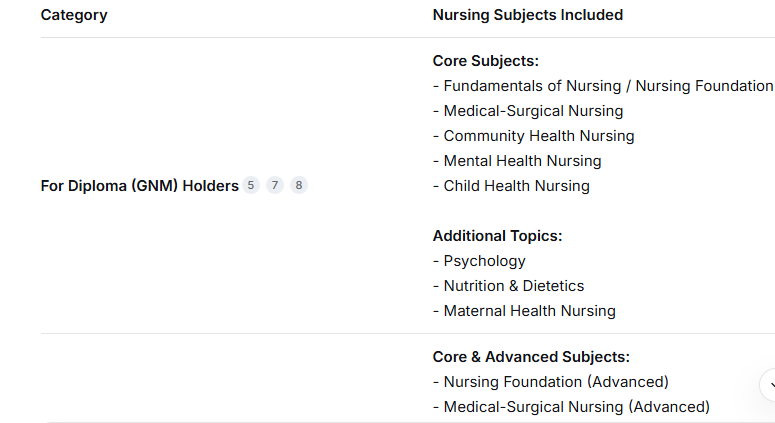
Paper 1 (Nursing Subjects): Fundamentals of Nursing, Medical-Surgical Nursing, Community Health Nursing, Child Health Nursing, Mental Health Nursing, Nutrition & Dietetics, Psychology, and Maternal Health Nursing. Key topics include patient care, diseases, pharmacology, immunisation, and health programs.
Paper 2 (General Section): General Hindi (grammar, vocabulary), General Knowledge (current affairs, history, polity), and General Studies (reasoning, aptitude, computer basics).
The exam is usually 200 marks with MCQs, emphasising nursing subjects (about 50% weightage).
UKMSSB Nursing Officer 2026: Exam Pattern at a Glance
The selection process for the UKMSSB Nursing Officer position consists of a written examination followed by document verification. The written exam is a crucial stage, and understanding its pattern is the first step toward effective preparation.
-
Mode of Examination: The exam is conducted in offline mode, using OMR sheets.
-
Total Marks and Questions: The paper consists of 200 multiple-choice questions (MCQs) carrying a total of 200 marks.
-
Exam Duration: Candidates are given 3 hours (180 minutes) to complete the paper.
-
Marking Scheme: Each correct answer is awarded 1 mark.
-
Negative Marking: An important aspect of the exam is the negative marking of ¼ mark (0.25) for every incorrect answer. This means accuracy is as vital as attempting questions.
-
Language: The question paper is available in both Hindi and English.
Breakdown of the Exam: Two Papers
The UKMSSB Nursing Officer exam is divided into two distinct papers, each evaluating different skill sets.
| Paper | Subject | Questions | Marks |
|---|---|---|---|
| Paper I | Nursing Subjects | 100 | 100 |
| Paper II | General Hindi, General Knowledge, & General Studies | 100 | 100 |
This structure highlights that while professional nursing knowledge is paramount, candidates cannot afford to neglect the general aptitude section .
UKMSSB Nursing Officer Syllabus 2026
The syllabus is based on GNM / B.Sc Nursing level. Core nursing subjects carry the highest weightage.
1. Fundamentals of Nursing
Important Topics:
- Nursing procedures & principles
- Vital signs & patient assessment
- Infection control & biomedical waste
- First aid & patient safety
- Nursing ethics & legal aspects
- Admission, discharge & documentation
This section builds the foundation and is highly scoring.
2. Medical-Surgical Nursing
Important Topics:
- Cardiovascular, respiratory & neurological disorders
- Gastrointestinal & renal diseases
- Endocrine disorders
- Oncology & burns
- Pharmacology basics
- Pre & post-operative care
This is the most important and high-weightage subject.
3. Child Health Nursing (Pediatrics)
Important Topics:
- Growth & development
- Neonatal care
- Immunization schedule
- Pediatric diseases & emergencies
- Nutrition in children
4. Mental Health Nursing
Important Topics:
- Psychiatric disorders
- Therapeutic communication
- Personality disorders
- Psychotropic drugs
- Substance abuse
5. Community Health Nursing
Important Topics:
- National health programs
- Primary health care
- Epidemiology & demography
- Environmental health
- Family welfare programs
6. Nursing Management & Research
Important Topics:
- Ward management & administration
- Leadership & supervision
- Nursing audit & quality control
- Research methodology
- Basic statistics
7. Other Nursing Subjects (Degree/Diploma Level)
- Nutrition & Dietetics
- Psychology
- Obstetrics & Gynecology
- Nursing Education
- Nursing Administration
Paper 2 Syllabus (Non-Nursing)
General Hindi
- Grammar
- Vocabulary
- Synonyms & antonyms
- Sentence correction
General Knowledge
- Current affairs
- Indian polity, history, geography
- Uttarakhand GK
- Government schemes
General Studies / Aptitude
- Reasoning
- Numerical ability
- Basic computer knowledge
High-Weightage Topics
Focus more on:
- Medical-Surgical Nursing
- Fundamentals of Nursing
- Community Health Nursing
- Pharmacology
- National Health Programs
Paper I: Detailed Syllabus for Nursing Subjects (100 Marks)
Paper I is the core of the examination, designed to test a candidate’s comprehensive knowledge of nursing. The syllabus and depth of questions may vary slightly depending on whether a candidate holds a Diploma (GNM) or a Degree (B.Sc. Nursing) . However, the core clinical subjects form the foundation for both.
High-Weightage Core Areas:
-
Medical-Surgical Nursing: This is consistently cited as the subject with the highest weightage. Key topics include cardiovascular disorders, respiratory diseases, neurological conditions, gastrointestinal disorders, renal system, endocrine disorders, oncology, burns, and pre- and post-operative care.
-
Fundamentals of Nursing: This is a highly scoring area covering nursing procedures and principles, nursing ethics, infection control and biomedical waste management, vital signs assessment, and patient safety.
-
Community Health Nursing: A vital subject for state-level exams, it covers national health programs, primary health care, epidemiology, demography and family welfare, and health education.
Other Important Subjects:
-
Child Health Nursing (Pediatrics): Growth and development, neonatal care, pediatric emergencies, common childhood diseases, and the immunisation schedule.
-
Mental Health Nursing: Includes psychiatric disorders, therapeutic communication, psychotropic drugs, and community mental health.
-
Nursing Management & Research: Ward management, leadership, nursing audit, and the research process are key topics.
-
Obstetrics & Gynaecological Nursing: This subject is particularly important for candidates with a B.Sc. Nursing background.
-
Anatomy, Physiology, Nutrition, and Pharmacology: These are foundational subjects that support clinical understanding.
Candidates are advised to prioritise Medical-Surgical Nursing, Fundamentals of Nursing, and Community Health Nursing, as these areas often dominate the paper.
Paper II: Syllabus for General Section (100 Marks)
Paper II is common for all candidates and tests general awareness and language proficiency.
-
General Hindi (approx. 20 marks): This section focuses on basic Hindi grammar, vocabulary, synonyms and antonyms, sentence correction, idioms and proverbs, and reading comprehension.
-
General Knowledge (approx. 40 marks): A major portion of this section is dedicated to Uttarakhand State GK, which includes history, geography, economy, and culture of the state. It also covers national and international current affairs, Indian polity, and general science.
-
General Studies/Aptitude (approx. 40 marks): This section evaluates analytical and reasoning skills through basic reasoning, numerical ability, and mental ability questions.
Conclusion
The UKMSSB Nursing Officer 2026 examination requires a focused and structured preparation strategy. The clear divide between nursing and general sections means you must allocate your study time effectively. With the nursing section being the deciding factor, prioritise subjects like Medical-Surgical Nursing, Fundamentals of Nursing, and Community Health Nursing. At the same time, practice your reasoning and quantitative skills for Paper II. A disciplined approach, thorough knowledge of the syllabus, and awareness of the negative marking scheme will be your greatest assets in this exam
About The Author
