
The Rajasthan Common Eligibility Test (CET) 2026, conducted by the Rajasthan Staff Selection Board (RSMSSB), is one of the most significant state-level examinations for government job aspirants. As per recent announcements, the 2026 edition introduces substantial changes, including the implementation of negative marking for the first time and an extended certificate validity period of three years . This detailed guide provides a comprehensive overview of the Rajasthan CET Syllabus 2026 and Exam Pattern for both Graduate and 12th Level posts.
Overview of Rajasthan CET 2026
The CET serves as a qualifying gateway for numerous Group B and Group C government positions in Rajasthan, including roles like Patwari, Junior Accountant, Tehsil Revenue Accountant, Supervisor, and Sub-jailer, among others .
Key Exam Highlights:
-
Conducting Body: Rajasthan Staff Selection Board (RSMSSB)
-
Exam Mode: Offline (OMR-based)
-
Question Type: Multiple Choice Questions (MCQs)
-
Total Questions: 150
-
Total Marks: 300
-
Time Duration: 3 Hours
-
Marking Scheme: 2 marks for each correct answer
Major Changes in Rajasthan CET 2026
This year’s examination introduces critical changes that candidates must be aware of:
-
Negative Marking Introduced: For the first time, the CET will feature negative marking of 1/3 mark for each incorrect answer at the Graduate Level . This shift aims to increase the exam’s difficulty and ensure only serious candidates qualify .
-
Extended Certificate Validity: The validity of the CET scorecard has been increased from 1 year to 3 years, allowing candidates more opportunities to apply for various recruitments using a single score .
-
Qualifying Marks: General category candidates require a minimum of 40% marks to qualify, while reserved categories receive a 5% relaxation (35%) .
Rajasthan CET Exam Pattern 2026 (Common for Both Levels)
The overall structure of the exam remains consistent across both levels: a single paper with 150 objective-type questions carrying a total of 300 marks. The following table provides a general overview of the exam pattern:
| Particulars | Details |
|---|---|
| Total Questions | 150 |
| Maximum Marks | 300 |
| Time Duration | 3 Hours |
| Question Type | Multiple Choice Questions (MCQs) |
| Negative Marking (Graduate Level) | 1/3 mark per wrong answer |
| Negative Marking (12th Level) | Not Applicable (as per available information) |
Subject-Wise Exam Pattern for Rajasthan CET 2026
The subject-wise distribution of questions varies slightly between the Graduate Level and 12th Level exams, primarily in the content of the General Science section.
Rajasthan CET Graduate Level Exam Pattern 2026
| Subjects | Weightage | Questions | Marks |
|---|---|---|---|
| General Science; History, Polity, and Geography of India; General Knowledge, Current Affairs | 25% | 38 | 76 |
| Geography, History, Culture, and Polity of Rajasthan | 20% | 30 | 60 |
| General English & Hindi | 15% | 22 | 44 |
| Mental Ability & Reasoning, Basic Numerical Efficiency | 30% | 45 | 90 |
| Basic Computer | 10% | 15 | 30 |
| Total | 100% | 150 | 300 |
Note: The Rajasthan CET Graduate Level Exam 2026 includes 1/3 negative marking .
Rajasthan CET 12th Level Exam Pattern 2026
| Subjects | Weightage | Questions | Marks |
|---|---|---|---|
| General Science (10th Standard Level) | 25% | 38 | 76 |
| Geography, History, Culture, and Polity of Rajasthan | 20% | 30 | 60 |
| General English & Hindi | 15% | 22 | 44 |
| Mental Ability & Reasoning, Basic Numerical Efficiency | 30% | 45 | 90 |
| Basic Computer | 10% | 15 | 30 |
| Total | 100% | 150 | 300 |
Note: As per current information, the Rajasthan CET 12th Level Exam does not have negative marking .
Detailed Rajasthan CET Syllabus 2026
Understanding the detailed syllabus is crucial for strategic preparation. The subjects covered are designed to test a candidate’s general awareness, analytical skills, and language proficiency.
1. History of India & Rajasthan (with emphasis on Indian National Movement)
Indian History:
-
Important events and chronology of Indian history.
-
Social and religious reform movements of the 19th and 20th centuries.
-
Various phases of the Indian freedom struggle and contributions of freedom fighters.
Rajasthan’s History:
-
Role of Rajasthan in the 1857 revolt.
-
Tribal and peasant movements in Rajasthan.
-
Political awakening and the Praja Mandal movement in Rajasthan.
-
Post-independence nation-building and the integration of Rajasthan .
2. Art, Culture, Heritage, and Literature of Rajasthan
Art and Architecture:
-
Ancient civilizations: Kalibangan, Ahar, Ganeshwar, Balathal, Bairat .
-
Key historical events and major dynasties of Rajasthan.
-
Forts, monuments, paintings, crafts, and sculptures.
-
Folk music, dance, fairs, and festivals.
-
Rajasthani literature, dialects, saints, and folk deities .
3. Geography of India & Rajasthan
Geography of India:
-
Physical features: mountains, plateaus, deserts, and plains.
-
Climate, monsoon system, and major rivers.
-
Crops, minerals, energy resources, and major industries.
-
National highways and transport .
Geography of Rajasthan:
-
Geological structure and physiographic regions.
-
Climate, drainage system, lakes, and dams.
-
Natural vegetation, wildlife, and sanctuaries.
-
Soils, major crops (Rabi and Kharif), and major tribes.
-
Mineral resources, energy resources, and tourist places .
4. Indian Polity with Special Reference to Rajasthan
Indian Political System:
-
Nature of the Indian Constitution: Preamble, Fundamental Rights, DPSP, Fundamental Duties.
-
Union and State Legislature, Executive, and Judiciary.
-
Constitutional Institutions: Election Commission, CAG, etc.
Rajasthan’s Political & Administrative System:
-
Governor, Chief Minister, State Legislative Assembly, High Court.
-
District Administration, State Election Commission, State Human Rights Commission .
5. Economy of India & Rajasthan
Indian Economy:
-
Budget, Banking, Public Finance, GST, National Income.
-
Monetary and Fiscal Policies, Subsidies, Public Distribution System.
-
Major sectors: Agriculture, Industry, Service, and Trade.
Economy of Rajasthan:
-
Major crops, irrigation projects, and agriculture-based industries.
-
Industrial development, small-scale and cottage industries.
-
Government schemes for poverty alleviation, unemployment, and social justice .
6. Science & Technology
-
Physics & Chemistry: Physical and chemical changes, acids, bases, salts, oxidation-reduction reactions .
-
Biology: Food and nutrition, health systems, communicable and non-communicable diseases.
-
Environment: Biodiversity, natural resource conservation, sustainable development.
-
Technology: ICT, Defence Technology, Space Technology .
7. Mental Ability, Reasoning & Numerical Efficiency
Logical Reasoning:
-
Coding-Decoding, Blood Relations, Direction Sense, Analogy, Classification.
-
Series, Figure Matrix, Puzzles, Seating Arrangement, Input-Output .
Numerical Efficiency:
-
Percentage, Average, Ratio and Proportion, Simple and Compound Interest.
-
Number System, Time and Work, Profit and Loss.
-
Basic Mensuration (Area, Volume of 2D and 3D shapes) .
8. General English & Hindi
General English:
-
Grammar: Articles, Tenses, Voice, Narration, Prepositions.
-
Vocabulary: Synonyms, Antonyms, One-word Substitution, Idioms and Phrases.
-
Comprehension, Letter Writing (Official, Demi-official) .
General Hindi:
-
Grammar: Sandhi, Compound Words, Prefixes and Suffixes, Punctuation.
-
Vocabulary: Antonyms, Synonyms, Homonyms.
-
Idioms and Proverbs, Official Hindi terminology .
9. Basic Computer Knowledge
-
Characteristics of Computers, Computer Organization (RAM, ROM, File System).
-
Input/Output Devices, Software-Hardware relationship.
-
Operating System.
-
MS Office (Word, Excel, PowerPoint) .
10. Current Affairs
-
Major national, international, and state (Rajasthan) events.
-
Persons, places, and institutions in the news.
-
Sports, awards, and important government schemes.
Detailed Syllabus (Subject-wise) in Tabular form
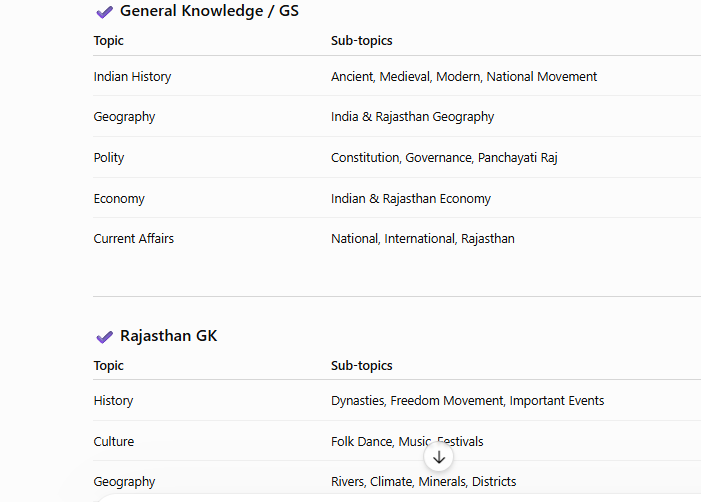
General Knowledge / GS
| Topic | Sub-topics |
|---|---|
| Indian History | Ancient, Medieval, Modern, National Movement |
| Geography | India & Rajasthan Geography |
| Polity | Constitution, Governance, Panchayati Raj |
| Economy | Indian & Rajasthan Economy |
| Current Affairs | National, International, Rajasthan |
Rajasthan GK
| Topic | Sub-topics |
|---|---|
| History | Dynasties, Freedom Movement, Important Events |
| Culture | Folk Dance, Music, Festivals |
| Geography | Rivers, Climate, Minerals, Districts |
| Polity | State Government, Panchayati Raj |
General Science & Technology
| Topic | Sub-topics |
|---|---|
| Physics | Motion, Energy, Light, Electricity |
| Chemistry | Matter, Atoms, Acids, Metals |
| Biology | Human Body, Health, Diseases |
| Technology | ISRO, AI, Computer basics |
Reasoning & Numerical Ability
| Topic | Sub-topics |
|---|---|
| Reasoning | Analogy, Coding-Decoding, Blood Relation |
| Logical Ability | Statement, Syllogism, Decision Making |
| Maths | Percentage, Profit-Loss, Ratio |
| Data Interpretation | Charts, Graphs |
Language (Hindi & English)
| Subject | Topics |
|---|---|
| Hindi | व्याकरण, मुहावरे, लोकोक्तियाँ, वाक्य |
| English | Grammar, Vocabulary, Comprehension |
Computer Knowledge
| Topic | Sub-topics |
|---|---|
| Basics | Hardware, Software |
| Internet | Email, Browser |
| MS Office | Word, Excel, PowerPoint |
| Advanced | Cloud, Cyber Security |
4. Key Subjects Summary
| Level | Main Subjects |
|---|---|
| 12th Level | GK, Science, Maths, Reasoning, Hindi, English, Computer |
| Graduation Level | History, Geography, Polity, Economy, Science, Reasoning, Languages |
Preparation Tips for Rajasthan CET 2026
Given the new pattern, a strategic approach is essential for success.
-
Prioritize Rajasthan GK: This section carries the highest weightage (38 questions). Thoroughly cover Rajasthan’s history, culture, and geography .
-
Focus on Mental Ability & Reasoning: With 45 questions, it’s a significant scoring section. Regular practice of puzzles and aptitude questions is vital .
-
Master Basic Computer Knowledge: This is a 15-question section that is often overlooked but can be easily scored .
-
Practice with Negative Marking: Since this is a new element for the Graduate Level, take mock tests that simulate negative marking to improve accuracy and avoid guesswork .
-
Time Management: Practice solving 150 questions in 3 hours. Speed and accuracy are equally important .
Rajasthan CET Syllabus 2026 (Subject-wise)
The syllabus is almost similar for both levels, but the difficulty level differs.
1. General Knowledge & Current Affairs
- National & International Current Events
- Indian History & Freedom Movement
- Indian Polity & Constitution
- Indian Economy
- Important Days & Events
2. Rajasthan General Knowledge
- राजस्थान का इतिहास (History)
- Geography of Rajasthan
- Culture, Art & Festivals
- राजस्थान की अर्थव्यवस्था
- राजस्थान की राजनीति
3. General Science
- Physics (Basic Concepts)
- Chemistry (Reactions, Elements)
- Biology (Human Body, Plants)
- Everyday Science Applications
Questions are usually based on 10th-level science.
4. Mathematics (Quantitative Aptitude)
- Percentage
- Profit & Loss
- Time & Work
- Ratio & Proportion
- Simple & Compound Interest
- Average
5. Reasoning & Mental Ability
- Coding-Decoding
- Series & Pattern
- Blood Relations
- Direction Test
- Puzzles & Seating Arrangement
6. Hindi & English Language
Hindi:
- व्याकरण (Grammar)
- वाक्य शुद्धि
- मुहावरे एवं लोकोक्तियाँ
English:
- Grammar
- Vocabulary
- Comprehension
7. Basic Computer Knowledge
- Computer Fundamentals
- MS Office
- Internet & Email
- Hardware & Software
Rajasthan CET 12th vs Graduation Level
| Feature | 12th Level | Graduation Level |
|---|---|---|
| Difficulty | Basic | Moderate |
| Subjects | School Level | Advanced GK + Economy |
| Focus | Basic Knowledge | Analytical Understanding |
Important Dates (Expected)
As per recent reports, the tentative schedule for Rajasthan CET 2026 is as follows :
-
CET 2026 (Graduate Level): Application forms are expected to be released in June 2026, with the exam likely in November 2026.
-
CET 2026 (Senior Secondary/12th Level): Application forms are expected in July 2026, with the exam likely in December 2026.
Disclaimer: Candidates are advised to regularly check the official RSMSSB website [https://rsmssb.rajasthan.gov.in/] for the latest updates, official notifications, and exact dates .
Conclusion
The Rajasthan CET Syllabus 2026 and Exam Pattern cover a wide range of subjects, emphasizing both core knowledge and analytical skills. With the introduction of negative marking for the graduate level, a more strategic and focused preparation is required. By thoroughly understanding the syllabus and exam pattern, candidates can create an effective study plan and enhance their chances of success in this competitive examination.
About The Author
