
TNPSC Diploma ITI Level Syllabus 2026: The Tamil Nadu Public Service Commission (TNPSC) conducts the Combined Technical Services (CTS) Diploma/ITI Level Examination annually to recruit candidates for various technical positions across Tamil Nadu government departments. With the 2026 notification scheduled for release on July 7, 2026, and the written examination commencing from September 20, 2026, aspirants must begin their preparation with a thorough understanding of the syllabus and exam pattern.
TNPSC Diploma ITI Level Exam 2026: Overview
The TNPSC CTS Diploma/ITI Level Examination is designed to assess candidates for technical posts requiring specialized knowledge in their respective trades. The selection process consists of a written examination followed by certificate verification, with merit lists prepared based solely on written examination performance.
Key Dates for TNPSC CTS Diploma ITI Level 2026:
| Event | Date |
|---|---|
| Notification Release | July 7, 2026 |
| Written Examination Commencement | September 20, 2026 |
| Examination Duration | 7 Days |
TNPSC Diploma ITI Level Exam Pattern 2026
The written examination follows a two-paper format designed to evaluate both general competency and technical expertise. Candidates must qualify in the Tamil eligibility test for their other papers to be evaluated.
Paper I: General Subjects
Paper I is conducted in a single session and consists of three parts:
| Part | Subject | Questions | Marks |
|---|---|---|---|
| Part A | Tamil Eligibility Test (SSLC Standard) | 100 | 150* |
| Part B | General Studies | 75 | Included |
| Part C | Aptitude & Mental Ability | 25 | Included |
*Part A is qualifying in nature. Candidates must score a minimum of 40% (60 marks) for their other papers to be evaluated. These marks are NOT counted for ranking purposes.
Paper II: Technical Trade Subject
The second paper focuses on the candidate’s trade-specific knowledge at the ITI/Diploma standard. This paper carries the highest weightage for final ranking:
| Subject | Questions | Marks | Duration |
|---|---|---|---|
| Trade Subject (ITI/Diploma Standard) | 200 | 300 | 3 Hours |
Final Merit Calculation: Ranking is based on 450 marks total (Paper I Part B & C: 150 marks + Paper II: 300 marks).
TNPSC Diploma ITI Level Syllabus 2026: Important Topics
The syllabus is divided into two main sections:
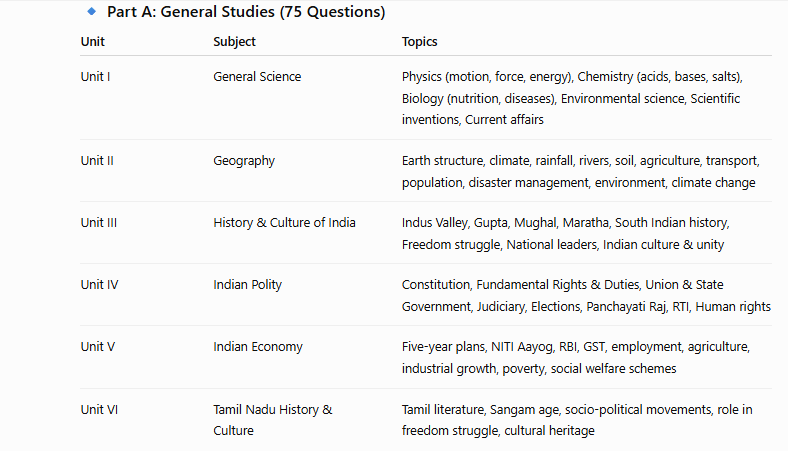
1. General Studies Syllabus (SSLC Standard)
This section carries 75% weightage, making it the most important part.
General Science
- Physics: Motion, force, energy, electricity, magnetism
- Chemistry: Acids, bases, salts, fertilizers, petroleum products
- Biology: Human body, nutrition, diseases, genetics
- Environment: Pollution, ecology, climate change
- Latest scientific developments
Geography
- Earth structure and physical features
- Climate, monsoon, rainfall
- Water resources and natural resources
- Agriculture and industries
- Geography of India & Tamil Nadu
History & Culture
- Ancient, Medieval, and Modern Indian History
- Indian Freedom Struggle
- Tamil Nadu history and culture
- Art, architecture, literature
Indian Polity
- Constitution of India
- Fundamental Rights & Duties
- Union, State & Local Government
- Elections and governance
Economy
- Basic economic concepts
- Five-year plans
- National income
- Poverty, unemployment
- Economic schemes
Current Affairs
- National & International events
- Science & Technology updates
- Sports, awards, books
- Government schemes
2. Aptitude & Mental Ability Syllabus
This section carries 25% weightage and is scoring.
Quantitative Aptitude
- Percentage
- Ratio & Proportion
- Profit & Loss
- Time & Work
- Simple & Compound Interest
Mental Ability (Reasoning)
- Number series
- Coding & decoding
- Analogies
- Classification
- Logical reasoning
TNPSC Diploma ITI Level Selection Process 2026
The recruitment process generally includes:
- Written Examination (Primary stage)
- Document Verification
- Interview (for certain posts only)
Subject-Wise TNPSC Diploma ITI Level Syllabus 2026 by Trade
TNPSC has released trade-specific syllabi for various ITI and Diploma-level technical subjects. The syllabus is comprehensive, covering both theoretical concepts and practical applications relevant to each trade.
Instrument Mechanic (Chemical Plant) – ITI Standard
The Instrument Mechanic syllabus covers ten comprehensive units focusing on measurement, control systems, and instrumentation principles:
Unit I: Safety & Basic Electricity
-
Elementary first aid, basic hand tools, precision measuring instruments
-
Ohm’s law, Kirchhoff’s law, series and parallel circuits
-
Electrical components: resistors, capacitors, inductors, transformers
-
AC/DC motors, stepper motors, and instrument transformers
Unit II: Electrical Measuring Instruments
-
Absolute and secondary instruments
-
PMMC instruments, Ohm meter, megger/insulation tester
-
AC instruments: MI, electrodynamometer, watt meter, energy meter
Unit III: Digital Electronics
-
PN junction diode, special diodes, transistors (CB, CE, CC configurations)
-
Rectifiers (half wave, full wave, bridge), filters, voltage regulators
-
Thyristor devices: SCR, TRIAC, DIAC
-
Operational amplifiers, IC 555 applications, logic gates and flip-flops
Unit IV: Measurement of Motion and Pressure
-
Static and dynamic characteristics of measurement systems
-
Stress and strain measuring instruments, tachometers, speedometers
-
Pressure sensors, transducers, manometers, calibration techniques
Unit V: Measurement of Flow
-
Basic fluid properties, flow rate units, flow meter types
-
Head type, variable area, mass flow meters
-
Solid flow measurement, calibration and installation procedures
Unit VI: Measurement of Level
-
Direct and indirect level measurement methods
-
Level instruments for open and closed channels
-
Conductivity and capacitance level instruments
Unit VII: Measurement of Temperature
-
Primary and secondary temperature standards
-
Thermocouples, RTD, thermistors, pyrometers
-
Recorders: strip chart, circular chart, paperless recorders
Unit VIII: Final Control Elements
-
Pneumatic, hydraulic, and electrical actuators
-
Control valves: types and flow characteristics
-
PLC systems, I/O devices, programming basics
Unit IX: Networking
-
Network types, cables, networking tools
-
SCADA and DCS fundamentals, HART communicators
-
Field bus, Ethernet, EDDL basics
Unit X: Basic Hydraulics, Pneumatics & Analytical Instruments
-
Pascal’s law, Bernoulli’s principle, hydraulic fluid properties
-
Pneumatic power system components
-
pH meter, conductivity meter, dissolved oxygen meter
Field Assistant (Electrician/Wireman) – TANGEDCO
For Field Assistant posts under TANGEDCO, the trade syllabus covers the following comprehensive topics:
| Topic | Key Areas |
|---|---|
| Safety Rules & Tool Handling | Safety signs, electrical hazards, prevention, first aid, protective equipment |
| Fundamentals of Electrical & Electronics | Ohm’s Law, Kirchhoff’s Law, AC/DC circuits, Star & Delta connections, transistors |
| Electrical Machines | DC generators, motors, alternators, single/three-phase motors, starting methods |
| Transformers | EMF equation, types, efficiency, cooling methods, protective devices |
| Measuring Instruments | Ammeter, voltmeter, multimeter, wattmeter, energy meter, megger |
| Power Generation | Thermal, nuclear, hydel, solar, wind energy, solar cells & panels |
| Transmission & Distribution | LV, MV, HV lines, conductors, insulators, substations, breakers, relays |
| Control Panels & Wiring | Relays, contactors, MCCB, MCB, ELCB, RCCB, domestic/industrial wiring |
Computer Hardware and Network Maintenance
For candidates in the Computer Hardware and Network Maintenance trade, the syllabus covers ten detailed units:
Unit I: Safety and Electronic Components
-
Semiconductor devices: DIAC, SCR, TRIAC, operational amplifiers
-
SMPS working principles, types, specifications, troubleshooting
Unit II: Computer Hardware Introduction
-
Computer generations, classifications, internal components
-
Processors (Intel: Celeron, Core i3/i5/i7, AMD), memory types (RAM, ROM, EPROM)
-
Hard disk drives (HDD) concepts: sector, track, cylinder
Unit III: Preventive Maintenance
-
POST, BIOS, CMOS, UEFI, power protection devices
-
RAID concepts, RAID levels, SATA/eSATA cables and connectors
-
Monitor characteristics, thick and thin clients, NAS
Unit IV: Operating System Installation and Utilities
-
Hard disk operations, partitioning (MBR and GPT), bad sector management
-
OS installation procedures, control panel, device driver installation
-
Linux commands, file system, shell scripting, UNIX concepts
Unit V: Laptop Hardware
-
Laptop block diagram, parts identification
-
Touchpad, docking station, wireless internet configuration
Unit VI: MS-Office and Peripherals
-
Word processing (MS-Word), spreadsheets (Excel), presentations (PowerPoint)
-
Printers: Dot Matrix, Laser, Inkjet, scanners, multifunction printers
Unit VII: Network Components and Internet
-
Network topologies (Star, Ring, Bus, Tree, Mesh), OSI and TCP/IP models
-
Network components: modems, hubs, routers, switches, access points
-
Internet protocols (HTTP, SMTP, FTP), DNS servers
Unit VIII: Network Security
-
Wired and wireless network security, remote device management
-
Surveillance using network devices, Aadhar-based authentication
Unit IX: Windows and Linux Server
-
Active Directory, DNS, DHCP, Routing and Remote Access
-
Apache web server, SAMBA, virtualization concepts
Unit X: Cloud Computing
-
World Wide Web, search engines, email systems, SPAM management
-
Cloud computing, virtualization (Type 1 and 2 hypervisors)
Additional Technical Subjects for 2026
TNPSC has released syllabi for several other ITI standard technical subjects for the 2026 examination cycle:
-
Diesel Mechanic
-
Mechanic Agricultural Machinery
-
Fire Technology and Industrial Safety Management
-
Remotely Piloted Aircraft (Drone Pilot)
-
Desktop Publishing Operator
-
Plumber
-
Marine Engine Fitter
-
Painter General
-
Technician Power Electronics System
Diploma-Level Subjects
For Diploma-level candidates, subject-specific syllabi are available for various engineering disciplines including:
-
Civil Engineering
-
Mechanical Engineering
-
Electrical and Electronics Engineering
-
Electronics and Communication Engineering
-
Instrumentation Engineering
-
Automobile Engineering
-
Architecture
-
Textile Technology
How to Access the Official Syllabus PDF
Candidates can download the official TNPSC syllabus from the Commission’s website:
Official Syllabus Page: https://tnpsc.gov.in/English/syllabus.html
For each trade or diploma subject, separate PDF links are available. Candidates should carefully verify that they are referring to the syllabus for their specific post, as the content varies significantly across different trades.
Preparation Strategy
Given the comprehensive nature of the syllabus, candidates should adopt a structured preparation approach:
1. Focus on Trade Subject (Paper II)
With 300 marks and 200 questions, Paper II is the most critical component. Candidates should:
-
Thoroughly review the official trade syllabus
-
Practice numerical problems related to electrical measurements, circuit calculations, and instrumentation principles
-
Study practical applications and safety procedures
2. General Studies Preparation
The General Studies section covers topics relevant to India and Tamil Nadu including history, geography, polity, and current affairs.
3. Aptitude and Mental Ability
Practice quantitative aptitude, logical reasoning, and mental ability questions at SSLC standard.
4. Tamil Language Proficiency
While qualifying in nature, candidates must secure 40% in the Tamil Eligibility Test to have their other papers evaluated.
Important Considerations
-
The syllabus and exam pattern are subject to modification until the date of notification publication. Candidates should verify the latest information from the official website.
-
Physical tests may be required for certain posts such as Field Assistant, which includes a mandatory pole climbing test.
-
Document verification is part of the selection process for all posts.
Conclusion
The TNPSC Diploma ITI Level Examination 2026 offers significant opportunities for technical candidates seeking government positions in Tamil Nadu. With the notification expected on July 7, 2026, and the examination scheduled from September 20, 2026, candidates have ample time to prepare systematically.
Success in this examination requires dedicated preparation focused on the specific trade syllabus, regular practice of technical problems, and consistent review of general studies topics. Candidates are advised to download the official trade syllabus from the TNPSC website and create a structured study plan covering all units comprehensively.
About The Author
