
The Bank of India (BOI) has announced a significant recruitment drive for 2026, offering 514 vacancies for the position of Credit Officer under the General Banking Officer (GBO) stream. This presents a substantial career opportunity for banking professionals specializing in credit and lending. The selection process is designed to rigorously evaluate candidates through an online examination followed by an interview. Understanding the detailed syllabus and exam pattern is the first and most crucial step towards success. This article provides a comprehensive breakdown of the Bank of India Credit Officer Syllabus and Exam Pattern for 2026, structured to help aspirants plan their preparation effectively.
Overview of Bank of India Credit Officer Recruitment 2026
Before delving into the syllabus, it’s essential to understand the basic framework of the recruitment process. The exam is conducted at a national level for candidates aspiring to join the bank across India . The selection process primarily consists of an online Computer-Based Test (CBT) followed by a personal interview.
| Particulars | Details |
|---|---|
| Organization | Bank of India (BOI) |
| Post Name | Credit Officer (GBO Stream) |
| Total Vacancies | 514 |
| Exam Mode | Online (Computer-Based Test) |
| Selection Process | Online Examination + Interview |
| Exam Date | March 1, 2026 |
Bank of India Credit Officer Exam Pattern 2026
The online examination is structured to test both general aptitude and specialized professional knowledge. The pattern consists of four sections with a composite time limit, meaning no individual time is allotted per section.
Detailed Exam Structure
The exam features a total of 150 objective-type questions, carrying a total of 150 marks. Candidates are given 120 minutes (2 hours) to complete the test.
| Section | Number of Questions | Maximum Marks | Duration |
|---|---|---|---|
| English Language | 25 | 25 | |
| Reasoning | 25 | 25 | 120 Minutes |
| Quantitative Aptitude | 25 | 25 | (No Sectional Timing) |
| Professional Knowledge | 75 | 75 | |
| Total | 150 | 150 |
Marking Scheme and Key Points
-
Marking Scheme: Each question carries 1 mark. There is a penalty for wrong answers, with 0.25 marks deducted for each incorrect response. No marks are deducted for unanswered questions.
-
Nature of the English Section: The English Language section is often considered qualifying in nature. This means the marks obtained in this section might not be added to the final merit list for shortlisting, although it is crucial to clear the sectional cut-off to avoid disqualification.
-
Language of the Exam: Except for the English Language section, the question paper is available bilingually, i.e., in English and Hindi.
-
Weightage for Final Selection: If both stages are conducted, the final merit list is typically prepared with a 70:30 weightage for the online exam and interview, respectively.
Bank of India Credit Officer Syllabus 2026: Subject-wise Breakdown
The syllabus is meticulously designed to assess a candidate’s proficiency in core banking concepts, numerical ability, logical reasoning, and language skills. The Professional Knowledge section carries the highest weightage, reflecting the specialized nature of the role.
1. Professional Knowledge (Credit Officer)
This is the most critical section, comprising 75 questions and contributing 75 marks. It is the deciding factor for shortlisting and requires in-depth preparation in banking and finance.
Key Topics Include:
-
Banking & Financial System: Structure of the Indian banking system, functions of RBI, commercial banks, NBFCs, and types of bank accounts and deposit products.
-
Credit Appraisal & Lending: The loan lifecycle, credit appraisal process, types of loans (retail, MSME, corporate, agriculture), fund-based and non-fund-based limits, and security, collateral, and guarantees.
-
Financial Statement Analysis: Analysis of Balance Sheets, Profit & Loss accounts, Cash Flow and Fund Flow statements. This also involves Ratio Analysis covering liquidity, profitability, and leverage .
-
Working Capital & Project Finance: Working capital assessment methods (e.g., Turnover method, MPBF), project appraisal, viability analysis, break-even analysis, and DSCR (Debt Service Coverage Ratio) .
-
Risk Management: Credit risk, market risk, operational risk, Basel norms, capital adequacy, and risk mitigation techniques .
-
Asset Quality & Recovery: NPA (Non-Performing Asset) classification and provisioning norms, SMA (Special Mention Account) categories, restructuring, and the SARFAESI Act .
-
Priority Sector & MSME Lending: RBI priority sector guidelines, MSME classification, financing schemes, and government credit-linked schemes .
-
Regulatory & Compliance: RBI guidelines on lending and exposure norms, KYC (Know Your Customer), AML (Anti-Money Laundering), and compliance basics .
2. Quantitative Aptitude
This section assesses numerical ability and calculation speed, essential for analyzing data and financial figures. It contains 25 questions for 25 marks.
Key Topics Include :
-
Simplification and Approximation
-
Number Series (Missing, Wrong, Pattern-based)
-
Data Interpretation (DI): Table-based, Line Graph, Bar Graph, Pie Chart, Caselet DI
-
Arithmetic Word Problems: Percentage, Ratio & Proportion, Profit & Loss, Simple & Compound Interest, Time & Work, Time, Speed & Distance, Mixtures & Allegations, Averages, Partnership, Number System basics (LCM, HCF, divisibility).
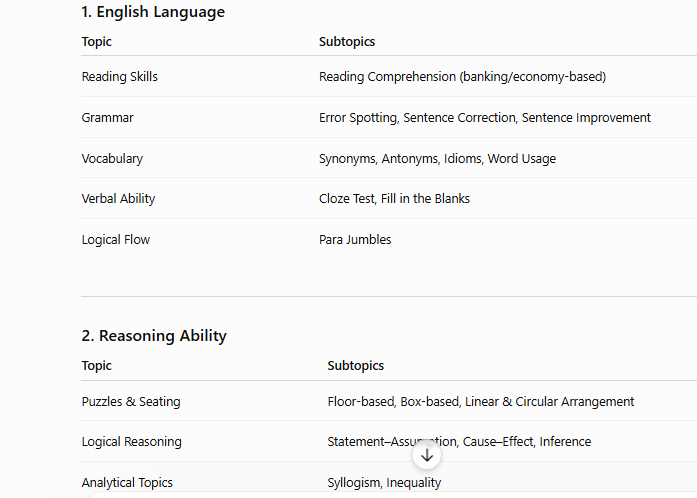
3. Reasoning Ability
This section tests logical thinking, analytical skills, and problem-solving ability, crucial for decision-making. It contains 25 questions for 25 marks.
Key Topics Include :
-
Puzzles: Floor-based, box-based, scheduling, comparison-based.
-
Seating Arrangement: Linear, circular, square, rectangular.
-
Syllogism (Traditional and Coded)
-
Inequality (Direct and Coded)
-
Coding-Decoding (Alphabet, Numeric, Symbolic)
-
Blood Relations (Family-based problems)
-
Direction Sense and Distance
-
Order & Ranking
-
Input-Output (Number and word patterns)
-
Logical Reasoning: Statement-assumption, cause-effect, inference.
4. English Language
This section evaluates reading comprehension, grammar, and vocabulary skills, essential for professional communication. It contains 25 questions for 25 marks.
Key Topics Include :
-
Reading Comprehension (based on banking, finance, economy, and business).
-
Cloze Test
-
Error Spotting and Sentence Correction
-
Fill in the Blanks (Single and Double)
-
Para Jumbles
-
Sentence Improvement and Phrase Replacement
-
Vocabulary: Synonyms, antonyms, word usage, and idioms.
Bank of India Credit Officer Syllabus 2026 (Important Topics)
The syllabus is divided into 4 major sections, combining aptitude + domain knowledge.
1. English Language
This section tests grammar, comprehension, and vocabulary skills.
Important Topics:
- Reading Comprehension (Banking/Economy based)
- Cloze Test
- Error Spotting
- Sentence Correction
- Fill in the Blanks
- Para Jumbles
- Sentence Improvement
- Vocabulary (Synonyms, Antonyms, Idioms)
2. Reasoning Ability
Focuses on logical thinking and analytical skills.
Important Topics:
- Seating Arrangement (Linear & Circular)
- Puzzles (Floor, Box, Scheduling)
- Syllogism
- Inequality
- Coding-Decoding
- Blood Relations
- Direction Sense
- Order & Ranking
- Input-Output
- Logical Reasoning (Cause-effect, inference)
3. Quantitative Aptitude
Tests numerical ability and data interpretation skills.
Important Topics:
- Simplification & Approximation
- Number Series
- Quadratic Equations
- Data Interpretation (Charts, Graphs, Tables)
- Percentage
- Ratio & Proportion
- Profit & Loss
- Simple & Compound Interest
- Time & Work
- Time, Speed & Distance
- Mixture & Allegation
- Averages
- Number System Basics
4. Professional Knowledge (Credit Officer)
This is the most important section and decides selection.
Key Topics:
- Banking System
- RBI functions, banking structure, NBFCs
- Credit Appraisal & Lending
- Loan process, credit assessment, types of loans
- Financial Statement Analysis
- Balance Sheet, P&L, Ratio Analysis
- Working Capital & Project Finance
- MPBF, DSCR, project evaluation
- Risk Management
- Credit risk, market risk, Basel norms
- Asset Quality & NPA
- NPA classification, provisioning, restructuring
- Recovery Laws
- SARFAESI Act, recovery mechanisms
- Priority Sector Lending
- MSME, agriculture, government schemes
- Regulatory Compliance
- KYC, AML, RBI guidelines
- Credit Management & Borrower Analysis
Selection Process
The selection process generally includes:
- Online Written Exam
- Personal Interview / GD (if applicable)
Final selection is based on:
- Online exam performance
- Interview performance
Strategy for Effective Preparation
-
Prioritize Professional Knowledge: Given its 75-mark weightage, dedicate the majority of your study time to mastering topics like credit appraisal, financial analysis, and RBI guidelines .
-
Practice Data Interpretation: Regularly practice different types of DI questions (graphs, charts, tables) as they are a staple of the Quantitative Aptitude section and core to credit analysis .
-
Master Puzzles and Arrangements: The Reasoning section is often dominated by high-difficulty puzzles and seating arrangements, so consistent practice is key .
-
Focus on Mock Tests: Attempt full-length mock tests to simulate the exam environment, manage time effectively, and identify weak areas. Since there is no sectional timing, practicing time management across all 150 questions is crucial .
-
Stay Updated: For the Professional Knowledge section and even reading comprehension passages, a good understanding of current economic news, banking policies, and financial trends is invaluable.
Bank of India Credit Officer Syllabus 2026 FAQs
Q1. How many questions are asked in the Bank of India Credit Officer exam?
The exam consists of 150 objective questions, each carrying one mark, making a total of 150 marks .
Q2. What is the total duration of the BOI Credit Officer exam?
Candidates are allotted a total of 120 minutes (2 hours) to complete the entire online test .
Q3. Which section carries the highest weightage in the Bank of India Credit Officer exam?
The Professional Knowledge section carries the highest weightage, with 75 questions and 75 marks .
Q4. Is there sectional timing in the Bank of India Credit Officer exam pattern?
No, the Bank of India Credit Officer exam follows a composite time structure, meaning there are no specific sectional time limits .
Q5. Is there a negative marking in the Bank of India Credit Officer Exam?
Yes, there is a penalty of 0.25 marks for every incorrect answer
About The Author
