
Jawaharlal Nehru Technological University Anantapur (JNTUA) periodically updates its curriculum framework to align with evolving industry standards and educational best practices. The regulations designated R23, R21, R20, and R19 represent distinct academic structures applicable to different batches of students. This article provides a detailed overview of the JNTUA Syllabus structures across these regulations for B.Tech, with insights into the general framework for MBA and MCA programs.
Overview of JNTUA Regulations
JNTUA follows a credit-based system where each regulation defines the course structure, credit distribution, and curriculum across semesters. The regulations are batch-specific:
-
R23: Applicable for students admitted from the academic year 2023-2024 onwards
-
R21: Applicable for students admitted from 2021-2022
-
R20: Applicable for students admitted from 2020-2021
-
R19: Applicable for students admitted from 2019-2020
Each regulation builds upon its predecessor, incorporating contemporary topics, emerging technologies, and revised pedagogical approaches.
What are JNTUA Regulations (R23, R21, R20, R19)?
JNTUA updates its syllabus periodically to match industry trends and academic standards. These regulations define:
- Course structure (semester-wise subjects)
- Credit system (L-T-P-C format)
- Evaluation pattern (internal + external)
- Electives, labs, and projects
👉 Example:
- R23 → Latest regulation (from 2023–24 onwards)
- R21 → Introduced for PG courses like MBA/MCA
- R20 → Used for 2020–21 B.Tech batch
- R19 → Older but still relevant for some batches
These regulations apply across multiple UG and PG programs offered by JNTUA.
JNTUA B.Tech Syllabus (R23, R20, R19)
1. B.Tech R23 Syllabus (Latest)
Applicable for students admitted from 2023 onwards, R23 is the most modern curriculum.
Key Features:
- Skill-based and industry-oriented curriculum
- Focus on AI, IoT, Data Science, and emerging technologies
- Induction program with communication & personality development
- Flexible electives and multidisciplinary subjects
Sample Subjects (1st Year):
- Engineering Mathematics
- Physics / Chemistry
- Programming (C/Python)
- Communication Skills
- Engineering Graphics
- Human Values & Ethics
R23 also includes an induction program with activities like yoga, career counseling, and aptitude development.
2. B.Tech R20 Syllabus
Applicable for 2020–2022 batch students.
Key Features:
- CBCS (Choice Based Credit System)
- Strong theoretical + practical balance
- Core + elective subjects introduced from 2nd year
Sample Subjects (CSE/AIML):
- Discrete Mathematics
- Digital Electronics
- Data Structures & Algorithms
- Java Programming
- Computer Organization
- Lab Work + Mini Projects
Example subjects like Algorithms, OOPs (Java), and Digital Electronics are part of the core curriculum.
3. B.Tech R19 Syllabus
Applicable for 2019–2020 batch.
Key Features:
- Foundation-focused syllabus
- Limited flexibility compared to R20/R23
- Standard engineering subjects across branches
Structure:
- 4 Years → 8 Semesters
- Basic Sciences (1st year)
- Core Engineering (2nd & 3rd year)
- Electives + Project (Final year)
B.Tech Syllabus Structure (All Regulations)
| Year | Focus Area |
|---|---|
| 1st Year | Basic Sciences + Programming |
| 2nd Year | Core Branch Subjects |
| 3rd Year | Advanced Topics + Electives |
| 4th Year | Projects + Specialization |
JNTUA offers B.Tech across multiple branches like CSE, ECE, EEE, Civil, Mechanical, IT, AI & Data Science etc.
JNTUA MBA Syllabus (R21)
The MBA program at JNTUA follows R21 regulation, designed to build managerial and leadership skills.
Course Duration:
- 2 Years (4 Semesters)
Semester-wise Subjects:
1st Year:
- Principles of Management
- Financial Accounting
- Marketing Management
- Organizational Behavior
- Business Economics
2nd Year:
- Human Resource Management
- Financial Management
- Operations Management
- Strategic Management
- Electives (Finance, Marketing, HR, etc.)
Key Features:
- Case study-based learning
- Industry-oriented electives
- Internship + project work
MBA syllabus is structured semester-wise with complete course coverage for all 4 semesters.
JNTUA MCA Syllabus (R21, R20, R19)
1. MCA R21 Syllabus (Latest)
Duration:
- 2 Years (as per NEP updates in some cases)
Core Subjects:
- Programming in Python / C
- Data Structures
- Database Management Systems
- Computer Networks
- Software Engineering
- Web Technologies
Features:
- Focus on modern IT skills
- Mini projects + major project
- Industry-oriented labs
2. MCA R20 Syllabus
Features:
- Traditional 3-year MCA structure
- Strong focus on fundamentals
Subjects:
- Mathematics
- Data Structures
- Operating Systems
- Computer Organization
- Java Programming
3. MCA R19 Syllabus
Features:
- Basic computing curriculum
- Less industry-oriented compared to R21
MCA Structure (General)
| Year | Subjects |
| 1st Year | Programming + Basics |
| 2nd Year | Core CS Subjects |
| Final Year | Project + Advanced Topics |
MCA syllabus across regulations is divided into 6 semesters (older) or 4 semesters (newer).
Key Differences: R23 vs R20 vs R19
| Feature | R23 | R20 | R19 |
| Focus | Industry + Skills | Balanced | Theory-based |
| Technology | AI, IoT, Data Science | Moderate | Limited |
| Flexibility | High | Medium | Low |
| Curriculum Type | Modern | Updated | Traditional |
R23 is the most advanced and industry-aligned syllabus.
B.Tech Syllabus Structure
R23 Regulation for B.Tech
The R23 regulation represents the most current curriculum framework, featuring a well-defined credit distribution across semesters. The structure emphasizes a balanced mix of Basic Sciences (BS), Engineering Sciences (ES), Humanities and Social Sciences (HS), and Professional Core (PC) courses.
I Year I Semester (CSE – R23)
| S.No | Category | Course Name | L | T | P | Credits |
|---|---|---|---|---|---|---|
| 1 | BS | Linear Algebra & Calculus | 3 | 0 | 0 | 3 |
| 2 | BS | Engineering Physics | 3 | 0 | 0 | 3 |
| 3 | HS | Communicative English | 2 | 0 | 0 | 2 |
| 4 | ES | Basic Civil & Mechanical Engineering | 3 | 0 | 0 | 3 |
| 5 | ES | Introduction to Programming | 3 | 0 | 0 | 3 |
| 6 | HS | Communicative English Lab | 0 | 0 | 2 | 1 |
| 7 | BS | Engineering Physics Lab | 0 | 0 | 2 | 1 |
| 8 | ES | Engineering Workshop | 0 | 0 | 3 | 1.5 |
| 9 | ES | IT Workshop | 0 | 0 | 2 | 1 |
| 10 | ES | Computer Programming Lab | 0 | 0 | 3 | 1.5 |
| 11 | Audit | Health and Wellness, Yoga and Sports | 0 | 0 | 1 | 0.5 |
| Total | 20.5 |
I Year II Semester (CSE – R23)
| S.No | Category | Course Name | L | T | P | Credits |
|---|---|---|---|---|---|---|
| 1 | BS | Differential Equations and Vector Calculus | 3 | 0 | 0 | 3 |
| 2 | BS | Chemistry | 3 | 0 | 0 | 3 |
| 3 | ES | Engineering Graphics | 1 | 0 | 4 | 3 |
| 4 | ES | Basic Electrical & Electronics Engineering | 3 | 0 | 0 | 3 |
| 5 | PC | Data Structures | 3 | 0 | 0 | 3 |
| 6 | BS | Chemistry Lab | 0 | 0 | 2 | 1 |
| 7 | ES | Electrical & Electronics Engineering Workshop | 0 | 0 | 3 | 1.5 |
| 8 | PC | Data Structures Lab | 0 | 0 | 3 | 1.5 |
| 9 | Audit | NSS/NCC/Scouts & Guides/Community Service | 0 | 0 | 1 | 0.5 |
| Total | 19.5 |
II Year I Semester (CSE – R23)
The second year introduces core computer science subjects and skill enhancement courses:
| S.No | Category | Course Name | L | T | P | Credits |
|---|---|---|---|---|---|---|
| 1 | BS | Mathematical Foundations of Computer Science | 3 | 0 | 0 | 3 |
| 2 | HSMC | Universal Human Values-Understanding Harmony & Ethical Human Conduct | 2 | 1 | 0 | 3 |
| 3 | ES | Digital Logic & Computer Organization | 3 | 0 | 0 | 3 |
| 4 | PC | Advanced Data Structures | 3 | 0 | 0 | 3 |
| 5 | PC | Database Management Systems | 3 | 0 | 0 | 3 |
| 6 | PC | Advanced Data Structures Lab | 0 | 0 | 3 | 1.5 |
| 7 | PC | Database Management Systems Lab | 0 | 0 | 3 | 1.5 |
| 8 | SEC | Python Programming | 0 | 1 | 2 | 2 |
| 9 | Audit | Environmental Science | 2 | 0 | 0 | – |
| Total | 20 |
II Year II Semester (CSE – R23)
This semester introduces management electives and specialized programming:
| S.No | Category | Course Name | L | T | P | Credits |
|---|---|---|---|---|---|---|
| 1 | Management Elective-I | Managerial Economics and Financial Analysis | 2 | 0 | 0 | 2 |
| 2 | BS | Probability & Statistics | 3 | 0 | 0 | 3 |
| 3 | PC | Operating Systems | 3 | 0 | 0 | 3 |
| 4 | PC | Object Oriented Programming Through JAVA | 3 | 0 | 0 | 3 |
| 5 | PC | Formal Languages and Automata Theory | 3 | 0 | 0 | 3 |
| 6 | PC | Object Oriented Programming Through JAVA Lab | 0 | 0 | 3 | 1.5 |
| 7 | SEC | Full Stack Development-I | 0 | 1 | 2 | 2 |
| 8 | BS&H | Design Thinking & Innovations | 1 | 0 | 2 | 2 |
| Total | 21 |
Key Features of R23:
-
Induction Program: A comprehensive induction program covering physical activities, career counselling, branch orientation, and proficiency modules before the start of regular classes
-
Skill Enhancement Courses: Integration of Python Programming and Full Stack Development as SEC courses
-
Audit Courses: Mandatory non-credit courses including Environmental Science, Health and Wellness, Yoga and Sports
-
Universal Human Values: A dedicated course on ethics and harmony
Mechanical Engineering – R23
The R23 curriculum is also available for other branches like Mechanical Engineering. The II Year I Semester for ME includes:
| S.No | Category | Course Name | L | T | P | Credits |
|---|---|---|---|---|---|---|
| 1 | BS | Transforms & Numerical Methods | 3 | 0 | 0 | 3 |
| 2 | HSMC | Universal Human Values | 2 | 1 | 0 | 3 |
| 3 | ES | Material Science and Metallurgy | 2 | 0 | 0 | 2 |
| 4 | PCC | Mechanics of Solids | 3 | 0 | 0 | 3 |
| 5 | PCC | Thermodynamics | 3 | 0 | 0 | 3 |
| 6 | PCC | Mechanics of Solids and Materials Science Lab | 0 | 0 | 3 | 1.5 |
| 7 | PCC | Machine Drawing | 0 | 0 | 3 | 1.5 |
| 8 | ES | Python Programming Lab | 0 | 0 | 2 | 1.0 |
| 9 | SEC | Computer Aided Drafting and Modeling Lab | 0 | 1 | 2 | 2 |
| 10 | Audit | Environmental Science | 2 | 0 | 0 | – |
| Total | 20 |
The III Year I Semester for ME includes Professional Electives and Open Electives, covering Machine Tools and Metrology, Thermal Engineering, Theory of Machines, and specialized electives like Sustainable Energy Technologies and Applied Operations Research.
R21 Regulation for B.Tech
The R21 regulation emphasizes program outcomes and Bloom’s Taxonomy levels for each course. This approach ensures measurable learning outcomes aligned with cognitive skill development.
I Year I Semester (Common to All Branches – R21)
| S.No | Category | Course Title | L | T | P | Credits |
|---|---|---|---|---|---|---|
| 1 | BS | Mathematics-I | 3 | 1 | 0 | 4.0 |
| 2 | BS | Applied Physics | 3 | 1 | 0 | 4.0 |
| 3 | BS Lab | Physics Lab | 0 | 0 | 3 | 1.5 |
| 4 | H&S | English | 2 | 0 | 0 | 2.0 |
| 5 | H&S Lab | English Language Skills Lab (ELSL) | 0 | 0 | 2 | 1.0 |
| 6 | ES | Programming for Problem Solving-I | 2 | 0 | 0 | 2.0 |
| 7 | ES Lab | Programming for Problem Solving Lab-I | 0 | 0 | 2 | 1.0 |
| 8 | ES | Engineering Graphics & Modeling | 1 | 0 | 3 | 2.5 |
| Total | 17.0 |
I Year II Semester (R21)
| S.No | Category | Course Title | L | T | P | Credits |
|---|---|---|---|---|---|---|
| 1 | BS | Mathematics-II | 3 | 1 | 0 | 4.0 |
| 2 | BS | Chemistry | 3 | 1 | 0 | 4.0 |
| 3 | BS Lab | Chemistry Lab | 0 | 0 | 3 | 1.5 |
| 4 | ES | Basic Electrical Engineering | 3 | 0 | 0 | 3.0 |
| 5 | ES Lab | Basic Electrical Engineering Lab | 0 | 0 | 2 | 1.0 |
| 6 | ES Lab | Engineering Workshop | 0 | 1 | 3 | 2.5 |
| 7 | H&S Lab | English Communication Skills Lab (ECSL) | 0 | 0 | 2 | 1.0 |
| 8 | ES | Programming for Problem Solving-II | 2 | 0 | 0 | 2.0 |
| 9 | ES Lab | Programming for Problem Solving Lab-II | 0 | 0 | 2 | 1.0 |
| Total | 20.0 |
Course Outcomes with Bloom’s Taxonomy – R21
The R21 regulation explicitly maps course outcomes to Bloom’s Taxonomy levels. For example, Mathematics-I outcomes include:
-
CO1: Write the matrix representation of system of linear equations and identify consistency (Level 1 – Remember)
-
CO2: Find Eigen values and Eigen vectors and discuss nature of quadratic form (Level 4 – Analyze)
-
CO5: Examine extrema of functions of two variables with/without constraints (Level 5 – Evaluate)
Programming for Problem Solving-I outcomes include:
-
CO1: Design Algorithms and Flowcharts for real-world applications using ‘C’ (Level 6 – Create)
-
CO5: Analyze various searching and sorting techniques using Arrays (Level 4 – Analyze)
II Year I Semester (EEE – R21)
For Electrical and Electronics Engineering, the II Year I Semester includes specialized core courses:
| S.No | Category | Course Title | L | T | P | Credits |
|---|---|---|---|---|---|---|
| 1 | BS | Complex Analysis & Fourier Transforms | 3 | 0 | 0 | 3 |
| 2 | H&S | Professional Communication | 2 | 0 | 0 | 2 |
| 3 | ES | Electronic Devices and Circuits | 3 | 0 | 0 | 3 |
| 4 | PC | Network Analysis | 3 | 0 | 0 | 3 |
| 5 | PC | Electro Magnetic Fields | 3 | 0 | 0 | 3 |
| 6 | PC | Electrical Machines-I | 4 | 0 | 0 | 4 |
| 7 | PC Lab | Basic Simulation Tools Lab | 0 | 0 | 2 | 1 |
| 8 | PC Lab | Electrical Circuits Lab | 0 | 0 | 2 | 1 |
| 9 | MC | Environmental Science | 2 | 0 | 0 | 0 |
| Total | 20 |
R20 Regulation for B.Tech
The R20 regulation follows a similar structure to R21 but with some variations in course offerings and credit distribution.
III Year II Semester (Mechanical Engineering – R20)
The R20 syllabus for Mechanical Engineering includes specialized courses like Dynamics of Machinery with detailed unit-wise coverage:
Course: (20A03601) DYNAMICS OF MACHINERY – L-T-P-C: 3-0-0-3
Unit I – Friction and Power Screws:
-
Inclined plane, friction of screws and nuts, pivot and collar
-
Power screws: Forms of threads, self-locking of screws, efficiency of different screws
Unit II – Precession, Turning Moment Diagram and Fly Wheel:
-
Gyroscopes, effect of precession on stability of moving vehicles
-
Turning moment diagrams for steam engine, IC Engine, and multi-cylinder engine
Unit III – Governors:
-
Watt, Porter, and Proell governors
-
Spring loaded governors: Hartnell and Hartung governors
-
Sensitiveness, isochronism, hunting, effort, and power of a governor
Unit IV – Balancing:
-
Balancing of rotating masses: single and multiple, different planes
-
Balancing of reciprocating masses: Primary and secondary balancing
Unit V – Vibration:
-
Free and forced vibration of single degree of freedom systems
-
Whirling of shafts and critical speeds
-
Vibration isolation and transmissibility
III & IV Year (CSE – Data Science – R20)
The R20 regulation for CSE with Data Science specialization includes courses like:
V Semester:
-
Data Management Techniques
-
Artificial Intelligence
-
Foundations of Data Analytics
-
Professional Electives: Advanced Databases, Data Warehousing and Data Mining, Object Oriented Programming through Java
-
Digital and Social Media Marketing (Skill-oriented course)
VI Semester:
-
Machine Learning
-
Cloud Computing
-
Data Visualization
-
Professional Electives: Predictive Analytics, Internet of Things, Computer Graphics
-
Soft Skills (Skill-oriented course)
-
Intellectual Property Rights & Patents (Mandatory non-credit course)
Comparison of Key Features Across Regulations
| Feature | R23 | R21 | R20 |
|---|---|---|---|
| Induction Program | Comprehensive 10-module program | Not specifically highlighted | Limited |
| Credit System | L-T-P-C format with fractional credits | L-T-P-C format | L-T-P-C format |
| Bloom’s Taxonomy Mapping | Not explicitly shown | Explicitly mapped for each course | Not prominently featured |
| Skill Enhancement Courses | Python, Full Stack Development, Design Thinking | Programming labs, Communication skills | Digital Marketing, Soft Skills |
| Audit/Mandatory Courses | Environmental Science, Yoga, NSS | Environmental Science, Gender Sensitization | Intellectual Property Rights, Environmental Science |
| MOOCs Integration | Not emphasized | Not emphasized | Mentioned for Honours/Minor degrees |
MBA and MCA Programs
While the search results primarily focus on B.Tech programs, the regulatory framework for MBA and MCA follows similar principles. Based on the broader JNTUA curriculum pattern:
General Structure for MBA and MCA
MBA Program typically follows a semester pattern with:
-
Core management courses covering Finance, Marketing, Human Resources, Operations, and Strategy
-
Skill-oriented courses and soft skills development
-
Industry internships and project work
-
Elective specializations in various functional areas
MCA Program generally includes:
-
Core computer science subjects: Programming, Data Structures, Database Management, Operating Systems, Computer Networks
-
Advanced topics: Artificial Intelligence, Cloud Computing, Data Science, Cyber Security
-
Skill-oriented courses and laboratory work
-
Project work and industrial training
The credit distribution and course offerings would vary based on the regulation year, with R23 being the most current and incorporating the latest industry-relevant topics.
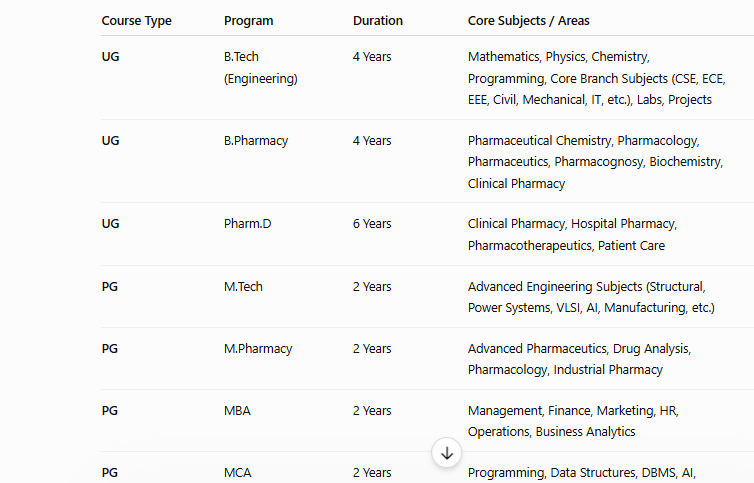
JNTUA Syllabus Overview (Course-wise)
| Course Type | Program | Duration | Core Subjects / Areas | Remarks |
|---|---|---|---|---|
| UG | B.Tech (Engineering) | 4 Years | Mathematics, Physics, Chemistry, Programming, Core Branch Subjects (CSE, ECE, EEE, Civil, Mechanical, IT, etc.), Labs, Projects | Multiple regulations (R23, R21, R20 etc.) |
| UG | B.Pharmacy | 4 Years | Pharmaceutical Chemistry, Pharmacology, Pharmaceutics, Pharmacognosy, Biochemistry, Clinical Pharmacy | Includes lab + practical training |
| UG | Pharm.D | 6 Years | Clinical Pharmacy, Hospital Pharmacy, Pharmacotherapeutics, Patient Care | Industry + hospital exposure |
| PG | M.Tech | 2 Years | Advanced Engineering Subjects (Structural, Power Systems, VLSI, AI, Manufacturing, etc.) | Specialization-based syllabus |
| PG | M.Pharmacy | 2 Years | Advanced Pharmaceutics, Drug Analysis, Pharmacology, Industrial Pharmacy | Research-oriented |
| PG | MBA | 2 Years | Management, Finance, Marketing, HR, Operations, Business Analytics | Case-study based learning |
| PG | MCA | 2 Years | Programming, Data Structures, DBMS, AI, Software Engineering, Networking | Focus on IT & software |
JNTUA B.Tech Branch-wise Syllabus (Major Specializations)
| Branch | Key Subjects |
|---|---|
| CSE (Computer Science) | Programming, Data Structures, AI, Machine Learning, DBMS, OS |
| ECE | Digital Electronics, Communication Systems, VLSI, Signal Processing |
| EEE | Electrical Machines, Power Systems, Control Systems |
| Mechanical | Thermodynamics, Manufacturing, Fluid Mechanics, Machine Design |
| Civil | Structural Engineering, Geotechnical, Transportation, Environmental |
| IT | Software Engineering, Networking, Cyber Security |
| Chemical | Process Engineering, Thermodynamics, Reaction Engineering |
JNTUA offers multiple engineering branches across UG & PG programs.
JNTUA B.Tech Year-wise Syllabus Structure (General)
| Year | Subjects Covered |
|---|---|
| 1st Year | Basic Sciences (Maths, Physics, Chemistry), Engineering Drawing, Programming |
| 2nd Year | Core Engineering Subjects + Labs |
| 3rd Year | Advanced Core Subjects + Electives |
| 4th Year | Specialized Electives, Major Project, Internship |
First-year syllabus is common across branches in most regulations.
JNTUA Syllabus Structure (General Pattern)
| Component | Description |
|---|---|
| Theory Subjects | Core and elective subjects per semester |
| Practical Labs | Hands-on experiments |
| Mini Projects | Usually from 2nd/3rd year |
| Major Project | Final year project |
| Internships | Industry exposure (mandatory in recent regulations) |
| Credits System | CBCS (Choice Based Credit System) |
Conclusion
JNTUA’s syllabus regulations—R23, R21, R20, and R19—demonstrate a progressive approach to technical education. The R23 regulation stands out with its comprehensive induction program, integration of Universal Human Values, skill enhancement courses in emerging technologies like Python and Full Stack Development, and a well-balanced credit distribution across semesters. The R21 regulation’s emphasis on Bloom’s Taxonomy mapping ensures measurable learning outcomes, while R20 offers specialization tracks like Data Science with courses in Machine Learning, Cloud Computing, and Artificial Intelligence.
For students and faculty, understanding these regulations is essential for academic planning, course selection, and ensuring compliance with university requirements. Students are advised to follow the syllabus applicable to their batch and branch, as detailed in the official university documents available through respective college portals.
About The Author
