The Karnataka Examinations Authority (KEA) is conducting the recruitment process for teachers in Karnataka Residential Educational Institutions Society (KREIS) schools. For candidates preparing for the examination, understanding the syllabus is just as important as knowing the eligibility criteria because the written test is divided into two papers. The 2026 recruitment has been announced for 1,087 teacher vacancies across residential schools under KREIS.
The KEA KREIS Teacher Syllabus 2026 consists of a common Paper 1 and a subject-specific Paper 2. Paper 1 tests candidates on general knowledge and general studies-related areas, while Paper 2 evaluates their knowledge of the teaching subject. Both papers carry 100 marks and are scheduled for two hours each.
Candidates should therefore prepare for both papers simultaneously. While Paper 1 requires broad awareness of Karnataka, India and general aptitude, Paper 2 requires a deeper understanding of the particular subject chosen for the teacher post.
KEA KREIS Syllabus 2026: Overview
| Particular | Details |
|---|---|
| Exam/Recruitment | KEA KREIS Teacher Recruitment 2026 |
| Conducting Authority | Karnataka Examinations Authority (KEA) |
| Organisation | Karnataka Residential Educational Institutions Society (KREIS) |
| Posts | Teacher posts in KREIS residential schools |
| Total Vacancies | 1,087 |
| Exam Mode | Objective-type written examination |
| Number of Papers | 2 |
| Paper 1 | General Knowledge/General Studies |
| Paper 2 | Subject-Specific Paper |
| Questions in Paper 1 | 100 |
| Marks in Paper 1 | 100 |
| Questions in Paper 2 | 100 |
| Marks in Paper 2 | 100 |
| Duration | 2 hours per paper |
| Total Marks | 200 |
The reported 2026 examination scheme gives candidates two papers of 100 questions and 100 marks each. Paper 2 varies according to the subject for which the candidate has applied.
KEA KREIS Teacher Exam Pattern 2026
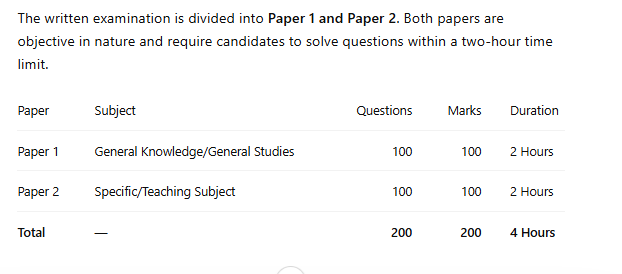
The written examination is divided into Paper 1 and Paper 2. Both papers are objective in nature and require candidates to solve questions within a two-hour time limit.
| Paper | Subject | Questions | Marks | Duration |
|---|---|---|---|---|
| Paper 1 | General Knowledge/General Studies | 100 | 100 | 2 Hours |
| Paper 2 | Specific/Teaching Subject | 100 | 100 | 2 Hours |
| Total | — | 200 | 200 | 4 Hours |
Paper 1 is common for teacher candidates, whereas Paper 2 is based on the subject selected by the candidate. A deduction of 0.25 mark for an incorrect answer has been reported for the 2026 examination scheme, so candidates should avoid blind guessing.
KEA KREIS Paper 1 Syllabus 2026
Paper 1 is designed to assess a candidate’s general awareness, knowledge of Karnataka and India, practical intelligence and mental ability. The paper is not limited to current affairs; it also covers social, constitutional, economic, scientific and environmental topics.
Paper 1: Important Topics
The major areas include:
- Current affairs
- General Knowledge
- General Science
- Indian society and its evolution
- Indian Constitution
- Public administration
- Practical knowledge
- General intelligence
- Mental ability
- Karnataka’s social and cultural history
- Land reforms in Karnataka
- Social change after Independence
- Karnataka’s economy
- Rural development
- Panchayat Raj institutions
- Rural cooperative institutions
- Science and technology in Karnataka
- Environmental issues
- Important national and international developments
These areas are reported as part of the General Knowledge/General Studies paper for the KREIS teacher examination.
1. General Knowledge and Current Affairs
Candidates should follow important events at the national and international levels. Questions may cover government schemes, important appointments, awards, sports, books and authors, science and technology developments, important days and major national events.
For Karnataka-specific preparation, candidates should give additional attention to state government schemes, important personalities, geography, economy, culture and recent developments.
2. Indian Constitution and Public Administration
This section can include basic knowledge of the Constitution of India, fundamental rights and duties, Directive Principles, Parliament, judiciary, President, Prime Minister, Governor, Chief Minister, state legislature and local self-government.
Candidates should also revise basic concepts related to public administration and the functioning of government institutions.
3. Karnataka History, Society and Culture
This is an important Karnataka-focused area. Preparation should cover:
- History of Karnataka
- Major dynasties and rulers
- Karnataka’s cultural heritage
- Literature and prominent writers
- Art and architecture
- Social reform movements
- Important personalities
- Festivals and traditions
- Karnataka’s role in India’s freedom movement
- Post-Independence social development
4. Karnataka Economy and Rural Development
Candidates should understand the basic structure of Karnataka’s economy and important development programmes.
Important areas include agriculture, industries, services, rural development, employment, poverty alleviation, cooperative institutions and Panchayat Raj.
5. Science and Technology
The General Studies paper also tests practical knowledge of science and technology. Candidates should revise basic Physics, Chemistry and Biology concepts along with recent developments in science and technology.
6. Environment
Environmental topics may include pollution, climate change, biodiversity, conservation, forests, natural resources, sustainable development and environmental protection.
7. Mental Ability and General Intelligence
Candidates should practise questions involving:
- Number series
- Analogy
- Classification
- Coding-decoding
- Logical reasoning
- Basic arithmetic
- Data interpretation
- Relationships
- Direction sense
- Problem solving
- Numerical reasoning
The objective is to improve speed as well as accuracy rather than simply memorising information.
KEA KREIS Paper 2 Syllabus 2026
Paper 2 is the most subject-specific component of the examination. Candidates must prepare according to the teaching subject mentioned in their application.
The notified subject areas include Kannada, English, Hindi, Mathematics, Science, Social Science, Physical Education and Computer Science.
The level and depth of questions can vary according to the subject and post. Candidates should therefore study their relevant degree/teacher-education subject content thoroughly rather than depending only on general competitive-exam books.
KREIS Kannada Teacher Syllabus 2026
Candidates appearing for the Kannada subject should focus on language, literature, grammar and literary concepts.
Important areas
- History of Kannada literature
- Old Kannada literature
- Medieval/Middle Kannada literature
- Modern Kannada literature
- Important poets and writers
- Major literary works
- Kannada language and grammar
- Poetics
- Kavya Mimamse
- Prosody/Chandassu
- Literary forms and concepts
The syllabus specifically includes the history of Kannada literature across different periods, along with poetics, prosody and language/grammar.
KREIS English Teacher Syllabus 2026
The English paper focuses on grammar, vocabulary, comprehension and English-language teaching concepts.
Important topics
- Pronunciation
- Spelling
- Parts of Speech
- Articles
- Prepositions
- Tenses
- Modals
- Phrasal verbs
- Subject-verb agreement
- Reported speech
- Grammar and usage
- Synonyms
- Antonyms
- Idioms and phrases
- Prefixes and suffixes
- Error detection
- Reading comprehension
- Cloze test
- Sentence arrangement
- Paragraph arrangement
- Functional English
- Testing and evaluation
- Methods and techniques of English language teaching
- ELT terminology
The Paper 2 English syllabus combines conventional language proficiency with language-teaching concepts, so candidates should not restrict preparation to grammar alone.
KREIS Hindi Teacher Syllabus 2026
Hindi teacher candidates should concentrate on Hindi linguistics and literary history.
Important topics
Bhasha Vigyan
- Basic concepts of linguistics
- Language structure
- Development of language
- Phonetics and related concepts
Hindi Sahitya ka Itihas
- Adikal
- Bhaktikal
- Ritikal
- Adhunik Kal
- Modern Hindi prose
- Modern Hindi poetry
Candidates should revise the major writers, movements, characteristics and representative works associated with each literary period.
KREIS Mathematics Teacher Syllabus 2026
The Mathematics paper requires strong conceptual preparation rather than formula-based memorisation. The notified teacher syllabus includes Mathematics-related subject knowledge, with the specific syllabus to be followed according to the Paper 2 subject document.
Important preparation areas include:
- Number systems
- Algebra
- Sets and relations
- Functions
- Equations
- Matrices and determinants
- Geometry
- Coordinate geometry
- Trigonometry
- Calculus
- Statistics
- Probability
- Mensuration
- Mathematical reasoning
Candidates should practise both conceptual and numerical questions. Regular problem-solving is particularly important because mathematics preparation improves through repeated practice.
KREIS Science Teacher Syllabus 2026
Science candidates should prepare the major concepts of Physics, Chemistry and Biology. The KREIS subject-wise syllabus identifies Science as a separate teacher subject, with detailed subject content to be followed from the notified syllabus.
Physics
Important preparation areas include:
- Units and measurements
- Motion
- Force and laws of motion
- Work, energy and power
- Gravitation
- Properties of matter
- Heat and thermodynamics
- Waves
- Light
- Electricity
- Magnetism
- Modern physics
- Basic electronics
Chemistry
Important areas include:
- Matter and its properties
- Atomic structure
- Periodic classification
- Chemical bonding
- Chemical reactions
- Acids, bases and salts
- Metals and non-metals
- Organic chemistry
- Inorganic chemistry
- Solutions
- Chemical equilibrium
- Environmental chemistry
Biology
Important topics include:
- Cell biology
- Plant tissues
- Animal tissues
- Classification
- Plant physiology
- Human physiology
- Reproduction
- Genetics
- Evolution
- Ecology
- Biodiversity
- Human health and disease
Candidates should focus on understanding concepts and their practical applications because teaching-oriented questions can test whether the candidate can apply subject knowledge rather than merely recall definitions.
KREIS Social Science Teacher Syllabus 2026
Social Science combines multiple disciplines. Candidates should prepare History, Civics/Political Science, Geography and Economics.
History
Preparation should include:
- Ancient Indian history
- Medieval Indian history
- Modern Indian history
- Indian freedom movement
- Important historical personalities
- Social and religious reform movements
- Post-Independence India
- Karnataka history
- Major dynasties and cultural developments
Civics/Political Science
Important areas include:
- Indian Constitution
- Fundamental Rights and Duties
- Parliament
- State Legislature
- Executive
- Judiciary
- Elections
- Local self-government
- Panchayat Raj
- Democratic institutions
- Centre-State relations
- Public administration
Geography
Important topics include:
- Physical geography
- Indian geography
- Karnataka geography
- Climate
- Rivers
- Soil
- Agriculture
- Natural resources
- Industries
- Population
- Transport
- Environmental geography
Economics
Candidates should study:
- Basic economic concepts
- Indian economy
- Karnataka economy
- Agriculture
- Industry
- Services sector
- Poverty
- Unemployment
- Inflation
- Development
- Government economic programmes
- Rural development
- Banking and financial institutions
KREIS Physical Education Teacher Syllabus 2026
Physical Education candidates should prepare the theoretical and practical aspects of physical education and sports.
Important areas include:
- Foundations of physical education
- History and development of sports
- Physical fitness
- Health and wellness
- Exercise physiology
- Anatomy and physiology
- Training methods
- Sports psychology
- Yoga
- Nutrition
- First aid
- Major sports and their rules
- Athletics
- Games and sports organisation
- Measurement and evaluation in physical education
Candidates should also revise important national and international sporting events and personalities as part of their general awareness preparation.
KREIS Computer Teacher Syllabus 2026
Computer Teacher candidates should prepare core computer science concepts along with programming and information technology.
Important areas include:
- Computer fundamentals
- Hardware and software
- Operating systems
- Number systems
- Computer networks
- Internet and web technologies
- Database management systems
- Data structures
- Algorithms
- Programming fundamentals
- C/C++ or relevant programming concepts
- Object-oriented programming
- Cybersecurity
- Information technology
- Computer applications
Candidates should give special attention to programming logic, databases, networking and fundamental computer concepts.
Paper 1 vs Paper 2: What is the Difference?
| Feature | Paper 1 | Paper 2 |
|---|---|---|
| Nature | Common paper | Subject-specific |
| Main focus | General Studies/General Knowledge | Teaching subject |
| Questions | 100 | 100 |
| Marks | 100 | 100 |
| Duration | 2 Hours | 2 Hours |
| Preparation | Broad | In-depth |
| Applicable to | Teacher candidates | Depends on selected subject |
The biggest difference is the breadth versus depth of preparation. Paper 1 covers several general areas, while Paper 2 requires detailed command of the candidate’s chosen teaching discipline.
How to Prepare for KEA KREIS Syllabus 2026?
A practical preparation strategy can make the large syllabus easier to manage.
Step 1: Complete Paper 1 basics
Begin with Karnataka-specific General Knowledge, Indian Constitution, current affairs, history, geography, economy and mental ability. Since these topics are broad, make short notes rather than trying to memorise entire books.
Step 2: Give priority to Paper 2
Paper 2 requires subject expertise. Divide your subject into individual units and complete them systematically. For example, Science candidates should maintain separate revision sections for Physics, Chemistry and Biology.
Step 3: Practise MCQs every day
After completing a topic, solve objective questions. This helps identify weak areas and improves speed.
Step 4: Revise Karnataka-specific information
Do not overlook Karnataka-related topics in Paper 1. Prepare state history, culture, geography, economy, government initiatives, Panchayat Raj and rural development carefully.
Step 5: Take full-length mock tests
Once the basic syllabus is completed, take mock tests under a two-hour time limit. Analyse incorrect answers instead of simply checking the score.
Step 6: Be careful with negative marking
If the 0.25-mark penalty specified for an incorrect answer applies to the examination, candidates should avoid making random guesses.
KEA KREIS Teacher Syllabus 2026: Preparation Tips
A good strategy is to divide the preparation time between the two papers instead of completing Paper 1 first and leaving Paper 2 for later.
A candidate can initially devote around 40% of study time to Paper 1 and 60% to Paper 2, particularly when the chosen subject requires extensive revision. During the final stage, more time can be given to mock tests, previous questions and revision.
Candidates should also maintain a separate notebook for Karnataka current affairs. Important government programmes, appointments, awards, sports events and state-level developments can be revised quickly from these notes before the examination.
KEA KREIS Syllabus 2026: Frequently Asked Questions
Q1. How many papers are there in the KEA KREIS Teacher Exam 2026?
The teacher examination consists of two papers: Paper 1 and Paper 2. Paper 1 is General Knowledge/General Studies, while Paper 2 is subject-specific.
Q2. How many marks are there in the KREIS Teacher examination?
Both papers carry 100 marks each, making the written examination 200 marks in total.
Q3. What is the duration of each KREIS paper?
Each paper is scheduled for two hours.
Q4. What is included in KREIS Paper 1?
Paper 1 includes General Knowledge/General Studies areas such as current affairs, general science, Indian society, Constitution, public administration, Karnataka history and culture, economy, rural development, Panchayat Raj, science and technology, environment and mental ability.
Q5. What is KREIS Paper 2?
Paper 2 is the Specific Paper based on the teaching subject selected by the candidate. Subjects include Kannada, English, Hindi, Mathematics, Science, Social Science, Physical Education and Computer Science.
Q6. Is there negative marking in the KEA KREIS Teacher Exam?
The 2026 examination pattern reported for KREIS teacher recruitment specifies a 0.25-mark deduction for an incorrect answer. Candidates should verify the final instructions on their examination/admit-card documents before the test.
Q7. Is Kannada language proficiency required?
Candidates who have not studied Kannada as a first or second language up to SSLC level, or do not meet the specified equivalent requirement, may have to appear for a qualifying Kannada Language Test as prescribed in the recruitment rules.
Q8. Which paper should candidates focus on more?
Both papers are important, but Paper 2 deserves substantial attention because it tests the candidate’s specialised teaching subject. Candidates should not ignore Paper 1, especially Karnataka-specific General Studies and current affairs.
Conclusion
The KEA KREIS Syllabus 2026 is broadly divided into two parts: a common General Studies paper and a subject-specific paper. Paper 1 tests awareness of Karnataka, India, current affairs, Constitution, economy, science, environment and mental ability, whereas Paper 2 checks in-depth knowledge of the candidate’s chosen teaching subject.
For a strong score, candidates should avoid treating the syllabus as a checklist. Paper 1 should be prepared through regular current-affairs revision and MCQ practice, while Paper 2 requires systematic study of the complete subject. With consistent revision, mock tests and careful time management, candidates can approach the KREIS teacher examination with much greater confidence.
About The Author
