
The Uttar Pradesh Cooperative Bank (UP Cooperative Bank) examination is a competitive gateway for candidates aspiring to build a career in the state’s cooperative banking sector. Conducted by the U.P. Co-operative Institutional Service Board (UPCISB), the Combined Co-operative Banking & Technical Services Examination (Special Recruitment) 2026 has announced 116 vacancies for various positions, including Manager, Junior Manager, Assistant (Clerk), Assistant/Typist, and Assistant Engineer (Civil) . As the official notification has been released, understanding the revised syllabus and exam pattern is crucial for candidates planning their preparation. This article provides a comprehensive breakdown of the UP Cooperative Bank Syllabus 2026 and the detailed exam pattern for both the Prelims and Mains stages.
UP Cooperative Bank Selection Process 2026
The selection process for the UP Cooperative Bank Recruitment 2026 is conducted in multiple stages to shortlist candidates efficiently for different posts. The stages may vary depending on the category of the post applied for .
-
Preliminary Examination: This is a qualifying stage conducted online to shortlist candidates for the Main examination .
-
Main Examination: This is the decisive stage. The marks obtained in the Mains exam determine the final merit list for most posts .
-
Interview/Personality Test: Candidates applying for Manager and Junior Manager posts are required to appear for an interview .
-
Proficiency Test: For posts such as Assistant/Typist, a proficiency test (like a typing test) is conducted as a qualifying stage .
The final selection is based on the combined performance in the Main Examination, Interview, and Proficiency Test as applicable .
UP Cooperative Bank Exam Pattern 2026
The examination is conducted online in Computer-Based Test (CBT) mode and consists of objective-type multiple-choice questions (MCQs) . A key feature of the marking scheme is the negative marking, where 0.25 marks are deducted for each incorrect answer . The exam pattern is divided into two main phases: Prelims and Mains.
Preliminary Exam Pattern
The Preliminary exam is the first filter in the selection process. It consists of 100 questions for a total of 100 marks . Candidates are given a duration of 90 minutes to complete this paper . This stage is purely qualifying in nature; the marks scored here are not counted in the final merit list .
The subject-wise distribution for the Prelims is as follows:
| Section | Number of Questions | Maximum Marks |
|---|---|---|
| Numerical Ability / Quantitative Aptitude | 35 | 35 |
| Reasoning Ability / Mental Ability | 35 | 35 |
| Hindi Language and General English / English Language | 20 | 20 |
| Cooperative Knowledge | 10 | 10 |
| Total | 100 | 100 |
Main Exam Pattern
Candidates who qualify for the Prelims will appear for the Main Examination. This stage is more comprehensive and carries more weight in the final selection. The Mains exam consists of 120 questions for a total of 200 marks, with a time limit of 120 minutes. The paper structure varies significantly depending on the post category.
For Manager, Junior Manager & Assistant Engineer (Civil) Posts
This pattern applies to Category 1 & 2 posts (Manager/Junior Manager) and the Assistant Engineer (Civil) post.
| Section | Number of Questions | Maximum Marks |
|---|---|---|
| Reasoning Ability / Mental Ability | 20 | 20 |
| Numerical Ability / Quantitative Aptitude | 20 | 20 |
| General Awareness | 15 | 15 |
| Cooperative Knowledge | 15 | 15 |
| Language (Hindi & English) | 10 | 10 |
| Professional Subject (Post-Specific) | 40 | 120 |
| Total | 120 | 200 |
The Professional Subject section is crucial for these posts. Depending on the post, this section covers:
-
Civil Engineering for the Assistant Engineer post.
-
Managerial Skills/Banking Knowledge for the Manager and Junior Manager posts. This section typically includes questions on Banking Awareness and Computer Knowledge.
For Assistant / Cashier / Typist Posts
This pattern applies to Category 3 posts (Clerical level) and differs significantly in subject weightage.
| Section | Number of Questions | Maximum Marks |
|---|---|---|
| Reasoning Ability / Mental Ability | 20 | 40 |
| Numerical Ability / Quantitative Aptitude | 20 | 40 |
| Computer Knowledge | 20 | 40 |
| Language (Hindi & English) | 20 | 40 |
| General Awareness | 20 | 20 |
| Cooperative Knowledge | 20 | 20 |
| Total | 120 | 200 |
1. Preliminary Exam Pattern
The Prelims exam is qualifying in nature and used for shortlisting candidates for the Mains.
| Section | No. of Questions | Marks | Duration |
|---|---|---|---|
| Quantitative Aptitude | 35 | 35 | |
| Reasoning Ability | 20 | 20 | |
| Hindi / English Language | 35 | 35 | |
| Cooperative Knowledge | 10 | 10 | |
| Total | 100 | 100 | 90 Minutes |
Negative Marking: 0.25 marks deducted for each wrong answer
2. Mains Exam Pattern
The Mains exam plays a crucial role in final selection.
| Section | No. of Questions | Marks | Duration |
| Reasoning Ability | 20 | 20 | |
| Quantitative Aptitude | 20 | 20 | |
| General Awareness | 40 | 40 | |
| Cooperative Knowledge | 15 | 15 | |
| Hindi & English Language | 15 | 15 | |
| Subject (Post-based) | 10 | 10 | |
| Total | 120 | 200 | 120 Minutes |
Final merit is prepared based on Mains marks only
UP Cooperative Bank Selection Process 2026
The selection process generally includes:
- Preliminary Examination (Qualifying)
- Main Examination (Merit-based)
- Interview / Skill Test (for some posts)
- Document Verification
UP Cooperative Bank Syllabus 2026 (Prelims)
1. Quantitative Aptitude
- Simplification & Approximation
- Number Series
- Percentage, Profit & Loss, Discount
- Ratio & Proportion
- Time & Work, Speed & Distance
- Simple & Compound Interest
- Data Interpretation (Bar, Pie, Graphs)
- Probability, Permutation & Combination
2. Reasoning Ability
- Coding-Decoding
- Seating Arrangement & Puzzles
- Blood Relation & Direction
- Syllogism
- Inequality
- Input-Output
- Data Sufficiency
- Non-Verbal Reasoning
3. Hindi Language
- अपठित गद्यांश (Comprehension)
- व्याकरण (Grammar)
- विलोम / पर्यायवाची
- वाक्य शुद्धि
- संधि एवं समास
4. English Language
- Reading Comprehension
- Error Detection
- Cloze Test
- Sentence Rearrangement
- Vocabulary (Synonyms/Antonyms)
5. Cooperative Knowledge
- Cooperative Movement in India
- Role of Cooperative Banks
- UP Cooperative Structure
- Government Schemes related to Cooperation
- Ministry of Cooperation initiatives
UP Cooperative Bank Syllabus 2026 (Mains)
The Mains syllabus includes all Prelims topics plus additional sections:
1. General Awareness
- Banking & Financial Awareness
- RBI Functions & Monetary Policy
- Indian Economy & Budget
- Current Affairs (National & UP State)
- Government Schemes
2. Cooperative Awareness (Advanced)
- Structure of Cooperative Banking
- NABARD, RBI roles
- Agricultural & Rural Banking
- Cooperative Laws & Reforms
3. Subject-Specific Topics (Post-Based)
- Civil Engineering (for AE posts)
- IT / Computer Knowledge
- Finance & Banking Concepts
Minimum Qualifying Marks
- SC/ST: 35% marks in Mains
- Other Categories: 40% marks
Candidates must meet minimum qualifying criteria to be included in the merit list.
UP Cooperative Bank Syllabus 2026
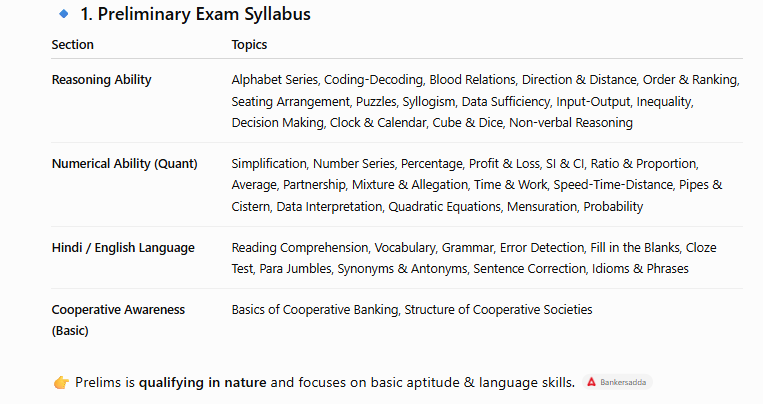
1. Preliminary Exam Syllabus
| Section | Topics |
|---|---|
| Reasoning Ability | Alphabet Series, Coding-Decoding, Blood Relations, Direction & Distance, Order & Ranking, Seating Arrangement, Puzzles, Syllogism, Data Sufficiency, Input-Output, Inequality, Decision Making, Clock & Calendar, Cube & Dice, Non-verbal Reasoning |
| Numerical Ability (Quant) | Simplification, Number Series, Percentage, Profit & Loss, SI & CI, Ratio & Proportion, Average, Partnership, Mixture & Allegation, Time & Work, Speed-Time-Distance, Pipes & Cistern, Data Interpretation, Quadratic Equations, Mensuration, Probability |
| Hindi / English Language | Reading Comprehension, Vocabulary, Grammar, Error Detection, Fill in the Blanks, Cloze Test, Para Jumbles, Synonyms & Antonyms, Sentence Correction, Idioms & Phrases |
| Cooperative Awareness (Basic) | Basics of Cooperative Banking, Structure of Cooperative Societies |
Prelims is qualifying in nature and focuses on basic aptitude & language skills.
2. Mains Exam Syllabus
| Section | Topics |
|---|---|
| Reasoning Ability (Advanced) | High-level Puzzles, Seating Arrangement, Logical Reasoning, Data Sufficiency, Input-Output, Analytical Reasoning |
| Quantitative Aptitude (Advanced) | Advanced DI, Case-based Arithmetic, Probability, Permutation & Combination, Algebra, Trigonometry |
| General / Financial Awareness | RBI & Monetary Policy, Banking Terms, NPA & Basel Norms, Inflation, Government Schemes, Current Affairs, UP GK, Indian Economy |
| Computer Knowledge | Basics of Computer, MS Office, Internet, Networking, Operating System, Cyber Security |
| Hindi / English (Advanced) | Advanced Grammar, Comprehension, Vocabulary, Error Detection, Cloze Test |
| Professional Knowledge (Post-wise) | Civil Engineering, Electrical, IT, Banking/Managerial Skills (depends on post applied) |
👉 Mains exam is scoring & selection deciding stage with higher difficulty leve
A detailed understanding of the syllabus is essential for focused preparation. The core subjects are common, but the level of difficulty and specific subtopics vary between Prelims and Mains.
Preliminary Exam Syllabus
The Prelims syllabus is designed to test the foundational aptitude and basic knowledge of the candidates.
Reasoning Ability / Mental Ability
This section tests logical thinking, analytical ability, and problem-solving skills.
-
Topics: Alphabetical and Miscellaneous Series, Coding-Decoding, Direction and Distance, Blood Relations, Order and Ranking, Seating Arrangement (Linear & Circular), Puzzles (Floor, Box, Scheduling), Data Sufficiency, Syllogism, Input-Output, Inequality, Decision Making, Clock & Calendar, Cube & Dice, Figure Series and Matrix, Non-Verbal Reasoning.
Numerical Ability / Quantitative Aptitude
This section evaluates the candidate’s calculation speed and problem-solving proficiency in mathematics .
-
Topics: Simplification and Approximation, Number Series, Percentage, Profit and Loss, Discount, Simple and Compound Interest, Average, Ratio and Proportion, Problems on Ages, Partnership, Mixture and Allegation, Time and Work, Speed, Time and Distance, Problems on Trains, Boat and Stream, Data Interpretation (Bar Graph, Pie Chart, Line Chart, Tabular Data), Probability, Permutation and Combination, Mensuration (Cone, Cylinder, Sphere), Basic Algebra, Basic Trigonometry.
Hindi Language & General English
Candidates can choose either Hindi or English as their language section.
-
English Language: Vocabulary, Tenses, Grammar Rules, Idioms and Phrases, Reading Comprehension, Fill in the Blanks, Error Detection/Spotting Errors, Cloze Test, Para Jumbles, Sentence Correction and Improvement.
-
Hindi Language: अपठित बोध (Reading Comprehension), रिक्त स्थान पूर्ति (Fill in the Blanks), वाक्य शुद्धि (Sentence Correction), अलंकार, पर्यायवाची/विलोम शब्द (Synonyms/Antonyms), शब्द सुधार (Spelling Correction), समास, संधि .
Cooperative Knowledge
This is a specialized section that holds importance in the context of cooperative bank exams.
-
Topics: Origin and Development of Cooperatives, National Level Important Cooperatives (e.g., Amul, IFFCO), Formation of the Union Ministry of Cooperation, Prosperity through Cooperation, Development of Cooperatives in Uttar Pradesh, Cooperative Societies in Uttar Pradesh, Innovations in Cooperatives.
Main Exam Syllabus
The Mains syllabus includes advanced-level questions from the Prelims topics, along with additional sections like General Awareness and the Professional Subject.
Reasoning & Numerical Ability
The topics remain largely the same as in the Prelims syllabus, but the difficulty level is higher, featuring advanced puzzles, case-based reasoning, complex arithmetic problems, and higher-level Data Interpretation.
General Awareness
This section is crucial for the Mains exam and focuses on current affairs, banking, and economic knowledge .
-
Topics: Structure, Role, and Development of Cooperative Banks in Uttar Pradesh, Reserve Bank of India and Monetary Policies, NPA and Basel Norms, Inflation, National Income, Indian Money Market and Capital Markets, Foreign Trade and Regulations, Financial Planning, Government Welfare Schemes, Insurance and Financial Awareness, General Information about Uttar Pradesh, Indian History, Indian Polity and Constitution, General Science, and Current Affairs (National and International) .
Cooperative Knowledge
The Mains syllabus includes a more detailed study of cooperative institutions.
-
Topics: All topics from Prelims, plus a deeper dive into the structure and functioning of cooperative banks, the role of NABARD, and priority sector lending.
Professional Subject (Post-Specific)
This is the highest-scoring section for managerial and technical posts, carrying 120 marks.
-
Civil Engineering (for AE): Engineering Mechanics, Strength of Materials, Structural Analysis, Structural Steel, Reinforced Concrete, Building Materials, Construction Technology and Management, Geotechnical Engineering, Fluid Mechanics, Hydrology, Highway Engineering, Railway Engineering, Environmental Engineering.
-
Managerial Skills/Banking (for Manager/Jr. Manager): Banking Regulations, RBI Functions, Cooperative Banking, NPA Management, Financial Inclusion, Digital Banking, Customer Service, KYC/AML, Human Resource Management, Strategy Formulation, and Fundamental Computer Knowledge (MS Office, Internet, Networking) .
Computer Knowledge (for Clerical Posts)
For Category 3 posts, the Computer Knowledge section is separate and carries 40 marks .
-
Topics: Basics of Hardware and Software, Operating Systems, Internet and Networking, MS Office (Word, Excel, PowerPoint), History of Computers, Basics of Databases, and Basics of Cyber Security .
UP Cooperative Bank Clerk Syllabus 2026
The selection process consists of 2 stages:
Prelims Exam (Qualifying)
Mains Exam (Final Merit)
Mode: Online (CBT)
Type: Objective (MCQs)
Negative Marking: 0.25 marks
Clerk Prelims Exam Pattern 2026
| Subject | Questions | Marks | Duration |
|---|---|---|---|
| Quantitative Aptitude | 35 | 35 | |
| Reasoning Ability | 20–35 | 20–35 | |
| Hindi / English Language | 20–35 | 20–35 | |
| Cooperative Knowledge | 10 | 10 | |
| Total | 100 | 100 | 90 min |
Prelims is qualifying only (marks not counted in final merit)
Prelims Syllabus (Subject-wise)
Quantitative Aptitude
- Simplification, Number Series
- Percentage, Profit & Loss, Discount
- Simple & Compound Interest
- Ratio & Proportion, Average
- Time & Work, Time-Speed-Distance
- Partnership
- Mensuration
- Data Interpretation (DI)
- Probability, Permutation & Combination
Reasoning Ability
- Coding-Decoding
- Blood Relation
- Direction & Distance
- Seating Arrangement & Puzzle
- Syllogism
- Data Sufficiency
- Input-Output
- Statement & Conclusion
- Non-verbal reasoning (figures, series)
Language (Hindi / English)
- Grammar (व्याकरण / Grammar rules)
- Vocabulary
- Reading Comprehension
- Error Detection
- Sentence Rearrangement
Cooperative Knowledge
- Cooperative Societies (especially in UP)
- Structure of Cooperative Banks
- Role & functions of cooperatives
- Recent developments in cooperative sector
Mains Exam Pattern 2026
| Subject | Questions | Marks |
|---|---|---|
| Reasoning Ability | 20 | 20 |
| Quantitative Aptitude | 20 | 20 |
| General Awareness | 40 | 40 |
| Cooperative Knowledge | 15 | 15 |
| Hindi & English | 15 | 15 |
| Subject (if applicable) | 10 | 10 |
| Total | 120 | 200 |
Duration: 120 minutes
Mains Syllabus (Important Topics)
General Awareness
- Banking Awareness (RBI, Monetary Policy)
- Indian Economy
- Current Affairs (National & UP State)
- Government Schemes
- Static GK (History, Polity, Geography)
Cooperative Knowledge (Advanced)
- Cooperative Banking System
- NABARD & Rural Finance
- UP Cooperative Structure
- Financial Inclusion & Schemes
Reasoning & Quant
Same topics as Prelims but moderate to high level
Language
- Advanced comprehension
- Cloze test
- Para jumbles
- Vocabulary usage
Minimum Qualifying Marks
- General/OBC: 40%
- SC/ST: 35%
UP Cooperative Bank Assistant Manager Syllabus 2026
The selection process generally includes:
Prelims Exam → Mains Exam → Interview/Skill Test (if applicable)
Exam Pattern (Assistant Manager / Manager Level)
| Section | Questions | Marks |
|---|---|---|
| Reasoning / Mental Ability | 20 | 20 |
| Numerical Ability | 20 | 20 |
| General Awareness | 15 | 15 |
| Cooperative Knowledge | 15 | 15 |
| Hindi & English Language | 10 | 10 |
| Professional / Banking / Management | 40 | 120 |
| Total | 120 | 200 |
Duration: 120 Minutes
Negative Marking: 0.25 marks
Prelims Syllabus 2026 (Assistant Manager)
1. Reasoning Ability
- Coding-Decoding
- Blood Relation
- Direction & Distance
- Seating Arrangement
- Puzzles
- Syllogism
- Order & Ranking
- Data Sufficiency
- Input-Output
- Clock & Calendar
- Non-verbal reasoning
2. Quantitative Aptitude
- Simplification & Approximation
- Number Series
- Percentage, Ratio
- Profit & Loss
- SI & CI
- Average
- Time & Work
- Speed, Time & Distance
- Mensuration
- Data Interpretation
- Probability, Algebra
3. Language (Hindi & English)
- Reading Comprehension
- Grammar (Error, Fillers)
- Vocabulary
- Synonyms/Antonyms
- Sentence Correction
- Cloze Test
4. Cooperative Awareness
- Cooperative Societies in India
- Role of NABARD & RBI
- Structure of Cooperative Banks
- Rural Banking System
- Government Schemes
Mains Syllabus 2026 (Assistant Manager)
Mains includes all Prelims subjects + Professional Section (High Weightage)
1. General Awareness
- Banking Awareness
- Current Affairs (National & International)
- Economy & Budget
- Financial Institutions
- Static GK
2. Computer Knowledge
- Basics of Computer
- MS Office
- Internet & Networking
- Cyber Security
- Operating Systems
3. Professional Knowledge (VERY IMPORTANT)
This section carries maximum marks (120)
Includes:
- Banking & Financial Management
- Principles of Banking
- Credit Management
- Risk Management
- Accounting Basics
- Cooperative Banking System
- Agriculture & Rural Finance
- Financial Markets
Key Points for Assistant Manager
Prelims is qualifying in nature
Mains score is most important for final selection
Focus more on:
- Professional/Banking section
- Cooperative knowledge
Speed + Accuracy both required
Marking Scheme & Minimum Qualifying Marks
The standard marking scheme for the UP Cooperative Bank Exam is as follows :
-
Each question carries equal marks.
-
Negative Marking: 1/4 (0.25) marks are deducted for each incorrect answer.
-
No negative marking for unanswered questions.
-
Multiple answers marked for a single question are treated as incorrect.
Candidates must also meet the minimum qualifying marks set by the commission to be eligible for the next stage :
-
For SC/ST Candidates: 35%
-
For Other Categories: 40%
Conclusion
The UP Cooperative Bank Syllabus 2026 is comprehensive and mirrors the structure of national-level banking exams while incorporating important state-level topics like Cooperative Knowledge. Success in this exam requires a strategic approach to cover the vast syllabus for the Prelims and Mains. Candidates must give special attention to the professional subject as it contributes the majority of marks in the Mains for technical and managerial roles. Regular practice through mock tests, a thorough review of current affairs, and an in-depth study of cooperative banking will be key to securing a high rank in this competitive examination.
About The Author
