VNR Vignana Jyothi Institute of Engineering & Technology (VNRVJIET), Hyderabad, follows a branch-wise curriculum for its B.Tech programmes. For the 2026 academic year, students need to check the applicable academic regulation before downloading the syllabus. This is particularly important because R25 applies to first-year B.Tech students admitted from 2025-26 onwards, while R22 continues for students studying in the second, third and fourth years.
The official VNRVJIET syllabus portal provides separate PDF syllabus books according to regulation, year and branch. The portal currently lists R25 first- and second-year syllabi and R22 first-, second-, third- and fourth-year syllabi for different engineering branches.
In this article, students can check the VNRVJIET B.Tech syllabus structure for the 1st, 2nd and 3rd years, important subjects for different trades, and the procedure to download the official PDF.
VNRVJIET B.Tech Syllabus 2026: Overview
| Particular | Details |
|---|---|
| Institute | VNR Vignana Jyothi Institute of Engineering & Technology |
| Course | Bachelor of Technology (B.Tech) |
| Location | Hyderabad, Telangana |
| Current 1st Year Regulation | R25 |
| Current 2nd & 3rd Year Regulation | R22 |
| Course Duration | 4 Years |
| Academic System | Choice-Based Credit System |
| Syllabus Format | Branch-wise |
| Official Syllabus | Available in PDF |
| Current B.Tech Branches | 17 |
VNRVJIET is an autonomous institution affiliated with JNTUH and offers 17 B.Tech programmes, including CSE, ECE, EEE, Mechanical, Civil, IT, AI & Data Science and several newer technology-oriented branches.
VNRVJIET B.Tech 1st Year Syllabus 2026
The first-year syllabus is designed to give students a common engineering foundation before they move deeper into their chosen specialisation. However, students should download the PDF corresponding to their branch because the institute maintains branch-wise syllabus books.
For the 2026 academic year, first-year students are covered under R25. The official syllabus page lists R25 first-year PDFs for 17 branches.
Major Areas Covered in 1st Year
The first year generally focuses on the following areas:
| Area | Topics/Subjects Covered |
|---|---|
| Mathematics | Engineering mathematics, calculus, algebra and related mathematical concepts |
| Physics | Engineering physics and applications |
| Chemistry | Engineering chemistry and materials-related concepts |
| Programming | Programming fundamentals and problem-solving |
| Engineering Graphics | Engineering drawing and graphical representation |
| Basic Electrical Engineering | Electrical fundamentals and circuits |
| Electronics | Basic electronic components and circuits |
| Engineering Mechanics | Fundamental mechanics concepts |
| Communication | English/communication and professional skills |
| Laboratories | Physics, chemistry, programming and engineering laboratories |
| Innovation/Skills | Design, problem-solving and practical learning |
The exact subject names, credits, contact hours and laboratory components should be checked against the R25 branch-specific PDF, rather than relying on a generic first-year syllabus.
CSE and Computer-Related First Year
Students entering CSE and related programmes can expect the foundation to gradually move towards programming, computational thinking and digital technologies. This foundation becomes important in the second and third years when subjects become more specialised.
VNRVJIET B.Tech 2nd Year Syllabus 2026
The second year is where the syllabus starts becoming significantly more branch-specific. For students studying in 2026-27, II B.Tech is under R22, according to the institute’s current academic regulations.
The official syllabus portal lists R22 II-year PDFs for 14 branches, including CSE, ECE, EEE, Mechanical, Civil, IT, AI & Data Science and other specialisations.
CSE / IT-Oriented Subjects
Students from CSE and IT-related branches typically progress into subjects such as:
- Data Structures
- Object-Oriented Programming
- Database Management Systems
- Computer Organisation
- Discrete Mathematics
- Operating Systems fundamentals
- Probability and statistics
- Programming laboratories
- Database laboratories
- Data-structure practical work
These subjects build the technical base required for software development, competitive programming, internships and advanced computer science courses.
ECE-Oriented Subjects
Electronics and Communication Engineering students move towards areas such as:
- Digital Electronics
- Electronic Devices
- Signals and Systems
- Network Theory
- Analog Electronics
- Microprocessors/Microcontrollers
- Communication fundamentals
- Electronics laboratories
The second year generally marks the transition from basic engineering concepts to actual electronics and communication systems.
EEE-Oriented Subjects
Electrical and Electronics Engineering students encounter subjects related to:
- Electrical circuits
- Electrical machines
- Power systems fundamentals
- Digital electronics
- Analog electronics
- Measurements
- Control-related concepts
- Electrical machine laboratories
Practical sessions are particularly important because they help students connect theoretical electrical concepts with real equipment and measurements.
Mechanical Engineering Subjects
Mechanical Engineering students generally progress towards:
- Engineering mechanics
- Thermodynamics
- Fluid mechanics
- Manufacturing processes
- Strength of materials
- Machine-related subjects
- Material science
- Mechanical laboratories
- Manufacturing/practical work
Students should use the official branch PDF for the exact R22 course sequence.
Civil Engineering Subjects
Civil Engineering students move towards core areas such as:
- Strength of materials
- Surveying
- Fluid mechanics
- Building materials
- Structural concepts
- Geotechnical fundamentals
- Civil engineering laboratory work
The second year therefore provides the foundation for specialised structural, transportation, environmental and construction-related subjects in later semesters.
VNRVJIET B.Tech 3rd Year Syllabus 2026
For the third year in 2026-27, R22 is applicable. The institute’s academic calendar specifically lists III B.Tech under R22 for the 2026-27 academic year.
The third year is especially important because students start studying advanced core subjects, professional electives and subjects that are closely connected with industry requirements.
The official VNRVJIET syllabus portal provides R22 III-year syllabus PDFs for 14 branches.
CSE Syllabus – Major Areas
For CSE students, third-year study generally becomes more advanced and may include areas such as:
- Computer Networks
- Operating Systems
- Software Engineering
- Web technologies
- Artificial Intelligence
- Machine Learning
- Compiler-related concepts
- Advanced database concepts
- Professional electives
- Open electives
- Technical laboratories
Students should pay special attention to electives because they can help them build a profile in areas such as AI, data science, cybersecurity, cloud computing or software development.
AI & Data Science
Students in AI & Data Science move towards subjects involving:
- Artificial Intelligence
- Machine Learning
- Data analytics
- Statistical methods
- Data mining
- Database technologies
- Programming for data science
- Machine learning laboratory work
- Professional electives
CSE – AI & Machine Learning
The AI/ML specialisation focuses increasingly on:
- Artificial Intelligence
- Machine Learning
- Deep learning concepts
- Data handling
- Algorithms
- Python/programming-based applications
- AI/ML laboratory work
- Specialisation electives
CSE – Data Science
The Data Science-oriented curriculum moves deeper into:
- Data analytics
- Data mining
- Machine learning
- Statistics
- Big-data concepts
- Database systems
- Data visualisation
- Data science practical work
CSE – Cyber Security
Students following the cybersecurity track can expect advanced areas connected with:
- Information security
- Network security
- Cybersecurity fundamentals
- Cryptography
- Secure systems
- Cyber forensics
- Security laboratories
- Security-oriented electives
CSE – Internet of Things
The IoT-oriented curriculum combines software, electronics and communication concepts. Major areas can include:
- IoT architecture
- Sensors and actuators
- Embedded systems
- Computer networks
- IoT communication
- Cloud/edge concepts
- IoT applications
- Practical IoT projects
VNRVJIET B.Tech Branch-Wise Syllabus 2026
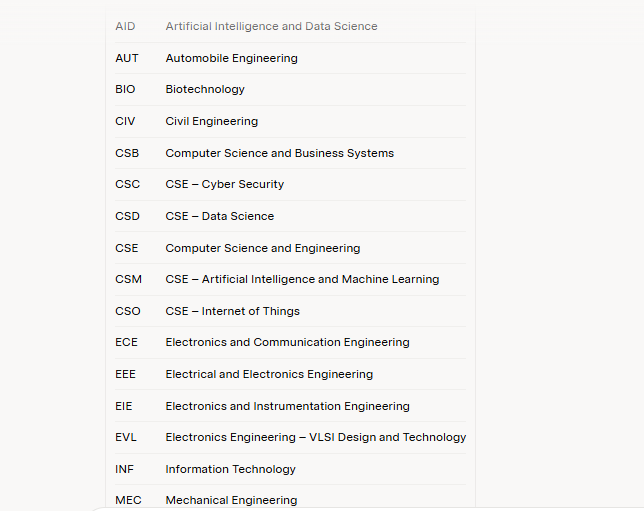
VNRVJIET currently lists the following 17 B.Tech programmes:
| Code/Branch | B.Tech Programme |
|---|---|
| AID | Artificial Intelligence and Data Science |
| AUT | Automobile Engineering |
| BIO | Biotechnology |
| CIV | Civil Engineering |
| CSB | Computer Science and Business Systems |
| CSC | CSE – Cyber Security |
| CSD | CSE – Data Science |
| CSE | Computer Science and Engineering |
| CSM | CSE – Artificial Intelligence and Machine Learning |
| CSO | CSE – Internet of Things |
| ECE | Electronics and Communication Engineering |
| EEE | Electrical and Electronics Engineering |
| EIE | Electronics and Instrumentation Engineering |
| EVL | Electronics Engineering – VLSI Design and Technology |
| INF | Information Technology |
| MEC | Mechanical Engineering |
| RAI | Robotics and Artificial Intelligence |
The institute’s programme details confirm these 17 B.Tech programmes, with a total sanctioned intake of 2,160 seats.
VNRVJIET Syllabus 2026 for Different Trades
1. Computer Science and Engineering
The CSE syllabus progresses from programming and mathematics in the first year to data structures, databases, operating systems, networks, software engineering and advanced electives in later years.
2. Information Technology
IT students study programming, data structures, databases, operating systems, networking, software development and technology-oriented electives.
3. Artificial Intelligence and Data Science
This programme combines computer science with statistics, data analytics, artificial intelligence and machine learning.
4. CSE – AI & ML
The curriculum is focused on computational foundations followed by artificial intelligence, machine learning and related advanced technologies.
5. CSE – Data Science
This branch gives greater emphasis to data management, statistics, analytics, machine learning and data-driven applications.
6. CSE – Cyber Security
The curriculum focuses on computer science fundamentals along with cybersecurity, network protection, cryptography and secure computing.
7. CSE – IoT
IoT students study the combination of embedded systems, sensors, networks, programming and connected-device technologies.
8. Electronics & Communication Engineering
ECE combines electronics, communication, digital systems, signals, embedded technologies and related practical work.
9. Electrical & Electronics Engineering
EEE focuses on electrical circuits, machines, power systems, electronics, control and electrical applications.
10. Electronics & Instrumentation Engineering
EIE combines electronics with measurement, instrumentation, sensors, control systems and industrial applications.
11. Electronics Engineering – VLSI Design and Technology
This newer programme focuses on electronics, semiconductor technologies, digital systems and VLSI-oriented design.
12. Mechanical Engineering
Mechanical students study mechanics, thermodynamics, manufacturing, materials, machines, design and related laboratory work.
13. Civil Engineering
Civil Engineering covers structures, construction materials, surveying, geotechnical engineering, fluids and other infrastructure-related areas.
14. Automobile Engineering
The Automobile Engineering programme focuses on vehicle systems, automobile components, manufacturing, mechanical systems and automotive technology.
15. Biotechnology
Biotechnology combines engineering principles with biological sciences, laboratory techniques and biotechnology applications.
16. Computer Science and Business Systems
This programme blends computer science with business-oriented concepts, making it relevant for students interested in technology and business applications.
17. Robotics and Artificial Intelligence
Robotics and AI combines programming, automation, robotics, artificial intelligence, control and related engineering technologies.
R25 vs R22: Which Syllabus Should Students Download?
This is one of the most important points for students searching for the VNRVJIET syllabus in 2026.
| Student | Applicable Regulation in 2026-27 |
|---|---|
| I B.Tech | R25 |
| II B.Tech | R22 |
| III B.Tech | R22 |
| IV B.Tech | R22 |
VNRVJIET officially states that R25 applies to students admitted from academic year 2025-26 onwards, while R22 remains applicable to the current II, III and IV-year B.Tech students.
Therefore, downloading an older syllabus simply because it appears in a search result can lead to confusion. Students should first identify their year + regulation + branch, and then download the corresponding PDF.
How to Download VNRVJIET B.Tech Syllabus 2026 PDF?
Students can download the syllabus directly from the institute’s official syllabus section.
Steps to Download
- Visit the official VNRVJIET website.
- Open the Academics section.
- Select Curriculum & Syllabus.
- Choose B.Tech.
- Select the applicable regulation, such as R25 or R22.
- Select your year- I, II, III or IV Year.
- Find your branch.
- Click the PDF Download option.
- Save the syllabus PDF on your phone or computer.
The official syllabus page currently provides branch-wise PDFs and filters for R25, R22, A19, R19, and earlier regulations, along with year-wise filtering.
Official syllabus portal: VNRVJIET Syllabus Books
VNRVJIET Syllabus 2026: How to Prepare?
Having the syllabus PDF is useful, but simply downloading it is not enough. Students should use it as a semester-wise study checklist.
Start With the Course Structure
First identify the subjects, credits, teaching hours and practical components. This gives you a clear picture of how much time each subject deserves.
Separate Theory and Practical Subjects
Do not treat laboratory subjects as secondary. Practical examinations can contribute significantly to your academic performance, while practical skills are also useful during internships and placements.
Prepare According to Units
Break each subject into individual units and complete them one at a time. This makes a lengthy syllabus much easier to manage.
Give More Time to Core Subjects
Branch-specific subjects should receive priority because they form the foundation for advanced subjects, internships and technical interviews.
Use Previous Question Papers
After completing each unit, practise previous examination questions. This helps you understand which concepts are repeatedly tested and how answers should be structured.
Frequently Asked Questions
Is VNRVJIET syllabus 2026 available in PDF?
Yes. VNRVJIET provides official branch-wise B.Tech syllabus PDFs through its syllabus portal. The page includes multiple regulations and year-wise options.
Which regulation is applicable to first-year B.Tech students in 2026?
First-year B.Tech students are covered under R25. VNRVJIET states that R25 applies to students admitted from 2025-26 onwards.
Which regulation applies to B.Tech 2nd and 3rd year?
For the current 2026-27 academic year, R22 applies to II, III and IV B.Tech students.
How many B.Tech branches are offered by VNRVJIET?
VNRVJIET currently lists 17 B.Tech programmes, covering traditional engineering branches as well as AI, Data Science, Cyber Security, IoT, VLSI and Robotics-oriented programmes.
Can I download the syllabus for CSE and other branches separately?
Yes. The institute’s syllabus portal provides separate PDFs for different branches and years.
Is the VNRVJIET syllabus the same for all B.Tech branches?
No. While students may share some foundational subjects, the curriculum becomes increasingly branch-specific as students progress into the second and third years.
Where can I get the latest VNRVJIET syllabus PDF?
The safest option is the institute’s official Syllabus Books page, where students can select the applicable regulation, year and branch.
Final Words
The VNRVJIET B.Tech Syllabus 2026 gives students a clear roadmap of what they will study during their engineering programme. One point students should remember is that the applicable regulation depends on the year of study. For 2026-27, first-year students follow R25, whereas the current second- and third-year students follow R22.
About The Author
