
The Delhi Subordinate Services Selection Board (DSSSB) has prescribed a Two-Tier examination scheme for the post of Grade-II (GNCTDSS)/Assistant Section Officer (ASO), Post Code 804/26. The recruitment is being conducted under Advertisement No. 01/2026. According to the official notification, the ASO examination consists of Tier-I and Tier-II, with objective questions in both stages and a descriptive English-writing component in Tier-II.
Candidates preparing for DSSSB ASO 2026 should understand the syllabus carefully because Tier-I is used for shortlisting, while the final selection is based on the combined performance in Tier-II Part-I and Part-II. The official notification also specifies negative marking, qualifying marks, and the subjects to be covered at each stage.
DSSSB ASO Syllabus 2026: Overview
The DSSSB ASO 2026 recruitment is for Grade-II (GNCTDSS)/Assistant Section Officer, Post Code 804/26. The post is under the Services Department of the Government of NCT of Delhi, along with ASO posts in the Delhi Pollution Control Committee and Delhi Urban Shelter Improvement Board. The original advertisement notified 587 ASO vacancies across these departments, including 576 under Services Department, 3 in DPCC and 8 in DUSIB.
| Particular | Details |
|---|---|
| Exam Conducting Body | Delhi Subordinate Services Selection Board (DSSSB) |
| Post | Assistant Section Officer/Grade-II (GNCTDSS) |
| Post Code | 804/26 |
| Advertisement | No. 01/2026 |
| Exam Type | Two-Tier |
| Tier-I | 200 Questions, 200 Marks |
| Tier-I Duration | 2 Hours |
| Tier-II | 300 Marks |
| Tier-II Duration | 3 Hours |
| Tier-II Part-I | 200 MCQs, 200 Marks |
| Tier-II Part-II | Descriptive, 100 Marks |
| Final Selection | Based on Tier-II Part-I + Part-II |
| Negative Marking | 0.25 mark for each wrong 1-mark MCQ |
The official notification states that Tier-I is qualifying and is used for shortlisting candidates for Tier-II. Final selection is based on the cumulative marks secured in both parts of Tier-II.
DSSSB ASO Exam Pattern 2026
Understanding the exam pattern before starting preparation is important because the two tiers have different purposes. Tier-I tests the candidate’s basic aptitude, reasoning, language and general awareness, whereas Tier-II adds computer proficiency and a substantial descriptive English component.
DSSSB ASO Tier-I Exam Pattern
Tier-I contains 200 objective-type questions carrying 200 marks. Candidates get 2 hours to complete the paper. Each question carries one mark.
| Subject | Questions | Marks |
|---|---|---|
| General Awareness | 40 | 40 |
| General Intelligence & Reasoning Ability | 40 | 40 |
| Arithmetical & Numerical Ability | 40 | 40 |
| Hindi Language & Comprehension | 40 | 40 |
| English Language & Comprehension | 40 | 40 |
| Total | 200 | 200 |
The official DSSSB notification confirms that all five sections carry 40 marks each in Tier-I.
DSSSB ASO Tier-II Exam Pattern
Tier-II is conducted in one session of three hours and carries a total of 300 marks. It has two parts.
Part-I consists of 200 objective questions for 200 marks. The subjects are General Awareness, General Intelligence & Reasoning Ability, Arithmetical & Numerical Ability, English Language & Comprehension and Computer Proficiency.
Part-II is descriptive and carries 100 marks. It tests candidates’ English writing ability through essay/expansion of ideas, letter/application writing and precis/summarising.
| Tier-II Component | Questions/Task | Marks |
|---|---|---|
| General Awareness | Objective | 40 |
| General Intelligence & Reasoning | Objective | 40 |
| Arithmetical & Numerical Ability | Objective | 40 |
| English Language & Comprehension | Objective | 40 |
| Computer Proficiency | Objective | 40 |
| Essay/Expansion of Ideas | Descriptive | 50 |
| Letter/Application Writing | Descriptive | 25 |
| Precis Writing/Summarising | Descriptive | 25 |
| Total | — | 300 |
The Board has specifically stated that there is no separate mandatory minimum qualifying mark for Tier-II Part-I and Part-II individually; the prescribed minimum qualifying requirement applies to their cumulative marks.
DSSSB ASO Tier-I Syllabus 2026
The Tier-I syllabus contains five subjects. The following topic-wise breakdown can be used as a practical preparation framework based on the subjects prescribed by DSSSB.
1. General Awareness
General Awareness is designed to test the candidate’s awareness of India, the world and current developments. Candidates should combine static GK preparation with current affairs.
Important topics include:
- Current national and international events
- Indian history
- Indian freedom movement
- Indian and world geography
- Indian polity and Constitution
- Parliament and constitutional bodies
- Government schemes and programmes
- Indian economy
- Basic economic terminology
- General science
- Physics, Chemistry and Biology basics
- Environment and ecology
- Important national and international organisations
- Awards and honours
- Books and authors
- Important personalities
- Sports and tournaments
- Important days and dates
- Capitals and currencies
- Countries and their locations
- Current government appointments
- Delhi-related general knowledge
Preparation tip: Current affairs from roughly the previous 6–8 months should receive special attention, particularly government policies, national events, awards, appointments and important developments.
2. General Intelligence & Reasoning Ability
Reasoning questions test logical thinking, pattern recognition and the ability to reach conclusions quickly.
Important topics include:
- Analogy
- Classification
- Series
- Number series
- Alphabet series
- Coding-decoding
- Blood relations
- Direction and distance
- Ranking and order
- Syllogism
- Statement and conclusion
- Statement and assumption
- Venn diagrams
- Calendar
- Clock
- Mathematical operations
- Missing number
- Puzzle
- Seating arrangement
- Data sufficiency
- Non-verbal reasoning
- Figure classification
- Mirror images
- Water images
- Paper folding
- Embedded figures
Candidates should practise questions with a timer because reasoning is generally a speed-oriented section.
3. Arithmetical & Numerical Ability
The numerical ability section covers fundamental mathematics and requires both accuracy and calculation speed.
Major topics include:
- Number system
- Simplification
- LCM and HCF
- Percentage
- Ratio and proportion
- Average
- Profit and loss
- Discount
- Simple interest
- Compound interest
- Time and work
- Pipes and cisterns
- Time, speed and distance
- Boats and streams
- Partnership
- Mixture and allegation
- Mensuration
- Data interpretation
- Algebraic basics
- Geometry
- Trigonometry basics
- Probability basics
A candidate who has strong command over percentages, ratios, averages, profit and loss, time-work and time-distance can build a strong foundation for this section.
4. Hindi Language & Comprehension
Hindi is included in Tier-I but is not part of the Tier-II Part-I language section. Preparation should focus on both grammar and comprehension.
Important areas include:
- हिंदी व्याकरण
- संधि
- समास
- उपसर्ग एवं प्रत्यय
- पर्यायवाची शब्द
- विलोम शब्द
- अनेकार्थी शब्द
- तत्सम एवं तद्भव
- मुहावरे एवं लोकोक्तियां
- वाक्य शुद्धि
- शब्द शुद्धि
- वर्तनी
- रिक्त स्थान
- वाक्य निर्माण
- गद्यांश
- शब्दावली
- भाषा संबंधी सामान्य प्रश्न
Regular practice of Hindi comprehension passages can improve both speed and accuracy.
5. English Language & Comprehension
English is an important subject in both tiers, so candidates should not restrict preparation to Tier-I.
Important topics include:
- Reading comprehension
- Vocabulary
- Synonyms
- Antonyms
- One-word substitution
- Idioms and phrases
- Spelling
- Fill in the blanks
- Error detection
- Sentence improvement
- Sentence rearrangement
- Active and passive voice
- Direct and indirect speech
- Articles
- Prepositions
- Conjunctions
- Tenses
- Subject-verb agreement
- Parts of speech
- Cloze test
- Para jumbles
For Tier-II, candidates should additionally practise formal writing because essay, letter/application and precis writing carry 100 descriptive marks.
DSSSB ASO Tier-II Syllabus 2026
Tier-II is the most important stage from the final-selection perspective. The Board has prescribed five subjects in Part-I and three types of descriptive English tasks in Part-II.
General Awareness
The General Awareness syllabus broadly continues from Tier-I. Focus on:
- Current affairs
- Indian history
- Geography
- Indian Constitution
- Polity
- Economy
- General science
- Environment
- Government schemes
- Important national institutions
- International organisations
- Awards and honours
- Sports
- Books and authors
- Important appointments
- National and international events
Since the same broad area appears in both tiers, candidates can prepare General Awareness as a combined subject instead of studying it separately for each stage.
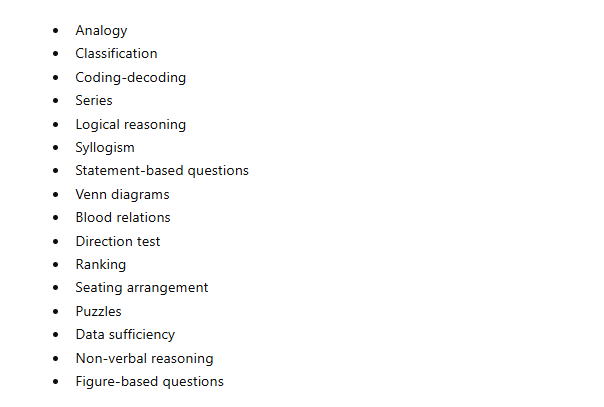
General Intelligence & Reasoning
The Tier-II reasoning preparation should focus on questions that require greater application and speed.
Important areas include:
- Analogy
- Classification
- Coding-decoding
- Series
- Logical reasoning
- Syllogism
- Statement-based questions
- Venn diagrams
- Blood relations
- Direction test
- Ranking
- Seating arrangement
- Puzzles
- Data sufficiency
- Non-verbal reasoning
- Figure-based questions
Candidates should move from basic concepts to mixed practice sets and full-length mock tests.
Arithmetical & Numerical Ability
The numerical section should be prepared with an emphasis on calculation accuracy.
Important areas include:
- Number system
- Simplification
- Percentage
- Ratio and proportion
- Average
- Profit and loss
- Discount
- SI and CI
- Time and work
- Time, speed and distance
- Partnership
- Mixture and allegation
- Mensuration
- Algebra
- Geometry
- Data interpretation
The biggest advantage in this section comes from learning standard calculation methods and practising questions under time pressure.
English Language & Comprehension
English has greater importance in Tier-II because it is tested through both objective and descriptive questions.
Prepare:
- Reading comprehension
- Grammar
- Vocabulary
- Sentence correction
- Error detection
- Fillers
- Cloze test
- Synonyms and antonyms
- Idioms and phrases
- One-word substitution
- Sentence rearrangement
- Active/passive voice
- Direct/indirect speech
- Tenses
- Articles
- Prepositions
- Subject-verb agreement
- Para jumbles
Along with objective questions, candidates should regularly write short essays and formal letters.
DSSSB ASO Computer Proficiency Syllabus 2026
Computer Proficiency is included in Tier-II Part-I and carries 40 marks.
Candidates should prepare the following areas:
- Fundamentals of computers
- Hardware and software
- Operating systems
- Input and output devices
- Computer memory
- Internet
- Networking basics
- Cybersecurity basics
- Microsoft Word
- Microsoft Excel
- Microsoft PowerPoint
- File and folder management
- Keyboard shortcuts
- Basic computer terminology
- Digital services
- Common office applications
Particular attention should be given to MS Word, Excel, PowerPoint, shortcuts and basic internet concepts, as these are highly relevant to office-oriented posts such as ASO.
DSSSB ASO Descriptive English Syllabus 2026
The descriptive component carries 100 marks, making it an important part of the final score.
Essay/Expansion of Ideas – 50 Marks
Candidates may be required to write an essay or expand an idea in English.
Preparation should include topics related to:
- Education
- Technology
- Digital India
- Environment
- Women empowerment
- Employment
- Social issues
- Governance
- Artificial intelligence
- Cybersecurity
- Youth
- Public administration
- Current affairs
A good answer should have a clear introduction, logically arranged points, relevant examples and a concise conclusion.
Letter/Application Writing – 25 Marks
Candidates should practise formal writing formats such as:
- Official applications
- Leave applications
- Complaints
- Requests to authorities
- Applications related to public services
- Office correspondence
- Letters concerning civic issues
Format, clarity, grammar and appropriate official language are important.
Precis Writing/Summarising – 25 Marks
Precis writing tests the ability to understand a passage and express its central idea concisely.
Candidates should practise:
- Reading the passage carefully.
- Identifying the central argument.
- Removing unnecessary examples and repetition.
- Writing the important points in their own words.
- Giving a suitable title where required.
- Maintaining grammatical accuracy.
DSSSB ASO Negative Marking 2026
DSSSB has prescribed negative marking for objective questions. A deduction of 0.25 marks is made for every incorrect answer to a one-mark MCQ. The notification also specifies a deduction of 0.50 marks for a wrong two-mark MCQ; however, the ASO 2026 scheme uses one-mark MCQs in the relevant objective papers.
Therefore, candidates should avoid blind guessing. Accuracy should be prioritised along with speed.
DSSSB ASO Qualifying Marks 2026
The official notification prescribes category-wise minimum qualifying marks for the written examination:
| Category | Minimum Qualifying Marks |
|---|---|
| General/EWS | 40% |
| OBC (Delhi) | 35% |
| SC/ST/PwBD | 30% |
| Ex-Servicemen | 5% relaxation in respective category, subject to minimum 30% |
The Board also reserves the right to prescribe a higher cut-off depending on the number of candidates and vacancies.
How to Prepare for DSSSB ASO 2026?
A practical preparation strategy is more useful than simply reading the syllabus repeatedly. Since Tier-I is qualifying while Tier-II determines final merit, candidates should use the first stage to build speed and the second stage to maximise their score.
Step 1: Complete the Basic Concepts
Start with the fundamentals of reasoning, mathematics, English, Hindi, General Awareness and computers. Do not immediately jump to difficult mock tests.
Step 2: Prepare Common Subjects Together
General Awareness, reasoning and numerical ability appear in both tiers. Prepare them comprehensively so that the same study effort benefits both stages.
Step 3: Give Extra Attention to English
English appears in Tier-I, Tier-II Part-I and Tier-II Part-II. Therefore, it offers a major opportunity to improve the overall score. Grammar and vocabulary should be combined with regular essay, letter and precis practice.
Step 4: Practise Computer Questions
Do not leave Computer Proficiency for the final weeks. Revise basic computer concepts and office applications regularly.
Step 5: Start Descriptive Writing Early
Writing 100 marks of descriptive content under examination conditions requires practice. Candidates should write at least one essay, one formal letter and one precis every week during the later stages of preparation.
Step 6: Take Full-Length Mock Tests
After completing the syllabus, attempt full-length Tier-I mocks. Analyse incorrect answers instead of simply counting the score.
For Tier-II, practise both objective questions and descriptive writing within the prescribed three-hour duration.
DSSSB ASO 2026 Preparation Strategy
| Subject | Recommended Focus |
|---|---|
| General Awareness | Current affairs + static GK |
| Reasoning | Concepts + timed practice |
| Numerical Ability | Formulae + calculation speed |
| Hindi | Grammar + comprehension |
| English | Grammar + vocabulary + comprehension |
| Computer | Fundamentals + office applications |
| Descriptive English | Essay + letter + precis |
A useful daily routine can include 2 hours for mathematics and reasoning, 1.5 hours for English/Hindi, 1 hour for general awareness, 45 minutes for computers and 30–45 minutes for descriptive writing. The exact schedule can be adjusted according to individual strengths.
DSSSB ASO Syllabus 2026 PDF Download
Candidates should always download the syllabus and examination scheme from the official DSSSB website rather than relying on an unofficial PDF. DSSSB’s official 2026 advertisement contains the complete examination scheme for Post Code 804/26, including Tier-I and Tier-II subjects, marks, duration and descriptive-paper details.
Official DSSSB ASO 2026 Advertisement PDF: Download DSSSB ASO 2026 Official Advertisement PDF
Candidates should also check the DSSSB website regularly because the Board can issue corrigenda, examination schedules and other notices after the initial advertisement. A corrigendum relating to Post Code 804/26 was issued in May 2026, so candidates should rely on the latest official notice when there is any change.
Important Points About DSSSB ASO Exam 2026
- ASO/Grade-II (GNCTDSS) is notified under Post Code 804/26.
- The examination has two tiers.
- Tier-I consists of 200 questions for 200 marks.
- Tier-I duration is 2 hours.
- Tier-II is conducted for 300 marks in a three-hour session.
- Tier-II Part-I contains 200 objective questions for 200 marks.
- Tier-II Part-II carries 100 descriptive marks.
- Tier-II descriptive questions are in English.
- Essay/Expansion of Ideas carries 50 marks.
- Letter/Application Writing carries 25 marks.
- Precis Writing/Summarising carries 25 marks.
- Computer Proficiency is included in Tier-II Part-I.
- Tier-I is qualifying and used for shortlisting.
- Final selection is based on the combined marks of Tier-II Part-I and Part-II.
- Negative marking applies to objective questions.
- Questions are bilingual where applicable, except language papers, which are in the concerned language.
Final Takeaway
The DSSSB ASO Syllabus 2026 is manageable if preparation is divided intelligently between the two stages. Tier-I should be treated as a speed-and-accuracy test, while Tier-II deserves greater attention because its objective and descriptive components determine the final merit.
Candidates should give special importance to English, General Awareness, reasoning, numerical ability and computer proficiency, while starting descriptive English practice well before the examination. Most importantly, candidates should keep checking the official DSSSB portal for the latest examination schedule, corrigenda and other recruitment notices rather than relying on old ASO syllabus information.
About The Author
