
The Indian Foreign Service (IFS) remains one of the most prestigious career options available through the UPSC Civil Services Examination. Officers represent India abroad, handle diplomacy, trade negotiations, consular services, and cultural promotion. While the basic pay structure matches other Group A services such as the IAS under the 7th Central Pay Commission, foreign postings transform the overall compensation package significantly through tax-free allowances and extensive perks.
As of 2026, salaries continue under the 7th CPC pay matrix, with Dearness Allowance (DA) periodically revised (sources indicate around 50–60% in recent updates). No full 8th Pay Commission implementation has taken effect yet, though projections exist for future revisions.
IFS Officer Salary 2026: Highlights
| Particular | Details |
|---|---|
| Service | Indian Foreign Service |
| Recruitment | UPSC Civil Services Examination |
| Starting Pay Level | Level 10 |
| Starting Basic Pay | ₹56,100 per month |
| Basic Pay Range at Level 10 | ₹56,100–₹1,77,500 |
| Senior Scale | Level 11 |
| Junior Administrative Grade | Level 12 |
| Grade IV | Level 13 |
| Grade III | Level 14 |
| Grade II | Level 15 |
| Grade I | Level 17 |
| Foreign Posting | Additional foreign-service allowances and facilities applicable |
| Highest Basic Pay | ₹2,25,000 per month |
The official IFS Recruitment, Cadre, Seniority and Promotion Rules show the progression from Junior Scale at Level 10 through Senior Scale, Junior Administrative Grade and higher grades up to Grade I at Level 17.
IFS Officer Starting Salary in India 2026
An IFS officer selected through the UPSC Civil Services Examination initially enters the service at Junior Scale, Pay Level 10. The corresponding basic pay is ₹56,100 per month.
The basic pay is only one component of the officer’s compensation. Depending on the applicable rules and posting, an officer may also receive allowances and government facilities. Therefore, the amount credited to the bank account should not be confused with the basic pay mentioned in the Pay Matrix.
An officer’s salary also increases through annual increments and promotions. As the officer moves to higher responsibilities, the applicable Pay Matrix level rises significantly.
IFS Officer Salary Per Month in India 2026
A simplified view of the IFS pay progression is given below:
| IFS Grade | Pay Level | Basic Pay Range/Basic Pay |
| Junior Scale | Level 10 | ₹56,100–₹1,77,500 |
| Senior Scale | Level 11 | ₹67,700–₹2,08,700 |
| Junior Administrative Grade | Level 12 | ₹78,800–₹2,09,200 |
| Grade IV | Level 13 | ₹1,23,100–₹2,15,900 |
| Grade III | Level 14 | ₹1,44,200–₹2,18,200 |
| Grade II | Level 15 | ₹1,82,200–₹2,24,100 |
| Grade I | Level 17 | ₹2,25,000 |
These figures are based on the official IFS Pay Matrix specified in the service rules.
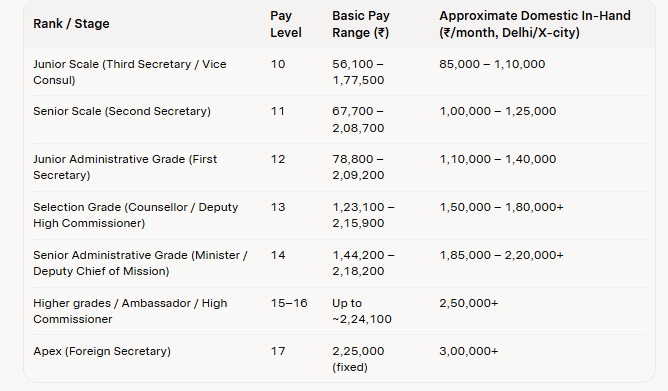
Rank-Wise Pay Structure and Domestic Salary
IFS officers progress through defined pay levels tied to diplomatic ranks. Entry begins at Pay Level 10.
| Rank / Stage | Pay Level | Basic Pay Range (₹) | Approximate Domestic In-Hand (₹/month, Delhi/X-city) |
|---|---|---|---|
| Junior Scale (Third Secretary / Vice Consul) | 10 | 56,100 – 1,77,500 | 85,000 – 1,10,000 |
| Senior Scale (Second Secretary) | 11 | 67,700 – 2,08,700 | 1,00,000 – 1,25,000 |
| Junior Administrative Grade (First Secretary) | 12 | 78,800 – 2,09,200 | 1,10,000 – 1,40,000 |
| Selection Grade (Counsellor / Deputy High Commissioner) | 13 | 1,23,100 – 2,15,900 | 1,50,000 – 1,80,000+ |
| Senior Administrative Grade (Minister / Deputy Chief of Mission) | 14 | 1,44,200 – 2,18,200 | 1,85,000 – 2,20,000+ |
| Higher grades / Ambassador / High Commissioner | 15–16 | Up to ~2,24,100 | 2,50,000+ |
| Apex (Foreign Secretary) | 17 | 2,25,000 (fixed) | 3,00,000+ |
Entry-level breakdown example (Pay Level 10, Delhi posting, approximate 2026 figures with DA ~60%):
- Basic Pay: ₹56,100
- Dearness Allowance: ~₹33,660
- House Rent Allowance (30% for X-class cities): ~₹16,830
- Transport Allowance + DA on TA: ~₹11,000–12,000
- Gross: roughly ₹1,15,000–1,20,000
- Deductions (NPS 10% of basic + DA, tax, etc.): ₹10,000–20,000
- Typical in-hand: ₹85,000–1,10,000
These figures vary with exact DA rate, city classification (HRA 30%/20%/10%), tax regime, and whether government accommodation is provided (which replaces HRA). During training at the Sushma Swaraj Institute of Foreign Service, officers receive the basic pay plus limited allowances.
IFS Officer Salary During Foreign Posting 2026
One of the biggest attractions of the Indian Foreign Service is the opportunity to serve at Indian diplomatic missions abroad. However, it is important to understand that an IFS officer does not simply receive a fixed foreign salary in addition to the Indian basic pay.
During an overseas assignment, the officer’s compensation is governed by the applicable government rules, including foreign-service-related allowances. The actual amount can vary considerably according to the country, city, post, officer’s rank and applicable government orders.
Therefore, figures commonly quoted online such as “IFS officers earn ₹3 lakh, ₹5 lakh or ₹10 lakh per month abroad” should not be treated as a universal fixed salary for every officer or every country.
Estimated Foreign-Posting Compensation
For an article-level understanding, the monthly financial package can be viewed as:
| Component | During Foreign Posting |
| Basic Pay | Continues according to Pay Matrix |
| Foreign allowance/compensation | Depends on posting and applicable rules |
| Accommodation-related facilities | Subject to government rules |
| Medical facilities | As per applicable government provisions |
| Travel-related benefits | As per applicable rules |
| Education-related benefits | May be available subject to rules |
| Other facilities | Depend on posting and entitlement |
The Ministry of External Affairs has official provisions governing foreign assignments and allowances. Historical MEA documents also refer to compensatory foreign allowance and related arrangements, demonstrating why the overseas component should not be represented as one fixed amount for every IFS officer.
How Much Does an IFS Officer Earn Abroad Per Month?
The answer depends heavily on the posting.
An IFS officer posted in a relatively inexpensive country cannot be directly compared with an officer serving in a very expensive city such as New York, London, Tokyo or Geneva. The applicable compensation and facilities are designed within government rules for overseas postings.
Consequently, a realistic way to describe an IFS officer’s foreign-posting income in 2026 is:
Basic Indian salary + applicable foreign-posting allowance + eligible facilities/benefits.
The total monetary value can therefore be substantially higher than the officer’s basic salary in India. However, there is no single official “IFS foreign salary” figure applicable to every country.
IFS Foreign Posting Salary vs India Posting
| Feature | Posting in India | Foreign Posting |
| Basic Pay | As per Pay Matrix | As per applicable Pay Matrix |
| Basic starting pay | ₹56,100 | ₹56,100 at entry level, subject to applicable rules |
| Foreign allowance | Not applicable as an overseas posting component | Applicable according to rules |
| Government accommodation | Subject to entitlement | Overseas accommodation/facilities subject to rules |
| Medical benefits | Government rules | Applicable overseas provisions |
| Official travel | As per rules | As per foreign-posting requirements |
| International exposure | Limited | Very high |
| Diplomatic work | Mainly at MEA headquarters | Embassy/High Commission/Consulate/Mission |
The Ministry of External Affairs states that IFS officers can work in Indian embassies, high commissions, consulates and permanent missions to international organisations.
IFS Officer Career Progression and Salary
An IFS officer’s salary increases as the officer gains experience and moves into higher grades.
The career generally begins with an overseas assignment as a Third Secretary. After confirmation, the officer is promoted to Second Secretary, followed by positions such as First Secretary, Counsellor, Minister and eventually Ambassador, High Commissioner or Permanent Representative, depending on the officer’s career progression and assignment.
At headquarters, officers can progress through positions such as Under Secretary, Deputy Secretary, Director, Joint Secretary, Additional Secretary and Secretary.
Salary Growth with Career
At the entry level, an officer is placed in Level 10. With promotion, the basic pay moves to higher Pay Matrix levels:
Level 10 → Level 11 → Level 12 → Level 13 → Level 14 → Level 15 → Level 17
This means an IFS officer’s long-term earning potential is considerably higher than the starting basic pay.
IFS Officer Salary After 5 Years
The exact salary after five years cannot be stated as one fixed figure because it depends on increments, promotions, pay fixation and the officer’s individual career progression.
Nevertheless, the officer remains within the structured Central Government Pay Matrix. The Level 10 range itself extends from ₹56,100 to ₹1,77,500, while promotion to Level 11 and above provides access to higher pay scales.
Thus, the salary after five years should be calculated based on the officer’s actual pay level and cell rather than simply multiplying the starting salary.
IFS Officer Salary After 10 Years
After around a decade, an IFS officer may have progressed into higher grades, depending on the individual’s service record and promotion timeline.
The official pay structure provides the following higher levels:
- Level 11: ₹67,700–₹2,08,700
- Level 12: ₹78,800–₹2,09,200
- Level 13: ₹1,23,100–₹2,15,900
- Level 14: ₹1,44,200–₹2,18,200
These are basic-pay ranges and do not represent the officer’s complete monthly compensation.
IFS Officer Salary at Ambassador Level
An Ambassador is one of the most senior diplomatic positions an IFS officer can hold. The highest grade of the IFS is Grade I, Level 17, with a basic pay of ₹2,25,000 per month under the service rules.
However, becoming an Ambassador is not an automatic outcome of completing a fixed number of years. Appointments depend on seniority, experience, suitability, vacancies and government decisions.
IFS Officer Allowances and Benefits
Salary is only one part of the overall compensation package. Depending on the officer’s posting and entitlement, the following benefits may be relevant:
1. Foreign Posting Allowance
Officers serving outside India may receive foreign-service-related compensation under applicable government rules. The amount is not identical for all countries.
2. Government Accommodation
Accommodation arrangements can form an important part of the overseas posting package. The actual entitlement depends on the officer’s rank, location and applicable rules.
3. Medical Facilities
Government employees and their eligible family members can receive medical benefits under applicable government provisions. Overseas postings may have specific arrangements.
4. Travel Benefits
IFS officers are frequently required to travel for official diplomatic work. Government rules provide travel-related benefits according to the nature of the assignment.
5. Education-Related Benefits
For eligible officers posted abroad with children, education-related provisions may be available under applicable government rules and the circumstances of the posting.
6. Other Government Facilities
The overall package can include several official facilities and reimbursements. These should be viewed as posting- and entitlement-dependent benefits rather than guaranteed cash salary.
Where Can IFS Officers Be Posted?
IFS officers can be posted to Indian diplomatic missions across the world. These include:
- Embassies
- High Commissions
- Consulates
- Permanent Missions to international organisations
- Ministry of External Affairs headquarters in India
The Ministry of External Affairs says that IFS officers represent India abroad, protect India’s national interests, promote friendly relations, report on developments in the host country and provide consular services.
IFS Foreign Posting: How Does It Work?
Foreign posting is an important part of an IFS career. After completing initial training and the required preparation, an officer can be assigned to a foreign mission.
The Foreign Service Institute explains that a new officer is assigned a Compulsory Foreign Language (CFL) and, after a period of desk attachment at the Ministry of External Affairs, is posted to an Indian Mission in a country where that language is used. The officer undergoes language training and is expected to pass the relevant examination before confirmation.
This makes language training a particularly important part of an IFS officer’s early career.
Foreign Posting Compensation: The Real Differentiator
Most of an IFS career involves postings abroad (typically 2–3 year tenures, alternating with Headquarters stints in New Delhi). Domestic allowances such as HRA and DA are largely replaced by a Special Foreign Allowance (SFA or FA), which is denominated in foreign currency (often USD or host-country currency) and calculated based on rank, family size, cost of living, and hardship classification of the station.
This allowance is tax-free in India under Section 10(7) of the Income Tax Act and generally exempt in the host country under the Vienna Convention on Diplomatic Relations. Officers continue receiving their Indian basic pay (credited to an Indian account).
Approximate Foreign Allowance ranges reported across reliable analyses for 2025–2026 (actual MEA rates are not publicly detailed and vary):
- Entry-level (Third/Second Secretary): $2,500–$5,500+ per month
- Mid-level (First Secretary/Counsellor): $3,500–$9,000+
- Senior (Minister/Ambassador): $8,000–$20,000+ in major capitals
Country/region examples (indicative monthly FA for junior officers):
- High-cost (USA – Washington/New York, UK – London, Japan – Tokyo, Geneva): $4,000–$5,500+
- Medium-cost (Europe – Paris/Berlin, Singapore, Australia/Canada): $3,000–$4,500
- Standard or lower-cost (many Asian, Middle East, SAARC, African posts): $1,500–$3,500
Total cash earnings abroad for an entry-level officer often reach ₹2.5–5 lakh per month (basic + FA), depending on the station and exchange rates. For mid-to-senior officers in premium posts, effective cash compensation can be substantially higher.
Full economic package includes non-cash benefits that add significant value:
- Rent-free or fully subsidized official accommodation (embassy-leased or owned residences)
- Official vehicle with driver (for protocol and official use)
- Full reimbursement of international school fees for up to two children (typically till Class 12)
- Comprehensive medical coverage
- Domestic help/furniture allowances in many posts
- Representational grant for official entertainment (higher for Heads of Mission)
- Home Leave Passage, emergency passages, and children’s annual visits to India
- Diplomatic passport, duty-free privileges, and security arrangements in high-risk posts
In major capitals, the total effective monthly value (cash + housing + education + other perks) for a junior officer can equate to ₹6–10 lakh or more. For Ambassadors in G7/G20 capitals, the package is among the highest in the Indian government system.
Other Allowances and Benefits (Domestic and Foreign)
- Dearness Allowance (revised twice yearly)
- Transport Allowance
- Foreign Service Special Pay / hardship allowances where applicable
- Foreign Language Allowance (for maintaining proficiency)
- Leave Travel Concession (LTC)
- Medical facilities under CGHS or mission panels
- Pension/NPS benefits, study leave, and career training opportunities
Promotions follow seniority-cum-merit, with time-bound progression in early years and selection-based later. Officers can rise to Ambassador/High Commissioner and, at the apex, Foreign Secretary (Pay Level 17).
IFS Officer Job Profile
An IFS officer’s responsibilities extend far beyond attending diplomatic meetings. The job involves representing India’s interests and working on political, economic, commercial, cultural and consular matters.
Major responsibilities include:
- Representing India at diplomatic missions.
- Maintaining relations with the host government.
- Protecting India’s national interests.
- Promoting trade and investment.
- Supporting Indian citizens abroad.
- Preparing reports on political and economic developments.
- Negotiating agreements.
- Handling consular matters.
- Promoting cultural relations.
- Participating in multilateral diplomacy.
The MEA describes these functions as central responsibilities of career diplomats.
Is IFS Salary Higher Than IAS Salary?
Both IAS and IFS officers are paid according to the Central Government’s Pay Matrix and their respective service rules. At the entry level, the basic pay is ₹56,100 under Level 10 for the IFS Junior Scale.
The major difference arises from the nature of the posting.
An IAS officer generally serves within India, while an IFS officer can spend significant portions of the career at overseas missions. Therefore, an IFS officer’s overall compensation during a foreign assignment can include additional overseas-related benefits that an officer serving in India would not ordinarily receive.
IFS Officer Salary 2026: Important Points
Before comparing salaries found on different websites, candidates should remember the following:
- ₹56,100 is the starting basic pay, not necessarily the final in-hand salary.
- Foreign posting does not mean that the officer gets a universal fixed salary in foreign currency.
- Overseas compensation varies according to posting and applicable government rules.
- The value of accommodation and other facilities can be significant but should not automatically be added as cash income.
- Promotions move the officer into higher Pay Matrix levels.
- The highest IFS Grade I is Level 17 with basic pay of ₹2,25,000.
- Foreign posting opportunities are an important part of the service’s career structure.
Career Context and Practical Realities
Entry is highly competitive via UPSC CSE. Training includes language specialization and attachment to missions. Postings are decided by the Ministry of External Affairs based on service needs, language skills, and cadre management. While foreign allowances make the service financially attractive—often exceeding domestic IAS/IPS packages during overseas tenures—the job involves long separations from extended family, cultural adjustments, and high-stakes representational duties.
IFS Officer Salary 2026 FAQs
What is the starting salary of an IFS officer in 2026?
The starting basic pay of an IFS officer is ₹56,100 per month at Pay Level 10. Allowances and deductions determine the actual monthly amount received.
What is the IFS officer salary during foreign posting?
During an overseas posting, the officer continues to receive pay under the applicable government Pay Matrix and may receive foreign-service-related allowances and facilities. The total varies according to the country, city, rank and applicable rules.
Does an IFS officer get paid in dollars abroad?
The officer’s compensation is governed by Indian government service rules. It should not be described simply as a fixed dollar salary. The overseas component depends on the applicable foreign-posting rules.
What is the highest salary of an IFS officer?
The highest basic pay specified for Grade I of the IFS is ₹2,25,000 per month at Level 17.
Does every IFS officer get a foreign posting?
Foreign assignments are a major part of an IFS career. MEA describes the career structure as involving postings at Indian missions abroad as well as assignments at headquarters in India.
Is IFS a good career in 2026?
Yes. IFS offers a combination of diplomatic responsibilities, international exposure, structured career progression and opportunities to represent India overseas. However, the career also demands adaptability, language skills, frequent transfers and the ability to work in diverse political and cultural environments.
Conclusion
The IFS Officer Salary in India in 2026 starts with a basic pay of ₹56,100 per month at Level 10, while the service’s pay structure rises through successive grades up to ₹225,000 basic pay at Level 17.
The most important difference between an India posting and a foreign posting is the additional compensation and facilities associated with serving overseas. The exact amount cannot be represented by one fixed figure because it depends on the country, city, rank, and government rules applicable to the particular assignment.
About The Author
