
The US Grade 5 English Language Arts (ELA) Curriculum 2026 in the United States is designed to strengthen students’ literacy, communication, and critical thinking skills. It follows widely adopted frameworks like the Common Core State Standards (CCSS) and focuses on the four core language domains—Reading, Writing, Speaking & Listening, and Language.
US Grade 5 English Language Arts (ELA) Curriculum 2026
| Strand | Topics / Units | Key Learning Outcomes |
|---|---|---|
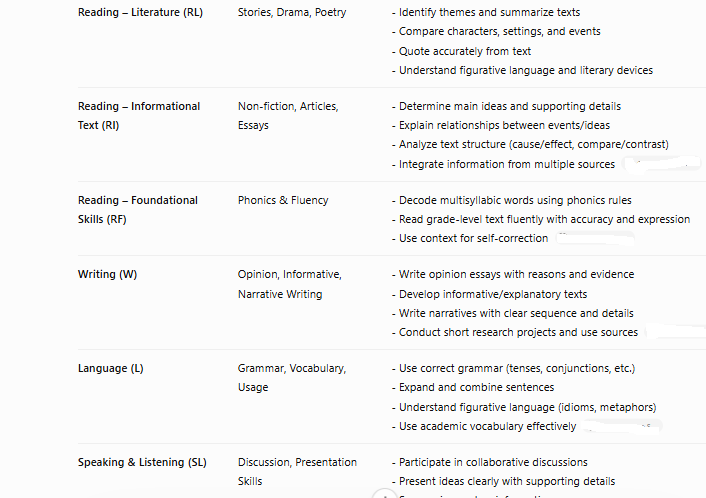
| Reading – Literature (RL) | Stories, Drama, Poetry | – Identify themes and summarize texts – Compare characters, settings, and events – Quote accurately from text – Understand figurative language and literary devices |
| Reading – Informational Text (RI) | Non-fiction, Articles, Essays | – Determine main ideas and supporting details – Explain relationships between events/ideas – Analyze text structure (cause/effect, compare/contrast) – Integrate information from multiple sources |
| Reading – Foundational Skills (RF) | Phonics & Fluency | – Decode multisyllabic words using phonics rules – Read grade-level text fluently with accuracy and expression – Use context for self-correction |
| Writing (W) | Opinion, Informative, Narrative Writing | – Write opinion essays with reasons and evidence – Develop informative/explanatory texts – Write narratives with clear sequence and details – Conduct short research projects and use sources |
| Language (L) | Grammar, Vocabulary, Usage | – Use correct grammar (tenses, conjunctions, etc.) – Expand and combine sentences – Understand figurative language (idioms, metaphors) – Use academic vocabulary effectively |
| Speaking & Listening (SL) | Discussion, Presentation Skills | – Participate in collaborative discussions – Present ideas clearly with supporting details – Summarize spoken information – Adapt speech to different contexts |
| Vocabulary Development | Word Study, Context Clues | – Use prefixes, suffixes, and root words – Interpret meanings using context clues – Use dictionaries and digital tools |
| Research & Media Literacy | Projects, Digital Literacy | – Gather information from print and digital sources – Evaluate credibility of sources – Present findings using multimedia tools |
| Critical Thinking Skills | Analysis & Interpretation | – Draw inferences from texts – Compare multiple texts and viewpoints – Support answers with textual evidence |
| Assessment & Practice | Tests, Projects, Activities | – Reading comprehension tests – Writing assignments (essays, reports) – Oral presentations and group work |
Key Highlights (2026 Update)
- Greater emphasis on critical thinking and evidence-based reading
- Integration of digital literacy and research skills
- Focus on vocabulary development using roots and affixes
- Balanced approach across reading, writing, speaking, and listening
- State-level frameworks (like 2026 updated ELA standards) guide curriculum implementation
Core Structure of Grade 5 ELA Curriculum
The curriculum is divided into five major strands:
- Reading (Literature & Informational Text)
- Writing
- Speaking & Listening
- Language (Grammar & Vocabulary)
- Foundational Reading Skills
These components ensure students develop the ability to read critically, write effectively, and communicate clearly.
1. Reading Skills (Literature & Informational Text)
Key Learning Areas:
- Understanding themes, characters, and plots
- Comparing stories across cultures
- Identifying main idea and supporting details
- Analyzing text structure and author’s purpose
- Making inferences using textual evidence
Students are expected to cite evidence and interpret meaning beyond the text, building analytical skills.
Literature Topics:
- Fiction, myths, drama, poetry
- Character development
- Figurative language (simile, metaphor)
Informational Text Topics:
- Biographies, historical texts
- Cause & effect, problem & solution
- Use of charts, diagrams, and media
2. Writing Skills
Types of Writing:
- Narrative Writing (stories, personal experiences)
- Informative/Explanatory Writing
- Opinion/Persuasive Writing
Writing Process:
- Prewriting (planning ideas)
- Drafting
- Revising & Editing
- Publishing
Students learn to write for different purposes such as explaining, narrating, or persuading.
Additional Skills:
- Research projects using digital and print sources
- Organizing evidence logically
- Using appropriate tone and structure
3. Speaking & Listening
Core Competencies:
- Participating in group discussions
- Asking and answering questions clearly
- Presenting ideas with facts and details
- Listening actively and respectfully
Students must engage in discussions, build on others’ ideas, and express their own clearly.
Presentation Skills:
- Oral presentations
- Use of multimedia tools
- Adapting speech for different audiences
4. Language (Grammar & Vocabulary)
Grammar & Usage:
- Parts of speech (nouns, verbs, conjunctions, etc.)
- Verb tenses (past, present, future, perfect tenses)
- Sentence structure and clarity
Students learn to apply grammar rules and correct errors in writing and speaking.
Punctuation & Spelling:
- Commas, quotation marks, capitalization
- Correct spelling using references
Vocabulary Development:
- Context clues
- Prefixes, suffixes, and root words
- Academic and domain-specific vocabulary
5. Foundational Reading Skills
Key Areas:
- Phonics and word recognition
- Reading multisyllabic words
- Improving reading fluency and expression
Students read with accuracy, speed, and comprehension to support deeper understanding.
Assessment & Evaluation Methods
The Grade 5 ELA curriculum uses a mix of formative and summative assessments:
- Reading comprehension tests
- Writing assignments and essays
- Oral presentations
- Group discussions and projects
- Vocabulary and grammar quizzes
Continuous assessment helps track progress in all four language skills.
Learning Outcomes (By End of Grade 5)
Students will be able to:
- Read and analyze complex texts independently
- Write structured essays with clear arguments
- Communicate ideas effectively in discussions
- Use correct grammar, punctuation, and vocabulary
- Conduct basic research and present findings
Curriculum Trends for 2026
- Increased focus on digital literacy and research skills
- Integration of multimedia and technology in learning
- Emphasis on critical thinking and real-world communication
- Greater use of project-based and collaborative learning
Grade 5 ELA Curriculum PDF
Get the Grade 5 ELA Syllabus PDF by clicking on the link below:
5th-Grade-English-Language-Arts-Elementary-Curriculum
Source: Francis Howell School
Conclusion
The US Grade 5 ELA Curriculum 2026 prepares students for middle school by building strong literacy foundations. It integrates reading, writing, speaking, and language skills to develop confident communicators and critical thinkers. By the end of Grade 5, students are expected to handle complex texts, express ideas clearly, and engage effectively in academic and real-world communication.
About The Author
