
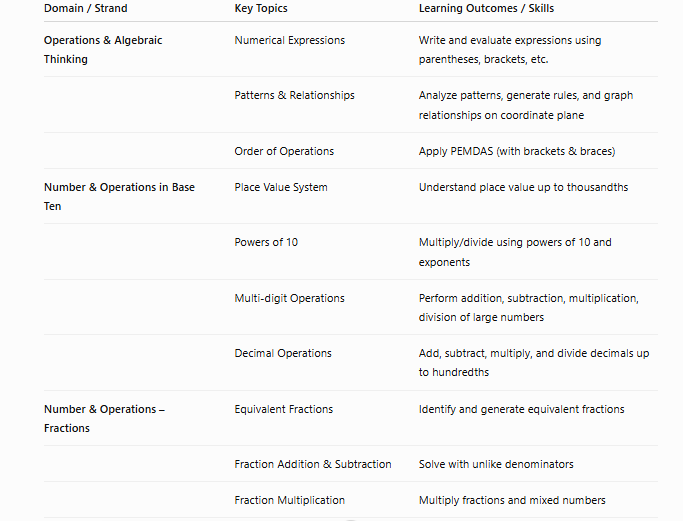
The US Grade 5 Mathematics Curriculum (2026) is designed to strengthen foundational math skills while preparing students for middle school concepts like algebra, geometry, and data analysis. It is primarily based on the Common Core State Standards (CCSS) and focuses on conceptual understanding, problem-solving, and real-life application of mathematics.
US Grade 5 Mathematics Curriculum 2026
| Domain / Strand | Key Topics | Learning Outcomes / Skills |
|---|---|---|
| Operations & Algebraic Thinking | Numerical Expressions | Write and evaluate expressions using parentheses, brackets, etc. |
| Patterns & Relationships | Analyze patterns, generate rules, and graph relationships on coordinate plane | |
| Order of Operations | Apply PEMDAS (with brackets & braces) | |
| Number & Operations in Base Ten | Place Value System | Understand place value up to thousandths |
| Powers of 10 | Multiply/divide using powers of 10 and exponents | |
| Multi-digit Operations | Perform addition, subtraction, multiplication, division of large numbers | |
| Decimal Operations | Add, subtract, multiply, and divide decimals up to hundredths | |
| Number & Operations – Fractions | Equivalent Fractions | Identify and generate equivalent fractions |
| Fraction Addition & Subtraction | Solve with unlike denominators | |
| Fraction Multiplication | Multiply fractions and mixed numbers | |
| Fraction Division | Divide fractions by whole numbers and vice versa | |
| Measurement & Data | Unit Conversion | Convert within measurement systems (metric/customary) |
| Volume | Understand and calculate volume of 3D shapes (rectangular prisms) | |
| Data Representation | Use line plots and interpret data with fractions | |
| Word Problems | Solve real-life problems involving measurement and data | |
| Geometry | Coordinate Plane | Plot and interpret points in first quadrant |
| 2D Figures | Classify shapes based on properties (angles, sides) | |
| 3D Shapes | Understand structure and attributes of solids | |
| Mathematical Practices | Problem Solving | Make sense of problems and persevere |
| Reasoning | Use logical reasoning and mathematical arguments | |
| Modeling | Apply math to real-life situations | |
| Precision & Tools | Use tools (ruler, graphs) accurately |
Overview of Grade 5 Math Curriculum
Grade 5 math emphasizes three major learning areas:
- Mastery of fractions and decimal operations
- Fluency with multi-digit arithmetic
- Understanding of volume and coordinate geometry
Instruction also integrates reasoning, modeling, and communication skills to help students think like mathematicians.
Key Learning Objectives
By the end of Grade 5, students should be able to:
- Perform operations with whole numbers, fractions, and decimals
- Understand place value up to thousandths
- Solve real-world problems using mathematical reasoning
- Interpret data using graphs and charts
- Understand basic geometry and coordinate planes
- Apply mathematical practices such as logical reasoning and precision
Grade 5 Math Curriculum Structure (2026)
| Domain | Topics Covered | Key Skills Developed |
|---|---|---|
| Operations & Algebraic Thinking | Numerical expressions, patterns, order of operations | Writing and evaluating expressions, identifying patterns |
| Number & Operations in Base Ten | Place value, decimals, powers of 10 | Multi-digit operations, decimal calculations |
| Number & Operations – Fractions | Equivalent fractions, addition/subtraction, multiplication/division | Fraction fluency and real-life application |
| Measurement & Data | Unit conversion, volume, graphs, line plots | Data interpretation, measurement accuracy |
| Geometry | Coordinate plane, 2D shapes classification | Spatial reasoning and graphing |
Detailed USA Grade 5 Syllabus Breakdown
1. Operations & Algebraic Thinking
- Use parentheses, brackets, and braces in expressions
- Evaluate expressions using order of operations
- Identify and extend number patterns
- Generate and graph ordered pairs on a coordinate plane
2. Number & Operations in Base Ten
- Understand place value up to thousandths
- Multiply/divide by powers of 10
- Perform operations with multi-digit numbers and decimals
- Explain decimal relationships and patterns
3. Number & Operations – Fractions
- Add and subtract fractions with unlike denominators
- Multiply fractions and mixed numbers
- Divide fractions (basic cases)
- Use models and number lines for understanding
4. Measurement & Data
- Convert units (length, mass, capacity)
- Calculate volume of 3D shapes
- Represent data using graphs and line plots
- Interpret statistical information and solve problems
5. Geometry
- Plot points on the coordinate plane (first quadrant)
- Classify 2D shapes based on properties
- Understand angles, sides, and symmetry
- Solve geometry problems using real-world contexts
Mathematical Practices (Core Skills)
Students also develop 8 essential practices:
- Problem-solving perseverance
- Logical reasoning
- Mathematical communication
- Modeling real-life situations
- Strategic tool use
- Precision and accuracy
- Recognizing patterns
- Repeated reasoning
These practices ensure students go beyond memorization and develop deeper conceptual understanding.
Suggested Annual Learning Plan (2026)
| Term | Focus Areas |
|---|---|
| Term 1 | Whole numbers, place value, basic operations |
| Term 2 | Fractions (addition, subtraction, multiplication) |
| Term 3 | Decimals, measurement, and data |
| Term 4 | Geometry, volume, revision, and projects |
Assessment & Evaluation
- Formative Assessments: Quizzes, worksheets, class participation
- Summative Assessments: Unit tests, term exams
- Project Work: Real-life math applications (e.g., budgeting, measurement tasks)
- Standardized Tests: State-level assessments aligned with CCSS
Importance of Grade 5 Math
Grade 5 is a transition year where students move from basic arithmetic to pre-algebraic thinking. Strong understanding at this stage ensures:
- Readiness for middle school math
- Confidence in solving complex problems
- Better performance in standardized exams
Conclusion
The US Grade 5 Mathematics Curriculum 2026 builds a strong bridge between elementary and middle school math. By focusing on fractions, decimals, algebraic thinking, and real-world problem-solving, it equips students with essential skills for future academic success. With a balance of conceptual learning and practical application, this curriculum ensures students become confident and capable mathematical thinkers.
About The Author
