
The Kuwait Grade 1 Mathematics Curriculum 2026 is designed to build a strong foundation in basic numeracy, logical thinking, and problem-solving skills among young learners. Guided by the Kuwait Ministry of Education’s modernization efforts, the curriculum aligns with international standards while preserving local educational priorities.
Importance of Syllabus:
- Develop skills in number awareness, place value, money, adding and subtracting, geometry, and measurement
- Begin to develop quick recall of addition and subtraction facts practicing daily
- Time, calendar, estimation and temperature will be part of daily number routine
- Be able to communicate mathematical ideas, work in cooperative learning groups, and understand mathematical terms
At this stage, mathematics is taught through interactive activities, visuals, and real-life examples, ensuring that students develop confidence and interest in the subject from an early age.
Objectives of KW Grade 1 Mathematics
The main goals of the curriculum are:
- Develop number sense and counting skills
- Understand basic arithmetic operations
- Recognize patterns, shapes, and measurements
- Build logical reasoning and problem-solving abilities
- Apply math concepts to daily life situations
Grade 1 acts as a bridge from informal counting to structured mathematical thinking.
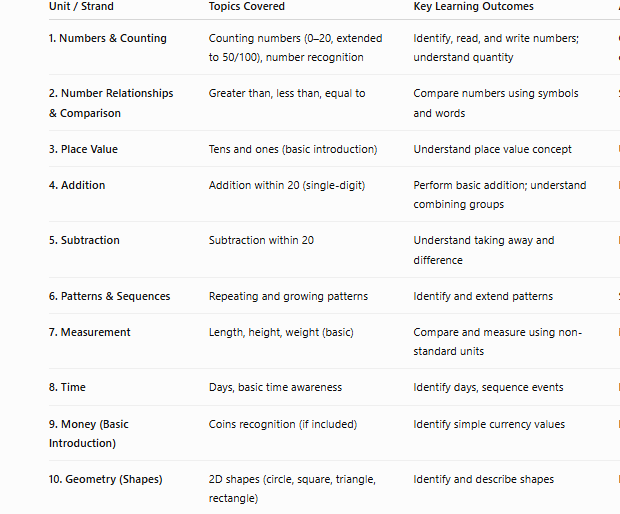
Kuwait Grade 1 Mathematics Curriculum 2026
| Unit / Strand | Topics Covered | Key Learning Outcomes | Activities / Skills Developed |
|---|---|---|---|
| 1. Numbers & Counting | Counting numbers (0–20, extended to 50/100), number recognition | Identify, read, and write numbers; understand quantity | Counting objects, number charts, oral counting |
| 2. Number Relationships & Comparison | Greater than, less than, equal to | Compare numbers using symbols and words | Sorting, matching, number games |
| 3. Place Value | Tens and ones (basic introduction) | Understand place value concept | Using blocks, bundles, visual aids |
| 4. Addition | Addition within 20 (single-digit) | Perform basic addition; understand combining groups | Number lines, objects counting |
| 5. Subtraction | Subtraction within 20 | Understand taking away and difference | Real-life examples, story problems |
| 6. Patterns & Sequences | Repeating and growing patterns | Identify and extend patterns | Shape patterns, number patterns |
| 7. Measurement | Length, height, weight (basic) | Compare and measure using non-standard units | Measuring with hands, blocks |
| 8. Time | Days, basic time awareness | Identify days, sequence events | Daily routine charts |
| 9. Money (Basic Introduction) | Coins recognition (if included) | Identify simple currency values | Role play, counting coins |
| 10. Geometry (Shapes) | 2D shapes (circle, square, triangle, rectangle) | Identify and describe shapes | Drawing, sorting shapes |
| 11. Data Handling | Simple graphs, sorting objects | Organize and interpret basic data | Pictographs, tally marks |
| 12. Problem Solving & Reasoning | Word problems (basic) | Apply math in real-life situations | Logical thinking, storytelling problems |
Key Features of Kuwait Grade 1 Math Curriculum
- Focus on foundational numeracy skills such as counting, addition, and subtraction.
- Emphasis on problem-solving and real-life applications of mathematics.
- Use of visual tools, activities, and interactive learning methods for better understanding.
- Gradual development from basic concepts to simple reasoning and logical thinking.
Kuwait Grade 1 Maths Curriculum: Core Subjects & Units Covered
Numbers & Number Sense
This is the most important section of the curriculum.
Topics include:
- Counting numbers (usually up to 20, 50, or 100)
- Reading and writing numbers
- Comparing numbers (greater than, less than, equal to)
- Number sequences and ordering
- Introduction to place value (tens and ones)
Students learn to understand numbers as quantities, not just symbols.
Addition & Subtraction
Basic arithmetic operations are introduced in a simple and engaging way.
Topics include:
- Addition within 10 and 20
- Subtraction within 10 and 20
- Using objects, pictures, and number lines
- Solving simple word problems
- Understanding the relationship between addition and subtraction
Focus is on concept clarity rather than memorization.
Shapes & Geometry
Students explore the world of shapes and spatial understanding.
Topics include:
- Identifying 2D shapes (circle, square, triangle, rectangle)
- Introduction to 3D shapes (cube, sphere, cone)
- Sorting and classifying shapes
- Understanding positions (above, below, near, far)
Builds visual and spatial intelligence.
Measurement
This section connects math to real-world experiences.
Topics include:
- Length (long/short)
- Weight (heavy/light)
- Capacity (full/empty)
- Comparing objects using informal units
Helps children relate math to everyday observations.
Time & Money
Students learn practical life skills.
Topics include:
- Reading time (hour and half-hour)
- Days of the week and months
- Identifying coins and basic money use
- Simple buying and selling concepts
Builds financial awareness and time management basics.
Patterns & Data Handling
This unit develops logical thinking.
Topics include:
- Recognizing and extending patterns
- Sorting and grouping objects
- Reading simple charts or pictographs
- Basic data interpretation
Encourages analytical thinking from an early age.
Teaching Methodology in Kuwait (2026)
The updated curriculum emphasizes:
- Activity-based learning
- Use of visual aids and manipulatives
- Group work and classroom interaction
- Integration of digital tools and smart classrooms
- Continuous formative assessment
Kuwait’s education reforms aim to make learning more interactive, skill-based, and globally competitive.
Assessment Pattern
Evaluation in Grade 1 is generally continuous and child-friendly:
- Classroom participation
- Worksheets and activities
- Oral assessments
- Simple written tests
- Periodic evaluations (formative & summative)
Focus is on understanding and application, not rote learning.
Expected Learning Outcomes
By the end of Grade 1, students should be able to:
- Count and compare numbers up to 100
- Perform basic addition and subtraction
- Identify common shapes and patterns
- Measure and compare everyday objects
- Tell time and recognize money
- Solve simple real-life math problems
Conclusion
The Kuwait Grade 1 Mathematics Curriculum 2026 is thoughtfully designed to ensure that children develop strong foundational math skills in a fun and engaging way. By combining conceptual learning, real-life application, and modern teaching methods, the curriculum prepares students for higher grades and lifelong learning.
It not only focuses on numbers but also nurtures critical thinking, creativity, and confidence, making mathematics an enjoyable subject for young learners.
Related Articles:
https://syllabus4u.com/kuwait-grade-1-arabic-curriculum/
https://syllabus4u.com/kuwait-grade-1-english-curriculum/
https://syllabus4u.com/kuwait-grade-1-mathematics-curriculum/
https://syllabus4u.com/kuwait-grade-1-science-curriculum/
https://syllabus4u.com/kuwait-grade-1-islamic-education-curriculum/
https://syllabus4u.com/kuwait-grade-1-physical-education-curriculum/
About The Author
