
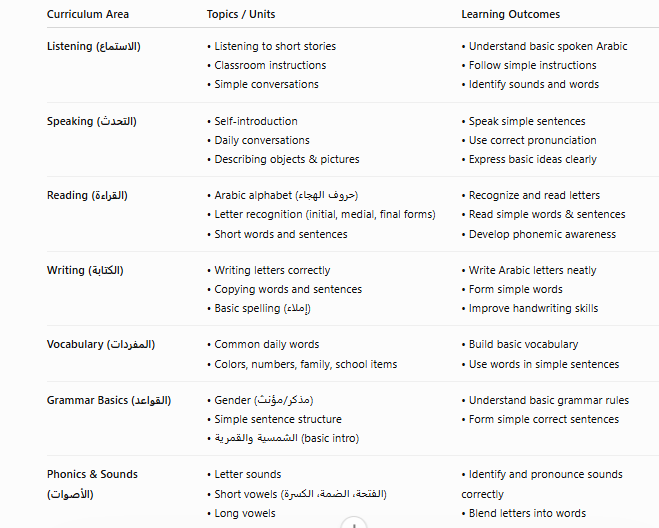
The Kuwait Grade 1 Arabic Curriculum 2026 is designed to build a strong foundation in the Arabic language during the early years of primary education. It focuses on developing essential language skills such as listening, speaking, reading, and writing through interactive and age-appropriate methods. Students are introduced to the Arabic alphabet, phonics, and basic vocabulary, gradually progressing to simple sentence formation and comprehension. The curriculum also emphasizes cultural identity, helping learners connect with their heritage and values. Through stories, activities, and visual learning, it aims to make language learning engaging while strengthening communication and literacy skills from an early stage.
Kuwait Grade 1 Arabic Curriculum 2026: Overview
The Grade 1 Arabic curriculum in Kuwait is designed to build foundational language skills in young learners. It focuses on:
- Recognizing Arabic letters and sounds
- Developing reading and writing abilities
- Enhancing listening and speaking skills
- Introducing basic grammar and vocabulary
The curriculum follows a gradual learning approach, starting from letters → words → sentences → simple texts.
| Curriculum Area | Topics / Units | Learning Outcomes | Assessment Methods |
|---|---|---|---|
| Listening (الاستماع) | • Listening to short stories • Classroom instructions • Simple conversations |
• Understand basic spoken Arabic • Follow simple instructions • Identify sounds and words |
Oral questioning, listening tasks |
| Speaking (التحدث) | • Self-introduction • Daily conversations • Describing objects & pictures |
• Speak simple sentences • Use correct pronunciation • Express basic ideas clearly |
Oral presentations, class participation |
| Reading (القراءة) | • Arabic alphabet (حروف الهجاء) • Letter recognition (initial, medial, final forms) • Short words and sentences |
• Recognize and read letters • Read simple words & sentences • Develop phonemic awareness |
Reading aloud, worksheets |
| Writing (الكتابة) | • Writing letters correctly • Copying words and sentences • Basic spelling (إملاء) |
• Write Arabic letters neatly • Form simple words • Improve handwriting skills |
Dictation, notebook work |
| Vocabulary (المفردات) | • Common daily words • Colors, numbers, family, school items |
• Build basic vocabulary • Use words in simple sentences |
Quizzes, oral tests |
| Grammar Basics (القواعد) | • Gender (مذكر/مؤنث) • Simple sentence structure • الشمسية والقمرية (basic intro) |
• Understand basic grammar rules • Form simple correct sentences |
Written exercises |
| Phonics & Sounds (الأصوات) | • Letter sounds • Short vowels (الفتحة، الضمة، الكسرة) • Long vowels |
• Identify and pronounce sounds correctly • Blend letters into words |
Phonics drills |
| Literature & Texts | • Short stories • Rhymes and poems • Picture-based texts |
• Develop interest in reading • Understand story meaning • Retell simple stories |
Story retelling, comprehension |
| Handwriting & Calligraphy | • Letter formation practice • Writing on lines |
• Improve neatness and alignment • Correct letter shapes |
Copywriting exercises |
| Values & Culture | • Respect, family, المدرسة • Islamic and cultural values |
• Build moral values • Connect language with culture |
Observation, activities |
Curriculum Structure (Kuwait MOE Approach)
- Based on “لغتي العربية” textbooks for primary grades
- Organized into units covering listening, speaking, reading, and writing skills
- Designed to develop communication skills, cultural awareness, and language proficiency
Key Features of Kuwait Grade 1 Arabic Curriculum
- Focus on foundational literacy (alphabet + phonics)
- Integrated approach: Listen → Speak → Read → Write
- Activity-based learning (stories, pictures, repetition)
- Gradual introduction to grammar and sentence building
- Strong emphasis on Arabic identity and culture
Key Learning Objectives
By the end of Grade 1, students are expected to:
- Identify and pronounce all Arabic letters
- Read simple words and short sentences
- Write letters and basic words correctly
- Understand basic vocabulary related to daily life
- Develop listening and speaking confidence
Kuwait Grade 1 Arabic Curriculum 2026: Core Topics
1. Arabic Alphabet & Phonics
- Recognition of all 28 Arabic letters
- Letter shapes (initial, medial, final forms)
- Correct pronunciation of letters
- Matching letters with pictures and words
Students learn letters step-by-step and practice through activities.
2. Short & Long Vowels (Harakat & Madd)
- Short vowels: Fatha (َ), Kasra (ِ), Damma (ُ)
- Long vowels: Alif (ا), Waw (و), Ya (ي)
- Reading words using vowel sounds
Focus on improving pronunciation and fluency.
3. Reading Skills
- Reading letters → words → short sentences
- Picture-based reading comprehension
- Simple stories and rhymes
- Recognizing common words
Students move gradually from decoding to understanding.
4. Writing Skills
- Writing letters in correct form
- Copying words and short sentences
- Dictation (إملاء)
- Handwriting practice
Emphasis on neat writing and correct spelling.
5. Basic Grammar (Language Structures)
- Sun & Moon letters (اللام الشمسية والقمرية)
- Tanween (ً ٍ ٌ)
- Taa Marbuta (ة) vs Taa Maftuha (ت)
- Demonstratives (هذا، هذه)
- Simple question words (من، ما)
Grammar is taught through examples, not memorization.
6. Listening & Speaking
- Listening to stories and instructions
- Repeating words and sentences
- Speaking about daily life (family, school, objects)
- Classroom conversations
Builds communication confidence from an early stage.
7. Vocabulary Development
- Everyday words (family, food, animals, school)
- Picture-word association
- Simple descriptive words
Helps students connect language with real-life situations.
8. Units & Themes (Example)
The syllabus is divided into thematic units such as:
- My School (مدرستي)
- My Family (أسرتي)
- Good Behavior (أخلاقي)
- وطن (My Country)
Each unit includes:
- Letters & sounds
- Vocabulary
- Reading passage
- Writing practice
- Activity-based learning
Teaching & Assessment Pattern
- Continuous assessment (classwork, reading, writing)
- Oral evaluation (speaking & listening)
- Worksheets and dictation tests
- No heavy exams—focus on skill development
Quick Summary Table
| Area | Topics Covered |
|---|---|
| Alphabet | Letters, shapes, sounds |
| Phonics | Short & long vowels |
| Reading | Words, sentences, stories |
| Writing | Letters, dictation, handwriting |
| Grammar | Basic rules (tanween, sun/moon letters) |
| Speaking | Daily conversation |
| Vocabulary | Everyday words |
Kuwait Grade 1 Arabic Curriculum PDF
The Kuwait Grade 1 Arabic curriculum, prescribed by the Ministry of Education, is designed to build foundational language skills through structured PDF textbooks and teacher guides. It focuses on four core areas: listening, speaking, reading, and writing. The syllabus introduces Arabic letters, sounds, and basic vocabulary through engaging units such as “Let’s Play,” “My Letters,” and “My Hobbies.” Students learn letter recognition, phonics, simple words, and sentence formation. Activities include storytelling, dictation, and handwriting practice. The curriculum is divided into semester-wise PDFs, including student books and teacher guides, ensuring gradual skill development and interactive learning.
Get Free PDF: kuwait arabic syllabus
Conclusion
The Kuwait Grade 1 Arabic Curriculum 2026 is designed to build a strong linguistic foundation through interactive and activity-based learning. It focuses on reading, writing, listening, and speaking skills, ensuring that students develop confidence in using Arabic from an early age while also connecting language learning with culture and daily life.
Related Articles:
https://syllabus4u.com/kuwait-grade-1-arabic-curriculum/
https://syllabus4u.com/kuwait-grade-1-english-curriculum/
https://syllabus4u.com/kuwait-grade-1-mathematics-curriculum/
https://syllabus4u.com/kuwait-grade-1-science-curriculum/
https://syllabus4u.com/kuwait-grade-1-islamic-education-curriculum/
https://syllabus4u.com/kuwait-grade-1-physical-education-curriculum/
About The Author

5 thoughts on “Kuwait Grade 1 Arabic Curriculum 2026”