
The Kuwait Grade 2 Mathematics Curriculum (2026–27) is designed to strengthen foundational numeracy skills while encouraging logical thinking and problem-solving. At this stage, students (typically aged 6–7 years) transition from basic number recognition to more structured mathematical operations and reasoning.
The curriculum follows a concept-based and activity-driven approach, ensuring students understand why mathematics works—not just how.
Kuwait Grade 2 Maths Curriculum 2026-27: Key Learning Objectives
By the end of Grade 2, students are expected to:
- Develop fluency in addition and subtraction
- Understand place value up to 3 digits (hundreds)
- Recognize and work with basic shapes and measurements
- Interpret simple data and patterns
- Apply math in real-life situations
Detailed Kuwait Grade 2 Maths Curriculum 2026-27
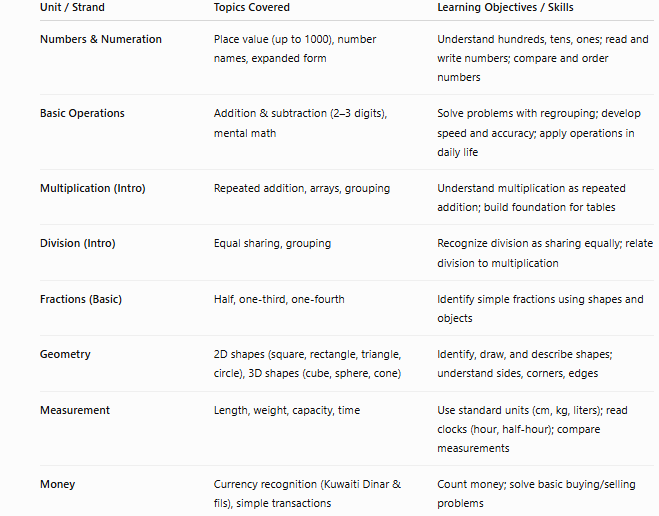
Kuwait Grade 2 Mathematics Curriculum (2026–27) based on typical Ministry of Education frameworks and international primary math standards (numbers, operations, geometry, measurement, and data handling).
| Unit / Strand | Topics Covered | Learning Objectives / Skills |
|---|---|---|
| Numbers & Numeration | Place value (up to 1000), number names, expanded form | Understand hundreds, tens, ones; read and write numbers; compare and order numbers |
| Basic Operations | Addition & subtraction (2–3 digits), mental math | Solve problems with regrouping; develop speed and accuracy; apply operations in daily life |
| Multiplication (Intro) | Repeated addition, arrays, grouping | Understand multiplication as repeated addition; build foundation for tables |
| Division (Intro) | Equal sharing, grouping | Recognize division as sharing equally; relate division to multiplication |
| Fractions (Basic) | Half, one-third, one-fourth | Identify simple fractions using shapes and objects |
| Geometry | 2D shapes (square, rectangle, triangle, circle), 3D shapes (cube, sphere, cone) | Identify, draw, and describe shapes; understand sides, corners, edges |
| Measurement | Length, weight, capacity, time | Use standard units (cm, kg, liters); read clocks (hour, half-hour); compare measurements |
| Money | Currency recognition (Kuwaiti Dinar & fils), simple transactions | Count money; solve basic buying/selling problems |
| Data Handling | Pictographs, bar graphs | Collect, represent, and interpret simple data |
| Patterns & Algebraic Thinking | Number patterns, sequences | Identify, extend, and create patterns; understand basic rules |
| Problem Solving | Word problems (daily life context) | Apply math concepts logically; improve reasoning and analytical thinking |
Key Learning Outcomes
- Strong understanding of place value and number operations
- Ability to solve real-life math problems
- Early exposure to multiplication, division, and fractions
- Development of logical thinking and pattern recognition
- Basic skills in measurement, money, and data interpretation
Teaching Approach (Kuwait Schools)
- Activity-based learning (games, visuals, manipulatives)
- Use of real-life examples (shopping, time, measurement)
- Continuous assessment (worksheets, quizzes, oral tasks)
- Integration with STEM-based learning methods
| Unit | Topic | Key Concepts | Learning Outcomes |
|---|---|---|---|
| 1 | Numbers & Place Value | Numbers up to 1000, place value (ones, tens, hundreds), number comparison | Read, write, and compare numbers up to 3 digits |
| 2 | Addition | 2-digit and 3-digit addition with/without carry | Solve addition problems and apply in daily life |
| 3 | Subtraction | Subtraction with borrowing | Understand difference and solve word problems |
| 4 | Multiplication Basics | Repeated addition, arrays | Understand concept of multiplication |
| 5 | Division Basics | Equal sharing, grouping | Understand simple division concepts |
| 6 | Measurement | Length, weight, capacity (using standard units) | Measure objects using tools |
| 7 | Time | Clock reading (hours & minutes), calendar | Tell time and understand days/months |
| 8 | Money | Currency recognition, simple transactions | Solve real-life money problems |
| 9 | Geometry | 2D & basic 3D shapes | पहचान shapes and their properties |
| 10 | Data Handling | Pictographs, simple charts | Interpret and represent data |
Example Concept: Triangle Basics
Students are introduced to simple geometry concepts such as triangles. They learn that the sum of angles in any triangle is always 180°, helping build early spatial reasoning skills.
Kuwait Grade 2 Maths – Chapter-wise Breakdown (2026–27)
Chapter-wise breakdown of the Kuwait Grade 2 Mathematics Curriculum (2026–27).
This is structured using Kuwait-specific topic progression along with internationally aligned Grade 2 frameworks (since Kuwait curriculum follows similar foundational math sequencing).
| Chapter No. | Chapter Name | Topics Covered | Key Skills Developed |
|---|---|---|---|
| 1 | Numbers up to 1000 | Counting, number names, numerals | Read, write, and understand numbers up to 3 digits |
| 2 | Place Value | Hundreds, tens, ones, expanded form | Break numbers into place values and compare numbers |
| 3 | Number Patterns | Skip counting (2, 5, 10), sequences | Identify and extend patterns |
| 4 | Comparing & Ordering Numbers | Greater than, less than, equal to | Arrange numbers in ascending/descending order |
| 5 | Even & Odd Numbers | Number classification | Recognize and differentiate even and odd numbers |
| 6 | Addition (Basic to Advanced) | 2-digit & 3-digit addition, carry over | Solve addition problems with accuracy |
| 7 | Subtraction | Borrowing, word problems | Perform subtraction with regrouping |
| 8 | Multiplication (Introduction) | Repeated addition, arrays | Understand multiplication concepts |
| 9 | Division (Introduction) | Equal sharing, grouping | Learn basic division concepts |
| 10 | Fractions (Basic)** | Half, one-third, one-fourth | Identify parts of a whole |
| 11 | Geometry – 2D Shapes | Square, rectangle, triangle, circle | Identify and draw basic shapes |
| 12 | Geometry – 3D Shapes | Cube, cuboid, sphere, cone | Recognize solid shapes in real life |
| 13 | Measurement | Length, weight, capacity | Use standard units and compare measurements |
| 14 | Time** | Clock reading (hour, half-hour), days | Understand time and daily routines |
| 15 | Money** | Kuwaiti Dinar, coins, transactions | Solve simple buying/selling problems |
| 16 | Data Handling | Pictographs, bar graphs | Interpret and represent data |
| 17 | Word Problems & Logical Thinking | Real-life application questions | Develop reasoning and problem-solving skills |
Curriculum Insights
- The curriculum progresses from basic number sense → operations → real-life applications
- Strong focus on activity-based learning and practical understanding
- Early introduction to multiplication, division, and fractions builds foundation for Grade 3
- Emphasis on daily-life math (money, time, measurement)
Teaching Methodology
The Kuwait curriculum emphasizes interactive learning, including:
- Activity-based exercises
- Visual aids (charts, shapes, number lines)
- Group work and discussions
- Real-life problem-solving (shopping, measuring, etc.)
Teachers focus on concept clarity rather than rote memorization.
Assessment Pattern
Assessment is continuous and includes:
- Classwork & Homework
- Worksheets and quizzes
- Oral assessments
- Term-end exams
Focus is given to:
- Accuracy
- Understanding
- Application skills
Learning Resources
Students typically use:
- Textbooks prescribed by Kuwait Ministry of Education
- Workbooks and practice sheets
- Digital learning tools (in some schools)
- Manipulatives like blocks, clocks, and measuring tools
Importance of the Curriculum
This curriculum lays the foundation for:
- Advanced arithmetic in higher grades
- Logical and analytical thinking
- Confidence in solving everyday problems
It ensures students are not just learning math—but understanding and enjoying it.
Kw Grade 2 Maths Curriculum PDF
Get Free PDF for all subjects of Grade 2
PDF for All Subject of Grade 2 2026-27
Conclusion
The Kuwait Grade 2 Maths Curriculum 2026–27 is structured to build strong mathematical fundamentals through engaging and practical learning. By combining core arithmetic, geometry, measurement, and data skills, it prepares students for higher-level math while making learning meaningful and enjoyable.
About The Author
