
The Kuwait Grade 2 Science Curriculum (2026–27) is designed to build a strong foundation in basic scientific concepts, observation skills, and curiosity about the natural world. At this stage, students (typically aged 6–7 years) learn through hands-on activities, simple experiments, and real-life connections.
The curriculum follows a concept-based and inquiry-driven approach, aligned with international primary education standards while reflecting Kuwait’s educational framework.
Kuwait Grade 2 Science Curriculum 2026-27: Key Objectives
The curriculum aims to:
- Develop curiosity and scientific thinking
- Encourage observation and questioning
- Introduce basic life, physical, and earth science concepts
- Promote environmental awareness
- Build early problem-solving and reasoning skills
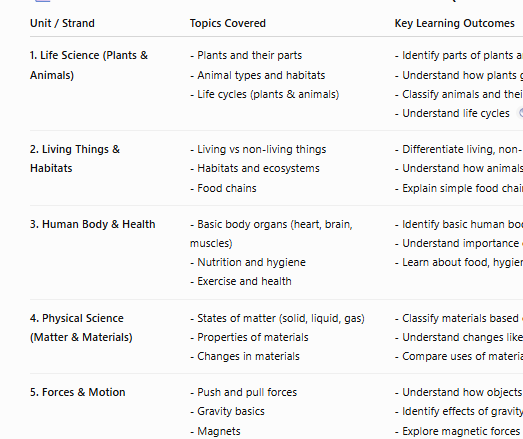
Kuwait Grade 2 Science Curriculum 2026
| Unit / Strand | Topics Covered | Key Learning Outcomes |
|---|---|---|
| 1. Life Science (Plants & Animals) | – Plants and their parts – Animal types and habitats – Life cycles (plants & animals) |
– Identify parts of plants and their functions – Understand how plants grow (water, light, air) – Classify animals and their habitats – Understand life cycles |
| 2. Living Things & Habitats | – Living vs non-living things – Habitats and ecosystems – Food chains |
– Differentiate living, non-living, and never-living things – Understand how animals depend on habitats – Explain simple food chains |
| 3. Human Body & Health | – Basic body organs (heart, brain, muscles) – Nutrition and hygiene – Exercise and health |
– Identify basic human body parts and functions – Understand importance of healthy habits – Learn about food, hygiene, and exercise |
| 4. Physical Science (Matter & Materials) | – States of matter (solid, liquid, gas) – Properties of materials – Changes in materials |
– Classify materials based on properties – Understand changes like melting/freezing – Compare uses of materials |
| 5. Forces & Motion | – Push and pull forces – Gravity basics – Magnets |
– Understand how objects move – Identify effects of gravity – Explore magnetic forces |
| 6. Earth & Space Science | – Sun, Moon, and stars – Day and night – Seasons |
– Identify celestial objects – Explain day/night cycle – Understand seasonal changes |
| 7. Weather & Environment | – Weather types – Water cycle – Natural changes (slow/fast) |
– Describe different weather conditions – Understand water cycle basics – Identify natural changes like erosion or storms |
| 8. Scientific Skills | – Observation and measurement – Experiments and investigations – Recording data |
– Ask questions and make predictions – Conduct simple experiments – Record and interpret results |
Key Features of Kuwait Grade 2 Science Curriculum
- Focus on inquiry-based learning and experiments
- Covers three main branches: Life Science, Physical Science, Earth Science
- Encourages observation, questioning, and problem-solving skills
- Builds foundation for higher-grade scientific concepts
Kuwait Chapter-wise Science Grade 2 Syllabus
The chapter-wise (term-wise) breakdown of the Kuwait Grade 2 Science Curriculum 2026–27 based on official curriculum distribution and textbooks.
Term 1 (الفصل الأول)
| Unit | Chapter / Lesson | Topics Covered |
|---|---|---|
| Unit 1: Living Things | 1. Living & Non-living Things | Difference between living and non-living |
| 2. Plants Around Us | Types of plants | |
| 3. Parts of a Plant | Roots, stem, leaves, flowers | |
| 4. Functions of Plant Parts | Role of roots, stem, leaves | |
| 5. What Plants Need | Water, sunlight, air | |
| Unit 2: Animals | 6. Types of Animals | Classification (domestic, wild, etc.) |
| 7. What Animals Eat | Herbivores, carnivores, omnivores | |
| 8. Animal Life Cycle | Growth and reproduction | |
| 9. Animal Habitats | Desert, water, forest | |
| Unit 3: Human Body & Health | 10. Human Body Parts | External & internal organs |
| 11. Bones & Muscles | Movement and support | |
| 12. Healthy Food | Balanced diet, food pyramid | |
| 13. Personal Hygiene | Cleanliness and habits |
Term 1 mainly focuses on Life Science (plants, animals, human body)
Term 2 (الفصل الثاني)
| Unit | Chapter / Lesson | Topics Covered |
|---|---|---|
| Unit 4: Matter & Materials | 1. What is Matter? | Solid, liquid, gas |
| 2. Properties of Materials | Hard, soft, transparent | |
| 3. Changes in Matter | Heating, cooling, melting | |
| Unit 5: Energy & Light | 4. Sources of Energy | Sun, electricity |
| 5. Light & Vision | How we see objects | |
| 6. Properties of Light | Reflection, simple refraction | |
| 7. Colors of Light | Basic color concepts | |
| Unit 6: Forces & Motion | 8. Push and Pull | Types of forces |
| 9. Movement of Objects | Speed and direction | |
| 10. Magnets | Magnetic attraction | |
| Unit 7: Earth & Environment | 11. Weather | Types of weather |
| 12. Water Cycle | Evaporation, condensation | |
| 13. Earth & Sky | Sun, moon, stars |
Term 2 focuses on Physical Science + Earth Science concepts
Summary of Term-wise Focus
| Term | Main Focus Areas |
|---|---|
| Term 1 | Living things, plants, animals, human health |
| Term 2 | Matter, energy, light, forces, earth & environment |
Curriculum Structure
The Grade 2 Science syllabus is broadly divided into the following units:
| Unit | Topics Covered | Key Learning Outcomes |
|---|---|---|
| Living and Non-Living Things | Plants, animals, differences, needs | Identify living vs non-living, basic needs of life |
| Plants and Animals | Plant parts, animal habitats | Understand plant growth and animal homes |
| Human Body and Health | Body parts, hygiene, healthy habits | Learn importance of cleanliness and nutrition |
| Matter and Materials | Solids, liquids, properties | Identify materials and their uses |
| Energy and Forces | Light, heat, simple forces | Understand basic energy sources |
| Earth and Environment | Weather, seasons, environment | Observe weather patterns and care for nature |
Unit Breakdown
1. Living and Non-Living Things
Topics:
- Characteristics of living things
- Differences between living and non-living
- Basic needs (food, water, air)
Skills Developed:
- Observation and classification
- Identifying life processes
2. Plants and Animals
Topics:
- Parts of plants (roots, stem, leaves, flowers)
- Animal types and habitats
- Food habits of animals
Skills Developed:
- Understanding ecosystems
- Recognizing diversity in nature
3. Human Body and Health
Topics:
- Basic body parts and their functions
- Personal hygiene (washing hands, brushing teeth)
- Healthy food and exercise
Skills Developed:
- Self-care habits
- Awareness of health and nutrition
4. Matter and Materials
Topics:
- Types of materials (wood, metal, plastic)
- States of matter (solid, liquid)
- Uses of different materials
Skills Developed:
- Sorting and grouping
- Understanding physical properties
5. Energy and Forces
Topics:
- Sources of light and heat
- Push and pull forces
- Everyday uses of energy
Skills Developed:
- Cause-and-effect understanding
- Basic physics concepts
6. Earth and Environment
Topics:
- Weather (sunny, rainy, windy)
- Seasons and changes
- Caring for the environment
Skills Developed:
- Environmental awareness
- Observation of natural changes
Kuwait Grade 2 Science Syllabus PDF
Kuwait Class-2 Science Curriculum 2026-27 PDF Direct Link to get Free PDF
Teaching Methodology
The curriculum uses interactive and child-centered teaching methods:
- Activity-based learning
- Group discussions
- Visual aids and storytelling
- Experiments and demonstrations
- Outdoor learning experiences
Assessment Pattern
Assessment is continuous and holistic, including:
- Class participation
- Worksheets and quizzes
- Projects and activities
- Oral assessments
- Term-end evaluations
Learning Outcomes
By the end of Grade 2, students will be able to:
- Identify basic scientific concepts
- Understand living organisms and their needs
- Explain simple physical and environmental phenomena
- Practice healthy and eco-friendly habits
- Develop curiosity and observation skills
Conclusion
The Kuwait Grade 2 Science Curriculum 2026–27 focuses on nurturing young learners’ curiosity and foundational scientific understanding. Through engaging lessons and practical experiences, students begin to explore the world around them while developing essential life skills. This early exposure prepares them for more advanced scientific learning in higher grades while encouraging a lifelong interest in science.
About The Author
