
The NMDC Steel Executive Trainee (ET) Recruitment 2026 is one of the top PSU opportunities for engineering graduates in India. Conducted by NMDC (a Navratna PSU under the Ministry of Steel), this recruitment is primarily based on GATE scores, followed by further evaluation stages.
In this article, you will get a detailed NMDC Steel Executive Trainee Syllabus 2026, exam pattern, selection process, and preparation strategy.
NMDC Steel Executive Trainee 2026: Overview
| Particulars | Details |
|---|---|
| Organization | NMDC Limited / NMDC Steel Ltd |
| Post Name | Executive Trainee (ET) |
| Disciplines | Mechanical, Electrical, Civil, Mining, Metallurgy, IT, etc. |
| Selection Mode | GATE Score + GD + Interview |
| Job Type | PSU (Central Government) |
NMDC recruits Executive Trainees mainly through GATE 2026 scores, so your preparation should align with the GATE syllabus.
NMDC Executive Trainee Selection Process 2026
The selection process consists of multiple stages:
1. GATE Score (Primary Stage)
- Candidates must appear in GATE 2026
- Shortlisting is done based on discipline-wise GATE score
2. Group Discussion (GD)
- 8–12 candidates per group
- Duration: 15–20 minutes
- Topics: Current affairs, industry issues, abstract topics
3. Personal Interview (PI)
- Duration: 20–30 minutes
- Includes:
- Technical questions (core subject)
- HR questions
- Situational judgement
4. Document Verification & Medical Test
Weightage Distribution
| Stage | Weightage |
|---|---|
| GATE Score | 70% |
| Group Discussion | 15% |
| Interview | 15% |
Final merit list is prepared based on this combined score.
NMDC Steel Executive Trainee Exam Pattern 2026
Unlike many PSU exams, NMDC does NOT conduct a separate written test for Executive Trainee recruitment.
Key Points:
- No CBT (Computer-Based Test) conducted separately
- Selection is based on:
- GATE score
- GD + Interview
- Medium: English
- Type: Objective (GATE exam format)
This means your GATE preparation = NMDC preparation.
NMDC Executive Trainee Syllabus 2026 (Branch-wise)
Since NMDC uses GATE syllabus, below is a branch-wise overview:
1. Mechanical Engineering Syllabus
- Engineering Mechanics
- Strength of Materials
- Theory of Machines
- Thermodynamics
- Fluid Mechanics
- Heat Transfer
- Manufacturing Engineering
- Industrial Engineering
2. Electrical Engineering Syllabus
- Engineering Mathematics
- Electric Circuits
- Electromagnetic Fields
- Electrical Machines
- Power Systems
- Control Systems
- Power Electronics
3. Civil Engineering Syllabus
- Structural Engineering
- Geotechnical Engineering
- Environmental Engineering
- Transportation Engineering
- Engineering Mathematics
4. Computer Science / IT Syllabus
- Programming (C/C++/Java)
- Data Structures & Algorithms
- Operating Systems
- DBMS
- Computer Networks
- Theory of Computation
5. Metallurgical / Mining / Other Branches
- Metallurgy: Physical metallurgy, thermodynamics, extraction of metals
- Mining: Mine planning, rock mechanics, ventilation
- Chemical: Reaction engineering, thermodynamics, process control
General Aptitude (Common for All)
GATE also includes a General Aptitude section:
- Quantitative Aptitude
- Logical Reasoning
- Verbal Ability
- Data Interpretation
Selection Process (Overview)
| Stage | Details |
|---|---|
| Stage 1 | GATE 2026 Score (Primary Shortlisting) |
| Stage 2 | Group Discussion (GD) |
| Stage 3 | Personal Interview (PI) |
| Weightage | GATE: 70% + GD: 15% + Interview: 15% |
NMDC Steel recruitment does not conduct a separate written exam; selection is mainly based on GATE syllabus.
GATE-Based Syllabus for NMDC Steel ET 2026
Common Subjects (All Branches)
| Subject | Topics |
|---|---|
| Engineering Mathematics | Linear Algebra, Calculus, Differential Equations, Probability & Statistics |
| General Aptitude | Verbal Ability, Reading Comprehension, Numerical Ability, Data Interpretation |
Discipline-wise Syllabus (Core Subjects)
Mechanical Engineering
| Subject | Important Topics |
|---|---|
| Engineering Mechanics | Force systems, equilibrium, friction |
| Thermodynamics | Laws of thermodynamics, cycles |
| Fluid Mechanics | Fluid properties, flow, turbines |
| Heat Transfer | Conduction, convection, radiation |
| Strength of Materials | Stress-strain, torsion, bending |
| Machine Design | Gears, bearings, shafts |
| Manufacturing | Casting, welding, machining |
Electrical Engineering
| Subject | Important Topics |
|---|---|
| Electrical Circuits | Network theorems, AC/DC circuits |
| Machines | Transformers, motors, generators |
| Power Systems | Transmission, distribution, faults |
| Control Systems | Stability, feedback systems |
| Power Electronics | Converters, inverters |
| Signals & Systems | Fourier transform, Laplace |
Civil Engineering
| Subject | Important Topics |
|---|---|
| Structural Engineering | RCC, steel structures |
| Geotechnical Engineering | Soil mechanics, foundation |
| Environmental Engineering | Water treatment, pollution |
| Transportation | Highway engineering |
| Fluid Mechanics | Hydrology, irrigation |
| Surveying | Leveling, mapping |
Computer Science / IT
| Subject | Important Topics |
|---|---|
| Programming | C, Data Structures |
| Algorithms | Sorting, searching, complexity |
| DBMS | SQL, normalization |
| Operating Systems | Processes, memory management |
| Computer Networks | OSI model, protocols |
| Theory of Computation | Automata, languages |
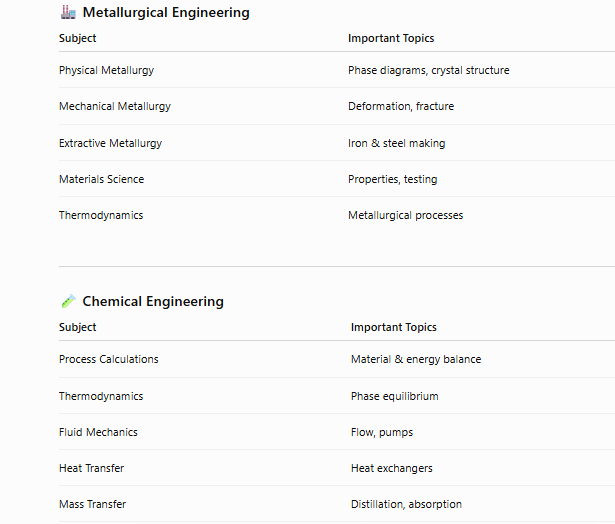
Metallurgical Engineering
| Subject | Important Topics |
|---|---|
| Physical Metallurgy | Phase diagrams, crystal structure |
| Mechanical Metallurgy | Deformation, fracture |
| Extractive Metallurgy | Iron & steel making |
| Materials Science | Properties, testing |
| Thermodynamics | Metallurgical processes |
Chemical Engineering
| Subject | Important Topics |
|---|---|
| Process Calculations | Material & energy balance |
| Thermodynamics | Phase equilibrium |
| Fluid Mechanics | Flow, pumps |
| Heat Transfer | Heat exchangers |
| Mass Transfer | Distillation, absorption |
| Chemical Reaction | Kinetics, reactors |
Instrumentation Engineering
| Subject | Important Topics |
|---|---|
| Sensors & Transducers | Measurement systems |
| Control Systems | PID, stability |
| Analog Electronics | Amplifiers, filters |
| Digital Electronics | Logic circuits |
| Signals | Sampling, modulation |
Group Discussion (GD) Topics
| Area | Topics |
|---|---|
| Current Affairs | Economy, PSU sector, Steel Industry |
| Technical | Core engineering concepts |
| Social Issues | Environment, sustainability |
Personal Interview (PI)
| Area | Focus |
|---|---|
| Technical Knowledge | Core subjects of discipline |
| Project Work | Final year projects |
| HR Questions | Strengths, career goals |
| PSU Awareness | NMDC Steel operations |
Key Points
- NMDC Steel ET recruitment is GATE-based, so GATE syllabus = NMDC syllabus.
- No separate CBT exam is conducted.
- Candidates must prepare both technical + aptitude + GD/PI.
- Recruitment is for multiple disciplines like Mechanical, Electrical, Civil, IT, Metallurgy, etc.
Preparation Strategy (Quick Tips)
- Focus on GATE standard books & PYQs
- Practice numerical problems daily
- Stay updated with current affairs
- Prepare technical + HR questions for interview
Important Preparation Tips
Focus primarily on GATE syllabus
Practice previous year GATE questions
Strengthen core engineering concepts
Prepare for GD topics:
- Current affairs
- PSU-related issues
- Economy & infrastructure
For Interview:
- Revise core subjects
- Prepare HR questions
- Know about NMDC and steel industry
Final Words
The NMDC Steel Executive Trainee 2026 recruitment is unique because it eliminates the need for a separate written exam. Your GATE score plays the most important role (70% weightage), followed by GD and Interview.
About The Author
