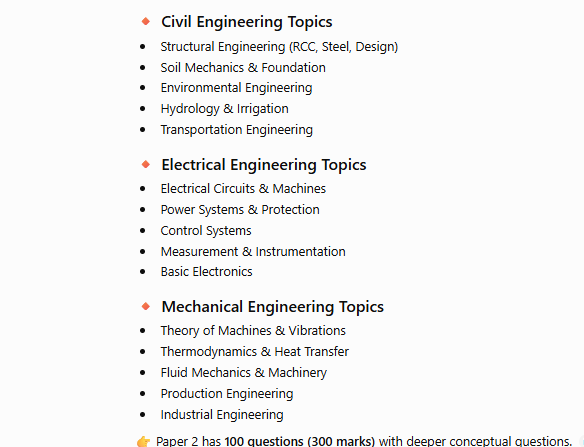
The SSC JE (Junior Engineer) Exam is conducted by the Staff Selection Commission to recruit engineers in Civil, Electrical, and Mechanical disciplines. The SSC JE Syllabus 2026 is divided into two papers, testing both general aptitude and technical engineering knowledge.
SSC JE Exam Pattern 2026: Overview
| Paper |
Mode |
Subjects |
Marks |
Duration |
| Paper 1 |
CBT (Objective) |
Reasoning, General Awareness, Engineering |
200 |
2 Hours |
| Paper 2 |
CBT (Technical) |
Engineering (Civil/Electrical/Mechanical) |
300 |
2 Hours |
- Paper 1 is qualifying for Paper 2
- Both papers are objective-type (MCQs)
- Negative marking applies in Paper 1 (approx. 0.25 marks
SSC JE Syllabus 2026
The SSC JE Syllabus 2026 is mainly divided into 2 Parts: Paper 1 & Paper 2.
- Paper I consists of topics from General Intelligence & Reasoning, General Awareness, and Basic Engineering from the candidates’ chosen field (Civil, Electrical, or Mechanical).
- Paper II is mainly focused only on your specific engineering branch. It covers technical subjects in detail.
SSC JE Paper 1 Syllabus 2026
SSC JE Paper 1 syllabus includes 3 sections, such as General Intelligence & Reasoning, General Awareness, and General Engineering (Civil & Structural, Electrical, or Mechanical). The detailed topics-wise syllabus is given in the table below:
| Section |
Topics |
| General Intelligence & Reasoning |
- Analogies
- Similarities and Differences
- Space Visualization
- Problem Solving
- Analysis
- Judgment
- Decision Making
- Visual Memory
- Discrimination
- Observation
- Relationship Concepts
- Arithmetical Reasoning
- Verbal and Figure Classification
- Arithmetical Number Series
- Dealing with Abstract Ideas and Symbols
- Arithmetical Computations
- Analytical Functions
|
| General Awareness |
- Current Affairs (National & International)
- India and Its Neighbouring Countries
- History of India
- Indian Culture
- Geography (Physical, Social & Economic aspects)
- Indian Polity and Constitution
- Economic Scene
- Scientific Research and Discoveries
- General Science
- Environmental Issues
- Important Government Schemes and Policies
- Awards and Honours
- Books and Authors
- Sports
- Static GK (e.g., national symbols, important days, etc.)
|
| Mechanical Engineering |
- Theory of Machines and Machine Design
- Engineering Mechanics & Strength of Materials
- Thermodynamics (1st & 2nd Laws)
- IC Engines (Performance, Combustion, Cooling & Lubrication)
- Air Standard Cycles (Otto, Diesel)
- Rankine Cycle & Boilers
- Air Compressors & Refrigeration Cycles
- Steam Nozzles & Turbines
- Fluid Mechanics & Machinery
- Measurement of Flow & Pressure
- Hydraulic Turbines & Centrifugal Pumps
- Classification of Steel & Basic Production Engineering
|
| Electrical Engineering |
- Basic Electrical Concepts
- Circuit Laws (Ohm’s Law, Kirchhoff’s Laws)
- Magnetic Circuits
- AC Fundamentals
- Measurement & Measuring Instruments
- Electrical Machines (DC & AC)
- Fractional Kilowatt Motors & Single-Phase Induction Motors
- Synchronous Machines
- Generation, Transmission & Distribution of Electrical Power
- Estimation and Costing
- Utilization of Electrical Energy (Heating, Welding, Lighting, etc.)
- Basic Electronics (Diodes, Transistors, BJTs, JFETs)
|
| Civil Engineering |
- Building Materials
- Estimating, Costing, and Valuation
- Surveying
- Soil Mechanics
- Hydraulics
- Irrigation Engineering
- Transportation Engineering
- Environmental Engineering
- Structural Engineering: Theory of Structures, Concrete Technology, RCC Design, Steel Design
|
SSC JE Paper 2 Syllabus 2026
The SSC Junior Engineer CBT 2 Syllabus is focused on the core subject of the candidates’ specific branch, such as Civil Engineering, Mechanical Engineering, & Electrical Engineering. The detailed trade-wise & topic-wise syllabus is given below.
SSC JE Civil Engineering Syllabus for Paper 2
| SSC JE Civil Engineering Syllabus |
| Subjects |
Topics |
| Building Materials |
- Physical and chemical properties
- Classification- Standard tests
- Use and manufacture/quarrying
- Materials: Building stones, silicate-based materials, Portland cement, asbestos products, timber, wood-based products, laminates, bituminous materials, paints, varnishes
|
| Estimating, Costing, and Valuation |
- Estimate, glossary of technical terms
- Analysis of rates, methods, and units of measurement
- Items of work: Earthwork, brickwork, RCC, shuttering, timber work, painting, flooring, plastering, boundary wall, water tank, septic tank
- Methods: Bar bending schedule, centre line method, mid-section formula, trapezoidal formula, Simpson’s rule
- Cost estimates: Septic tank, pavements, tube wells, footings, steel truss, piles, pile caps
- Valuation: Value and cost, scrap value, salvage value, assessed value, sinking fund, depreciation, obsolescence, valuation methods
|
| Surveying |
- Principles, distance measurement
- Chain surveying, compass, plane table
- Bearings, local attraction
- Theodolite traversing and adjustments
- Levelling, contouring, corrections
- Dumpy level adjustments
- Contour mapping and its uses
- Tachymetry, curve setting, earthwork calculation
- Advanced surveying equipment
|
| Soil Mechanics |
- Origin, phase diagram
- Definitions: Void ratio, porosity, water content, etc.
- Grain size curves, Atterberg’s limits, ISI classification
- Plasticity chart- Permeability, aquifers, effective stress
- Quicksand, consolidation, pre-consolidation
- Shear strength, compaction
- Earth pressure theories, bearing capacity
|
| Hydraulics |
- Fluid properties and hydrostatics
- Flow measurement- Bernoulli’s theorem and applications
- Flow through pipes and open channels
- Weirs, flumes, spillways- Pumps and turbines
|
| Irrigation Engineering |
- – Definition, need, benefits- Irrigation types and methods- Hydrology: Rainfall, runoff, rain gauge-
- Crop water needs: Duty, delta, base period
- – Crops: Kharif & Rabi- Canal systems and lining- Wells, weirs, flood control-
- Waterlogging, land reclamation
- – Major Indian irrigation projects
|
| Transportation Engineering |
- Highway engineering: Cross-sectional elements, Geometric design, Pavement types & materials, Flexible and rigid pavement design
- Maintenance and drainage
- Railway engineering:
- Permanent way components
- Track geometry
- Points and crossings
- Traffic engineering:
- Surveys
- Intersections and interchanges
- Traffic signals
- Road safety
|
| Environmental Engineering |
- Water quality and sources
- Water purification and distribution
- Sanitation and sewerage systems
- Sewage treatment
- Solid waste management
- Air pollution: causes, effects, control
- Noise pollution: causes, effects, control
|
| Theory of Structures |
- Elasticity constants
- Beam types: determinate and indeterminate
- Bending moment and shear force diagrams
- Moment of inertia
- Shear stress: tee, channel, compound sections
- Eccentric loads
- Slope deflection method
- Columns and critical load
- Torsion of circular sections
|
| Concrete Technology |
- Properties and uses of concrete
- Cement, aggregates, water-cement ratio
- Workability and mix design
- Storage, batching, mixing
- Placement, compaction, finishing, curing
- Quality control measures
- Hot and cold weather concreting
- Concrete repair and maintenance
|
| RCC Design |
- RCC beams:
- Flexural, shear, and bond strength
- Singly and doubly reinforced
- Cantilevers, T-beams, lintels
- Slabs: one-way and two-way
- Footings: isolated types
- Columns, staircases
- Retaining walls, water tanks
- Design approaches:
- Limit state method
- Working stress method
|
| Steel Design |
- Steel column and beam design
- Roof trusses
- Plate girders
|
SSC JE Electrical Engineering Syllabus For Paper 2
| SSC JE Electrical Engineering Syllabus |
| Subjects |
Topics |
| Basic Concepts |
- Resistance, inductance, capacitance
- Factors affecting R, L, and C
- Current, voltage, power, energy
- Units of electrical quantities
|
| Circuit Law |
- Kirchhoff’s Current and Voltage Laws
- Simple circuit solutions using:
- Network theorems
|
| Magnetic Circuit |
- Flux, MMF (Magneto-Motive Force), and reluctance
- Types of magnetic materials
- Magnetic field calculations for:
- Straight conductors
- Circular loops
- Solenoids
- Electromagnetic induction
- Self and mutual induction
|
| AC Fundamentals |
- Instantaneous, peak, RMS, and average values
- Sinusoidal waveform representation
- Simple series and parallel AC circuits (R, L, C)
- Resonance, tank circuit
- Polyphase systems:
- Star and delta connection
- 3-phase power concepts
- DC and sinusoidal response of R-L and R-C circuits
|
| Measurement and Measuring Instruments |
- Power and energy measurement:
- Single-phase and three-phase (active/reactive)
- 2-wattmeter method for 3-phase power
- Measurement of frequency and phase angle
- Instruments:
- Ammeter and voltmeter (moving coil and moving iron)
- Wattmeter (range extension)
- Multimeter, megger, energy meter
- AC bridges
- CRO and signal generator
- CT (Current Transformer) and PT (Potential Transformer)
- Earth fault detection methods
|
| Electrical Machines |
- DC Machines
Construction and working principles
- Characteristics of DC motors and generators
- Speed control methods
- Starting and braking of DC motors
- Losses and efficiency analysis
- (b) Transformers
Single-phase and three-phase transformers
- Construction and working principle
- Equivalent circuit, voltage regulation
- OC (Open Circuit) and SC (Short Circuit) tests
- Losses and efficiency
- Effect of voltage, frequency, and waveform
- Parallel operation of transformers
- Auto-transformers
- (c) Induction Motors
3-phase induction motor construction and working
- Rotating magnetic field
- Torque-speed characteristics
- Starting and speed control methods
- Braking techniques
- Impact of voltage and frequency on performance
|
| Generation, Transmission & Distribution |
- Power station types
- Load factor, diversity factor, demand factor
- Cost of generation and station interconnection
- Power factor improvement
- Tariff types
- Faults and symmetrical short circuit current
- Switchgear basics:
- Circuit breaker ratings
- Arc extinction (oil, air)
- HRC fuses
- Protection systems:
- Earth leakage, overcurrent
- Buchholtz relay
- Merz-Price protection (generators & transformers)
- Feeder and busbar protection
- Lightning arresters
- Transmission & distribution systems
- Cable types, ratings, and derating factors
- Comparison of conductor materials and system efficiency
|
| Utilization of Electrical Energy |
- Illumination systems
- Electric heating and welding
- Electroplating
- Electric drives and industrial motors
|
SSC JE Mechanical Engineering Syllabus for Paper 2
| SSC JE Syllabus Mechanical Engineering 2026 |
| Subjects |
Topics |
| Theory of Machines and Machine Design |
- Simple machine concept
- Four-bar linkage, link motion
- Flywheels and energy fluctuation
- Power transmission (V-belts & Flat belts)
- Clutches: Plate and Conical
- Gears: Types, profiles, gear ratio calculation
- Governors: Principles and classification- Riveted joints- Cams and bearings- Friction in collars and pivots
|
| Engineering Mechanics and Strength of Materials |
- Equilibrium of forces
- Laws of motion
- Friction concepts
- Stress and strain, elastic limit, elastic constants
- Bending moment and shear force diagrams
- Stress in composite bars
- Torsion in circular shafts
- Buckling of columns: Euler’s and Rankine’s theories
- Thin-walled pressure vessels
|
| Properties of Pure Substances |
- p-v and P-T diagrams (e.g., H₂O)
- Steam tables and steam generation
- Saturated, wet, and superheated steam
- Dryness fraction and degree of superheat
- Mollier’s (h-s) chart
|
| 1st Law of Thermodynamics |
- Stored/internal energy definition
- 1st Law for cyclic process
- Non-flow and flow energy equations
- Enthalpy definition
- Steady State Steady Flow (SSSF) conditions
- SSSF Energy Equation
|
| 2nd Law of Thermodynamics |
- Heat reservoir, sink, source
- Heat engine, heat pump, refrigerator
- Thermal efficiency & Coefficient of Performance (COP)
- Kelvin-Planck & Clausius statements
- Thermodynamic temperature scale
- Entropy, Clausius integral
- Entropy changes in ideal gases
- Carnot cycle & efficiency
- PMM-2 (definition & impossibility)
|
| Air Standard Cycles for IC Engines |
- Otto cycle: P-V, T-S diagrams, thermal efficiency
- Diesel cycle: P-V, T-S diagrams, thermal efficiency
- IC engine performance, combustion, cooling & lubrication
|
| Rankine Cycle of Steam |
- Simple Rankine cycle on P-V, T-S, h-s diagrams
- Efficiency with and without the pump work
|
| Boilers |
- Classification and specifications
- Boiler fittings and accessories
- Fire-tube and water-tube boilers
|
| Air Compressors & Refrigeration |
- Air compressor cycles
- Refrigeration cycle principles
- Working of the refrigeration plant
|
| Nozzles & Steam Turbines |
Functioning principles and classifications |
| Properties & Classification of Fluids |
Ideal vs real fluids- Newton’s law of viscosity- Newtonian & Non-Newtonian fluids- Compressible & incompressible fluids |
| Fluid Statics |
Pressure at a point |
| Measurement of Fluid Pressure |
Manometers: U-tube and inclined tube |
| Fluid Kinematics |
Streamline, laminar & turbulent flow- Internal & external flows- Continuity equation |
| Dynamics of Ideal Fluids |
Bernoulli’s equation- Total, pressure, and velocity head- Applications of Bernoulli’s principle |
| Measurement of Flow Rate |
Venturimeter- Pitot tube- Orifice meter |
| Hydraulic Turbines |
Classifications and working principles |
| Centrifugal Pumps |
Classifications, working principles, and performance |
| Production Engineering |
- Steel classification: Mild & alloy steel
- Heat treatment of steel
- Welding: Arc, Gas, Resistance, TIG, MIG
- Brazing, soldering
- Welding defects and testing (including NDT)
- Foundry & casting: methods, defects, processes
- Forging and extrusion
- Metal cutting principles
- Cutting tools and machining basics: Lathe, Milling, Drilling, Shaping, Grinding
- Machines, tools, and manufacturing processes
|
Source: adda247 Education
SSC JE Marking Scheme
| Paper |
Questions |
Marks |
Negative Marking |
| Paper 1 |
200 |
200 |
Yes (0.25) |
| Paper 2 |
100 |
300 |
Yes (1 mark approx.) |
Important Points
- Choose your engineering branch carefully (same for both papers)
- Focus on technical subjects (70% weightage overall)
- Practice previous year questions regularly
- Current affairs and reasoning are scoring areas
Preparation Tips
- Start with Paper 1 basics (Reasoning + GA)
- Give maximum time to core engineering subjects
- Solve mock tests weekly
- Revise formulas and concepts daily
SSC JE 60-Day Study Plan (Complete Strategy + Daily Routine)
Cracking SSC JE in 60 days is absolutely possible with a structured, disciplined plan. The ideal strategy is to divide your preparation into 2 major phases:
- Phase 1 (Day 1–30): Syllabus Completion
- Phase 2 (Day 31–60): Practice + Revision + Mock Tests
Experts recommend finishing the syllabus in the first 30 days and using the remaining time for mocks and revision to improve accuracy and speed.
Overall Strategy (Before You Start)
- Study 6–8 hours daily
- Follow 70% Technical + 30% Non-Technical
- Solve Previous Year Questions (PYQs) daily
- Make short notes + formula sheet
- Weekly full-length mock test
Phase 1: Day 1–30 (Syllabus Completion)
Goal: Build strong concepts + cover complete syllabus
Weekly Plan (First 30 Days)
Week 1–2 (Day 1–14)
Focus: Core Engineering Subjects (High Weightage)
- Study 2 technical subjects daily
- Start Reasoning basics
- Begin Current Affairs (15–20 min daily)
Example Daily Routine:
- 3 hrs → Technical Subject 1
- 2 hrs → Technical Subject 2
- 1 hr → Reasoning
- 30 min → Current Affairs
Week 3 (Day 15–21)
Focus: Remaining Technical + Start General Awareness
- Cover weak/leftover topics
- Start:
Divide GA like:
- History → 4–5 days
- Polity → 3–4 days
- Geography → 2–3 days
Week 4 (Day 22–30)
Focus: Revision + Practice
- Revise all technical subjects
- Solve PYQs (last 10 years)
- Attempt 2–3 sectional mock tests
Phase 2: Day 31–60 (Mock Test + Revision Phase)
Goal: Improve accuracy, speed & exam temperament
Weekly Plan (Next 30 Days)
Week 5–6 (Day 31–45)
Focus: Practice + Weak Areas
- Daily:
- 1 sectional test
- 50–100 MCQs practice
- Analyze mistakes
- Revise formulas daily
Week 7–8 (Day 46–60)
Focus: Full Mock Tests + Final Revision
- Attempt full-length mock every 2 days
- Analyze each mock (VERY IMPORTANT)
- Revise:
- Short notes
- Formula sheets
- Important concepts
Mock tests are “game changers” because they improve time management and reduce exam anxiety.
Ideal Daily Time Table (Sample)
| Time |
Task |
| Morning (2–3 hrs) |
Technical Subject |
| Afternoon (2 hrs) |
Technical Practice (MCQs) |
| Evening (1 hr) |
Reasoning |
| Night (1 hr) |
General Awareness + Current Affairs |
| Before Sleep |
Formula Revision |
Subject Priority (Very Important)
High Weightage (70% Time)
- Core Engineering (Civil/Electrical/Mechanical)
Medium Priority
Low Priority (30% Time)
Golden Rules for SSC JE Success
Stick to limited resources (don’t read too many books)
Practice PYQs multiple times
Focus more on concepts than theory
Revise every Sunday
Track your weak areas
Final 7-Day Strategy (Before Exam)
- No new topics
- Revise only notes + formulas
- Give 3–4 full mocks
- Focus on accuracy > attempts
Conclusion
The SSC JE Syllabus 2026 is a balanced mix of technical engineering knowledge and general aptitude. Candidates must focus on their core branch subjects while also preparing for reasoning and general awareness for Paper 1. With a structured study plan and consistent practice, cracking SSC JE is achievable within 4–6 months of dedicated preparation.
About The Author
Brajesh (MCA, M.Tech (IT)) is a passionate education and career content creator with a strong academic background in Computer Applications (MCA) and Technology (M.Tech). With years of hands-on experience in exam preparation strategies, syllabus analysis, and government job updates, he helps students and aspirants navigate their academic and professional journeys with clarity and confidence.