
Hindustan Aeronautics Limited (HAL), a Maharatna CPSE under the Ministry of Defense, has released the recruitment notification for 120 posts (60 Management Trainees + 60 Design Trainees) under Advertisement No. HAL/CHRC-TM/RECT-02/2026. The online test is scheduled for 5 & 6 September 2026.
The selection process and exam structure are the same for both MT and DT posts. Candidates are shortlisted based on an All-India online computer-based test, followed by a personal interview at Bengaluru. Final merit is prepared with 85% weightage to the online test and 15% to the interview. Candidates must secure at least 50% marks in both stages (relaxations apply for reserved categories as per rules). Shortlisting for interview is in the ratio of 1:5 to the number of vacancies in each discipline and category.
HAL MT & DT Selection Process 2026
- Online Computer-Based Test (All-India basis)
- Personal Interview (Bengaluru)
- Pre-Employment Medical Examination
- Document Verification
HAL MT & DT Exam Pattern 2026
The online test is objective-type (multiple-choice questions) and identical for both posts.
| Part | Section | No. of Questions | Marks | Duration |
|---|---|---|---|---|
| I | General Awareness | 20 | 20 | 2.5 hours (150 minutes) |
| II | English & Reasoning | 40 | 40 | |
| III | Concerned Discipline of Engineering | 100 | 100 | |
| Total | 160 | 160 |
- Each question carries 1 mark.
- No negative marking is mentioned in the notification.
- The test can be taken in Hindi or English (choice to be given at the time of application; cannot be changed later).
- Part III is based on the candidate’s engineering discipline.
HAL Management Trainee Syllabus 2026
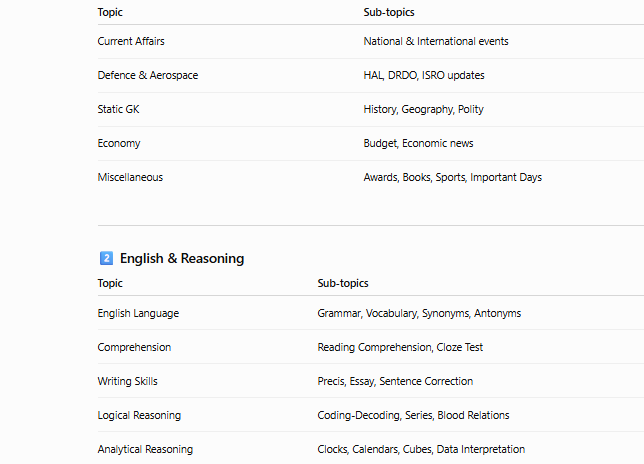
General Awareness
| Topic | Sub-topics |
|---|---|
| Current Affairs | National & International events |
| Defence & Aerospace | HAL, DRDO, ISRO updates |
| Static GK | History, Geography, Polity |
| Economy | Budget, Economic news |
| Miscellaneous | Awards, Books, Sports, Important Days |
English & Reasoning
| Topic | Sub-topics |
|---|---|
| English Language | Grammar, Vocabulary, Synonyms, Antonyms |
| Comprehension | Reading Comprehension, Cloze Test |
| Writing Skills | Precis, Essay, Sentence Correction |
| Logical Reasoning | Coding-Decoding, Series, Blood Relations |
| Analytical Reasoning | Clocks, Calendars, Cubes, Data Interpretation |
Technical / Engineering Discipline (Common Structure)
This section varies by branch (Mechanical, Electrical, Civil, CSE, etc.)
HAL Exam Syllabus for Mechanical Engineering Students
| Subject | Important Topics |
|---|---|
| Engineering Mathematics | Calculus, Differential Equations, Linear Algebra, Probability |
| Engineering Mechanics | Statics, Dynamics |
| Strength of Materials | Stress, Strain, Torsion, Bending |
| Thermodynamics | Laws, Cycles, Heat Transfer |
| Fluid Mechanics | Fluid Statics, Dynamics |
| Theory of Machines | Gears, Vibrations, Mechanisms |
| Manufacturing | Casting, Welding, Machining |
| Machine Design | Failure Theories, Fatigue |
| Industrial Engineering | Quality Control, PERT/CPM |
The technical syllabus is largely similar to GATE-level topics.
HAL DT Syllabus 2026 – General Awareness
The General Awareness section generally covers the following areas:
| Topic | Important Areas |
|---|---|
| Current Affairs | National & international events |
| Indian History | Ancient, Medieval and Modern History |
| Geography | Indian and World Geography |
| Indian Polity | Constitution, Parliament, Fundamental Rights |
| Economy | Indian economy, banking and basic economic terms |
| General Science | Physics, Chemistry and Biology basics |
| Defence Awareness | Indian defence forces, aircraft and defence organisations |
| Awards & Honours | National and international awards |
| Sports | Major tournaments, players and achievements |
| Important Days | National and international important days |
| Books & Authors | Important books and writers |
| Static GK | Countries, capitals, currencies, organisations |
English & Reasoning Syllabus
This section contains 40 questions combining English and Reasoning. Important topics include:
English
- Reading Comprehension
- Synonyms and Antonyms
- Vocabulary
- Fill in the Blanks
- Error Detection
- Sentence Improvement
- Sentence Rearrangement
- Idioms and Phrases
- Active and Passive Voice
- Direct and Indirect Speech
- Grammar
- One-word Substitution
Reasoning
- Analogy
- Coding-Decoding
- Number and Alphabet Series
- Blood Relations
- Direction Sense
- Syllogism
- Venn Diagrams
- Classification
- Statement and Conclusion
- Data Sufficiency
- Puzzles
- Seating Arrangement
- Logical Reasoning
HAL DT Technical Syllabus 2026
The Technical/Concerned Discipline section carries the highest weightage—100 questions and 100 marks. The syllabus depends on the engineering discipline selected by the candidate. HAL’s 2026 DT recruitment covers relevant engineering disciplines, with the technical section based on the concerned discipline.
Mechanical Engineering
Important areas to prepare include:
- Engineering Mechanics
- Strength of Materials
- Theory of Machines
- Machine Design
- Thermodynamics
- Fluid Mechanics
- Heat Transfer
- Manufacturing Processes
- Production Engineering
- Industrial Engineering
- Engineering Materials
- Metrology and Measurements
- CAD/CAM
- IC Engines
- Refrigeration and Air Conditioning
Electrical Engineering
- Electrical Circuits
- Electrical Machines
- Power Systems
- Power Electronics
- Control Systems
- Electrical Measurements
- Signals and Systems
- Network Theory
- Digital Electronics
- Analog Electronics
- Electrical Drives
- Transformers
- Generation, Transmission and Distribution
Electronics Engineering
- Electronic Devices
- Analog Circuits
- Digital Electronics
- Communication Systems
- Microprocessors and Microcontrollers
- Signals and Systems
- Network Theory
- Control Systems
- Electromagnetic Theory
- VLSI
- Computer Fundamentals
- Instrumentation
Aeronautical Engineering
For candidates appearing from the Aeronautical discipline, focus on:
- Aerodynamics
- Aircraft Structures
- Aircraft Propulsion
- Flight Mechanics
- Aircraft Materials
- Aircraft Design
- Aircraft Systems
- Avionics
- Aircraft Maintenance
- Fluid Mechanics
- Thermodynamics
- Engineering Mechanics
- Strength of Materials
HAL DT Selection Process 2026
The selection process consists primarily of:
- Online Computer-Based Test
- Personal Interview
- Document Verification
- Pre-Employment Medical Examination
The online test carries 85% weightage, while the interview carries 15% weightage in the final selection.
HAL Design Trainee Syllabus 2026 (Difference)
| Section | Details |
|---|---|
| Pattern | Same as MT (160 Questions, 160 Marks) |
| Focus | More design-oriented + core engineering concepts |
| Level | GATE-level difficulty (especially Mathematics & Core Subjects) |
| Core Topics | Mechanics, Thermodynamics, Fluid Mechanics, Design Concepts |
Design Trainee exam also follows the same CBT structure with discipline-specific focus.
Key Preparation Highlights
| Area | Strategy |
|---|---|
| Technical | Focus on core engineering subjects (70–80% time) |
| GK | Defence & PSU-based current affairs |
| English | Practice comprehension & grammar basics |
| Practice | Solve previous year & mock tests |
| Strategy | Attempt all questions (no negative marking) |
HAL Management & Design Trainee Syllabus 2026: Important Topics
Part I: General Awareness (20 Questions)
This section tests knowledge of current events and general knowledge:
- Current Affairs (National & International)
- Indian Constitution and Polity
- History, Culture, and Geography of India
- Indian National Movement
- Economic Science, Budget, and Five-Year Plans
- Science – Inventions & Discoveries
- Books and Authors
- Awards and Honors
- Sports and Games
- Important Days
- Important Financial & Economic News
- International and National Organizations
- Countries and Capitals
- Science and Technology
Part II: English & Reasoning (40 Questions)
English Language:
- Grammar and Vocabulary
- Synonyms and Antonyms
- Fill in the Blanks
- Idioms & Phrases
- Reading Comprehension
- Sentence Rearrangement / Error Correction
- Precise Writing / Drafting skills
- Essay Writing (as applicable in some references)
Reasoning:
- Arithmetical Reasoning
- Alphabet Series
- Coding-Decoding
- Blood Relations
- Clocks & Calendars
- Statements & Arguments
- Cubes and Dice
- Mirror Images / Embedded Figures
- Number Ranking
- Odd Man Out
- Computer Awareness (basic)
Part III: Concerned Discipline of Engineering (100 Questions)
This is the most important section and follows the undergraduate (B.E./B.Tech) curriculum of the respective discipline. Key topics for major streams (based on standard HAL and previous patterns) include:
Mechanical Engineering:
- Theory of Machines and Machine Design
- Engineering Mechanics
- Strength of Materials
- Thermodynamics and Statistical Mechanics
- Heat and Mass Transfer
- Fluid Mechanics and Turbomachinery
- Manufacturing Processes (Metal Casting, Forming, Joining)
- Industrial Engineering and Operations Research
- Refrigeration and Air-Conditioning
- Tool Engineering
- Engineering Materials
Electrical Engineering:
- Electric Circuits and Fields
- Electrical Machines
- Power Systems
- Control Systems
- Electrical and Electronic Measurements
- Analog and Digital Electronics
- Power Electronics and Drives
- Basic Electronics Engineering
- Electrical Materials
- Computer Fundamentals
Electronics / Electronics & Communication:
- Basics of Circuits and Measurement Systems
- Analog and Digital Electronics
- Signals, Systems, and Communications
- Control Systems and Process Control
- Electrical and Electronic Measurements
- Transducers, Mechanical Measurement & Industrial Instrumentation
- Analytical, Optical Instrumentation
Computer Science / IT:
- Digital Logic
- Computer Organization and Architecture
- Programming and Data Structures
- Algorithms
- Theory of Computation
- Operating Systems
- Databases
- Computer Networks
- Software Engineering
- Compiler Design (as per standard engineering syllabus)
Other Disciplines (Aeronautical, Metallurgy, Production, Civil, Instrumentation, etc.): Topics align with the core undergraduate curriculum of the respective branch. Candidates should refer to standard GATE/engineering textbooks for their discipline.
Key Highlights for Preparation
- Focus on Part III — It carries the highest weightage (100 marks).
- Strengthen General Awareness with daily current affairs (especially defence, aerospace, and national developments).
- Practice reasoning and English regularly for speed and accuracy.
- No negative marking allows attempting all questions, but accuracy still matters for ranking.
- Shortlisting is strictly merit-based on online test scores.
Important Dates (Tentative Schedule)
- Online Application: 29 July 2026 – 14 August 2026 (1400 hrs)
- Admit Card: 20 August 2026
- Online Test: 5 & 6 September 2026
- Online Test Result: 10 September 2026
- Interviews (Bengaluru): 21–25 September 2026
- Induction Training: From 29 October 2026 (Bengaluru)
Eligibility Snapshot
- Age: Upper limit 28 years (as on 14.08.2026); relaxations for OBC/SC/ST/PwBD as per rules.
- Qualification: Full-time B.E./B.Tech (or equivalent) in the prescribed discipline under 10+2+4 system with minimum 70% (UR/OBC-NCL/EWS) or 60% (SC/ST/PwBD). Final-year students may also apply.
- Application Fee: ₹500 (UR/OBC-NCL/EWS); Nil for SC/ST/PwBD/Internal candidates.
For the most accurate and updated details, including the detailed official notification PDF and discipline-wise vacancies, always refer to the official HAL website: www.hal-india.co.in (Careers section). Candidates should download the detailed advertisement for exact branch-wise eligibility and any specific notes on the technical syllabus.
This structured pattern and syllabus help aspirants plan focused preparation for the 2026 HAL MT & DT recruitment. Good luck!
About The Author
