
Union Bank of India SO Syllabus 2026: Union Bank of India (UBI) released the notification for Recruitment Project 2026-27 for 395 vacancies of Specialist Officers (SO), General Banking Officers (GBO), and Officers with Domain Expertise across scales MMGS-II to TEGS-VI (Manager to Deputy General Manager). Online applications ran from 21 July to 10 August 2026. The selection process and exam pattern differ by post code and scale.
Union Bank of India SO Selection Process 2026
- Posts up to Scale III (S01–S108 Specialist Officers and G01–G19 General Banking/Domain Officers): Online Examination → Group Discussion (if conducted) → Personal Interview → Document Verification → Medical Examination.
- Higher scales (SMGS-IV, SMGS-V, TEGS-VI – Chief Manager, AGM, DGM): Primarily Group Discussion (if required)/other assessment + Personal Interview (no online written exam in most cases).
Minimum qualifying marks in the online exam sections are generally 40% for General/EWS and 35% for SC/ST/OBC/PwBD (Bank’s discretion may apply). Interview is typically of 100 marks (qualifying thresholds apply by category). Final merit considers online exam (where applicable) + interview scores, with age as a tie-breaker in some cases.
Union Bank of India SO Exam Pattern 2026
The online exam is objective (MCQ), bilingual (Hindi & English except the English Language section), and includes negative marking of 1/4th (0.25) of the marks assigned to a question for every wrong answer. Unattempted questions carry no penalty.
Specialist Officers (Post Codes S01–S108, up to Scale III) Only Professional Knowledge is tested:
| Test | No. of Questions | Maximum Marks | Duration |
|---|---|---|---|
| Professional Knowledge relevant to the post | 50 | 100 | 60 minutes |
| Total | 50 | 100 | 60 minutes |
General Banking Officers / Domain Posts (Post Codes G01–G19, up to Scale III)
| Test | No. of Questions | Maximum Marks | Duration | Nature |
|---|---|---|---|---|
| Quantitative Aptitude | 25 | 25 | 60 minutes (composite for aptitude sections) | Qualifying only |
| Reasoning | 25 | 25 | Qualifying only | |
| English Language | 25 | 25 | Qualifying only | |
| Professional Knowledge relevant to the post/domain | 50 | 100 | 60 minutes | Counted for merit |
| Total | 125 | 175 | 120 minutes |
Aptitude sections (Quant, Reasoning, English) are qualifying; only Professional Knowledge marks contribute to the final merit list for these posts.
UBI Union Bank of India SO Syllabus 2026
1. Reasoning Ability
| Topic | Details |
|---|---|
| Puzzles & Seating Arrangement | Linear, Circular, Floor-based puzzles |
| Coding-Decoding | Letter/Number coding, new pattern |
| Syllogism | Venn diagram-based questions |
| Blood Relations | Family tree problems |
| Direction Sense | Distance & direction problems |
| Inequality | Direct & coded inequality |
| Data Sufficiency | Logical decision making |
| Input-Output | Machine-based questions |
| Order & Ranking | Position-based questions |
2. Quantitative Aptitude
| Topic | Details |
|---|---|
| Simplification/Approximation | BODMAS, quick calculations |
| Number Series | Missing & wrong series |
| Data Interpretation | Table, Pie Chart, Line Graph |
| Quadratic Equations | Roots comparison |
| Arithmetic | Profit & Loss, SI-CI, Time & Work, Speed-Distance |
| Ratio & Proportion | Partnership, mixture |
| Percentage | Basic to advanced |
| Data Sufficiency | Case-based questions |
3. English Language
| Topic | Details |
|---|---|
| Reading Comprehension | Passage-based questions |
| Cloze Test | Fill in the blanks |
| Error Detection | Grammar-based |
| Sentence Improvement | Correction of sentences |
| Para Jumbles | Sentence arrangement |
| Fill in the Blanks | Vocabulary & grammar |
| Vocabulary | Synonyms, antonyms |
| Phrase Replacement | Context-based |
4. Professional Knowledge (Most Important)
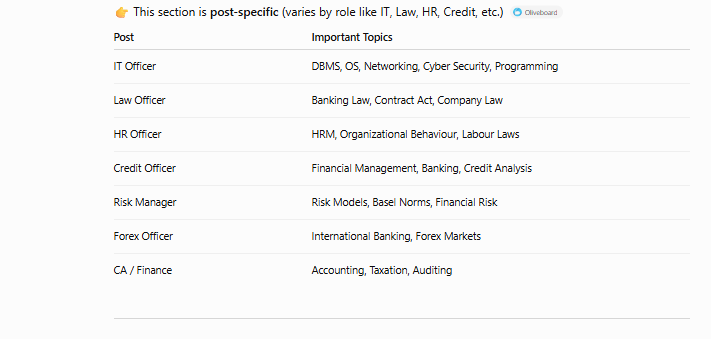
This section is post-specific (varies by role like IT, Law, HR, Credit, etc.)
| Post | Important Topics |
|---|---|
| IT Officer | DBMS, OS, Networking, Cyber Security, Programming |
| Law Officer | Banking Law, Contract Act, Company Law |
| HR Officer | HRM, Organizational Behaviour, Labour Laws |
| Credit Officer | Financial Management, Banking, Credit Analysis |
| Risk Manager | Risk Models, Basel Norms, Financial Risk |
| Forex Officer | International Banking, Forex Markets |
| CA / Finance | Accounting, Taxation, Auditing |
Union Bank of India SO Syllabus 2026 in Detail
The syllabus has two broad parts. Professional Knowledge carries the highest weightage and is post-specific. Aptitude syllabus applies mainly to G01–G19 posts.
1. Reasoning Ability
Direction Sense Test, Arithmetical Reasoning, Alpha-Numeric Sequence Puzzle, Logical Sequence of Words, Eligibility Test, Data Sufficiency, Logical Venn Diagrams, Inserting the Missing Character, Alphabet Test, Mathematical Operations, Series Completion, Theme Detection, Analogy, Clocks & Calendars, Deriving Conclusions from Passages, Statement–Conclusions, Coding-Decoding, Number Ranking & Time Sequence, Statement–Arguments, Situation Reaction Test, Seating Arrangements, Puzzles, Inequalities, Syllogism, Input-Output, Blood Relations, Order and Ranking, Coded Distance and Direction, Logical Reasoning.
2. Quantitative Aptitude
Simplification & Approximation, Number Series, Quadratic Equations, Percentage, Profit & Loss, Ratio & Proportion, Average, Partnership, Simple & Compound Interest, Time & Work, Time, Speed & Distance, Problems on Trains, Boats & Streams, Pipes & Cisterns, Mixtures & Allegations, Mensuration, Probability, Permutation & Combination, Indices and Surds, Data Interpretation, Data Sufficiency, LCM & HCF, Numbers and Ages, Volumes, Areas, Races and Games.
3. English Language
Reading Comprehension, Cloze Test, Error Detection/Correction, Sentence Improvement/Rearrangement, Para Jumbles, Fill in the Blanks, Vocabulary, Synonyms & Antonyms, Phrase Replacement, Word Usage, Grammar (Tenses, Subject-Verb Agreement, Articles, etc.), Idioms & Phrases, One-Word Substitutions, Unseen Passages.
4. Professional Knowledge (Post-Specific – Most Important)
This section tests domain expertise. Key areas by common specializations include:
- IT Officers / Related (API Management, Cyber Security, Cloud, Data, etc.): Computer Networks, Operating Systems, DBMS, Data Structures & Algorithms, Software Engineering, OOP Concepts, Programming (C/C++/Java/Python basics), Cyber Security, Cloud Computing, AI/ML basics, Blockchain, Network Security, Web Technologies, Linux/Windows Administration, Digital Banking/FinTech.
- Credit / Finance / Chartered Accountant posts: Accounting Concepts (Costing, Marginal Costing, etc.), Corporate Accounting, Financial Statements & Ratio Analysis, Credit Appraisal & Monitoring, Basel Norms, NPA Management, SARFAESI, IBC, Banking Regulation, RBI guidelines, Project Finance, Capital Markets, Taxation (including GST basics where relevant).
- Forex Officers: Foreign Exchange Management, FEMA, Trade Finance, Letter of Credit, UCP 600, SWIFT, International Banking, Treasury Operations, Exchange Rates, RBI guidelines.
- Risk Management: Credit/Market/Operational/Liquidity Risk, Basel Norms, Enterprise Risk Management, Stress Testing, Risk Analytics.
- Law Officers: Banking Laws, RBI Act, Banking Regulation Act, SARFAESI, Negotiable Instruments Act, Companies Act, Contract Act, IBC, Recovery Laws, Consumer Protection.
- Engineering / Fire / Architect posts: Core technical subjects of the respective branch (Building Materials, RCC/Steel Design, Surveying, Soil Mechanics, Fire Safety standards, National Building Code, Architecture Design, Project Management, Estimation & Costing, etc.).
- General Banking / Domain posts: Banking Awareness, RBI functions, Financial Markets, Credit Management, Retail & Priority Sector Lending, Digital Banking, NPA Management, Financial Inclusion, Current Banking Developments.
Candidates must prepare strictly according to the educational qualification, experience, and role described for their specific post code in the official notification, as Professional Knowledge is highly specialized.
Preparation Tips
- Prioritize Professional Knowledge heavily (it decides merit for most posts).
- For GBO posts, clear the qualifying aptitude sections comfortably while maximizing Professional Knowledge score.
- Practice previous-year style questions, take timed mocks matching the exact pattern, and revise core concepts + latest RBI/banking developments.
- Stay updated via the official website (unionbankofindia.co.in) for exam dates, admit cards, and any changes.
About The Author
