SSB TGT Syllabus 2026: The State Selection Board (SSB), Odisha, conducts recruitment for Trained Graduate Teacher (TGT) posts in Non-Government Fully Aided High Schools. Posts typically include TGT Arts, TGT Science (PCM), TGT Science (CBZ), Hindi Teacher, Classical Teacher (Sanskrit), Urdu Teacher, and Physical Education Teacher (PET). The official model syllabus is available on the SSB Odisha website (ssbodisha.ac.in). The pattern and syllabus structure remain consistent with recent cycles) and are expected to apply for 2026 unless revised in a new notification.
Candidates should always verify the latest official notification and model syllabus PDF on ssbodisha.ac.in, as minor updates or clarifications can occur.
SSB TGT Selection Process 2026
Selection is primarily based on a written examination. In some cycles, career marks (from HSC, +2, graduation, and B.Ed.) may also be considered, followed by document verification. The written test is the key screening stage that determines the merit list.
SSB Odisha TGT Exam Pattern 2026
The written exam is an objective-type test conducted offline (OMR-based).
| Particulars | Details |
|---|---|
| Mode | Offline (OMR) |
| Type of Questions | Multiple Choice Questions (MCQs) |
| Total Questions | 100 |
| Total Marks | 150 |
| Marks per Question | 1.5 |
| Negative Marking | 0.5 mark deducted for each wrong answer |
| Duration | 2 hours |
| Sections | Pedagogy & Evaluation + Subject Content |
Mark Distribution Overview
- Pedagogy and Evaluation: 24 marks (common for most TGT posts; slightly different for PET).
- Subject-specific content: 126 marks (distributed across the concerned subjects).
The paper tests graduation-level subject knowledge with a focus on school-level teaching relevance, along with pedagogical understanding.
SSB TGT Syllabus 2026
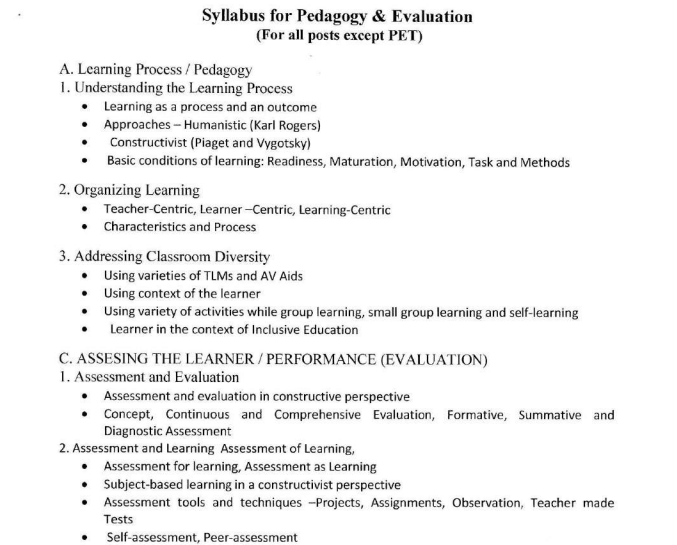
Pedagogy and Evaluation Syllabus (24 Marks)
This section is common for TGT Arts, Odia, Science (PCM/CBZ), Hindi, Sanskrit, and Urdu.
Understanding the Learning Process
- Learning as a process and outcome
- Approaches: Humanistic (Carl Rogers), Constructivist (Piaget and Vygotsky)
- Basic conditions of learning: Readiness, maturation, motivation, task, and methods
Organizing Learning
- Classroom management, lesson planning, and instructional strategies
- Addressing diversity in the classroom
Assessment and Evaluation
- Continuous and Comprehensive Evaluation (CCE)
- Assessment tools and techniques (projects, assignments, observation, teacher-made tests)
- Self-assessment and peer-assessment
- Test construction: Steps, principles, blueprint development, preparation of test items
- Standardized vs. teacher-made tests
For Physical Education Teacher (PET)
- Teaching techniques (lecture, demonstration, discussion, project methods)
- Teaching procedures (whole method, part method, whole-and-part method)
- Programme planning and evaluation in Physical Education and school health education
SSB TGT Syllabus 2026 Highlights
TGT Arts
- History (approx. 13 marks): Ancient Indian rulers, art/architecture/literature/science (Maurya, Gupta, Kushana periods), Delhi Sultanate administration, Mughal architecture and painting, rise of British power (1757–1856), Indian nationalism (1857–1905), national movement (1905–1947), World Wars.
- Political Science (approx. 12 marks): Indian Constitution (features, Preamble, Fundamental Rights, DPSP, Fundamental Duties), Union and State governments, local governance, electoral process, India’s foreign policy, UN, political thinkers (Kautilya, Gandhi, Ambedkar, etc.), ideologies.
- Geography (approx. 13 marks): Physical geography of India, resources, physical geography concepts, globe and maps.
- Economics (approx. 12 marks): Indian economy, current challenges, economic development, money and banking.
- English (approx. 13 marks): Comprehension, grammar and usage, speaking (common errors/mispronounced words), teaching of English.
- Odia (approx. 13 marks): Comprehension, grammar and usage, writers and books, sentence types, Sandhi, Samasa, Bibhakti, idioms, ornaments, prose/poetry passages.
TGT Science (PCM)
- Physics (approx. 25–40 marks range in distribution): Motion, gravitation, properties of matter, sound, optics, electrostatics, current electricity, electromagnetic induction.
- Chemistry (approx. 25 marks): Basic concepts, states of matter, structure of atom, classification of elements and periodicity, chemical bonding, reactions, hydrocarbons, general principles of extraction of metals.
- Mathematics (higher weightage): Set theory, relations and functions, number system, algebra, trigonometry, coordinate geometry, calculus, probability, statistics, mensuration, sequences and series.
TGT Science (CBZ)
- Chemistry (similar topics as PCM)
- Botany and Zoology (graduation-level topics covering plant and animal biology, physiology, ecology, genetics, etc., with school curriculum relevance).
Hindi Teacher
- Hindi literature (prose, poetry, drama), grammar, comprehension, pedagogy of language teaching, and contribution of major writers.
Classical Teacher (Sanskrit)
- Elements of Sanskrit language, unseen passages (prose/verse from sources like Panchatantra, Hitopadesha, Kalidasa, etc.), grammar (Sandhi, Karaka, Vibhakti, Samasa, Prakriti-Pratyaya), parts of speech, literature (major authors and works).
Urdu Teacher
- Prose, poetry, drama/novel/short stories, grammar, comprehension, and contribution of famous Urdu writers, plus pedagogy.
Physical Education Teacher (PET)
- Principles and history of Physical Education
- Sports psychology
- Organization, administration, and recreation
- Anatomy, physiology, and health education
- Methods of physical education
- Officiating and coaching
Section-wise Syllabus: Important Topic
1. Pedagogy & Teaching Aptitude
| Topic | Subtopics |
|---|---|
| Teaching Methodology | Methods of teaching, classroom techniques |
| Lesson Planning | Objectives, structure, teaching aids |
| Learning Process | Child psychology, learning theories |
| Classroom Management | Handling diversity, inclusive education |
| Evaluation Techniques | Assessment methods, performance evaluation |
| Teaching Aids | Use of ICT, smart learning tools |
Pedagogy carries significant weight (~24 marks).
2. Subject-wise Syllabus
TGT Arts / Social Science
| Subject | Important Topics |
|---|---|
| History | Ancient India, Freedom movement, reformers (Gandhi, Nehru, Ambedkar), cultural development |
| Geography | Physical geography, resources, maps, Indian geography |
| Economics | Indian economy, banking, development, current challenges |
| English | Grammar, comprehension, vocabulary, teaching methods |
| Odia | Grammar, prose, poetry, idioms, writers & literature |
TGT Science (PCM)
| Subject | Important Topics |
|---|---|
| Physics | Motion, gravitation, electricity, optics |
| Chemistry | Chemical reactions, acids-bases, periodic table |
| Mathematics | Algebra, geometry, trigonometry, statistics |
TGT Science (CBZ)
| Subject | Important Topics |
|---|---|
| Chemistry | Organic & inorganic basics, reactions |
| Botany | Plant physiology, cell biology |
| Zoology | Human physiology, genetics |
TGT Languages (Odia / Hindi / Sanskrit / Urdu)
| Subject | Important Topics |
|---|---|
| Grammar | Sentence structure, vocabulary |
| Literature | Prose, poetry, authors |
| Language Skills | Comprehension, writing skills |
| Teaching Methods | Language pedagogy |
TGT Physical Education (PET)
| Topic | Subtopics |
|---|---|
| Sports Science | Anatomy, physiology |
| Physical Fitness | Training methods |
| Coaching | Techniques, planning |
| Evaluation | Performance measurement |
Key Highlights
- Syllabus is graduation-level + teaching-oriented
- Focus is on concept clarity and classroom application
- Subject section carries maximum weightage
- Pedagogy ensures testing of teaching skills and educational understanding
SSB TGT Syllabus 2026 PDF Download
SSB TGT -Syllabus PDF Download Link: Click on this link.
Preparation Tips
- Download the official model syllabus PDF from ssbodisha.ac.in for exact topic lists and any updates.
- Focus on conceptual clarity at the graduation level with emphasis on school teaching applications.
- Practice previous years’ questions (especially 2024 papers) for pattern familiarity.
- Allocate time proportionally: strong weightage on subject content (126 marks) while securing the pedagogy section.
- Revise pedagogy thoroughly, as it is common and scoring.
- Stay updated via the official SSB Odisha website for notifications, admit cards, and any syllabus clarifications.
The SSB Odisha TGT exam tests both subject expertise and teaching aptitude. Thorough coverage of the model syllabus, combined with regular mock tests under timed conditions, will help candidates perform well. Always cross-check the latest advertisement on the official website for any changes specific to the 2026 cycle.
About The Author
