
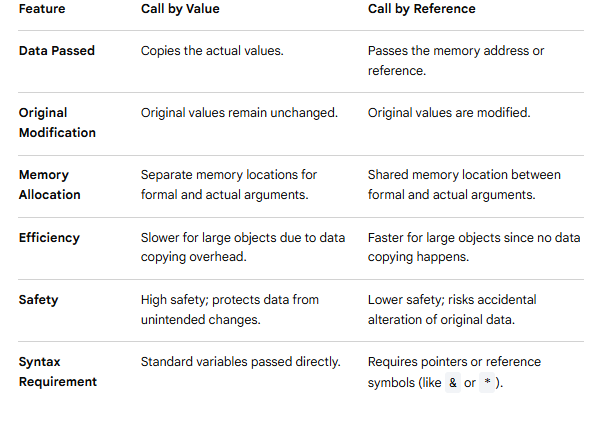
In programming, the way arguments are passed to functions or methods plays a fundamental role in how data is handled, modified, and returned. Two of the most important parameter-passing mechanisms are call by value and call by reference. Understanding the distinction between them is essential for writing correct, efficient, and predictable code, especially when dealing with mutable data, large objects, or performance-critical applications.
This article provides a detailed explanation of both mechanisms, their internal working, practical differences, advantages, disadvantages, language-specific behaviors, and guidelines on when to use each approach.
What is Call by Value?
Call by value (also known as pass by value) is a parameter-passing technique in which a copy of the actual argument’s value is created and passed to the function’s formal parameter. The function works exclusively on this local copy. Any modifications made to the parameter inside the function body affect only the copy and leave the original variable in the calling scope completely unchanged.
When a function is invoked using call by value, the following sequence typically occurs:
- The expression or variable supplied as an argument is evaluated.
- A temporary copy of that value is allocated (usually on the stack).
- The formal parameter is initialized with this copy.
- The function executes using its own independent copy.
- When the function returns, the local copy is destroyed, and the original data remains intact.
This mechanism guarantees that the caller’s data cannot be accidentally or intentionally modified by the callee. It provides strong encapsulation and predictability. Most modern programming languages use call by value as the default for primitive types (integers, floating-point numbers, characters, booleans, etc.).
Because a full copy is made, call by value can become expensive when the argument is a large structure or object. In such cases, the cost of copying may outweigh the safety benefits, which is one reason languages also provide reference or pointer mechanisms.
What is Call by Reference?
Call by reference (also known as pass by reference) is a parameter-passing technique in which the function receives a reference (or alias) to the original argument rather than a copy of its value. The formal parameter becomes another name for the same memory location that holds the actual argument. Consequently, any read or write operation performed on the parameter inside the function directly affects the original variable in the caller’s scope.
In a call-by-reference scenario:
- The address (or a reference to the location) of the actual argument is passed.
- The formal parameter is bound to that same memory location.
- Operations inside the function read from or write to the original data.
- Changes persist after the function returns because the original storage has been modified.
This approach is particularly useful when a function needs to modify one or more of its arguments, return multiple values, or avoid the overhead of copying large data structures. Languages such as C++ support explicit call by reference using the reference declarator (&). Other languages achieve similar effects through pointers (C), or by passing object references (Java, C#, Python — though these are more accurately described as “call by object reference” or “call by sharing”).
Key Differences Between Call by Value and Call by Reference
The following points highlight the most important distinctions:
Nature of what is passed
- Call by value passes a copy of the data.
- Call by reference passes a reference (or address) to the original data.
Effect on the original variable
- In call by value, the original variable remains unchanged regardless of what the function does.
- In call by reference, modifications made inside the function permanently alter the original variable.
Memory and performance characteristics
- Call by value incurs the cost of copying the argument. For large objects this can be significant in both time and space.
- Call by reference is generally more efficient for large data because only a reference (usually the size of a pointer) is passed.
Safety and side effects
- Call by value is safer; the function cannot produce unintended side effects on the caller’s data.
- Call by reference can introduce side effects. The caller must be aware that the arguments may change.
Syntax and language support
- Most languages implement call by value by default for primitive types.
- Call by reference usually requires explicit syntax (references in C++, ref/out in C#, pointers in C, etc.).
Use cases
- Call by value is preferred when the function should not alter the caller’s data or when the data is small.
- Call by reference is preferred when the function needs to modify the argument, return multiple results, or avoid expensive copies.
Return of multiple values
- With pure call by value it is difficult to return more than one value without using a structure or class.
- Call by reference naturally supports modifying several arguments, effectively allowing multiple “return” values.
Detailed Comparison Table
| Aspect | Call by Value | Call by Reference |
|---|---|---|
| What is passed | Copy of the value | Reference / address of the original |
| Original data modified? | No | Yes |
| Memory overhead | Higher (full copy) | Lower (only reference) |
| Performance for large data | Slower | Faster |
| Safety | High (no side effects) | Lower (possible side effects) |
| Typical syntax | Default in most languages | Requires special syntax or pointers |
| Ability to return multiple values | Limited | Natural |
| Common languages | C (primitives), Java (primitives), Python (immutable objects) | C++, C# (ref), Pascal, Fortran |
Practical Code Illustrations
Example in C++ – Call by Value
#include <iostream>
using namespace std;

void incrementByValue(int x) {
    x = x + 1;          // only the local copy is changed
    cout << "Inside function: " << x << endl;
}

int main() {
    int num = 10;
    incrementByValue(num);
    cout << "Outside function: " << num << endl;  // still 10
    return 0;
}
Example in C++ – Call by Reference
#include <iostream>
using namespace std;

void incrementByReference(int& x) {
    x = x + 1;          // original variable is modified
    cout << "Inside function: " << x << endl;
}

int main() {
    int num = 10;
    incrementByReference(num);
    cout << "Outside function: " << num << endl;  // now 11
    return 0;
}
In the first case the value of num remains 10 after the call. In the second case it becomes 11 because the function received a reference to the original variable.
Advantages and Disadvantages
Call by Value – Advantages
- Protects the caller’s data from accidental modification.
- Makes functions pure and easier to reason about.
- Ideal for concurrent programming because shared mutable state is avoided.
- Simple mental model for beginners.
Call by Value – Disadvantages
- Copying large objects or arrays can be costly.
- Cannot directly modify the caller’s variables.
- Returning multiple results requires additional constructs (structures, tuples, or classes).
Call by Reference – Advantages
- Efficient for large data structures.
- Allows a function to modify its arguments and effectively return multiple values.
- Useful for implementing algorithms that need to update several variables (e.g., swapping two values, updating counters, filling output parameters).
Call by Reference – Disadvantages
- Introduces side effects that can make code harder to understand and debug.
- The caller must carefully document and remember which parameters may be modified.
- Can lead to aliasing problems and unexpected interactions between different parts of a program.
- In some languages, careless use of references can create dangling references or lifetime issues.
Language-Specific Notes
- C: Supports only call by value. Call by reference is simulated by passing pointers.
- C++: Supports both; references (&) provide true call by reference, while pointers offer a similar but more explicit mechanism.
- Java: Everything is passed by value. Object variables hold references, so the reference itself is copied (call by value of the reference). The object can still be mutated through that reference.
- C#: Default is call by value. The keywords ref and out enable call by reference.
- Python: Uses “call by object reference” (or call by sharing). Immutable objects behave like call by value; mutable objects behave more like call by reference with respect to their contents.
- JavaScript: Similar to Java — primitives are passed by value, objects by reference (the reference is copied).
When to Prefer Each Approach
Use call by value when:
- The function should not alter the original data.
- The data size is small (primitives or small structures).
- You want maximum safety and predictability.
- The function is intended to be pure (no side effects).
Use call by reference when:
- The function needs to modify one or more of its arguments.
- You are dealing with large objects or arrays and want to avoid expensive copies.
- You need to return multiple values without creating additional container types.
- Performance is critical and the safety trade-off is acceptable (with proper documentation).
In modern software engineering, many style guides recommend preferring immutable data and pure functions (favoring call-by-value semantics) unless there is a clear performance or design reason to use references.
Conclusion
Call by value and call by reference represent two fundamental strategies for passing information into functions. Call by value emphasizes safety and isolation by working on copies, while call by reference emphasizes efficiency and the ability to modify original data by sharing memory locations. Neither approach is universally superior; the correct choice depends on the size of the data, the need for mutation, performance requirements, and the desired level of safety.
A solid understanding of both mechanisms, together with awareness of how a particular language implements them, enables developers to write clearer, more efficient, and more maintainable code. When in doubt, start with call by value for its simplicity and safety, and introduce call by reference only when the benefits clearly outweigh the additional complexity and potential for side effects.
About The Author
