
Fastest Trains in India: India’s railway network continues to modernize rapidly in 2026. Semi-high-speed services, indigenous trainsets, and dedicated regional corridors have raised maximum permissible speeds on select sections. While the Mumbai-Ahmedabad Bullet Train (designed for 320 km/h) remains under construction and is targeted for phased operations around August 2027, current commercial services top out at 160 km/h on upgraded stretches such as Tughlakabad–Agra. Below is a detailed look at the top 10 fastest trains operating or newly introduced in India in 2026, ranked primarily by maximum operational or design speed, with supporting details on routes, features, and performance.
Top 10 Fastest Trains in India 2026 – List With Speeds
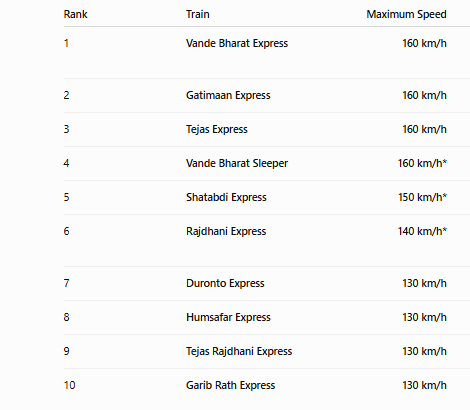
India’s railway network has several high-speed and semi-high-speed services. Based on their maximum permitted/operational speeds, the following are among the fastest passenger trains currently operating in India. Note that a train’s maximum speed is different from its average journey speed.
| Rank | Train | Maximum Speed | Major Route/Example |
|---|---|---|---|
| 1 | Vande Bharat Express | 160 km/h | New Delhi–Varanasi and selected routes |
| 2 | Gatimaan Express | 160 km/h | Hazrat Nizamuddin–Jhansi |
| 3 | Tejas Express | 160 km/h | Mumbai–Karmali and other routes |
| 4 | Vande Bharat Sleeper | 160 km/h* | Selected sleeper services |
| 5 | Shatabdi Express | 150 km/h* | Selected routes |
| 6 | Rajdhani Express | 140 km/h* | Delhi–Mumbai/Howrah and other routes |
| 7 | Duronto Express | 130 km/h | Multiple intercity routes |
| 8 | Humsafar Express | 130 km/h | Multiple long-distance routes |
| 9 | Tejas Rajdhani Express | 130 km/h | Selected Rajdhani routes |
| 10 | Garib Rath Express | 130 km/h | Multiple routes |
*Maximum speed can vary by route, section, timetable and current railway restrictions. Indian Railways documents confirm 160 km/h as the maximum speed capability of Vande Bharat, while Gatimaan is also designed for operation at up to 160 km/h on suitable sections.
Key Facts
- Vande Bharat Express is India’s best-known semi-high-speed train and has a maximum operating capability of 160 km/h on suitable routes.
- Gatimaan Express is capable of 160 km/h on the Delhi–Agra section and is among India’s fastest conventional passenger services.
- Tejas Express services can reach high speeds on upgraded railway sections, although the actual speed depends on the particular route.
- The 180 km/h figure often associated with Vande Bharat refers to its test speed, not its normal maximum commercial operating speed. Indian Railways has stated that the train was tested at 180 km/h and designed for a maximum service speed of 160 km/h.
Top 10 Fastest Trains in India 2026
Indian Railways has shifted focus from pure volume to speed, comfort, and reliability. Track upgrades, continuous welded rails, Kavach automatic train protection, and indigenous manufacturing at Integral Coach Factory and BEML have enabled higher speeds. Vande Bharat and related services now dominate the fastest category. Average speeds remain lower than peak figures because of stops, shared tracks, and congestion, yet travel times on key corridors have improved noticeably. Passengers increasingly prefer these modern trains for daytime intercity and emerging overnight routes. The list below reflects the situation in mid-2026 based on operational maximums and widely reported capabilities.
1. Vande Bharat Express (Chair Car / Daytime Services)
Vande Bharat Express stands as India’s flagship semi-high-speed train. Designed and built in India, it is a self-propelled electric multiple unit capable of reaching design speeds around 180–183 km/h in trials. In regular service it operates at a maximum of 160 km/h on approved sections such as Tughlakabad–Agra. Rapid acceleration (0–100 km/h in about 52 seconds on later generations) allows it to maintain competitive average speeds despite stops. Modern amenities include automatic doors, rotating seats in executive class, onboard Wi-Fi, infotainment, and improved air quality systems. Multiple routes now connect major cities, making it the most visible symbol of India’s rail modernization.
2. Namo Bharat (RRTS / RapidX)
Namo Bharat trains on the Delhi–Meerut Regional Rapid Transit System match the 160 km/h maximum of the fastest conventional services. These purpose-built regional trains run on largely dedicated tracks with platform screen doors and high-frequency operations. The corridor has cut journey times dramatically compared with road travel; Delhi to Meerut can now take around 55 minutes on the rail link. Design speed is reported near 180 km/h, with commercial operations currently capped at 160 km/h. As an urban-regional system rather than a long-distance express, it offers a different travel experience focused on punctuality and capacity. Expansion of the RRTS network continues to strengthen its position among India’s quickest services.
3. Gatimaan Express
Gatimaan Express was India’s first commercially operated semi-high-speed train and still holds a 160 km/h maximum on the Delhi–Agra/Jhansi corridor. Launched in 2016, it pioneered higher-speed running on the Tughlakabad–Agra section that later hosts Vande Bharat services as well. The train features premium catering, hostesses on some services, and a focus on tourist-friendly timings for Agra. Although newer trainsets have matched or exceeded its capabilities in other respects, Gatimaan remains a reliable benchmark for 160 km/h operations. Its average speeds stay competitive on the relatively short, high-quality stretch it serves.
4. Vande Bharat Sleeper Express
The sleeper version of Vande Bharat entered commercial service in early 2026, beginning with routes such as Howrah–Kamakhya/Guwahati. It retains the self-propelled design and high acceleration of the daytime version while offering AC First, 2-Tier, and 3-Tier sleeping berths. Design speed is listed at 180 km/h (with potential for higher), though operational speeds follow the same track-limited ceilings as other premium services. These trains aim to modernize overnight long-distance travel previously dominated by Rajdhani services. Features include automatic doors, bio-vacuum toilets, infotainment, and improved ride quality. More sleeper trainsets are planned for progressive rollout through 2027.
5. New Delhi–Bhopal Shatabdi Express (and select Shatabdis)
The Bhopal Shatabdi has long been one of India’s highest-performing daytime trains, with a maximum permissible speed of 150 km/h on key sections. It maintains strong average speeds and a reputation for punctuality on the Delhi–Bhopal corridor. Other Shatabdi services on upgraded routes also approach similar peaks. These locomotive-hauled trains predate Vande Bharat but continue to offer reliable, meal-inclusive daytime travel. Track and signalling improvements have allowed sustained higher speeds on portions of their routes. They remain popular for business and leisure travellers who prefer established schedules and onboard catering.
6. Tejas Express
Tejas Express operates as a premium service with modern interiors, automatic doors, and enhanced passenger amenities. Design capability reaches up to 160 km/h on suitable sections, though many routes see operational speeds closer to 130–150 km/h depending on track conditions. Routes such as Mumbai–Ahmedabad and Delhi–Lucknow highlight its role in intercity travel. The train emphasizes comfort and aesthetics, positioning it between traditional expresses and the newer Vande Bharat fleet. Passengers appreciate the airline-style service elements and cleaner, quieter coaches. Expansion of Tejas services continues alongside the broader modernization drive.
7. Rajdhani Express (select services)
Rajdhani trains connect New Delhi with state capitals and major cities, carrying priority status on the network. Maximum speeds typically range from 130–140 km/h, with some services cleared for 160 km/h on limited upgraded stretches. They offer fully air-conditioned accommodation, onboard meals, and relatively high average speeds for long-distance overnight journeys. The Mumbai–New Delhi and Howrah–New Delhi Rajdhanis are among the better-performing examples. While newer trainsets are gradually challenging their dominance, Rajdhanis still provide reliable high-priority long-haul options. Continuous track upgrades help maintain competitive timings.
8. Duronto Express
Duronto services were introduced as non-stop or limited-stop long-distance trains designed for higher average speeds. Operational maxima generally sit around 130–135 km/h. Fewer intermediate halts allow them to post solid end-to-end timings on many corridors. They serve as an intermediate option between fully premium Rajdhani/Vande Bharat services and ordinary expresses. Onboard facilities vary by rake but usually include air-conditioned coaches and catering. As track capacity improves, some Duronto routes benefit from modest speed enhancements. They remain relevant for travellers seeking fewer stops on longer journeys.
9. Humsafar Express
Humsafar Express trains are fully air-conditioned, relatively modern services aimed at mid-to-long distance travel. Maximum speeds are typically capped at 130 km/h. They feature improved interiors, CCTV, and better passenger amenities compared with older stock. These trains expanded the availability of comfortable AC travel on routes that previously had limited premium options. While not matching the peak speeds of Vande Bharat or Gatimaan, they contribute to overall network modernization. Demand remains steady on corridors where they operate. Further upgrades to rakes and tracks could raise their performance over time.
10. Other Premium Services (Garib Rath, Double Decker, Jan Shatabdi, and similar)
Several other named services—Garib Rath, Double Decker Express, Jan Shatabdi, and select Superfast expresses—operate at maximum speeds around 130 km/h. Double Decker trains increase capacity on busy daytime routes while maintaining competitive timings. Jan Shatabdi services offer a balance of speed and affordability for intercity travel. These trains fill important niches in the network and benefit from the same gradual infrastructure improvements that support higher-speed services. Although they rank lower on pure maximum speed, their role in everyday mobility remains significant. Continued investment in tracks and signalling is expected to lift overall network speeds further.
Looking Ahead: Bullet Train and Future Speeds
The Mumbai–Ahmedabad High-Speed Rail corridor is designed for 320 km/h operations using Shinkansen-derived technology. Passenger services are targeted to begin in phases from around August 2027. Additional high-speed corridors have been announced or are under study, including Delhi–Varanasi and others. Indigenous efforts at higher speeds (around 250 km/h prototypes) are also progressing. Until dedicated high-speed lines open, 160 km/h remains the practical commercial ceiling on the conventional broad-gauge network. Mission Raftaar and related programmes continue to expand the length of higher-speed track.
Conclusion
In 2026 the fastest trains in India are led by Vande Bharat variants, Namo Bharat RRTS, and Gatimaan Express, all capable of 160 km/h on suitable sections, with design capabilities reaching 180 km/h or more. Shatabdi, Tejas, Rajdhani, and other premium services follow closely. Passengers benefit from shorter journey times, better comfort, and improved reliability on key corridors. As track upgrades, signalling, and new trainsets roll out, and as the first true high-speed line approaches completion, India’s railway speeds are set to rise further in the coming years. Always check the latest Indian Railways or IRCTC information for current timings, speeds, and availability, as operational limits can vary by route and section.
About The Author
