
Highest Peak of Eastern Ghats 2026
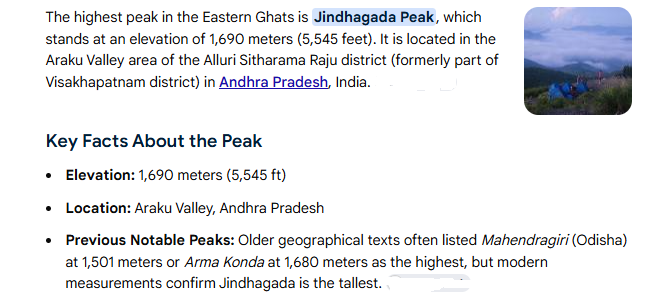
Jindhagada Peak (also known as Arma Konda or Sitamma Konda), located in the Araku Valley region of Andhra Pradesh, is widely recognized as the highest peak of the Eastern Ghats, with an elevation of approximately 1,680–1,690 meters (about 5,510–5,545 feet).
Overview of the Eastern Ghats
The Eastern Ghats form a discontinuous mountain range running roughly parallel to India’s eastern coast along the Bay of Bengal. The range stretches about 1,750 km from northern Odisha (near the Mahanadi River) southward through Andhra Pradesh, Telangana, Karnataka, and Tamil Nadu, covering an area of roughly 75,000 km². Unlike the more continuous and higher Western Ghats, the Eastern Ghats are older, more eroded, and broken by major east-flowing rivers such as the Godavari, Krishna, Mahanadi, and others. Average elevations are around 600 m, with higher sections in the north.
Geologically ancient (formed through processes dating back to the Archean and Proterozoic eras), the range consists mainly of rocks such as charnockite, granite, khondalite, and quartzite. It acts as an important watershed and influences local climate and rainfall patterns along the east coast, though less dramatically than the Western Ghats.
Highest Peak of Eastern Ghats 2026: Height, Location, and Naming
Jindhagada Peak / Arma Konda (Sitamma Konda) stands as the highest point. Reliable geographic references, including Wikipedia and peak databases, list Arma Konda at 1,680 m (5,510 ft). Many educational, exam, and travel sources cite Jindhagada Peak at about 1,690 m and treat the names as interchangeable or as referring to closely related/twin summits in the same massif (with a reported difference of around 20 m in some accounts). It is situated in the Madugula Konda sub-range, north of Paderu, in Alluri Sitharama Raju district (Andhra Pradesh), within the broader Araku Valley area and the Godavari basin. Coordinates are approximately 18°13′41″N 82°43′23″E.
It is also the highest peak in Andhra Pradesh and notable for its topographic isolation (second only to Anamudi among Indian peaks in some measures).
Historical note: Older textbooks and sources often listed Mahendragiri (in Gajapati district, Odisha) at about 1,501 m as the highest. Surveys and measurements (notably around 2011) established that peaks in the Andhra Pradesh section, including Jindhagada/Arma Konda, are taller. Deomali in Odisha (around 1,672 m) is another high point but lower than the Andhra summit. Some commercial peak databases occasionally list other candidates, but Arma Konda/Jindhagada remains the consensus highest in standard geographic and educational references.
No significant revision to the height ranking has emerged as of 2026; elevations of established peaks are stable.
Importance of the Peak and the Eastern Ghats
Ecological and biodiversity value: The Eastern Ghats support diverse forest types (evergreen, semi-evergreen, moist and dry deciduous, scrub, and others) and harbor thousands of plant species (estimates often exceed 3,000–4,500 flowering plants, representing a significant share of India’s total, with numerous endemics). Fauna includes mammals such as tigers, leopards, elephants, deer, wild dogs, and primates; hundreds of bird species; reptiles; amphibians; and insects. The higher elevations and varied habitats around peaks like Jindhagada contribute to this richness and serve as refugia. The range is recognized for its role as a biodiversity repository, though it has historically received less conservation attention than the Western Ghats or Himalayas.
Hydrological importance: The Ghats form part of a major watershed. Rivers and streams originating in or cutting through the range support irrigation, drinking water, and agriculture in the eastern coastal plains. Forests help regulate water flow, reduce erosion, and maintain downstream ecosystems, including wetlands and lagoons.
Economic and resource significance: The region holds mineral resources (including bauxite, iron ore, and others), timber and non-timber forest products, and supports traditional livelihoods of tribal communities (such as those in the Araku and surrounding areas). Coffee plantations are prominent in the Araku Valley near the peak.
Cultural and historical aspects: Parts of the Eastern Ghats, including nearby peaks like Mahendragiri, hold mythological associations (linked to the Ramayana and other traditions). Tribal communities maintain traditional knowledge of medicinal plants and sustainable resource use. The landscapes contribute to regional identity and heritage.
Tourism, recreation, and climate services: Jindhagada/Arma Konda is an emerging trekking destination offering moderate-to-challenging trails (often starting from villages such as Olubidda in Hukumpeta mandal), panoramic views of valleys, cloudscapes, coffee estates, and forests. Best seasons are typically post-monsoon through winter (around September–February). The peak and surrounding hills support eco-tourism potential while providing cooler microclimates. Broader Eastern Ghats tourism includes hill stations, waterfalls, wildlife viewing, and cultural experiences. Forests also act as carbon sinks and help buffer against climate extremes.
Conservation challenges: Deforestation, mining, agricultural expansion, fragmentation, fires, and climate pressures threaten habitats and endemic species. Protected areas (national parks, wildlife sanctuaries, tiger/elephant reserves) exist across the range, and community-based approaches are increasingly emphasized for sustainable management.
Visiting and Practical Notes
Access is typically via Visakhapatnam (road or train to Araku/Paderu areas, then local transport to trailheads). Guided treks are recommended due to remote terrain, tribal areas, and variable conditions. Respect local communities, follow Leave No Trace principles, and check current regulations, weather, and permissions.
In summary, Jindhagada Peak (Arma Konda/Sitamma Konda) at roughly 1,680–1,690 m is the highest summit of the Eastern Ghats. Beyond its elevation, it and the wider range hold lasting importance for India’s biodiversity, water security, tribal livelihoods, mineral resources, and growing nature-based tourism—underscoring the need for continued conservation alongside sustainable development.
FAQs based on The Highest Peak of Eastern Ghats 2026
Q1. What is the highest peak of the Eastern Ghats in 2026?
The highest peak of the Eastern Ghats is Jindhagada Peak, with an elevation of approximately 1,690 metres (5,545 feet). It is located in Andhra Pradesh.
Q2. Is Jindhagada Peak also known as Arma Konda?
Yes. Jindhagada Peak is commonly associated with Arma Konda, also known as Sitamma Konda/Seethamma Konda in different sources and maps. Some sources give the elevation as 1,680 metres for Arma Konda, while Jindhagada is listed at 1,690 metres.
Q3. In which state is the highest peak of the Eastern Ghats located?
The peak is located in Andhra Pradesh, in the northern Eastern Ghats around the Araku–Paderu region.
Q4. What is the height of Jindhagada Peak?
Jindhagada Peak is generally listed at around 1,690 metres above sea level. This makes it the highest identified summit of the Eastern Ghats.
Q5. Which is the second-highest peak of the Eastern Ghats?
Arma Konda, at about 1,680 metres, is generally listed immediately below Jindhagada Peak.
Q6. Is Mahendragiri the highest peak of the Eastern Ghats?
No. Mahendragiri is 1,501 metres high and was traditionally listed as the highest peak in some older references. Current geographical references identify Jindhagada Peak as the highest.
Q7. What is the highest peak of the Eastern Ghats in Odisha?
Deomali (Devamali), at approximately 1,672 metres, is the highest peak in Odisha and is situated in the Koraput district.
Q8. Why is Jindhagada Peak important for competitive exams?
Questions about the highest peak of the Eastern Ghats frequently appear in SSC, state PSC, police, teaching and other government examinations. The expected answer in current exam-oriented sources is Jindhagada Peak.
Q9. Which mountain range does Jindhagada Peak belong to?
Jindhagada Peak belongs to the Eastern Ghats, a discontinuous mountain system running broadly parallel to India’s eastern coast.
Q10. What are some other important peaks of the Eastern Ghats?
Important summits include Jindhagada Peak (1,690 m), Arma Konda (1,680 m), Gali Konda (1,643 m), Sunkrametta (1,620 m), and Mahendragiri (1,501 m).
Exam One-Liner: Jindhagada Peak (about 1,690 m) is the highest peak of the Eastern Ghats.
About The Author
