Online education is a flexible mode of learning in which students receive instructional content, lectures, assignments, and assessments through the internet. It has become one of the most significant shifts in the education sector, especially after the COVID-19 pandemic. With improved digital tools and platforms, online learning is now widely used by schools, colleges, and universities across the world.
Online Education Essay
Education is no longer limited to physical classrooms and printed textbooks. In the digital age, learning can happen anytime and anywhere with an internet connection. Online education has opened doors for students who live in remote areas, working professionals, and those who cannot attend traditional institutions due to health, financial, or personal reasons. It allows learners to access quality courses, recorded lectures, interactive quizzes, and global expertise while staying at home. This modern approach has made education more inclusive and adaptable to individual needs.
Online Education Essay PDF
(You may download or save this article as a PDF for study purposes.)
Online Education Essay in English (150-250) words
Here are 10 lines on Online Education for students:
- Online education means acquiring knowledge and skills through the internet.
- It relies on digital devices such as smartphones, laptops, and tablets.
- Students can learn at their own pace and according to their own schedule.
- It saves time and money spent on travelling and accommodation.
- A wide variety of courses and degree programmes are available online.
- During the pandemic, online learning helped maintain continuity in education.
- It requires self-discipline and good time-management skills.
- Poor internet connectivity can create difficulties for many learners.
- Platforms like Coursera, Udemy, Khan Academy, and others offer quality resources.
- Videos, animations, and interactive tools make online lessons easier to understand.
Online Education Essay in Paragraph 150-250 Words
Technology has transformed almost every field, and education is no exception. Online education has emerged as a convenient and effective way of learning. Students can attend virtual classes, watch recorded lectures, submit assignments, and take tests from the comfort of their homes using a laptop or smartphone. One of the biggest advantages is flexibility—there is no fixed timetable, and learners can study early in the morning or late at night according to their convenience. Online platforms also offer a huge range of subjects, skill-based courses, and even full degree programmes from reputed institutions.
This mode of learning is especially helpful for working people, homemakers, and students living in remote areas. It reduces expenses related to travel, uniform, and hostel facilities. However, online education also has certain limitations. Continuous screen time can affect eyesight and physical health. Students need strong self-motivation because there is less direct supervision. In places with weak internet connections, attending live classes becomes difficult. Despite these challenges, online education continues to grow and offers valuable opportunities for lifelong learning when used wisely.
Online Education Essay in 500-1000 words for UPSC
Introduction: Online education refers to the delivery of educational content and instruction through digital platforms over the internet. It enables students to study at their own pace and location while giving teachers the ability to reach learners who may not be able to join a conventional classroom. After the COVID-19 pandemic, online learning moved from being an alternative option to a mainstream method of education worldwide.
The modern online education system is very different from traditional classroom teaching. Teachers use a combination of live video sessions, pre-recorded lectures, digital notes, animations, discussion forums, and online assessments to make learning engaging. Many universities and colleges now offer complete degree programmes, diplomas, and certificate courses in online mode. Students must carefully choose recognised and accredited institutions to ensure the value of their qualifications.
One major benefit of online learning is synchronised interaction. Live classes and discussion boards allow students and teachers to exchange ideas, ask questions, and share resources in real time. This creates a collaborative virtual environment that encourages critical thinking. Another important advantage is that learners do not need to travel long distances. Working professionals can continue their jobs while upgrading their skills, and digital nomads can study from any location with internet access.
Online education is generally more affordable than traditional campus-based programmes because it eliminates costs related to commuting, accommodation, and physical infrastructure. The flexible schedule is another key strength—students can balance studies with family responsibilities or employment. However, success in online learning depends heavily on self-motivation and time management. Effective learners usually set a fixed study routine, create a quiet workspace, and avoid distractions.
Conclusion: Online education has expanded access to quality learning, improved skill development, and removed barriers of distance and time. When supported by reliable technology and self-discipline, it offers a powerful pathway for personal and professional growth in the 21st century.
Online Education
Online education is the process of delivering teaching and learning materials through the internet. It ranges from short skill-based courses to full university degree programmes. Students can access content anytime as long as they have a stable internet connection.
Key Features of Online Education:
- Accessibility – Learning materials are available 24/7.
- Flexibility – Students decide when and where to study.
- Variety of Courses – Academic subjects, professional skills, and hobby courses are all available.
- Interactive Tools – Video lectures, quizzes, discussion forums, and virtual whiteboards enhance engagement.
- Cost-Effective – Lower expenses compared to traditional education.
Benefits:
- Students can learn at their own speed and revise difficult topics multiple times.
- Access to teachers and institutions from different countries.
- Practical skill development that can be applied directly in jobs.
Challenges:
- Requires strong self-discipline and time management.
- Limited face-to-face interaction with teachers and classmates.
- Depends on good internet connectivity and basic technical knowledge.
Advantages and Disadvantages of Online Education
Advantages of Online Education
Saves time and money: No daily commuting reduces both time and travel costs. Accessible to All: Students of any age, background, or physical ability can learn from home. No Fixed Timetable: Learners can study according to their personal schedule. Wide Choice: A large number of courses and skills can be explored online.
Disadvantages of Online Education
Need for Self-Discipline: Young children and less motivated students may struggle without supervision. Technical Requirements: Reliable devices and internet are essential; many rural areas still face connectivity issues. Health and Social Concerns: Long screen hours can affect eyesight and posture, and students may feel isolated from peers.
Online vs Offline Education Comparison
- Time Management: Offline education follows a fixed timetable, while online learning allows students to choose their own study hours.
- Cost-Effectiveness: Online education is usually cheaper because it avoids transport, uniform, and hostel expenses.
- Social Development: Offline schooling helps children develop social skills, teamwork, and discipline through daily interaction. Online learning offers fewer such opportunities.
- Choice and Revision: Online platforms let students select subjects and re-watch lectures as many times as needed. Traditional classrooms offer limited flexibility.
- Practical Life Skills: Offline education teaches manners, punctuality, and behaviour through real-life interaction—skills that online modes develop less effectively.
Online Education Essay in English
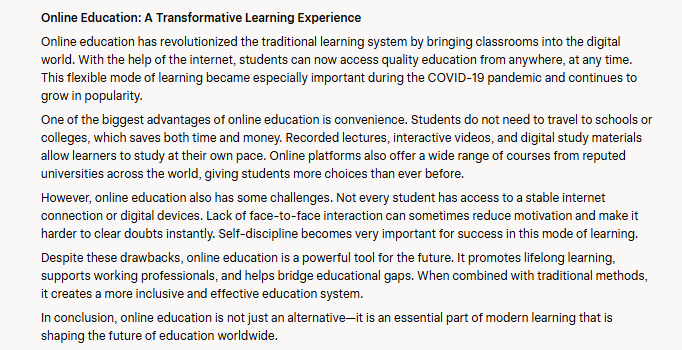
Online Education: A Transformative Learning Experience
Online education has revolutionized the traditional learning system by bringing classrooms into the digital world. With the help of the internet, students can now access quality education from anywhere, at any time. This flexible mode of learning became especially important during the COVID-19 pandemic and continues to grow in popularity.
One of the biggest advantages of online education is convenience. Students do not need to travel to schools or colleges, which saves both time and money. Recorded lectures, interactive videos, and digital study materials allow learners to study at their own pace. Online platforms also offer a wide range of courses from reputed universities across the world, giving students more choices than ever before.
However, online education also has some challenges. Not every student has access to a stable internet connection or digital devices. Lack of face-to-face interaction can sometimes reduce motivation and make it harder to clear doubts instantly. Self-discipline becomes very important for success in this mode of learning.
Despite these drawbacks, online education is a powerful tool for the future. It promotes lifelong learning, supports working professionals, and helps bridge educational gaps. When combined with traditional methods, it creates a more inclusive and effective education system.
In conclusion, online education is not just an alternative—it is an essential part of modern learning that is shaping the future of education worldwide.
Online Education Essay in Hindi (250 Words)
ऑनलाइन शिक्षा: एक परिवर्तनकारी अनुभव
ऑनलाइन शिक्षा ने पारंपरिक शिक्षा प्रणाली को डिजिटल दुनिया में लाकर क्रांति ला दी है। इंटरनेट की मदद से छात्र अब कहीं से भी, कभी भी गुणवत्तापूर्ण शिक्षा प्राप्त कर सकते हैं। यह लचीला तरीका विशेष रूप से कोविड-19 महामारी के दौरान महत्वपूर्ण बना और आज भी लोकप्रिय हो रहा है।
ऑनलाइन शिक्षा का सबसे बड़ा फायदा सुविधा है। छात्रों को स्कूल या कॉलेज जाने की जरूरत नहीं पड़ती, जिससे समय और पैसा दोनों बचते हैं। रिकॉर्डेड लेक्चर, इंटरैक्टिव वीडियो और डिजिटल अध्ययन सामग्री से छात्र अपनी गति से पढ़ सकते हैं। विश्व भर के प्रतिष्ठित विश्वविद्यालयों के कोर्स उपलब्ध होने से विकल्प भी बढ़ गए हैं।
हालांकि कुछ चुनौतियाँ भी हैं। हर छात्र के पास स्थिर इंटरनेट या डिजिटल उपकरण नहीं होते। आमने-सामने बातचीत की कमी से कभी-कभी प्रेरणा कम हो सकती है। सफलता के लिए आत्म-अनुशासन बहुत जरूरी है।
इन कमियों के बावजूद ऑनलाइन शिक्षा भविष्य का शक्तिशाली माध्यम है। यह आजीवन सीखने को बढ़ावा देती है और शिक्षा की खाई को पाटने में मदद करती है। पारंपरिक तरीकों के साथ मिलकर यह अधिक प्रभावी प्रणाली बनाती है।
निष्कर्षतः, ऑनलाइन शिक्षा आधुनिक शिक्षा का अनिवार्य अंग है जो शिक्षा के भविष्य को आकार दे रही है।
Online Education Essay in Hindi
आज के समय में प्रौद्योगिकी ने शिक्षा क्षेत्र को भी बदल दिया है। इंटरनेट के माध्यम से शिक्षा प्राप्त करने का तरीका ऑनलाइन शिक्षा कहलाता है। छात्र स्मार्टफोन, लैपटॉप या टैबलेट की मदद से घर बैठे पढ़ाई कर सकते हैं। यह तरीका समय और स्थान की दृष्टि से बहुत लचीला है।
ऑनलाइन शिक्षा के कई फायदे हैं। इसमें यात्रा का खर्च नहीं लगता, छात्र अपनी सुविधा के अनुसार पढ़ सकते हैं और दुनिया भर के अच्छे कोर्स आसानी से उपलब्ध हो जाते हैं। महामारी के दौरान यह शिक्षा जारी रखने का सबसे अच्छा माध्यम साबित हुआ।
हालाँकि कुछ कमियाँ भी हैं। लंबे समय तक स्क्रीन देखने से आँखों और स्वास्थ्य पर असर पड़ सकता है। अच्छी इंटरनेट कनेक्टिविटी की जरूरत होती है और छात्रों में स्वयं अनुशासन होना आवश्यक है। फिर भी, अगर सही तरीके से उपयोग किया जाए तो ऑनलाइन शिक्षा आज के युग में बहुत उपयोगी और प्रभावी माध्यम है।
About The Author
