
The Punjab Subordinate Services Selection Board (PSSSB) Clerk examination is an important opportunity for candidates looking for a Group-C clerical post in Punjab. For the 2026 recruitment, the written examination has been divided into Part A and Part B. The first part is qualifying, while the marks obtained in Part B are considered for preparing the merit list. The written test is objective in nature and is conducted through MCQs. As per the 2026 examination plan, the total duration is 2 hours 30 minutes.
Candidates should not treat Part A casually simply because it is qualifying. A minimum of 50% marks in Part A, that is, 25 out of 50 marks, is required for Part B to be evaluated. Part B carries 100 marks and includes General Knowledge and Current Affairs, Punjab History and Culture, Logical Reasoning and Mental Ability, Punjabi, English and ICT.
PSSSB Clerk Exam Pattern 2026
The exam pattern is fairly straightforward, but there is one important difference between the two parts: Part A has no negative marking, whereas Part B has negative marking. Candidates should therefore attempt Part B questions carefully.
| Part | Subject | Questions | Marks | Nature |
|---|---|---|---|---|
| Part A | Punjabi Language | 50 | 50 | Qualifying |
| Part B | GK & Current Affairs, Punjab History & Culture, Reasoning & Mental Ability, Punjabi, English and ICT | 100 | 100 | Merit-based |
| Total | — | 150 | 150 | — |
The examination contains 150 MCQs in total and is scheduled for 2 hours 30 minutes. Each question carries one mark. There is no negative marking in Part A. In Part B, one-fourth mark (0.25) is deducted for every incorrect answer.
Part A: Punjabi Language
Part A tests Punjabi language knowledge at approximately the Matriculation level. It is qualifying in nature and candidates need to secure at least 25 marks out of 50 to move ahead for evaluation of Part B. Since these marks do not determine the merit ranking, the main objective here should be to clear the qualifying threshold comfortably.
The Punjabi preparation should cover grammar, vocabulary, sentence formation, comprehension, synonyms and antonyms, idioms and phrases, correct and incorrect words, and other language fundamentals.
Part B: Merit-Based Examination
Part B is the section that deserves the maximum attention because the merit list is prepared on the basis of marks secured in this part after qualifying Part A. It contains 100 questions for 100 marks.
The broad subject-wise distribution is:
| Subject | Marks |
| General Knowledge & Current Affairs | 25 |
| Logical Reasoning, Mental Ability & Quantitative Aptitude | 25 |
| Punjab History & Culture | 17 |
| Punjabi | 13 |
| English | 12 |
| ICT | 8 |
| Total | 100 |
This distribution shows that GK/Current Affairs and Reasoning/Mental Ability together account for half of Part B, so these areas can make a noticeable difference to the final score.
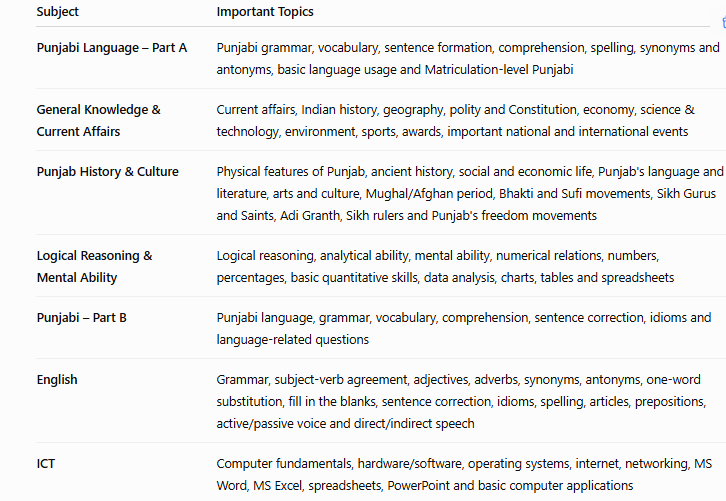
PSSSB Clerk Syllabus 2026: Subject-Wise Details
| Subject | Important Topics |
|---|---|
| Punjabi Language – Part A | Punjabi grammar, vocabulary, sentence formation, comprehension, spelling, synonyms and antonyms, basic language usage and Matriculation-level Punjabi |
| General Knowledge & Current Affairs | Current affairs, Indian history, geography, polity and Constitution, economy, science & technology, environment, sports, awards, important national and international events |
| Punjab History & Culture | Physical features of Punjab, ancient history, social and economic life, Punjab’s language and literature, arts and culture, Mughal/Afghan period, Bhakti and Sufi movements, Sikh Gurus and Saints, Adi Granth, Sikh rulers and Punjab’s freedom movements |
| Logical Reasoning & Mental Ability | Logical reasoning, analytical ability, mental ability, numerical relations, numbers, percentages, basic quantitative skills, data analysis, charts, tables and spreadsheets |
| Punjabi – Part B | Punjabi language, grammar, vocabulary, comprehension, sentence correction, idioms and language-related questions |
| English | Grammar, subject-verb agreement, adjectives, adverbs, synonyms, antonyms, one-word substitution, fill in the blanks, sentence correction, idioms, spelling, articles, prepositions, active/passive voice and direct/indirect speech |
| ICT | Computer fundamentals, hardware/software, operating systems, internet, networking, MS Word, MS Excel, spreadsheets, PowerPoint and basic computer applications |
The detailed Part B topics include national and international current affairs, Indian freedom movement, Punjab’s history and culture, reasoning/numerical skills, English grammar and ICT/computer applications.
Knowing only the names of the subjects is not enough. A candidate preparing seriously should break each section into smaller topics and study them systematically.
1. General Knowledge and Current Affairs
The General Knowledge section covers a mixture of static GK and current events. Questions may require knowledge of India as well as Punjab, so preparation should not be limited to national current affairs.
Important areas include:
- Indian Constitution and polity
- Political and economic developments
- History and geography
- Science and technology
- Environment
- Sports
- Important national and international events
- Awards and honours
- Important personalities
- Punjab-related general knowledge
- Recent government schemes and developments
- Current affairs of national and international importance
Current affairs should be studied regularly rather than left for the last few days. A monthly revision approach is much more manageable for this section.
2. Punjab History and Culture
Punjab-specific questions are an important part of the examination. Candidates should give this section dedicated preparation because general Indian history alone will not be enough.
The syllabus broadly covers:
- Physical features of Punjab
- Ancient history of Punjab
- Social, religious and economic life
- Punjab’s language and literature
- Art and cultural development
- Punjab under Afghan and Mughal rule
- Bhakti Movement
- Sufism
- Sikh Gurus and their teachings
- Saints associated with Punjab
- Adi Granth
- Sikh rulers
- Freedom movements in Punjab
A good way to prepare this section is to make short chronological notes. Important personalities, events, movements and places can then be revised quickly before the examination.
3. Logical Reasoning, Mental Ability and Quantitative Aptitude
This is one of the larger sections of Part B, carrying 25 marks. It combines reasoning, mental ability and basic numerical skills.
Important topics include:
- Coding-decoding
- Analogy
- Classification
- Number and alphabet series
- Direction sense
- Blood relations
- Ranking and ordering
- Mathematical operations
- Odd one out
- Verbal reasoning
- Non-verbal reasoning
- Number system
- LCM and HCF
- Percentage
- Ratio and proportion
- Average
- Problems on ages
- Profit and loss
- Partnership and mixture
- Simple and compound interest
- Time and work
- Time, speed and distance
- Mensuration
- Data interpretation
- Charts and tables
The trick with this section is not to spend too much time reading theory. Learn the basic methods and then solve questions repeatedly. Speed improves naturally when the same question types are practised several times.
4. Punjabi Language
Apart from the qualifying Punjabi paper, Part B also contains Punjabi questions carrying 13 marks. The focus is on language skills rather than simply memorising facts.
Candidates should prepare:
- Grammar
- Vocabulary
- Synonyms
- Antonyms
- Idioms and phrases
- Fill in the blanks
- Sentence structure
- Usage of words
- Unseen passages
- Reading comprehension
Regular reading of Punjabi newspapers, books or other standard material can help improve vocabulary and comprehension.
5. English Language
The English section carries 12 marks. It is not extremely large, but these marks can be valuable when the competition is close.
The major areas include:
- Basic grammar
- Subject-verb agreement
- Adjectives and adverbs
- Synonyms
- Antonyms
- One-word substitution
- Fill in the blanks
- Sentence correction
- Idioms and meanings
- Spellings
- Articles
- Prepositions
- Direct and indirect speech
- Active and passive voice
Candidates should focus on accuracy first. Grammar rules that repeatedly appear in objective questions should be revised through practice sets.
6. ICT and Computer Knowledge
ICT carries 8 marks, making it the smallest individual component of Part B. However, it can be one of the easier sections to score in if the basics are clear.
The syllabus includes:
- Fundamentals of computers
- Computer hardware
- Basic software concepts
- Operating systems
- Internet and networking basics
- MS Word
- MS Excel
- MS PowerPoint
- Spreadsheets
- Basic web concepts
Instead of going into advanced computer science concepts, candidates should concentrate on the practical and fundamental concepts generally used in office work.
PSSSB Clerk Marking Scheme 2026
The marking scheme needs special attention because the two parts follow different rules.
| Particular | Part A | Part B |
| Correct answer | +1 | +1 |
| Wrong answer | No deduction | -0.25 |
| Unattempted question | No marks | No marks |
| Total marks | 50 | 100 |
| Qualifying requirement | 25 marks | — |
| Merit consideration | No | Yes |
Part A is evaluated first. If a candidate does not achieve the required 50% marks, Part B is not evaluated. In Part B, negative marking makes random guessing risky.
How to Prepare for PSSSB Clerk Syllabus 2026
The syllabus becomes much easier to manage if preparation is divided into three stages.
First, complete the basic concepts of every subject. Do not spend the entire preparation period on GK while leaving English, Punjabi or ICT untouched.
Second, start solving topic-wise questions. This is particularly important for reasoning and quantitative aptitude because knowing a formula is different from being able to apply it quickly.
Finally, move towards full-length mock tests. The 150-question paper has to be completed within 150 minutes, so candidates should develop a habit of maintaining speed without sacrificing accuracy.
One practical strategy is to keep a separate notebook for mistakes. Whenever a mock test contains an unfamiliar fact, grammar rule, reasoning shortcut or calculation error, record it. Revising this notebook during the final weeks can be more useful than repeatedly reading the entire syllabus.
Which Subjects Should Be Given More Attention?
Based on the prescribed distribution, GK & Current Affairs and Logical Reasoning/Mental Ability/Quantitative Aptitude deserve considerable preparation time because each carries 25 marks.
Punjab History & Culture comes next with 17 marks, followed by Punjabi with 13 marks and English with 12 marks. ICT has 8 marks but should not be ignored because it can provide relatively direct questions.
At the same time, Part A should be treated as a qualifying checkpoint. Scoring 25 marks is the minimum requirement, but aiming for a comfortable score is safer than preparing only to cross the cutoff.
PSSSB Clerk Typing Test
The written examination is not necessarily the final stage of the recruitment process. Candidates who qualify the applicable written examination requirements may also have to clear the prescribed typing/skill test before appointment. Recent 2026 recruitment information indicates a typing test as part of the Clerk selection process.
Therefore, candidates should not wait until after the written examination to begin typing practice. Regular practice in both English and Punjabi can help candidates become comfortable with the required keyboard layout and typing environment.
PSSSB Clerk Syllabus 2026: Preparation Tips
A few simple habits can make preparation more effective:
Start with the official syllabus: Avoid studying every topic available in coaching material. Use the prescribed syllabus as your boundary.
Give Punjab GK special importance: Punjab History & Culture is a dedicated component, so it should receive regular revision.
Practise reasoning every day: Even 30–45 minutes of daily practice can improve calculation speed and familiarity with question patterns.
Revise current affairs weekly: Waiting until the end creates a huge revision burden.
Do not ignore languages: English and Punjabi together account for a meaningful number of Part B marks.
Use mock tests strategically: After completing the basics, attempt full papers under the actual time limit.
Be careful with guessing: The 0.25-mark penalty in Part B can reduce the benefit of uncertain attempts.
PSSSB Clerk Syllabus 2026 PDF
Candidates should always prefer the latest syllabus and examination plan issued by the Punjab Subordinate Services Selection Board. The 2026 examination plan for Advertisement No. 02 of 2026 specifies the two-part structure, duration, question format, qualifying requirement and negative-marking rules.
Click here to download syllabus: Punjab Clerk Syllabus PDF
About The Author
