
Data Analytics has emerged as one of the most promising career options in India for graduates, working professionals and career switchers. With businesses increasingly relying on data for decision-making, the demand for professionals who can collect, clean, analyse and interpret data continues to grow.
In 2026, the Data Analyst salary in India generally ranges from around ₹3.5 LPA for freshers to ₹25–35 LPA or more for senior and lead-level professionals. However, salary varies significantly according to experience, technical skills, city, industry, company type and job responsibilities. Recent 2026 salary guides place the broad national average around ₹6.5–₹7 LPA, although this should be treated as an indicative market benchmark rather than a guaranteed salary.
This article explains the Data Analyst salary in India 2026, including fresher CTC, experienced salary, monthly in-hand salary, city-wise pay, salary according to skills and career growth.
Data Analyst Salary in India 2026: Highlights
A Data Analyst’s salary can differ considerably even when two professionals have the same job title. Freshers with only basic Excel knowledge may start at a lower package, while candidates with SQL, Python, Power BI/Tableau and a strong project portfolio can target considerably better offers.
| Particular | Expected Salary in 2026 |
|---|---|
| Fresher Data Analyst | ₹3.5–6 LPA |
| Skilled Fresher | ₹5–8 LPA |
| 1–3 Years Experience | ₹5–10 LPA |
| 3–5 Years Experience | ₹8–16 LPA |
| 5–8 Years Experience | ₹14–25 LPA |
| 8+ Years / Lead | ₹22–35 LPA+ |
| Overall market benchmark | Around ₹6.5–₹7 LPA |
These are indicative ranges compiled from current 2026 salary-market reports and career guides; actual CTC can be lower or higher depending on the employer and candidate profile.
Data Analyst Salary in India Based on Experience
Experience is one of the most important factors determining compensation. As analysts gain experience, they generally take on larger datasets, more complex analytical problems, stakeholder management and business decision-making responsibilities.
| Experience | Expected Annual CTC | Approx. Monthly CTC |
| 0–1 Year | ₹3.5–6 LPA | ₹29,000–₹50,000 |
| 1–3 Years | ₹5–10 LPA | ₹42,000–₹83,000 |
| 3–5 Years | ₹8–16 LPA | ₹67,000–₹1.33 lakh |
| 5–8 Years | ₹14–25 LPA | ₹1.17–₹2.08 lakh |
| 8+ Years | ₹22–35 LPA+ | ₹1.83–₹2.92 lakh+ |
The ranges represent CTC rather than guaranteed monthly take-home pay. CTC can include employer PF contributions, gratuity, insurance, bonuses and variable compensation, so the amount credited to a bank account is normally lower.
Data Analyst Salary for Freshers in India 2026
A fresher entering the Data Analytics field can generally expect ₹3.5–6 LPA. Candidates with strong technical skills, internships and practical projects may receive offers in the ₹5–8 LPA range, while some product companies and highly competitive roles can offer even more.
Fresher Salary According to Skill Level
| Fresher Profile | Expected CTC |
| Basic Excel + Reporting | ₹3–4 LPA |
| Excel + SQL | ₹3.5–5 LPA |
| SQL + Power BI/Tableau | ₹4–6 LPA |
| SQL + Python + Power BI | ₹4.5–7 LPA |
| Strong Portfolio + Internship + SQL/Python/BI | ₹5.5–8 LPA |
| Top Product/Tech Company | ₹6–10 LPA in some cases |
These figures are indicative rather than fixed salary slabs. A candidate’s interview performance, location, degree, internship experience and the company’s hiring budget can substantially change the offer.
Data Analyst Salary After 1 to 3 Years
After gaining one to three years of experience, analysts generally move beyond basic reporting and begin working independently on SQL queries, dashboards, business analysis and stakeholder requirements.
The expected CTC at this stage is approximately ₹5–10 LPA, with stronger professionals and candidates working at better-paying employers potentially earning above this range.
Professionals who can independently build dashboards, optimise SQL queries, automate recurring reports and explain business insights usually have better opportunities for salary growth.
Data Analyst Salary After 3 to 5 Years
With three to five years of experience, professionals can target approximately ₹8–16 LPA depending on their skills and employer. Some 2026 market guides put the mid-level range around ₹8–15 LPA, while specialised professionals can move higher.
At this stage, employers increasingly look for:
- Advanced SQL
- Python for data analysis
- Power BI or Tableau
- Statistical analysis
- Data modelling
- Business understanding
- Dashboard ownership
- Stakeholder communication
- Automation
- Ability to convert business questions into analytical solutions
Data Analyst Salary After 5 to 8 Years
Professionals with five to eight years of experience can earn approximately ₹14–25 LPA, particularly when they move into senior analyst, analytics consultant, BI or specialist positions.
Senior professionals are expected to do more than prepare reports. They may be responsible for defining KPIs, designing analytical frameworks, mentoring junior analysts and presenting insights to senior management.
Some 2026 salary sources place senior analyst compensation around ₹14–22 LPA, while specialised or product-company roles can extend beyond ₹25 LPA.
Data Analyst Salary for Lead and Manager-Level Professionals
At eight or more years of experience, experienced professionals may move into roles such as:
- Lead Data Analyst
- Analytics Lead
- BI Lead
- Analytics Manager
- Business Intelligence Manager
- Senior Analytics Consultant
Indicative compensation can reach ₹22–35 LPA or more, particularly in product companies, GCCs, financial services, consulting and technology firms.
At this level, leadership, business strategy and stakeholder management become as important as technical skills.
Data Analyst Salary in India: City-Wise
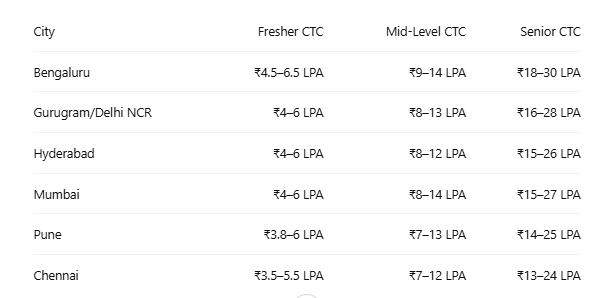
Location continues to influence Data Analyst compensation. Bengaluru, Gurugram/Delhi NCR and Hyderabad are among the major analytics employment markets, although opportunities also exist in Mumbai, Pune, Chennai, Noida and other cities.
| City | Fresher CTC | Mid-Level CTC | Senior CTC |
| Bengaluru | ₹4.5–6.5 LPA | ₹9–14 LPA | ₹18–30 LPA |
| Gurugram/Delhi NCR | ₹4–6 LPA | ₹8–13 LPA | ₹16–28 LPA |
| Hyderabad | ₹4–6 LPA | ₹8–12 LPA | ₹15–26 LPA |
| Mumbai | ₹4–6 LPA | ₹8–14 LPA | ₹15–27 LPA |
| Pune | ₹3.8–6 LPA | ₹7–13 LPA | ₹14–25 LPA |
| Chennai | ₹3.5–5.5 LPA | ₹7–12 LPA | ₹13–24 LPA |
City-wise figures should be considered broad market estimates. The company, role and skill set can have a greater effect on compensation than location alone.
Data Analyst Salary According to Skills
Technical skills are one of the strongest factors affecting an analyst’s career progression. Basic reporting skills can help candidates enter the industry, but advanced analytical and technical capabilities can open higher-paying roles.
| Skill | Salary Impact |
| MS Excel | Essential entry-level skill |
| SQL | Highly important for analyst roles |
| Power BI | Strong demand in BI/reporting roles |
| Tableau | Useful for dashboard and visualisation roles |
| Python | Helps with automation and advanced analysis |
| Statistics | Important for analytical decision-making |
| Advanced SQL | Valuable for mid/senior positions |
| Data Modelling | Useful for BI and analytics roles |
| Cloud/Data Platforms | Helpful for advanced analytics careers |
| AI-assisted Analytics | Increasingly useful in modern workflows |
Current 2026 salary guides consistently identify SQL, Python and BI tools such as Power BI/Tableau among the skills associated with stronger Data Analyst opportunities.
Data Analyst Salary by Company Type
The employer can make a substantial difference to CTC. Service companies, startups, product companies, consulting firms and GCCs may offer different compensation for similar job titles.
| Employer Type | Typical Fresher CTC |
| IT Services | ₹3.5–5.5 LPA |
| Startups | ₹3.5–7 LPA |
| BFSI/Insurance | ₹4–7 LPA |
| E-commerce/Retail | ₹4.5–7.5 LPA |
| Consulting | ₹5–8.5 LPA |
| GCC/Global Analytics Teams | ₹5–8 LPA |
| Product/Technology Companies | ₹5–10 LPA+ |
Actual offers vary widely by company and role. For example, a fresher with strong SQL, Python and Power BI skills may command a substantially better package than someone applying for a basic MIS/reporting position.
Data Analyst Salary: CTC vs In-Hand Salary
One of the most common mistakes candidates make is treating CTC as their monthly bank credit. CTC and in-hand salary are not the same.
CTC can include:
- Basic salary
- House Rent Allowance
- Employer PF contribution
- Gratuity
- Insurance benefits
- Performance bonus
- Variable pay
- Other company benefits
Therefore, a ₹6 LPA CTC does not necessarily mean ₹50,000 will be credited every month.
Approximate Monthly In-Hand Salary
| Annual CTC | Approx. Monthly In-Hand* |
| ₹3.5 LPA | ₹24,000–28,000 |
| ₹4.5 LPA | ₹28,000–34,000 |
| ₹6 LPA | ₹36,000–44,000 |
| ₹8 LPA | ₹48,000–58,000 |
| ₹10 LPA | ₹60,000–72,000 |
| ₹14 LPA | ₹80,000–95,000 |
| ₹20 LPA | ₹1.10–1.35 lakh |
| ₹25 LPA | ₹1.35–1.65 lakh |
*These are rough estimates. Actual in-hand salary depends on the salary structure, PF, income-tax regime, variable pay, professional tax and other deductions. Current 2026 salary guides similarly caution that CTC should not be equated with take-home pay.
Which Skills Can Help Increase Data Analyst Salary?
Candidates who want to increase their salary should focus on skills that solve real business problems rather than collecting certificates.
1. SQL
SQL is arguably one of the most important technical skills for a Data Analyst. Analysts use it to retrieve, filter, aggregate and join information from databases.
Advanced SQL knowledge, including CTEs, window functions, subqueries and query optimisation, becomes particularly valuable as professionals gain experience.
2. Python
Python is useful for data cleaning, automation, exploratory analysis and handling larger datasets. Libraries such as Pandas, NumPy and Matplotlib are commonly used in analytics workflows.
3. Power BI and Tableau
Business Intelligence tools help analysts convert raw information into interactive dashboards and reports. Power BI and Tableau skills can be particularly useful for professionals working with business stakeholders.
4. Statistics
Understanding averages, distributions, correlation, hypothesis testing and regression helps analysts interpret data correctly rather than simply producing charts.
5. Business Communication
A good analyst should be able to explain what the data means and what the business should do next. Strong communication and stakeholder-management skills can become increasingly important at senior levels.
Data Analyst Career Growth in India
A typical career progression can look like this:
Data Analyst → Senior Data Analyst → Lead Data Analyst → Analytics Manager → Head of Analytics
Some professionals also move into adjacent career paths such as:
Data Analyst → Data Scientist
or
Data Analyst → Data Engineer
or
Data Analyst → Business Intelligence Specialist
The exact career path depends on technical interests, business knowledge and leadership ambitions.
How to Get a Data Analyst Job as a Fresher in 2026?
Candidates without professional experience can improve their chances by building demonstrable skills.
Step 1: Learn Excel
Start with formulas, PivotTables, lookup functions, conditional logic and data cleaning.
Step 2: Learn SQL
Practise real-world queries involving joins, aggregation, subqueries, CTEs and window functions.
Step 3: Learn Power BI or Tableau
Create dashboards using publicly available datasets.
Step 4: Learn Python
Focus on Pandas, NumPy, data cleaning and exploratory data analysis before moving into advanced programming.
Step 5: Build a Portfolio
Create two to four practical projects covering areas such as sales, finance, e-commerce, customer behaviour or HR analytics.
Step 6: Prepare for Interviews
Practise SQL problems, Excel exercises, data interpretation, statistics and business-case questions.
Step 7: Apply Strategically
Do not restrict applications to the exact title “Data Analyst”. Relevant entry-level titles can include Junior Data Analyst, Business Analyst, BI Analyst, Reporting Analyst and MIS Analyst.
Is Data Analyst a Good Career in India in 2026?
Yes. Data Analytics can be a strong career option for candidates who enjoy working with numbers, technology and business problems. The entry barrier can also be lower than some software-development roles because candidates from commerce, management, economics, mathematics and other backgrounds can transition into analytics after developing the required skills.
However, candidates should not expect a high salary simply because they complete a Data Analytics course. Employers increasingly value practical SQL ability, dashboards, programming, analytical thinking and the ability to demonstrate business impact.
FAQs on Data Analyst Salary in India 2026
What is the average salary of a Data Analyst in India in 2026?
A broad 2026 market benchmark is around ₹6.5–₹7 LPA, although the actual salary can range from roughly ₹3.5 LPA for entry-level positions to ₹25–35 LPA or more for senior and lead roles.
What is the salary for a Data Analyst freshers in India?
Freshers generally earn around ₹3.5–6 LPA. Candidates with strong SQL, Python, Power BI/Tableau skills and a practical portfolio may target approximately ₹5–8 LPA or higher in competitive companies.
Can a data analyst earn ₹10 LPA?
Yes. Professionals with relevant experience and strong technical and business skills can reach ₹10 LPA. Some mid-level analysts can reach this level within approximately 2–5 years, depending on their company, role and performance.
What is the data analyst salary after 5 years?
A reasonable 2026 market range is approximately ₹14–25 LPA for professionals with five to eight years of experience, although actual compensation can be lower or substantially higher in specialised or high-paying organisations.
Which skills are most important for a high data analyst salary?
SQL, Python, Power BI/Tableau, statistics, data modeling, business understanding, and communication skills are among the most useful skills for career progression.
Is ₹6 LPA a good salary for a fresher data analyst?
Yes. ₹6 LPA is a competitive starting CTC for many entry-level data analyst roles in India, although the quality of the role, fixed-vs.-variable salary, and location should also be considered.
Can non-IT graduates become data analysts?
Yes. Candidates from commerce, management, economics, mathematics, science, and other backgrounds can enter analytics if they develop the required technical and analytical skills. The important factors are practical ability, projects, internships, and interview performance.
Conclusion
The data analyst salary in India in 2026 offers considerable scope for career growth. Freshers can generally expect around ₹3.5–6 LPA, while professionals with 3–5 years of experience may reach ₹8–16 LPA, and senior professionals can target ₹14–25 LPA or more. Lead and managerial roles can cross ₹25 LPA, particularly in high-paying product, technology, consulting, and GCC environments.
For candidates starting their career, the most practical combination is Excel + SQL + Power BI + Python + statistics + real-world projects. Instead of focusing only on certifications, candidates should build a portfolio that demonstrates how they can turn raw data into useful business insights. This approach can significantly improve both job opportunities and long-term earning potential.
About The Author
