
KPSC Junior Project Assistant Syllabus 2026: The Kerala Public Service Commission (commonly abbreviated as KPSC) conducts the Junior Project Assistant examination for posts in the Kerala State Backward Classes Development Corporation Ltd. A fresh notification under Category No. 746/2025 has been issued for anticipated vacancies, with the written exam scheduled for 9 September 2026 (OMR mode). The syllabus and pattern closely follow the detailed framework released for earlier cycles (Category Nos. 495/2022 and 496/2022), which remains the standard reference.
Candidates should always cross-check the latest official notification and syllabus PDF on keralapsc.gov.in, as minor updates can occur.
KPSC Junior Project Assistant Syllabus 2026: Overview
Candidates can check the major details of the examination in the table below. The 2026 examination schedule confirms the post, category numbers, examination date, marks, duration and medium of the test.
| Particulars | Details |
|---|---|
| Recruiting Organisation | Kerala Public Service Commission |
| Department | Kerala State Backward Classes Development Corporation Limited |
| Post | Junior Project Assistant |
| Category No. | 746/2025 – Direct Recruitment; 747/2025 – By Transfer |
| Exam Date | September 9, 2026 |
| Exam Mode | Online/OMR |
| Maximum Marks | 100 |
| Duration | 1 Hour 30 Minutes |
| Part I, II, III & V | Malayalam/Tamil/Kannada |
| Part IV & VI | English |
| Recruitment Type | Statewide |
The official Kerala PSC examination programme lists the Junior Project Assistant examination for September 9, 2026, with a total of 100 marks and a duration of 90 minutes.
KPSC Junior Project Assistant Exam Pattern 2026
The examination is an objective-type test (multiple-choice questions) conducted in OMR mode.
- Total Marks: 100
- Duration: 1 hour 30 minutes
- Medium: Parts I, II, III and V – Malayalam / Tamil / Kannada; Parts IV and VI – English
- Negative Marking: 0.33 marks deducted for each wrong answer (as per previous cycles)
- Question Type: Objective (four options per question)
Section-wise Marks Distribution
| Part | Subject / Section | Marks |
|---|---|---|
| I | General Knowledge (detailed breakdown below) | 40 |
| II | Current Affairs | 10 |
| III | Simple Arithmetic, Mental Ability & Reasoning | 10 |
| IV | General English | 10 |
| V | Regional Language (Malayalam / Tamil / Kannada) | 10 |
| VI | Computer Application | 20 |
| Total | 100 |
This pattern tests a balanced mix of general awareness (with strong Kerala focus), language skills, numerical/mental ability, and practical computer knowledge, essential for the administrative nature of the Junior Project Assistant role.
KPSC Junior Project Assistant Syllabus 2026
Part I: General Knowledge (40 Marks)
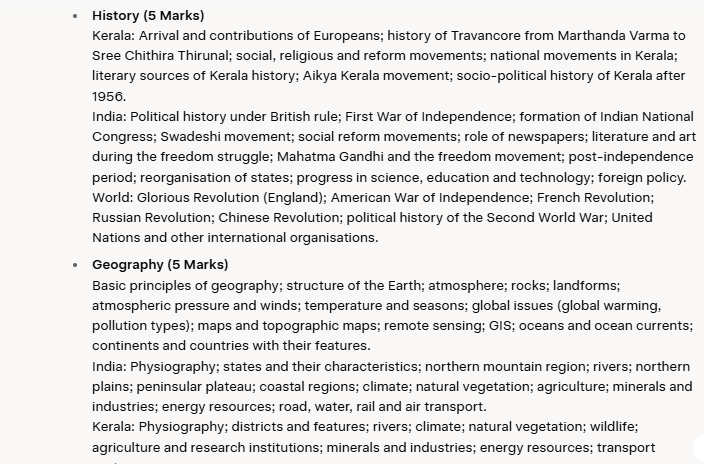
- History (5 Marks) Kerala: Arrival and contributions of Europeans; history of Travancore from Marthanda Varma to Sree Chithira Thirunal; social, religious and reform movements; national movements in Kerala; literary sources of Kerala history; Aikya Kerala movement; socio-political history of Kerala after 1956. India: Political history under British rule; First War of Independence; formation of Indian National Congress; Swadeshi movement; social reform movements; role of newspapers; literature and art during the freedom struggle; Mahatma Gandhi and the freedom movement; post-independence period; reorganisation of states; progress in science, education and technology; foreign policy. World: Glorious Revolution (England); American War of Independence; French Revolution; Russian Revolution; Chinese Revolution; political history of the Second World War; United Nations and other international organisations.
- Geography (5 Marks) Basic principles of geography; structure of the Earth; atmosphere; rocks; landforms; atmospheric pressure and winds; temperature and seasons; global issues (global warming, pollution types); maps and topographic maps; remote sensing; GIS; oceans and ocean currents; continents and countries with their features. India: Physiography; states and their characteristics; northern mountain region; rivers; northern plains; peninsular plateau; coastal regions; climate; natural vegetation; agriculture; minerals and industries; energy resources; road, water, rail and air transport. Kerala: Physiography; districts and features; rivers; climate; natural vegetation; wildlife; agriculture and research institutions; minerals and industries; energy resources; transport systems.
- Economics (5 Marks) Indian economy; Five-Year Plans; Planning Commission and NITI Aayog; new economic reforms; financial institutions; agricultural crops; minerals; Green Revolution.
- Indian Constitution (8 Marks) Constituent Assembly; Preamble; Citizenship; Fundamental Rights; Directive Principles of State Policy; Fundamental Duties; organs of government; important amendments (42, 44, 52, 73, 74, 86, 91); Panchayati Raj institutions and their functions; Union List, State List and Concurrent List; constitutional bodies.
- Kerala – Governance and Administrative System (3 Marks) Kerala State Civil Service; constitutional institutions; various commissions; socio-economic and commercial planning basics; Disaster Management Authority; wetland conservation; employment schemes; National Rural Employment schemes; land reforms; protection of women, children and senior citizens; social welfare and social security.
- Life Science and Public Health (4 Marks) Basic knowledge of the human body; vitamins and minerals and deficiency diseases; communicable diseases and pathogens; health and welfare programmes in Kerala; lifestyle diseases; basic health science; environment and environmental issues.
- Physics (3 Marks) Branches of physics; matter – units and measurements; motion (Newton’s laws, momentum, projectile motion, applications, ISRO achievements); light (lenses, mirrors, reflection, refraction, electromagnetic spectrum – IR, UV, X-rays); sound (waves, speed in different media, resonance, frequency); force (types, friction, fluid pressure, Archimedes’ principle, Pascal’s law, density, relative density, adhesion, cohesion, capillary action, viscosity, surface tension); gravitation and centripetal force; mass and weight; variation of ‘g’; heat and temperature (thermometers, humidity); work, energy and power; simple machines.
- Chemistry (3 Marks) Atom; states of matter; Avogadro’s number; molecules; periodic table; chemical reactions; solutions; metals and non-metals; alloys; acids, bases and pH value; physical and chemical changes; mixtures and compounds.
- Arts, Literature, Culture and Sports (4 Marks) Major visual and performing arts of Kerala (origin, spread, training centres, famous places, institutions, personalities, artists and writers). Sports: Prominent Kerala, Indian and international sportspersons and their achievements; major awards; important trophies and associated sports; number of players in major games; sports terminology; Olympics (basic facts, venues, famous victories, India’s performance, Winter and Paralympics); Asian Games, Afro-Asian Games, Commonwealth Games, SAARC Games; National Games; state and national sports/games.
Part II: Current Affairs (10 Marks) National, international and Kerala-specific current events, government schemes, awards, appointments, sports and important developments (focus on recent months leading up to the exam).
Part III: Simple Arithmetic, Mental Ability and Reasoning (10 Marks)
- Simple Arithmetic (approx. 5 Marks): Numbers and basic operations; fractions and decimals; percentage; profit and loss; simple and compound interest; ratio and proportion; time and distance; time and work; average; laws of exponents; mensuration; progressions.
- Mental Ability & Reasoning (approx. 5 Marks): Series; mathematical signs; analogy (word, alphabet, number); odd man out; coding-decoding; family relations; sense of direction; time and angles; clock problems and reflections; calendar and dates; clerical ability.
Part IV: General English (10 Marks)
- Grammar (5 Marks): Types and interchange of sentences; parts of speech; subject-verb agreement; articles; primary and modal auxiliaries; question tags; infinitives and gerunds; tenses (including conditional sentences); active and passive voice; direct and indirect speech; degrees of comparison; etc.
- Vocabulary and Usage: Synonyms, antonyms, one-word substitutes, idioms and phrases, spelling, abbreviations and their expansions, error detection, sentence correction, comprehension, fill-in-the-blanks.
Part V: Regional Language – Malayalam / Tamil / Kannada (10 Marks) Word purity; sentence purity; translation; one-word substitutes; synonyms; antonyms; idioms and proverbs; similar words; correct usage; gender; number; separation of words; combining words into sentences; etc. (Candidates choose one language based on preference/region.)
Part VI: Computer Application (20 Marks)
- Computer Fundamentals, Windows, Linux & Internet (approx. 5 Marks): Hardware and software concepts; motherboard components; input/output devices; operating systems (Windows features, shortcuts, booting); types of memory; basic troubleshooting; application software; DOS commands; Linux basics and commands; internet concepts (www, IP address, URL, HTTP, firewall, browsers, servers).
- Additional Modules (typically covering MS Office – Word, Excel, PowerPoint; data management; networking basics; cybersecurity awareness; and practical applications relevant to office work). Full coverage includes file management, shortcuts, basic programming concepts where applicable, and e-governance tools.
KPSC Junior Project Assistant Syllabus: Important Topics
1. General Knowledge
General Knowledge is an important component of the examination and covers several areas related to India and Kerala. Candidates should study both basic concepts and factual information, particularly topics related to Kerala’s history, administration and social development.
The General Knowledge section includes the following topics:
| Topic | Marks |
| History | 5 |
| Geography | 5 |
| Economics | 5 |
| Indian Constitution | 8 |
| Kerala Administration and Governance | 3 |
| Biology and Public Health | 4 |
| Physics | 3 |
| Chemistry | 3 |
| Arts, Sports, Literature and Culture | 4 |
| Total | 40 |
The Indian Constitution carries 8 marks, the highest individual weightage within the General Knowledge section. Therefore, candidates should give special attention to constitutional provisions, fundamental rights and duties, constitutional bodies, governance and related topics.
2. Current Affairs
The Current Affairs section carries 10 marks. Candidates should regularly follow important national, international and Kerala-related developments.
Preparation should cover:
- Major national and international events
- Government schemes and programmes
- Kerala government initiatives
- Important appointments
- Awards and honours
- Sports events
- Science and technology developments
- Important reports and indices
- Economic developments
- Important days and events
- Recent social and welfare initiatives
Since current affairs can change until the examination, candidates should revise recent events regularly rather than relying only on an old compilation.
3. Simple Mathematics, Mental Ability and Observation Skills
This section carries 10 marks and tests basic numerical ability, reasoning and observation skills. Candidates should focus on accuracy as well as speed.
Important areas for preparation include:
- Basic arithmetic
- Number operations
- Fractions and decimals
- Percentage
- Ratio and proportion
- Average
- Profit and loss
- Simple interest
- Time and work
- Time, speed and distance
- Number series
- Analogy
- Classification
- Basic logical reasoning
- Observation-based questions
Regular practice of short questions can help candidates improve their calculation speed.
4. General English
General English carries 10 marks. The section is designed to test basic English language ability and understanding.
Candidates should prepare:
- Grammar
- Vocabulary
- Synonyms
- Antonyms
- Sentence formation
- Parts of speech
- Tenses
- Articles
- Prepositions
- Conjunctions
- Active and passive voice
- Direct and indirect speech
- Error identification
- Reading comprehension
- Idioms and phrases
A good strategy is to revise grammar rules and solve objective questions regularly.
5. Regional Language
The Regional Language section carries 10 marks. The examination programme specifies Malayalam, Tamil and Kannada as the language options for the relevant section.
Candidates should prepare according to the language selected for the examination and concentrate on:
- Vocabulary
- Grammar
- Synonyms and antonyms
- Sentence formation
- Common expressions
- Basic comprehension
- Correct usage of words
- Language-related objective questions
Candidates should check their PSC profile and the applicable examination instructions for the language medium before the examination.
6. Computer Application
Computer Application carries 20 marks, making it the second-highest individual component after the overall General Knowledge section. Candidates should not treat this as a minor section because a strong performance here can significantly improve the overall score.
Important areas include:
- Fundamentals of computers
- Computer hardware
- Computer software
- Operating systems
- Input and output devices
- Memory and storage
- File management
- Internet
- Networking basics
- Word processing
- Spreadsheets
- Presentation software
- Computer security
- Common computer terminology
- Basic application software
Candidates should give particular attention to practical computer concepts and frequently used applications.
KPSC Junior Project Assistant Exam Medium
The examination is not conducted entirely in English. According to the 2026 Kerala PSC examination programme, Parts I, II, III and V are available in Malayalam/Tamil/Kannada, while Parts IV and VI are in English.
Therefore, candidates should understand the language arrangement before attempting mock tests and previous question papers.
KPSC Junior Project Assistant Exam Duration
The examination duration is 1 hour 30 minutes for 100 marks. This means candidates have approximately 54 seconds per mark on average, so time management is important.
Candidates should avoid spending too much time on a single difficult question. A practical strategy is to first answer questions that can be solved quickly and then return to questions requiring additional calculation or thought.
KPSC Junior Project Assistant Preparation Strategy
A structured preparation strategy can make the syllabus easier to complete. Candidates should first divide the syllabus into high-, medium- and low-priority topics according to marks.
Focus on High-Weightage Areas
Computer Application carries 20 marks, while Indian Constitution alone accounts for 8 marks within General Knowledge. These areas should receive consistent attention during preparation.
Follow Current Affairs Daily
Spend some time every day reading important current affairs, with special emphasis on Kerala-related government schemes, appointments, awards, sports, economy and social development.
Practise Mathematics and Mental Ability
These questions can generally be improved through practice. Solve a fixed number of questions every day and maintain a record of mistakes.
Improve English and Regional Language
Do not leave language sections for the final days. Regular vocabulary and grammar revision can help improve accuracy.
Practise Previous Question Papers
Kerala PSC has previously conducted a Junior Project Assistant examination for KSBCDC. Its official website provides the earlier question paper and answer-key information, making previous papers useful for understanding the nature of questions.
Attempt Full-Length Mock Tests
Since the paper has 100 marks and a 90-minute duration, candidates should practise completing mock papers within the same time limit. This helps improve question selection and reduces the possibility of leaving easy questions unanswered.
KPSC Junior Project Assistant 2026: Important Topics at a Glance
| Subject | Important Topics |
| General Knowledge | History, Geography, Economics, Constitution, Kerala Administration, Science, Arts and Culture |
| Current Affairs | National, International and Kerala Current Affairs |
| Mathematics | Basic Arithmetic, Percentage, Ratio, Average, Profit & Loss |
| Mental Ability | Series, Analogy, Classification, Logical Reasoning |
| General English | Grammar, Vocabulary, Comprehension, Sentence Correction |
| Regional Language | Grammar, Vocabulary, Comprehension and Usage |
| Computer Application | Hardware, Software, OS, Internet, MS Office, Security and Basic Applications |
KPSC Junior Project Assistant 2026 Preparation Tips
Candidates preparing for the examination should avoid trying to complete the entire syllabus in a single revision cycle. Instead, divide preparation into smaller daily targets.
A useful approach is to study General Knowledge and Computer Application every day, because these sections together account for a substantial portion of the paper. Current affairs should also be revised regularly.
For Mathematics and Mental Ability, solving questions is more useful than merely reading formulas. Similarly, English and regional-language preparation should involve regular question practice.
In the final stage, candidates should concentrate on revision, mock tests and previous question papers. New topics should be introduced sparingly during the last few days before the examination.
KPSC Junior Project Assistant Syllabus 2026: FAQs
Q1. What is the total mark of the KPSC Junior Project Assistant examination?
The examination is conducted for 100 marks.
Q2. What is the duration of the Junior Project Assistant exam?
The examination duration is 1 hour 30 minutes.
Q3. How many marks are allotted to Computer Application?
Computer Application carries 20 marks.
Q4. How many marks are allotted to Current Affairs?
The Current Affairs section carries 10 marks.
Q5. What is the syllabus for General Knowledge?
General Knowledge covers History, Geography, Economics, Indian Constitution, Kerala Administration, Biology and Public Health, Physics, Chemistry, and Arts, Sports, Literature and Culture.
Q6. When is the KPSC Junior Project Assistant exam 2026?
According to the Kerala PSC examination programme, the Junior Project Assistant examination for Category Nos. 746/2025 and 747/2025 is scheduled for September 9, 2026.
Q7. Where can I check the official KPSC Junior Project Assistant information?
Candidates should use the official Kerala Public Service Commission website for the latest examination programme, syllabus, admission-ticket information, answer keys and recruitment updates.
Final Words
The KPSC Junior Project Assistant Syllabus 2026 is relatively broad but manageable when prepared according to the marks distribution. With 100 marks to be attempted in 90 minutes, candidates need a balance of knowledge, speed and accuracy. General Knowledge, Computer Application and Current Affairs deserve particular attention, while Mathematics, English and the regional-language section should be practised regularly.
About The Author
